Thank you for visiting SNEWPapers!
Sign up free
Editorial
May 28, 1949
Chicago World
Chicago, Cook County, Illinois
What is this article about?
Editorial criticizes damage to U.S. highways by heavy commercial trucks, citing Commissioner Thomas H. MacDonald on need for axle load limits to 18,000 pounds to avoid excessive repair costs borne by taxpayers amid growing truck usage and state legalizations of heavier loads.
Clipping
OCR Quality
98%
Excellent
Full Text
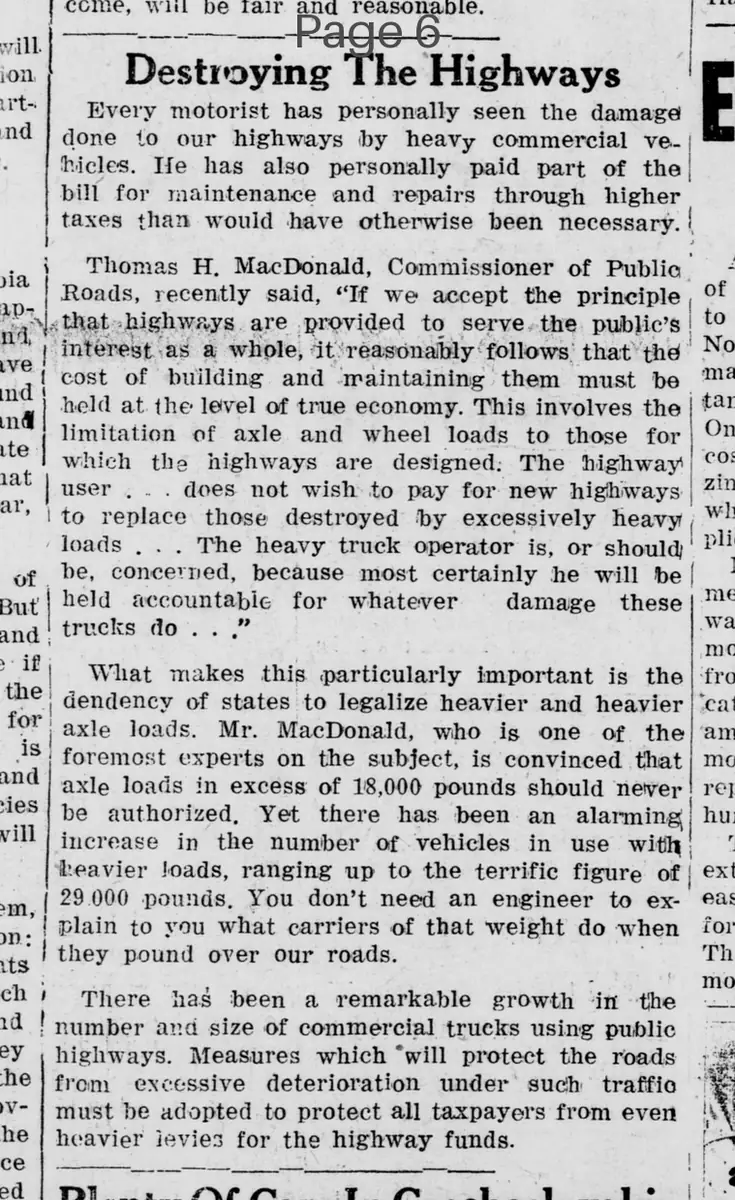
Destroying The Highways
Every motorist has personally seen the damage done to our highways by heavy commercial vehicles. He has also personally paid part of the bill for maintenance and repairs through higher taxes than would have otherwise been necessary.
Thomas H. MacDonald, Commissioner of Public Roads, recently said, "If we accept the principle that highways are provided to serve the public's interest as a whole, it reasonably follows that the cost of building and maintaining them must be held at the level of true economy. This involves the limitation of axle and wheel loads to those for which the highways are designed: The highway user . . . does not wish to pay for new highways to replace those destroyed by excessively heavy loads . . . The heavy truck operator is, or should be, concerned, because most certainly he will be held accountable for whatever damage these trucks do . . ."
What makes this particularly important is the tendency of states to legalize heavier and heavier axle loads. Mr. MacDonald, who is one of the foremost experts on the subject, is convinced that axle loads in excess of 18,000 pounds should never be authorized. Yet there has been an alarming increase in the number of vehicles in use with heavier loads, ranging up to the terrific figure of 29,000 pounds. You don't need an engineer to explain to you what carriers of that weight do when they pound over our roads.
There has been a remarkable growth in the number and size of commercial trucks using public highways. Measures which will protect the roads from excessive deterioration under such traffic must be adopted to protect all taxpayers from even heavier levies for the highway funds.
Every motorist has personally seen the damage done to our highways by heavy commercial vehicles. He has also personally paid part of the bill for maintenance and repairs through higher taxes than would have otherwise been necessary.
Thomas H. MacDonald, Commissioner of Public Roads, recently said, "If we accept the principle that highways are provided to serve the public's interest as a whole, it reasonably follows that the cost of building and maintaining them must be held at the level of true economy. This involves the limitation of axle and wheel loads to those for which the highways are designed: The highway user . . . does not wish to pay for new highways to replace those destroyed by excessively heavy loads . . . The heavy truck operator is, or should be, concerned, because most certainly he will be held accountable for whatever damage these trucks do . . ."
What makes this particularly important is the tendency of states to legalize heavier and heavier axle loads. Mr. MacDonald, who is one of the foremost experts on the subject, is convinced that axle loads in excess of 18,000 pounds should never be authorized. Yet there has been an alarming increase in the number of vehicles in use with heavier loads, ranging up to the terrific figure of 29,000 pounds. You don't need an engineer to explain to you what carriers of that weight do when they pound over our roads.
There has been a remarkable growth in the number and size of commercial trucks using public highways. Measures which will protect the roads from excessive deterioration under such traffic must be adopted to protect all taxpayers from even heavier levies for the highway funds.
What sub-type of article is it?
Infrastructure
Economic Policy
What keywords are associated?
Highway Damage
Heavy Trucks
Axle Loads
Public Roads
Taxpayer Burden
Commercial Vehicles
Road Maintenance
What entities or persons were involved?
Thomas H. Macdonald
Commissioner Of Public Roads
Heavy Truck Operators
States
Editorial Details
Primary Topic
Damage To Highways From Heavy Commercial Vehicles And Need For Load Limits
Stance / Tone
Critical Of Excessive Axle Loads And Supportive Of Protective Measures
Key Figures
Thomas H. Macdonald
Commissioner Of Public Roads
Heavy Truck Operators
States
Key Arguments
Heavy Commercial Vehicles Damage Highways
Motorists Pay Higher Taxes For Maintenance And Repairs
Highways Should Serve Public Interest With Costs At True Economy Level
Limit Axle And Wheel Loads To Design Specifications
Axle Loads Over 18,000 Pounds Should Not Be Authorized
Increase In Vehicles With Loads Up To 29,000 Pounds Causes Severe Damage
Growth In Commercial Trucks Requires Measures To Protect Roads
Protect Taxpayers From Heavier Levies For Highway Funds