Thank you for visiting SNEWPapers!
Sign up free
Editorial
October 29, 1944
Atlanta Daily World
Atlanta, Fulton County, Georgia
What is this article about?
Editorial from The Cincinnati Independent warns Negro families against rushing into home purchases with meager savings during wartime, highlighting risks of exploitation by real estate dealers, overpayment, and financial ruin post-war. Advises considering total costs and income guidelines for prudent buying.
Clipping
OCR Quality
98%
Excellent
Full Text
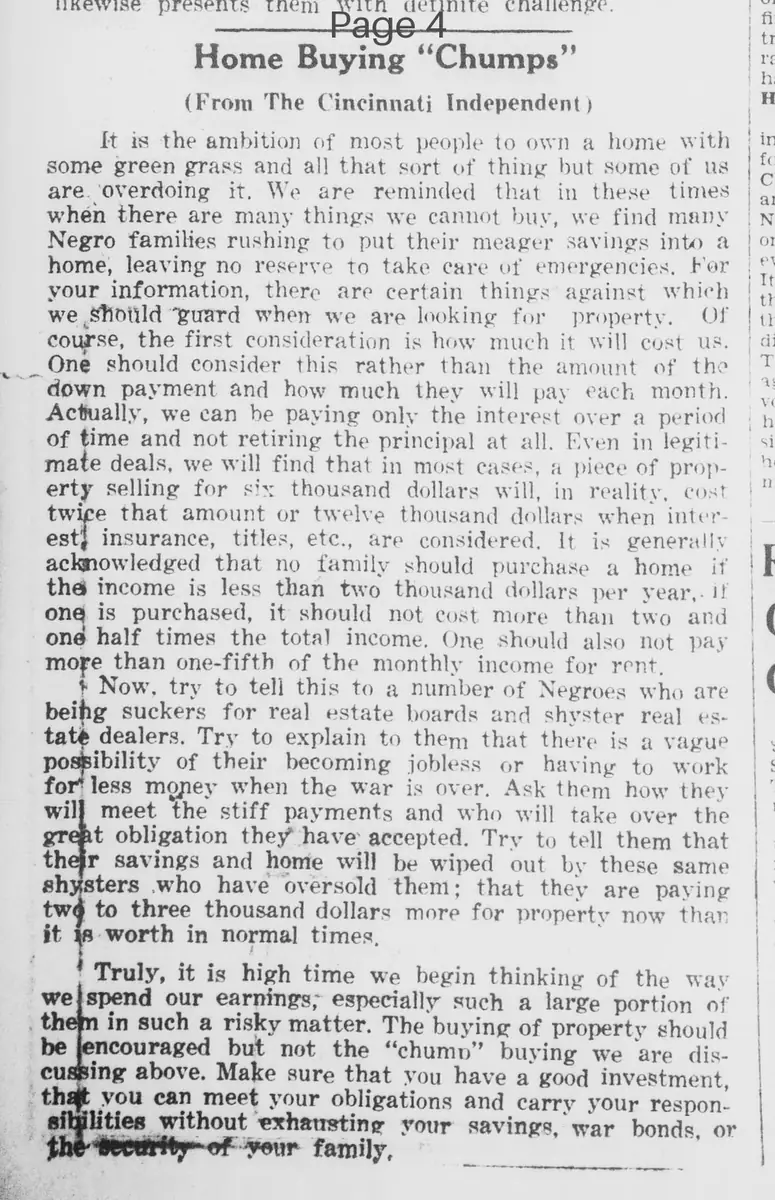
Home Buying "Chumps"
(From The Cincinnati Independent)
It is the ambition of most people to own a home with some green grass and all that sort of thing but some of us are overdoing it. We are reminded that in these times when there are many things we cannot buy, we find many Negro families rushing to put their meager savings into a home, leaving no reserve to take care of emergencies. For your information, there are certain things against which we should guard when we are looking for property. Of course, the first consideration is how much it will cost us.
One should consider this rather than the amount of the down payment and how much they will pay each month. Actually, we can be paying only the interest over a period of time and not retiring the principal at all. Even in legitimate deals, we will find that in most cases, a piece of property selling for six thousand dollars will, in reality, cost twice that amount or twelve thousand dollars when interest, insurance, titles, etc., are considered. It is generally acknowledged that no family should purchase a home if the income is less than two thousand dollars per year. If one is purchased, it should not cost more than two and one half times the total income. One should also not pay more than one-fifth of the monthly income for rent.
Now, try to tell this to a number of Negroes who are being suckers for real estate boards and shyster real estate dealers. Try to explain to them that there is a vague possibility of their becoming jobless or having to work for less money when the war is over. Ask them how they will meet the stiff payments and who will take over the great obligation they have accepted. Try to tell them that their savings and home will be wiped out by these same shysters who have oversold them; that they are paying two to three thousand dollars more for property now than it is worth in normal times.
Truly, it is high time we begin thinking of the way we spend our earnings; especially such a large portion of them in such a risky matter. The buying of property should be encouraged but not the "chump" buying we are discussing above. Make sure that you have a good investment, that you can meet your obligations and carry your responsibilities without exhausting your savings, war bonds, or the security of your family.
(From The Cincinnati Independent)
It is the ambition of most people to own a home with some green grass and all that sort of thing but some of us are overdoing it. We are reminded that in these times when there are many things we cannot buy, we find many Negro families rushing to put their meager savings into a home, leaving no reserve to take care of emergencies. For your information, there are certain things against which we should guard when we are looking for property. Of course, the first consideration is how much it will cost us.
One should consider this rather than the amount of the down payment and how much they will pay each month. Actually, we can be paying only the interest over a period of time and not retiring the principal at all. Even in legitimate deals, we will find that in most cases, a piece of property selling for six thousand dollars will, in reality, cost twice that amount or twelve thousand dollars when interest, insurance, titles, etc., are considered. It is generally acknowledged that no family should purchase a home if the income is less than two thousand dollars per year. If one is purchased, it should not cost more than two and one half times the total income. One should also not pay more than one-fifth of the monthly income for rent.
Now, try to tell this to a number of Negroes who are being suckers for real estate boards and shyster real estate dealers. Try to explain to them that there is a vague possibility of their becoming jobless or having to work for less money when the war is over. Ask them how they will meet the stiff payments and who will take over the great obligation they have accepted. Try to tell them that their savings and home will be wiped out by these same shysters who have oversold them; that they are paying two to three thousand dollars more for property now than it is worth in normal times.
Truly, it is high time we begin thinking of the way we spend our earnings; especially such a large portion of them in such a risky matter. The buying of property should be encouraged but not the "chump" buying we are discussing above. Make sure that you have a good investment, that you can meet your obligations and carry your responsibilities without exhausting your savings, war bonds, or the security of your family.
What sub-type of article is it?
Social Reform
Economic Policy
What keywords are associated?
Home Buying
Financial Caution
Negro Families
Real Estate Exploitation
Wartime Savings
Property Investment
Economic Risks
What entities or persons were involved?
Negro Families
Real Estate Boards
Shyster Real Estate Dealers
Editorial Details
Primary Topic
Caution Against Impulsive Home Buying By Negro Families
Stance / Tone
Warning Against Financial Exploitation And Risks
Key Figures
Negro Families
Real Estate Boards
Shyster Real Estate Dealers
Key Arguments
Consider Total Cost Including Interest, Insurance, Titles Rather Than Just Down Payment
No Family Should Buy A Home If Income Is Less Than $2000 Per Year
Home Should Not Cost More Than 2.5 Times Total Income
Do Not Pay More Than One Fifth Of Monthly Income For Housing
Many Negroes Are Being Misled By Real Estate Dealers Into Overpaying
Risk Of Joblessness Or Reduced Income After War
Savings And Homes Can Be Lost To Exploitative Dealers
Property Now Costs 2 3 Thousand More Than Normal Times
Encourage Prudent Property Buying, Not 'Chump' Buying