Thank you for visiting SNEWPapers!
Sign up free
Arkansas Intelligencer
Van Buren, Crawford County, Arkansas
What is this article about?
In 1843 Little Rock, 'Uno' responds to the Times and Advocate editor's defense of inflated printing bills for the legislature, accusing the printer of unauthorized overcharging equivalent to 150% usury due to specie shortages, and urges scrutiny of executive financial practices for taxpayer benefit.
Clipping
OCR Quality
Full Text
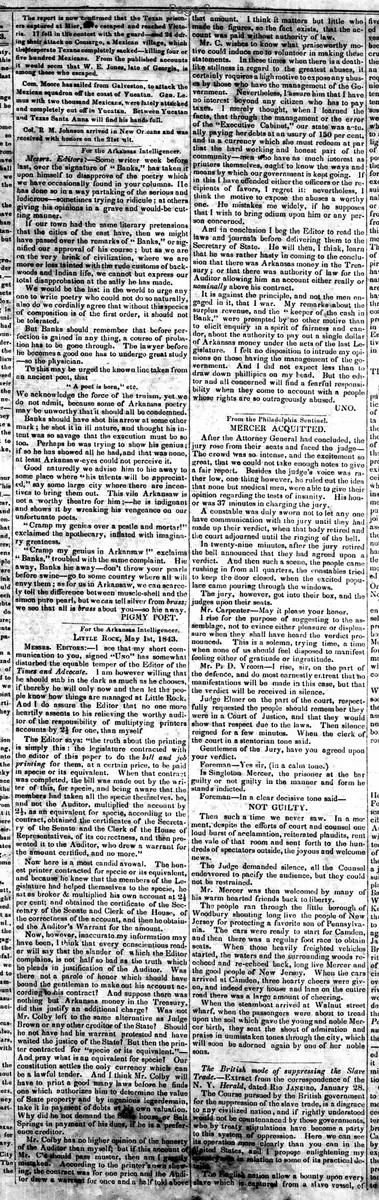
Little Rock, May 1st, 1843.
Messrs. Editors:—I see that my short communication to you, signed "Uno" has somewhat disturbed the equable temper of the Editor of the Times and Advocate. I am however willing that he should stab in the dark as much as he chooses, if thereby he will only now and then let the people know how things are managed at Little Rock. And I do assure the Editor that no one more heartily assents to his relieving the worthy auditor of the responsibility of multiplying printers accounts by 2½ for one, than myself.
The Editor says: "the truth about the printing is simply this: the legislature contracted with the editor of this paper to do the bill and job printing for them, at a certain price, to be paid in specie or its equivalent. When that contract was completed, the bill was made out by the writer of this, in specie, and being aware that the members had taken all the specie themselves, he, and not the Auditor, multiplied the account by 2½, as an equivalent for specie, according to the contract, obtained the certificates of the Secretary of the Senate and the Clerk of the House of Representatives, of its correctness, and then presented it to the Auditor, who drew a warrant for the amount certified, and no more."
Now here is a most candid avowal. The honest printer contracted for specie or its equivalent, and because he knew that the members of the Legislature had helped themselves to the specie, he sat as broker & multiplied his own account at 2½ per cent; and obtained the certificate of the Secretary of the Senate and Clerk of the House, of the correctness of the account, and then he obtained the Auditor's Warrant for the amount.
Now, however inaccurate my information may have been, I think that every conscientious reader will say that the slander of which the Editor complains, is not half so bad as the truth which he pleads in justification of the Auditor. Was there not a parole of honor which should have bound the gentleman to make out his account according to his contract? And suppose there was nothing but Arkansas money in the Treasury, did this justify an additional charge? Was not Mr. Colby left to the same alternative as Judge Brown or any other creditor of the State? Should he not have had his warrant protested and have waited the justice of the State? But then the printer contracted for "specie or its equivalent."
And pray what is an equivalent for specie? Our constitution settles the only currency which can be a lawful tender. And I think Mr. Colby will have to print a good many laws before he finds one which authorizes him to determine the value of State property and by ingenious legerdemain, take it in payment of debts at his own valuation. Why did he not demand the State house or Salt Springs in payment of his dues, if he is a preference creditor.
Mr. Colby has no higher opinion of the honesty of the Auditor than myself; but if this account of Mr. C should pass muster, then am I greatly mistaken. According to the printer's own showing, the contract was for one price and the Auditor drew a warrant for once and a half fold above that amount. I think it matters but little who made the figures, so the fact exists, that the account was paid without authority of law.
Mr. C. wishes to know what praiseworthy motive could induce me to volunteer in making these statements. In these times when there is a death-like stillness in regard to the greatest abuses, it certainly requires a high motive to expose any abuses by those who have the management of the Government. Nevertheless, I assure him that I have no interest beyond any citizen who has to pay taxes. I merely thought, when I learned the facts, that through the management or the error of the "Executive Cabinet," our state was actually paying her debts at an usury of 150 per cent, and in a currency which she must redeem at par that the hard working and honest part of the community—men who have as much interest as printers themselves, ought to know the ways and means by which our government is kept going. If in this I have offended either the officers or the recipients of favors, I regret it: nevertheless, I think the motive to expose the abuses a worthy one. He mistakes me widely, if he supposes that I wish to bring odium upon him or any person concerned.
And in conclusion I beg the Editor to read the laws and journals before delivering them to the Secretary of State. He will then, I think, learn that he was rather hasty in coming to the conclusion that there was Arkansas money in the Treasury; or that there was authority of law for the Auditor allowing him an account either really or nominally above his contract.
It is against the principle, and not the men engaged in it, that I war. My remarks about the surplus revenue, and the "keeper of the cash in Bank," were prompted by no other motive than to elicit enquiry in a spirit of fairness and candor, about the authority to pay out a single dollar of Arkansas money under the acts of the last Legislature. I felt no disposition to intrude my opinions on those having the management of the government. And I did not expect less than to draw down philippics on my head. But the editor and all concerned will find a fearful responsibility when they come to account with a people whose rights are so outrageously abused.
UNO.
What sub-type of article is it?
What themes does it cover?
What keywords are associated?
What entities or persons were involved?
Letter to Editor Details
Author
Uno.
Recipient
Messrs. Editors
Main Argument
the writer defends his prior exposure of financial irregularities in the payment of legislative printing contracts, arguing that the printer's inflation of the bill by 2.5 times to compensate for lack of specie was unauthorized usury, violating the contract and state law, and calls for greater transparency and accountability in government finances.
Notable Details