Thank you for visiting SNEWPapers!
Sign up free
Story
December 3, 1824
The Virginian
Lynchburg, Virginia
What is this article about?
William Ferguson was executed in Liberty for murdering his wife, confessing guilt due to intoxication-induced insanity. The article critiques public executions for evoking sympathy over deterrence, advocating solitary punishment, and cites a Baltimore murderer's dignified treatment as counterproductive to justice.
Clipping
OCR Quality
95%
Excellent
Full Text
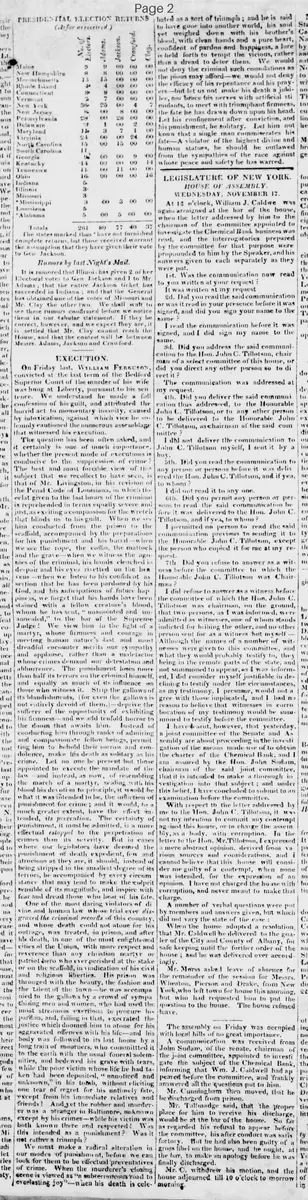
EXECUTION.
On Friday last, WILLIAM FERGUSON, convicted at the last term of the Bedford Superior Court of the murder of his wife, was hung at Liberty, pursuant to his sentence. We understand he made a full confession of his guilt, and attributed the horrid act to momentary insanity, caused by intoxication, against which vice he solemnly cautioned the numerous assemblage that witnessed his execution.
The question has been often asked, and it certainly is one of much importance, whether the present mode of executions is conducive to the suppression of crime? The best and most forcible view of this subject that we recollect to have seen, is that of Mr. Livingston, in his revision of the Penal Code of Louisiana, in which the eclat given to the last hours of the criminal is reprehended in terms equally severe and just, as exciting a compassion for the wretch that blinds us to his guilt. When we see him conducted from the prison to the scaffold, accompanied by the preparations for his punishment and his burial—when we see the rope, the coffin, the mattock and the grave—when we witness the agonies of the criminal, his hands clenched in despair and his eyes rivetted on the heavens—when we listen to his confident assertion that he has been pardoned by his God, and his anticipations of future happiness, we forget that his hands have been stained with a fellow creature's blood, whom he has sent, "unanointed and unannealed," to the bar of the Supreme Judge! We view him in the light of a martyr, whose firmness and courage in meeting human nature's last and most dreadful encounter merits our sympathy and applause, rather than a malefactor whose crimes demand our detestation and abhorrence. The punishment loses more than half its terrors on the criminal himself, and equally as much of its influence on those who witness it. Strip the gallows of its blandishments, (for even the gallows is not entirely devoid of them,)—deprive the sufferer of the opportunity of exhibiting his firmness—and we add tenfold horror to the doom that awaits him. Instead of conducting him through ranks of admiring and compassionate fellow beings, permitting him to behold their sorrow and condolence, make his death as solitary as his crime. Let no one be present but those appointed to execute the mandate of the law; and instead, as now, of resembling the march of a martyr, sealing with his blood his devotion to principle, it would be what it was intended to be, the infliction of punishment for crime; and it would, to a much greater extent, have the effect intended, its prevention. The certainty of punishment, it must be admitted, is a more effectual estoppel to the perpetration of crimes than its severity. But in cases where our legislators have deemed the punishment of death expedient, few and atrocious as they are, it should, instead of being stripped in the smallest degree of its terrors, be accompanied by every circumstance that may tend to make the culprit sensible of its magnitude, and inspire with fear and dread those who hear of his fate.
One of the most daring violators of divine and human law whose trial ever disgraced the criminal records of this county, and whose death could not atone for his outrage, was treated, in prison, and after his death, in one of the most enlightened cities of the Union, with more respect and reverence than any christian martyr or patriot hero who ever perished at the stake or on the scaffold, in vindication of his civil and religious liberties. His prison was thronged with the beauty, the fashion and the talent of the town—he was accompanied to the gallows by a crowd of sympathising men and women, who had used the most strenuous exertions to procure his pardon, and, failing in that, execrated the justice which doomed him to atone for his aggravated offences with his life—and his body was followed to its last home by a long train of mourners, who committed it to the earth with the usual funeral solemnities, and bedewed his grave with tears, while the poor victim whose life he had taken had been deposited, "unnoticed and unknown," in his tomb, without eliciting one tear of regret for his untimely fate, except from his immediate relatives and friends! And yet the robber and murderer was a stranger in Baltimore, unknown except by his crimes—while his victim was both known there and respected. Was this intended as a punishment? Was it not rather a triumph?
We must make a radical alteration in our modes of punishment, before we can look for them to be effectual preventatives of crime. When the murderer's closing scene is viewed as "a subordinate road to everlasting joy"—when his death is celebrated as a sort of triumph: and he is said to have gone into another world, his soul yet weighed down with his brother's blood, with clean hands and a pure heart, confident of pardon and happiness, a lure is held forth to tempt the vicious, rather than a dread to deter them. We would not deny the criminal such consolations as the pious may afford—we would not deny the efficacy of his repentance and his prayers—but let us not make his death a jubilee, nor brace his nerves with artificial stimulants, to meet with triumphant firmness, the fate he has drawn down upon his head. Let his confinement after conviction, and his punishment, be solitary. Let him not know that a single man commiserates his fate—A violator of the highest divine and human statutes, he should be outlawed from the sympathies of the race against whose peace and safety he has warred.
On Friday last, WILLIAM FERGUSON, convicted at the last term of the Bedford Superior Court of the murder of his wife, was hung at Liberty, pursuant to his sentence. We understand he made a full confession of his guilt, and attributed the horrid act to momentary insanity, caused by intoxication, against which vice he solemnly cautioned the numerous assemblage that witnessed his execution.
The question has been often asked, and it certainly is one of much importance, whether the present mode of executions is conducive to the suppression of crime? The best and most forcible view of this subject that we recollect to have seen, is that of Mr. Livingston, in his revision of the Penal Code of Louisiana, in which the eclat given to the last hours of the criminal is reprehended in terms equally severe and just, as exciting a compassion for the wretch that blinds us to his guilt. When we see him conducted from the prison to the scaffold, accompanied by the preparations for his punishment and his burial—when we see the rope, the coffin, the mattock and the grave—when we witness the agonies of the criminal, his hands clenched in despair and his eyes rivetted on the heavens—when we listen to his confident assertion that he has been pardoned by his God, and his anticipations of future happiness, we forget that his hands have been stained with a fellow creature's blood, whom he has sent, "unanointed and unannealed," to the bar of the Supreme Judge! We view him in the light of a martyr, whose firmness and courage in meeting human nature's last and most dreadful encounter merits our sympathy and applause, rather than a malefactor whose crimes demand our detestation and abhorrence. The punishment loses more than half its terrors on the criminal himself, and equally as much of its influence on those who witness it. Strip the gallows of its blandishments, (for even the gallows is not entirely devoid of them,)—deprive the sufferer of the opportunity of exhibiting his firmness—and we add tenfold horror to the doom that awaits him. Instead of conducting him through ranks of admiring and compassionate fellow beings, permitting him to behold their sorrow and condolence, make his death as solitary as his crime. Let no one be present but those appointed to execute the mandate of the law; and instead, as now, of resembling the march of a martyr, sealing with his blood his devotion to principle, it would be what it was intended to be, the infliction of punishment for crime; and it would, to a much greater extent, have the effect intended, its prevention. The certainty of punishment, it must be admitted, is a more effectual estoppel to the perpetration of crimes than its severity. But in cases where our legislators have deemed the punishment of death expedient, few and atrocious as they are, it should, instead of being stripped in the smallest degree of its terrors, be accompanied by every circumstance that may tend to make the culprit sensible of its magnitude, and inspire with fear and dread those who hear of his fate.
One of the most daring violators of divine and human law whose trial ever disgraced the criminal records of this county, and whose death could not atone for his outrage, was treated, in prison, and after his death, in one of the most enlightened cities of the Union, with more respect and reverence than any christian martyr or patriot hero who ever perished at the stake or on the scaffold, in vindication of his civil and religious liberties. His prison was thronged with the beauty, the fashion and the talent of the town—he was accompanied to the gallows by a crowd of sympathising men and women, who had used the most strenuous exertions to procure his pardon, and, failing in that, execrated the justice which doomed him to atone for his aggravated offences with his life—and his body was followed to its last home by a long train of mourners, who committed it to the earth with the usual funeral solemnities, and bedewed his grave with tears, while the poor victim whose life he had taken had been deposited, "unnoticed and unknown," in his tomb, without eliciting one tear of regret for his untimely fate, except from his immediate relatives and friends! And yet the robber and murderer was a stranger in Baltimore, unknown except by his crimes—while his victim was both known there and respected. Was this intended as a punishment? Was it not rather a triumph?
We must make a radical alteration in our modes of punishment, before we can look for them to be effectual preventatives of crime. When the murderer's closing scene is viewed as "a subordinate road to everlasting joy"—when his death is celebrated as a sort of triumph: and he is said to have gone into another world, his soul yet weighed down with his brother's blood, with clean hands and a pure heart, confident of pardon and happiness, a lure is held forth to tempt the vicious, rather than a dread to deter them. We would not deny the criminal such consolations as the pious may afford—we would not deny the efficacy of his repentance and his prayers—but let us not make his death a jubilee, nor brace his nerves with artificial stimulants, to meet with triumphant firmness, the fate he has drawn down upon his head. Let his confinement after conviction, and his punishment, be solitary. Let him not know that a single man commiserates his fate—A violator of the highest divine and human statutes, he should be outlawed from the sympathies of the race against whose peace and safety he has warred.
What sub-type of article is it?
Crime Story
Historical Event
What themes does it cover?
Crime Punishment
Justice
What keywords are associated?
Execution
Murder
Capital Punishment
Public Execution
Solitary Punishment
Deterrence
Baltimore Murderer
What entities or persons were involved?
William Ferguson
Mr. Livingston
Where did it happen?
Liberty, Bedford, Baltimore
Story Details
Key Persons
William Ferguson
Mr. Livingston
Location
Liberty, Bedford, Baltimore
Event Date
Friday Last
Story Details
William Ferguson executed for wife's murder, confessed due to intoxication; article argues public executions foster sympathy over deterrence, advocates solitary punishment, references Baltimore case where murderer received martyr-like treatment.