Thank you for visiting SNEWPapers!
Sign up free
The National Intelligencer And Washington Advertiser
Washington, District Of Columbia
What is this article about?
In the U.S. House of Representatives on December 12, members debated and amended a bill regulating the clearance of armed merchant vessels, focusing on penalties for misuse of arms, bonds for vessels and cargo, and restrictions related to trade with St. Domingo and other regions. Amendments were adopted to strike sections, add provisos, and ensure punishments for offenses match those on U.S. soil.
Merged-components note: Changed label from 'story' to 'domestic_news' as this is a factual report of congressional debate and proceedings, fitting national non-narrative news. Merged continuation across pages.
Clippings
1 of 2
OCR Quality
Full Text
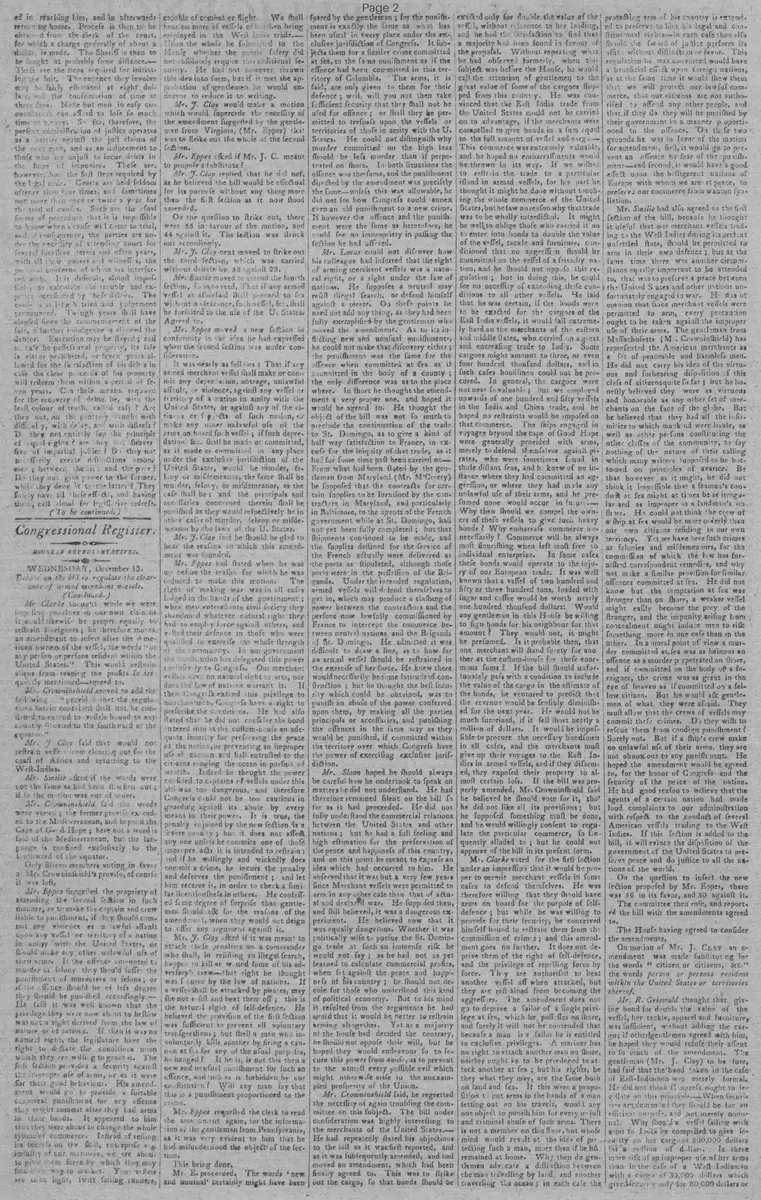
HOUSE OF REPRESENTATIVES.
WEDNESDAY, December 12.
Debate on the bill to regulate the clearance of armed merchant vessels.
(Concluded.)
Mr. Clarke thought while we were imposing penalties on our own citizens it would likewise be proper equally to restrain foreigners; he therefore moved an amendment to insert after the American owners of the vessel, the words "or any person or persons resident within the United States." This would restrain aliens from reaping the profits of fire quasi; itly mentioned agreed to.
Mr. Crowninshield moved to add the following "provided; that the regulations herein contained shall not be construed to extend to vessels bound to any country situated to the southward of the equator."
Mr. F. Clay said that would not restrain vessels from clearing out or the coast of Africa and returning to the West-Indies.
Mr. Smilie asked if the words were not the same as had been stricken out; if so the motion was out of order.
Mr. Crowninshield said the words were varied; the former proviso extended to the Mediterranean, and beyond the Cape of Good Hope; here not a word is said of the Mediterranean, but the language is confined exclusively to the southward of the equator.
Only fifteen members voting in favor of Mr. Crowninshield's proviso, of course it was lost,
Mr. Eppes opposed the propriety of amending the second Section in such manner, as to make the captain and crew liable to punishment, if they should commit any violence or unlawful assault upon any vessel or territory of a nation in amity with the United States, or should make any other unlawful use of their arms. If the offence amounted to murder or felony they should use the punishment of murderers or felons; or if the offence should be of less degree they should be punished accordingly --He said it was well known that the privilege they were now about to bestow was not a right derived from the law of nature or of nations. If then it was no natural right, the legislature have the right to dictate the conditions upon which they are willing to grant it. The section provides a security against the improper use of arms, or as it were for their good behaviour. His amendment would go to provide a suitable corporal punishment for any offence they might commit after they had arms in their hands. It appeared to him that they were about to change the whole system of commerce. Instead of relying its success on the skill, enterprize and industry of our mariners, we are about to give them force by which they may find their way to market. Your vessels are to be light, swift sailing gun brigs, capble of combat or flight. We shall hear no more of vessels of burthen being employed in the West India trade.
Upon the whole he submitted to the House whether the public safety did not absolutely require this additional security. He had not however thrown this idea into form, but if it met the approbation of gentlemen he would endeavor to reduce it to writing.
Mr. F. Clay would make a motion which would supersede the necessity of the amendment suggested by the gentleman from Virginia, (Mr. Eppes) that was to strike out the whole of the second section.
Mr. Eppes asked if Mr. J. C. meant to propose a substitute?
Mr. J. Clay replied that he did not, as he believed the bill would be effectual for its purpose without any thing more than the first section as it now stood amended.
On the question to strike out, there were 55 in favour of the motion. and 44 against it. The section was struck out accordingly.
Mr. F. Clay next moved to strike out the third section, which was carried without debate by 58 against 22.
Mr. Eustis moved to amend the fourth section, so as to read, That if any armed vessel as aforesaid shall proceed to sea without a clearance. such vessel, &c. shall be forfeited to the use of the U. States.
Agreed to.
Mr. Eppes moved a new section in conformity to the idea he had expressed when the second section was under consideration.
It was nearly as follows : That if any armed merchant vessel shall make or commit any depredation, outrage, unlawful assault, or violence, against any vessel or territory of a nation in amity with the United States, or against any of the citizens or subjects of such nation, or make any other unlawful use of the arms on board such vessel ; if such depredation. &c. shall be made or committed, as if made or committed in any place under the exclusive jurisdiction of the United States, would be murder, felony or misdemeanor, the same shall be murder, felony, or misdemeanor, as the case shall be: and the principals and accessaries concerned therein shall be punished as they would respectively be in other cases of murder, felony or misdemeanor by the laws of the U. States.
Mr. F. Clay said he should be glad to hear the reasons on which this amendment was founded.
Mr. Eppes had stated when he was up before the reason for which he was induced to make this motion. The right of making war was in all cases lodged in the hands of the government : when men entered into civil society they abandoned whatever natural right they had to employ force against others, and vested their defence in those who were qualified to exercise the whole strength of the community. In our government the constitution has delegated this power exclusively to Congress. Our merchant vessels have no natural right to arm, nor does the law of nations warrant it. If then Congress extend this privilege to merchantsmen, Congress have a right to prescribe the conditions. He had also stated that he did not consider the bond entered into at the custom-house an adequate security for preserving the peace of the nation, or preventing an improper use of cannon and ball entrusted to the citizens ranging the ocean in pursuit of wealth. Indeed he thought the power confided to Captains of vessels under this bill was too dangerous, and therefore Congress could not be too cautious in guarding against its abuse by every means in their power. It is true, the penalty enjoined by the new section is a severe penalty; but it does not affect any one unless he commits one of those improper acts it is intended to restrain: and if he willingly and wickedly does commit a crime, he incurs the penalty and deserves the punishment ; and let him receive it, in order to check a similar licentiousness in others. He conceded some degree of surprise that gentlemen should ask for the reasons of the amendment, when they would not deign to offer any argument against it.
Mr. F. Clay asked if it was meant to attach these penalties on a commander who shall, in resisting an illegal search, happen to kill or wound some of his adversary's crew- that right he thought was secured by the law of nations. If a vessel shall be attacked by pirates, may she not resist and beat them off; this is the natural right of self-defence. He believed the provision of the first section was sufficient to prevent all voluntary transgressions; but shall a man who involuntarily kills another by firing a cannon at sea for any of the usual purposes, be hanged ? If he is, is not this then a new and unusual punishment for such an offence, and such as is forbidden by our constitution? Will any man say that this is a punishment proportioned to the crime.
Mr. Eppes requested the clerk to read the amendment again, for the information of the gentleman from Pennsylvania, as it was very evident to him that he had misunderstood the object of the section.
This being done,
Mr. E. proceeded, The words 'new and unusual' certainly might have been pared by the gentleman ; for the punifhment is exactly the same as what has been usual in every place under the exclusive jurisdiction of Congress. It subjects them for a similar crime committed at sea, to the same punishment as if the offence had been committed in this territory of Columbia. The arms, it is said, are only given to them for their defence; well, will you not then take sufficient security that they shall not be used for offence ; or shall they be permitted to trespass upon the vessels or territories of those in amity with the U. States. He could not distinguish why murder committed on the high seas should be less murder than if perpetrated on shore. In both situations the offence was the same, and the punishment directed by the amendment was precisely the same-unless this was allowable, he did not see how Congress could annex even an old punishment to a new crime. If however the offence and the punifhment were the same as heretofore, he could see no impropriety in passing the section he had offered.
Mr. Lucas could not discover how his colleague had inferred that the right of arming merchant vessels was a natural right, or a right under the law of nations. He supposes a neutral may resist illegal search, or defend himself against a pirate. On these points he need not add any thing, as they had been fully exemplified by the gentleman who moved the amendment. As to its inflicting new and unusual punishments, he could not make that discovery either; the punishment was the same for the offence when committed at sea as if committed in the body of a county ; the only difference was as to the place where. In short he thought the amendment a very proper one, and hoped it would be agreed to. He thought the object of the bill was not so much to preclude the continuation of the trade to St. Domingo, as to give a kind of half way satisfaction to France, in excuse for the iniquity of that trade, as it had for some time past been carried on-- From what had been stated by the gentleman from Maryland (Mr. M'Creery) he supposed that the contracts for certain supplies to be furnished by the contractors in Maryland, and particularly in Baltimore, to the agents of the French government while at St. Domingo, had not yet been fully completed ; but that shipments continued to be made, and the supplies destined for the service of the French actually were delivered at the ports as stipulated, although those ports were in the possession of the Brigands. Under the intended regulation, armed vessels will defend themselves to get in, which may produce a clashing of power between the contractors and the persons now lawfully commissioned by France to intercept the commerce between neutral nations and the Brigands of St. Domingo. He admitted it was difficult to draw a line, as to how far an armed vessel should be restrained in the exercise of her force. He knew there would necessarily be some latitude of construction ; but he thought the best security which could be obtained, was to punish an abuse of the power conferred upon them, by making all the parties principals or accessories, and punishing the offences in the same way as they would be punished, if committed within the territory over which Congress have the power of exercising exclusive jurisdiction,
Mr. Sloan hoped he should always be careful how he undertook to speak on matters he did not understand. He had therefore remained silent on the bill so far as it had proceeded. He did not fully understand the commercial relations between the United States and other nations ; but he had a full feeling and high estimation for the preservation of the peace and happiness of this country, and on this point he meant to express an idea which had occurred to him. He observed that it was but a very few years since Merchant vessels were permitted to arm in any other case than that of actual and declared war. He supposed then, and still believed, it was a dangerous experiment. He believed now that it was equally dangerous. Whether it was politically wise to pursue the St. Domingo trade at such an immense risk he would not say ; as he had not as yet learned to calculate commercial profits, when set against the peace and happiness of his country ; he should not decide for those who understood this kind of political economy. But to his mind it resulted from the arguments he had heard that it would be better to restrain arming altogether. Yet as a majority of the house had decided the contrary, he should not oppose their will, but he hoped they would endeavour so to secure this power from abuse, as to prevent to the utmost every possible evil which might otherwise arise to the unexampled prosperity of the Union.
Mr, Crowninshield said, he regretted the necessity of again troubling the committee on this subject. : The. bill under consideration was highly interesting : to the merchants of the United States.--He had repeatedly. stated his objections to the bill as it was first reported, and as it was subsequently amended, and had moved an amendment, which had been finally:agreed to." This. was to strike cut the cargo,: so that bonds should be exacted only for double the value of the vessel, without reference to her loading, and he had the satisfaction to find that a majority had been found in favour of the proposal. Without repeating what he had observed formerly, when this subject was before the House, he would call the attention of gentlemen to the great value of some of the cargoes shipped from this country. He was convinced that the East India trade from the United States could not be carried on to advantage, if the merchants were compelled to give bonds in a sum equal to the full amount of vessel and cargo-This commerce was extremely valuable, and he hoped no embarrassments would be thrown in its way. If we wished to restrain the trade to a particular island in armed vessels, for his part he thought it might be done without touching the whole commerce of the United States, but he saw no reason why that trade was to be wholly interdicted. It might be wellto oblige those who carried it on to enter into bonds to double the value of the vessel, tackle and furniture, Conditioned that no aggression should be committed on the vessel of a friendly nation, and he should not oppose this regulation ; but in doing this, he could see no necessity of extending these conditions to all other vessels. He said that he was certain, if the bonds were to be exacted for the cargoes of the East India vessels, it would fall extremely hard on the merchants of the eastern and middle states, who carried on a great and increasing trade to India. Some cargoes might amount to three, or even four hundred thousand dollars. and in such cases bondmen could not be procured. In general, the cargoes were not near so valuable; but we employed upwards of one hundred and fifty vessels in the India and China trade, and he hoped no restraints would be imposed on that commerce. The ships engaged in voyages beyond the cape of Good Hope were generally provided with arms, merely to defend themselves against pirates, who were sometimes found in those distant seas, and he knew of no instance where they had committed an aggression, or where they had made any unlawful use of their arms, and he presumed none would occur in future.- Why then should we compel the owners of these vessels to give such heavy bonds ? Why embarrass commerce unnecessarily ? Commerce will be always most flourishing when left most free to individual enterprize. In some cases these bonds would operate to the injury of our European trade. It was well known that a vessel of two hundred and fifty or three hundred tons, loaded with sugar and coffee would be worth nearly one hundred thousand dollars: Would any gentleman in this House be willing to sign bonds for his neighbour for that amount? They would not, it might be presumed. Is it probable then, that one merchant will stand surety for another at the custom-house for these enormous sums ? If the bill should unfortunately pass with a condition to include the valueof the cargo in the estimate of the bonds, he ventured to predict that the revenue would be sensibly diminished for the next year. He would not be much surprised, if it fell short nearly a million of dollars. It would be impossible to procure the necessary bondmen in all cases, and the merchants must give up their voyages to the East Indies in armed vessels, and if they disarmed, they exposed their property to almost certain loss. If the bill was properly amended, Mr, Crowninshield said he believed he should vote for it, tho' he did not like all its provisions; but he supposed something must be done, and he would willingly consent to regulate the particular commerce, so frequently alluded to ; but he could not approve of the bill in its present form.
Mr. Clarke voted for the first section under an impression that it would be proper to permit merchant vessels in some cases to defend themselves. He was therefore willing that they should have arms on board for the purpose of self.defence : but while he was willing to provide for their security, he conceived himself bound to restrain them from the commission of crimes: and this amendment goes no further. It does not deprive them of the right of self-defence, and the privilege of repelling force by force. They are authorized to beat another vessel off when attacked, but they are restrained from becoming the aggressors. The amendment does not go to deprive a sailor of a single privilege at sea, which he, possesses on shore, and surely it will not be contended that because a man is a sailor he is entitled to exclusive privileges. A mariner has no right to attack another man on shore, neither ought he to be privileged to attack another at sea ; but his rights, be they what they may, are the same both on land and sea. If this were a proposition to put arms in the hands of a man setting out on his travels, would any one object to punish him for every unjust and criminal abuse of such arms. There is not a member on this floor, but whose mind would revolt at the idea of protecting such a man, more than if he had remained at home. Why then do gentlemen advocate a distinction between the man travelling by land, and another traversing the ocean; in each case the protecting arm of his country is extended to preserve to him his legal and constitutional rights-in each case then also should the sword of justice perform its office without distinction or favor. This regulation he was convinced would have a beneficial effect upon foreign nations, as at the same time it would shew them that we will protect our lawful commerce, that our citizens are not authorized to offend any other people, and that if they do they will be punished by their government in a manner proportioned to the offence. On these two grounds he was in favor of the motion for amendment, first, it would go to prevent an offence by fear of the punishment--and second, it would have a good effect upon the belligerent nations of Europe with whom we are at peace, to preserve: our commerce from wanton polliation.
Mr. Smilie had also agreed to the first section of the bill, because he thought it useful that our merchant vessels trading to the West Indies during its present unsettled state, should be permitted to arm in their own defence : but at the same time there was another circumstance equally important to be attended to, that was to preserve a peace between the United States and other nations unfortunately engaged in war. He was of opinion that since merchant vessels were permitted to arm, every precaution ought to be taken against the improper use of their arms. The gentleman from Massachusetts (Mr. Crowninshield) has represented the American merchants as a set of peaceable and harmless men. He did not carry his idea of the virtuous and forbearing disposition of this class of citizensquite so far ; but he honestly believed they were as virtuous and honorable as any other set of merchants on the face of the globe. But he believed that they had all the infirmities to which mankind were liable, as well as other persons constituting the other classes of the community, to say nothing of the nature of their calling which many writers supposed to be bottemed on principles of avarice. Be that however as it might, he did not think it impossible that a seaman's conduct at sea might at times be as irregular and as improper as a landman's on shore. He could not think the crew of a ship at sea would be more orderly than our own citizens residing in our own territory. Yet we have here such crimes as felonies and misdemeanors, for the commission of which the law has furnished correspondent remedies, and why not make a similar provision for similar offenders committed at sea. He did not know but the temptation at sea was stronger than on shore, a weaker vessel might easily become the prey of the stronger, and the impunity arising from concealment might induce men to risk something more in one case than in the other. In a moral point of view a murder committed at sea was as heinous an offence as a murder perpetrated on Shore. and if committed on the body of a foreigner, the crime was as great in the eye of heaven as if committed on a fellow citizen. But he would ask gentlemen of what they were afraid. They must allow that the crews of vessels may commit these Crimes. Do, they wish to rescue them from condign punishment? Surely not. But if a ship's crew make no unlawful use of their arms, they are not obnoxious to any punishment. He hoped the amendment would be agreed to, for the honor of Congress and the security of the peace of the nation. He had good reason to believe that the agents of a certain nation had made loud complaints to our administration with respect to the conduct of several American vessels trading to the West Indies. If this section is added to the bill, it will evince the disposition of the government of the United States to preserve peace and do justice to all the nations of the world.
On the question to insert the new section proposed by Mr. Eppes, there was 56 in its favor, and 50 against it, The Committee then rose, and reported the bill with the amendments agreed to.
The House having agreed to consider the amendments,
On motion of Mr. J. CLAY an amendment was made substituting for the words " citizen or citizens, &c." the words person or persons resident within the United States or territories thereof.
Mr. R. Griswold thought that giving bond for double the value of the vessel, her tackle, apparel and furniture, was sufficient, without adding the cargo; if other gentlemen agreed with him. he hoped they would refuse their assent to so much of the amendment. The gentleman (Mr. J. Clay) to be sure, had said that the'bond taken in the case of East-Indiamen was merely formal. He did not think Congress ought to legislate on this principle.-a When security is demanded they should be for an efficient purpose, and not merely nominal. Why should a vessel sailing with arms to India be compelled to give security on her cargoof 500,000 dollars for'a million of dollars. Is there more risk of an improper use of her arms than in the case of a West Indianman with a cargo of 30,000 dollars which givesecurity only for 60,000 dollars or is a murder or felony committed by one vessel a murder or felony if committed by another, and yet from the disparity of the bonds one would be led to suppose that such was the idea. Viewing this additional incumbrance on commerce as a shackle that would subject small traders to real inconvenience, while it would facilitate the enterprise of merchants of large capital and long established credit, he meant to call the yeas and nays on the question of agreeing to this part of the report of the committee of the whole. Mr. V. Clay said it was true that he had said that bonds given at the custom house for East India ships were merely formal: it is not however because they are unnecessary or improper, but because the commanders of such vessels were men of such consideration and prudence, that they would not subject themselves to the forfeiture, and so far he was willing to admit that the amendment would also be a mere formal regulation as to the clearance of armed East Indiamen. But as to vessels bound to the W. Indies, it was a notorious fact that the value of the vessel and her equipment formed no proportion to the profits made on the cargo, if they have a fortunate run, and it was against the illicit commerce of such that he wished to be secure. He was unwilling unnecessarily to shackle commerce as any gentlemen; but this regulation was not an unnecessary shackle, it was one absolutely required by existing circumstances, and will not work a hardship on any merchant engaged in a lawful commerce. One thing, however, he acknowledged it would effect. It will prevent in future that species of trade, which, to say the least of it, approaches very near to illicit trade at the present moment. A merchant, willing to run the risk of such a voyage as he had alluded to, would prefer to make it unarmed rather than armed, because he knows the consequences, and the probability of transgressing some of the provisions of this act. It had been suggested that two bonds would be required; he did not believe they would, as it was not the practice under the law of 1798, which was expressed in the same terms as the amendment before the House— If the House should however consider this regulation as bearing hard on the East India trade, they might remedy it by refusing to concur with the committee of the whole in striking out the proviso.
(To be continued.)
What sub-type of article is it?
What keywords are associated?
What entities or persons were involved?
Where did it happen?
Domestic News Details
Primary Location
Washington, D.C.
Event Date
Wednesday, December 12
Key Persons
Outcome
amendments adopted: insertion of resident persons clause (agreed); crowninshield's proviso lost (15-?); second section struck (55-44); third section struck (58-22); fourth section amended (agreed); new section on punishments for offenses inserted (56-50). bill reported with amendments; further amendment on residents substituted. debate on bonds for cargo value ongoing.
Event Details
Members of the House debated amendments to a bill regulating armed merchant vessels' clearance, addressing penalties for foreigners, provisos excluding southern equator voyages, striking sections on captain/crew liability and other provisions, adding forfeiture for no clearance, and inserting a new section treating offenses at sea as equivalent to those on U.S. soil for punishment. Concerns raised about self-defense rights, bonds including cargo value impacting East India and West Indies trade, risks to peace with nations, and preventing illicit trade to St. Domingo.