Thank you for visiting SNEWPapers!
Sign up free
Literary
October 10, 1827
The Massachusetts Spy, And Worcester County Advertiser
Worcester, Worcester County, Massachusetts
What is this article about?
Extract from a review in the North American Review of Bonaparte's Ornithology, asserting the Wild Turkey's American origins, its spread to Europe, and detailing its habits like river crossings and predator evasion.
Clipping
OCR Quality
98%
Excellent
Full Text
THE WILD TURKEY.
Extract from a notice of Bonaparte's Ornithology, contained in the 54th number of the North American Review.
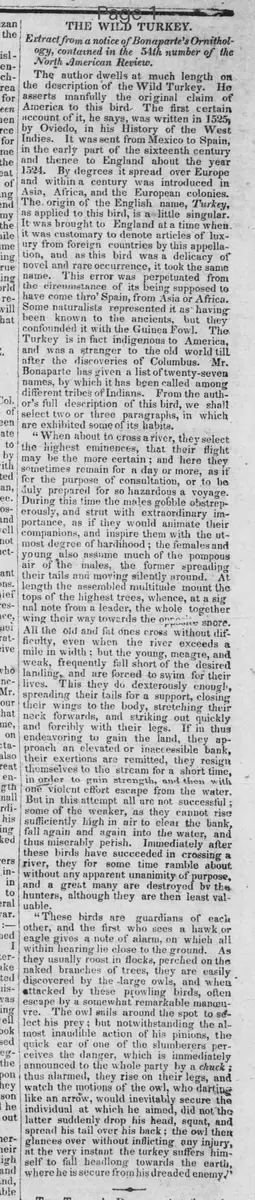
The author dwells at much length on the description of the Wild Turkey. He asserts manfully the original claim of America to this bird. The first certain account of it, he says, was written in 1525 by Oviedo, in his History of the West Indies. It was sent from Mexico to Spain, in the early part of the sixteenth century and thence to England about the year 1524. By degrees it spread over Europe and within a century was introduced in Asia, Africa, and the European colonies. The origin of the English name, Turkey, as applied to this bird, is a little singular. It was brought to England at a time when. it was customary to denote articles of luxury from foreign countries by this appellation, and as this bird was a delicacy of novel and rare occurrence, it took the same name. This error was perpetuated from the circumstance of its being supposed to have come thro' Spain, from Asia or Africa. Some naturalists represented it as having been known to the ancients, but they confounded it with the Guinea Fowl. The Turkey is in fact indigenous to America, and was a stranger to the old world till after the discoveries of Columbus. Mr. Bonaparte has given a list of twenty-seven names, by which it has been called among different tribes of Indians. From the author's full description of this bird, we shall select two or three paragraphs, in which are exhibited some of its habits.
"When about to cross a river, they select the highest eminences, that their flight may be the more certain; and here they sometimes remain for a day or more, as if for the purpose of consultation, or to be duly prepared for so hazardous a voyage. During this time the males gobble obstreperously, and strut with extraordinary importance, as if they would animate their companions, and inspire them with the utmost degree of hardihood; the females and young also assume much of the pompous air of the males, the former spreading their tails and moving silently around. At length the assembled multitude mount the tops of the highest trees, whence, at a signal note from a leader, the whole together wing their way towards the opposite shore. All the old and fat ones cross without difficulty, even when the river exceeds a mile in width; but the young, meagre, and weak, frequently fall short of the desired landing, and are forced to swim for their lives. This they do dexterously enough, spreading their tails for a support, closing their wings to the body, stretching their neck forwards, and striking out quickly and forcibly with their legs. If in thus endeavoring to gain the land, they approach an elevated or inaccessible bank, their exertions are remitted, they resign themselves to the stream for a short time, in order to gain strength, and then with one violent effort escape from the water. But in this attempt all are not successful: some of the weaker, as they cannot rise sufficiently high in air to clear the bank, fall again and again into the water, and thus miserably perish. Immediately after these birds have succeeded in crossing a river, they for some time ramble about without any apparent unanimity of purpose, and a great many are destroyed by the hunters, although they are then least valuable.
"These birds are guardians of each other, and the first who sees a hawk or eagle gives a note of alarm, on which all within hearing lie close to the ground. As they usually roost in flocks, perched on the naked branches of trees, they are easily discovered by the large owls, and when attacked by these prowling birds, often escape by a somewhat remarkable manoeuvre. The owl sails around the spot to select his prey; but notwithstanding the almost inaudible action of his pinions, the quick ear of one of the slumberers perceives the danger, which is immediately announced to the whole party by a chuck; thus alarmed, they rise on their legs, and watch the motions of the owl, who darting like an arrow, would inevitably secure the individual at which he aimed, did not the latter suddenly drop his head, squat, and spread his tail over his back; the owl then glances over without inflicting any injury, at the very instant the turkey suffers himself to fall headlong towards the earth, where he is secure from his dreaded enemy.
Extract from a notice of Bonaparte's Ornithology, contained in the 54th number of the North American Review.
The author dwells at much length on the description of the Wild Turkey. He asserts manfully the original claim of America to this bird. The first certain account of it, he says, was written in 1525 by Oviedo, in his History of the West Indies. It was sent from Mexico to Spain, in the early part of the sixteenth century and thence to England about the year 1524. By degrees it spread over Europe and within a century was introduced in Asia, Africa, and the European colonies. The origin of the English name, Turkey, as applied to this bird, is a little singular. It was brought to England at a time when. it was customary to denote articles of luxury from foreign countries by this appellation, and as this bird was a delicacy of novel and rare occurrence, it took the same name. This error was perpetuated from the circumstance of its being supposed to have come thro' Spain, from Asia or Africa. Some naturalists represented it as having been known to the ancients, but they confounded it with the Guinea Fowl. The Turkey is in fact indigenous to America, and was a stranger to the old world till after the discoveries of Columbus. Mr. Bonaparte has given a list of twenty-seven names, by which it has been called among different tribes of Indians. From the author's full description of this bird, we shall select two or three paragraphs, in which are exhibited some of its habits.
"When about to cross a river, they select the highest eminences, that their flight may be the more certain; and here they sometimes remain for a day or more, as if for the purpose of consultation, or to be duly prepared for so hazardous a voyage. During this time the males gobble obstreperously, and strut with extraordinary importance, as if they would animate their companions, and inspire them with the utmost degree of hardihood; the females and young also assume much of the pompous air of the males, the former spreading their tails and moving silently around. At length the assembled multitude mount the tops of the highest trees, whence, at a signal note from a leader, the whole together wing their way towards the opposite shore. All the old and fat ones cross without difficulty, even when the river exceeds a mile in width; but the young, meagre, and weak, frequently fall short of the desired landing, and are forced to swim for their lives. This they do dexterously enough, spreading their tails for a support, closing their wings to the body, stretching their neck forwards, and striking out quickly and forcibly with their legs. If in thus endeavoring to gain the land, they approach an elevated or inaccessible bank, their exertions are remitted, they resign themselves to the stream for a short time, in order to gain strength, and then with one violent effort escape from the water. But in this attempt all are not successful: some of the weaker, as they cannot rise sufficiently high in air to clear the bank, fall again and again into the water, and thus miserably perish. Immediately after these birds have succeeded in crossing a river, they for some time ramble about without any apparent unanimity of purpose, and a great many are destroyed by the hunters, although they are then least valuable.
"These birds are guardians of each other, and the first who sees a hawk or eagle gives a note of alarm, on which all within hearing lie close to the ground. As they usually roost in flocks, perched on the naked branches of trees, they are easily discovered by the large owls, and when attacked by these prowling birds, often escape by a somewhat remarkable manoeuvre. The owl sails around the spot to select his prey; but notwithstanding the almost inaudible action of his pinions, the quick ear of one of the slumberers perceives the danger, which is immediately announced to the whole party by a chuck; thus alarmed, they rise on their legs, and watch the motions of the owl, who darting like an arrow, would inevitably secure the individual at which he aimed, did not the latter suddenly drop his head, squat, and spread his tail over his back; the owl then glances over without inflicting any injury, at the very instant the turkey suffers himself to fall headlong towards the earth, where he is secure from his dreaded enemy.
What sub-type of article is it?
Essay
What themes does it cover?
Nature
Patriotism
What keywords are associated?
Wild Turkey
Ornithology
American Origins
Bonaparte
River Crossing
Predator Evasion
North American Review
What entities or persons were involved?
From Bonaparte's Ornithology, As Reviewed In The North American Review
Literary Details
Title
The Wild Turkey.
Author
From Bonaparte's Ornithology, As Reviewed In The North American Review
Subject
Description Of The Wild Turkey
Key Lines
When About To Cross A River, They Select The Highest Eminences, That Their Flight May Be The More Certain; And Here They Sometimes Remain For A Day Or More, As If For The Purpose Of Consultation, Or To Be Duly Prepared For So Hazardous A Voyage.
The Turkey Is In Fact Indigenous To America, And Was A Stranger To The Old World Till After The Discoveries Of Columbus.
These Birds Are Guardians Of Each Other, And The First Who Sees A Hawk Or Eagle Gives A Note Of Alarm, On Which All Within Hearing Lie Close To The Ground.