Thank you for visiting SNEWPapers!
Sign up free
Story
March 14, 1902
The Commoner
Lincoln, Lancaster County, Nebraska
What is this article about?
Article promoting plain toast moistened with warm milk as a nutritious breakfast, explaining how toasting aids digestion by converting starch to dextrine, and offering preparation tips including reviving stale toast.
Clipping
OCR Quality
98%
Excellent
Full Text
Toast
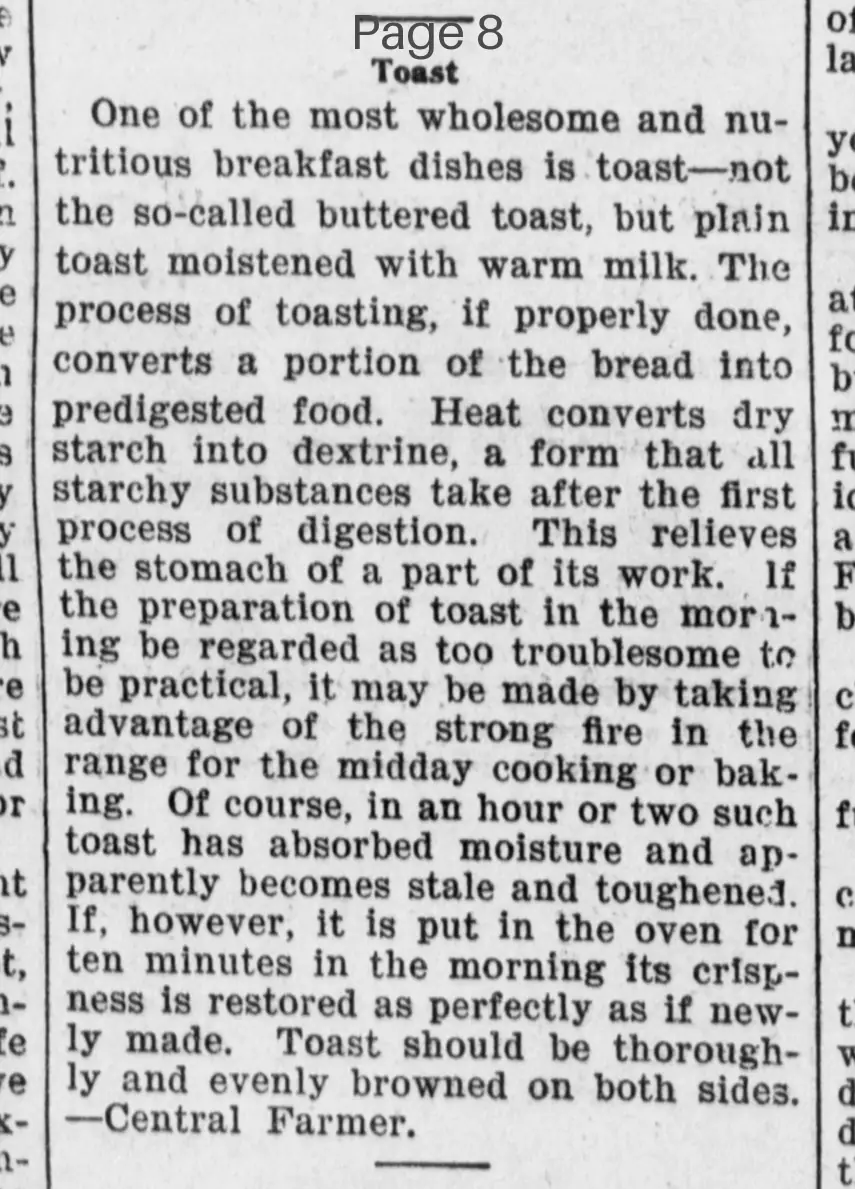
One of the most wholesome and nutritious breakfast dishes is toast—not the so-called buttered toast, but plain toast moistened with warm milk. The process of toasting, if properly done, converts a portion of the bread into predigested food. Heat converts dry starch into dextrine, a form that all starchy substances take after the first process of digestion. This relieves the stomach of a part of its work. If the preparation of toast in the morning be regarded as too troublesome to be practical, it may be made by taking advantage of the strong fire in the range for the midday cooking or baking. Of course, in an hour or two such toast has absorbed moisture and apparently becomes stale and toughened. If, however, it is put in the oven for ten minutes in the morning its crispness is restored as perfectly as if newly made. Toast should be thoroughly and evenly browned on both sides.
Central Farmer.
One of the most wholesome and nutritious breakfast dishes is toast—not the so-called buttered toast, but plain toast moistened with warm milk. The process of toasting, if properly done, converts a portion of the bread into predigested food. Heat converts dry starch into dextrine, a form that all starchy substances take after the first process of digestion. This relieves the stomach of a part of its work. If the preparation of toast in the morning be regarded as too troublesome to be practical, it may be made by taking advantage of the strong fire in the range for the midday cooking or baking. Of course, in an hour or two such toast has absorbed moisture and apparently becomes stale and toughened. If, however, it is put in the oven for ten minutes in the morning its crispness is restored as perfectly as if newly made. Toast should be thoroughly and evenly browned on both sides.
Central Farmer.
What sub-type of article is it?
Curiosity
Medical Curiosity
What keywords are associated?
Toast
Nutrition
Breakfast
Digestion
Dextrine
Preparation
Story Details
Story Details
Plain toast moistened with warm milk is nutritious; toasting converts starch to dextrine, aiding digestion; prepare ahead and revive in oven; brown evenly on both sides.