Thank you for visiting SNEWPapers!
Sign up free
Editorial
October 6, 1804
Norfolk Gazette And Publick Ledger
Norfolk, Virginia
What is this article about?
This editorial critiques the U.S. administration's handling of the dispute with Spain over West Florida's inclusion in the Louisiana Purchase. It argues the U.S. claim relies on a narrow legal interpretation unlikely shared by Spain or France, warns of inevitable war given U.S. military and commercial weaknesses, and laments the potential economic devastation from blockades and privateering.
Clipping
OCR Quality
98%
Excellent
Full Text
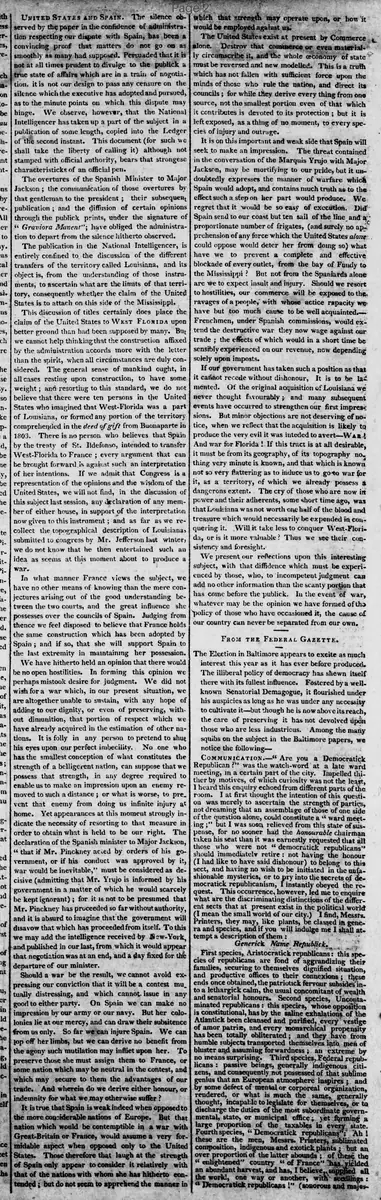
UNITED STATES AND SPAIN.
The silence observed by the paper in the confidence of administration respecting our dispute with Spain, has been a convincing proof that matters do not go on as smoothly as many had supposed. Persuaded that it is not at all times prudent to divulge to the publick a true state of affairs which are in a train of negotiation, it is not our design to pass any censure on the silence which the executive has adopted and pursued, as to the minute points on which this dispute may hinge. We observe, however, that the National Intelligencer has taken up a part of the subject in a publication of some length, copied into the Ledger of the second instant. This document (for such we shall take the liberty of calling it) although not stamped with official authority, bears the strongest characteristics of an official pen.
The overtures of the Spanish Minister to Major Jackson; the communication of those overtures by that gentleman to the president; their subsequent publication; and the diffusion of certain opinions through the publick prints, under the signature of "Graviora Manent"; have obliged the administration to depart from the silence hitherto observed.
The publication in the National Intelligencer, is entirely confined to the discussion of the different transfers of the territory called Louisiana, and its object is, from the understanding of those instruments, to ascertain what are the limits of that territory, consequently whether the claim of the United States is to attach on this side of the Mississippi.
This discussion of titles certainly does place the claim of the United States to West Florida upon better ground than had been supposed by many. But we cannot help thinking that the construction affixed by the administration accords more with the letter than the spirit, when all circumstances are duly considered. The general sense of mankind ought, in all cases resting upon construction, to have some weight; and resorting to this standard, we do not believe that there were ten persons in the United States who imagined that West-Florida was a part of Louisiana, or formed any portion of the territory comprehended in the deed of gift from Buonaparte in 1803. There is no person who believes that Spain by the treaty of St. Ildefonso, intended to transfer West-Florida to France; every argument that can be brought forward is against such an interpretation of her intentions. If we admit that Congress is a representation of the opinions and the wisdom of the United States, we will not find, in the discussion of this subject last session, any declaration of any member of either house, in support of the interpretation now given to this instrument; and as far as we recollect the topographical description of Louisiana, submitted to congress by Mr. Jefferson last winter, we do not know that he then entertained such an idea as seems at this moment about to produce a war.
In what manner France views the subject, we have no other means of knowing than the mere conjectures arising out of the good understanding between the two courts, and the great influence she possesses over the councils of Spain. Judging from thence we feel disposed to believe that France holds the same construction which has been adopted by Spain; and if so, that she will support Spain to the last extremity in maintaining her possession.
We have hitherto held an opinion that there would be no open hostilities. In forming this opinion we perhaps mistook desire for judgment. We did not wish for a war which, in our present situation, we are altogether unable to sustain, with any hope of adding to our dignity, or even of preserving, without diminution, that portion of respect which we have already acquired in the estimation of other nations. It is folly in any person to pretend to shut his eyes upon our perfect imbecility. No one who has the smallest conception of what constitutes the strength of a belligerent nation, can suppose that we possess that strength, in any degree required to enable us to make an impression upon an enemy removed to such a distance; or what is worse, to prevent that enemy from doing us infinite injury at home. Yet appearances at this moment strongly indicate the necessity of resorting to that measure in order to obtain what is held to be our right. The declaration of the Spanish minister to Major Jackson, "that if Mr. Pinckney acted by orders of his government, or if his conduct was approved by it, war would be inevitable," must be considered as decisive (admitting that Mr. Yrujo is informed by his government in a matter of which he would scarcely be kept ignorant); for it is not to be presumed that Mr. Pinckney has proceeded so far without authority, and it is absurd to imagine that the government will disavow that which has proceeded from itself. To this we may add the intelligence received by New-York, and published in our last, from which it would appear that negotiation was at an end, and a day fixed for the departure of our minister.
Should a war be the result, we cannot avoid expressing our conviction that it will be a contest mutually distressing, and which cannot issue in any good to either party. On Spain we can make no impression by our army or our navy. But her colonies lie at our mercy, and can draw their subsistence from us only. So far we can injure Spain. We can lop off her limbs, but we can derive no benefit from the agony such mutilation may inflict upon her. To preserve those she must assign them to France, or some nation which may be neutral in the contest, and which may secure to them the advantages of our trade. And wherein do we derive either honour, or indemnity for what we may otherwise suffer?
It is true that Spain is weak indeed when opposed to the more considerable nations of Europe. But that nation which would be contemptible in a war with Great-Britain or France, would assume a very formidable aspect when opposed only to the United States. Those therefore that laugh at the strength of Spain only appear to consider it relatively with that of the nations with whom she has hitherto contended; but do not seem to apprehend the manner in which that strength may operate upon, or how it would be employed against us.
The United States exist at present by Commerce alone. Destroy that commerce or even materially circumscribe it, and the whole oeconomy of state must be reversed and new modelled. This is a truth which has not fallen with sufficient force upon the minds of those who rule the nation, and direct its councils; for while they derive every thing from one source, not the smallest portion even of that which it contributes is devoted to its protection; but it is left exposed, as a thing of no moment, to every species of injury and outrage.
It is on this important and weak side that Spain will seek to make an impression. The threat contained in the conversation of the Marquis Yrujo with Major Jackson, may be mortifying to our pride, but it undoubtedly expresses the manner of warfare which Spain would adopt, and contains much truth as to the effect such a step on her part would produce. We regret that it would be so easy of execution. Did Spain send to our coast but ten sail of the line and a proportionate number of frigates, (and surely no apprehension of any force which the United States alone could oppose would deter her from doing so) what have we to prevent a complete and effective blockade of every outlet, from the bay of Fundy to the Mississippi? But not from the Spaniards alone are we to expect insult and injury. Should we resort to hostilities, our commerce will be exposed to the ravages of a people, with whose active rapacity we have but too much cause to be well acquainted.—Frenchmen, under Spanish commissions, would extend the destructive war they now wage against our trade; the effects of which would in a short time be sensibly experienced on our revenue, now depending solely upon imposts.
If our government has taken such a position as that it cannot recede without dishonour, It is to be lamented. Of the original acquisition of Louisiana we never thought favourably; and many subsequent events have occurred to strengthen our first impressions. But minor objections are not deserving of notice, when we reflect that the acquisition is likely to produce the very evil it was intended to avert—War! And war for Florida! If this tract is at all desirable, it must be from its geography, of its topography nothing very minute is known, and that which is known not so very flattering as to induce us to go to war for it, as a territory, of which we already possess a dangerous extent. The cry of those who are now in power and their adherents, some short time ago, was that Louisiana was not worth one half of the blood and treasure which would necessarily be expended in conquering it. Will it take less to conquer West-Florida, or is it more valuable? Thus we see their consistency and foresight.
We present our reflections upon this interesting subject, with that diffidence which must be experienced by those, who, to incompetent judgment can add no other information than the scanty portion that has come before the publick. In the event of war, whatever may be the opinion we have formed of the policy of those who have occasioned it, the cause of our country can never be separated from our own.
The silence observed by the paper in the confidence of administration respecting our dispute with Spain, has been a convincing proof that matters do not go on as smoothly as many had supposed. Persuaded that it is not at all times prudent to divulge to the publick a true state of affairs which are in a train of negotiation, it is not our design to pass any censure on the silence which the executive has adopted and pursued, as to the minute points on which this dispute may hinge. We observe, however, that the National Intelligencer has taken up a part of the subject in a publication of some length, copied into the Ledger of the second instant. This document (for such we shall take the liberty of calling it) although not stamped with official authority, bears the strongest characteristics of an official pen.
The overtures of the Spanish Minister to Major Jackson; the communication of those overtures by that gentleman to the president; their subsequent publication; and the diffusion of certain opinions through the publick prints, under the signature of "Graviora Manent"; have obliged the administration to depart from the silence hitherto observed.
The publication in the National Intelligencer, is entirely confined to the discussion of the different transfers of the territory called Louisiana, and its object is, from the understanding of those instruments, to ascertain what are the limits of that territory, consequently whether the claim of the United States is to attach on this side of the Mississippi.
This discussion of titles certainly does place the claim of the United States to West Florida upon better ground than had been supposed by many. But we cannot help thinking that the construction affixed by the administration accords more with the letter than the spirit, when all circumstances are duly considered. The general sense of mankind ought, in all cases resting upon construction, to have some weight; and resorting to this standard, we do not believe that there were ten persons in the United States who imagined that West-Florida was a part of Louisiana, or formed any portion of the territory comprehended in the deed of gift from Buonaparte in 1803. There is no person who believes that Spain by the treaty of St. Ildefonso, intended to transfer West-Florida to France; every argument that can be brought forward is against such an interpretation of her intentions. If we admit that Congress is a representation of the opinions and the wisdom of the United States, we will not find, in the discussion of this subject last session, any declaration of any member of either house, in support of the interpretation now given to this instrument; and as far as we recollect the topographical description of Louisiana, submitted to congress by Mr. Jefferson last winter, we do not know that he then entertained such an idea as seems at this moment about to produce a war.
In what manner France views the subject, we have no other means of knowing than the mere conjectures arising out of the good understanding between the two courts, and the great influence she possesses over the councils of Spain. Judging from thence we feel disposed to believe that France holds the same construction which has been adopted by Spain; and if so, that she will support Spain to the last extremity in maintaining her possession.
We have hitherto held an opinion that there would be no open hostilities. In forming this opinion we perhaps mistook desire for judgment. We did not wish for a war which, in our present situation, we are altogether unable to sustain, with any hope of adding to our dignity, or even of preserving, without diminution, that portion of respect which we have already acquired in the estimation of other nations. It is folly in any person to pretend to shut his eyes upon our perfect imbecility. No one who has the smallest conception of what constitutes the strength of a belligerent nation, can suppose that we possess that strength, in any degree required to enable us to make an impression upon an enemy removed to such a distance; or what is worse, to prevent that enemy from doing us infinite injury at home. Yet appearances at this moment strongly indicate the necessity of resorting to that measure in order to obtain what is held to be our right. The declaration of the Spanish minister to Major Jackson, "that if Mr. Pinckney acted by orders of his government, or if his conduct was approved by it, war would be inevitable," must be considered as decisive (admitting that Mr. Yrujo is informed by his government in a matter of which he would scarcely be kept ignorant); for it is not to be presumed that Mr. Pinckney has proceeded so far without authority, and it is absurd to imagine that the government will disavow that which has proceeded from itself. To this we may add the intelligence received by New-York, and published in our last, from which it would appear that negotiation was at an end, and a day fixed for the departure of our minister.
Should a war be the result, we cannot avoid expressing our conviction that it will be a contest mutually distressing, and which cannot issue in any good to either party. On Spain we can make no impression by our army or our navy. But her colonies lie at our mercy, and can draw their subsistence from us only. So far we can injure Spain. We can lop off her limbs, but we can derive no benefit from the agony such mutilation may inflict upon her. To preserve those she must assign them to France, or some nation which may be neutral in the contest, and which may secure to them the advantages of our trade. And wherein do we derive either honour, or indemnity for what we may otherwise suffer?
It is true that Spain is weak indeed when opposed to the more considerable nations of Europe. But that nation which would be contemptible in a war with Great-Britain or France, would assume a very formidable aspect when opposed only to the United States. Those therefore that laugh at the strength of Spain only appear to consider it relatively with that of the nations with whom she has hitherto contended; but do not seem to apprehend the manner in which that strength may operate upon, or how it would be employed against us.
The United States exist at present by Commerce alone. Destroy that commerce or even materially circumscribe it, and the whole oeconomy of state must be reversed and new modelled. This is a truth which has not fallen with sufficient force upon the minds of those who rule the nation, and direct its councils; for while they derive every thing from one source, not the smallest portion even of that which it contributes is devoted to its protection; but it is left exposed, as a thing of no moment, to every species of injury and outrage.
It is on this important and weak side that Spain will seek to make an impression. The threat contained in the conversation of the Marquis Yrujo with Major Jackson, may be mortifying to our pride, but it undoubtedly expresses the manner of warfare which Spain would adopt, and contains much truth as to the effect such a step on her part would produce. We regret that it would be so easy of execution. Did Spain send to our coast but ten sail of the line and a proportionate number of frigates, (and surely no apprehension of any force which the United States alone could oppose would deter her from doing so) what have we to prevent a complete and effective blockade of every outlet, from the bay of Fundy to the Mississippi? But not from the Spaniards alone are we to expect insult and injury. Should we resort to hostilities, our commerce will be exposed to the ravages of a people, with whose active rapacity we have but too much cause to be well acquainted.—Frenchmen, under Spanish commissions, would extend the destructive war they now wage against our trade; the effects of which would in a short time be sensibly experienced on our revenue, now depending solely upon imposts.
If our government has taken such a position as that it cannot recede without dishonour, It is to be lamented. Of the original acquisition of Louisiana we never thought favourably; and many subsequent events have occurred to strengthen our first impressions. But minor objections are not deserving of notice, when we reflect that the acquisition is likely to produce the very evil it was intended to avert—War! And war for Florida! If this tract is at all desirable, it must be from its geography, of its topography nothing very minute is known, and that which is known not so very flattering as to induce us to go to war for it, as a territory, of which we already possess a dangerous extent. The cry of those who are now in power and their adherents, some short time ago, was that Louisiana was not worth one half of the blood and treasure which would necessarily be expended in conquering it. Will it take less to conquer West-Florida, or is it more valuable? Thus we see their consistency and foresight.
We present our reflections upon this interesting subject, with that diffidence which must be experienced by those, who, to incompetent judgment can add no other information than the scanty portion that has come before the publick. In the event of war, whatever may be the opinion we have formed of the policy of those who have occasioned it, the cause of our country can never be separated from our own.
What sub-type of article is it?
Foreign Affairs
War Or Peace
Trade Or Commerce
What keywords are associated?
Louisiana Purchase
West Florida
Us Spain Dispute
War Threat
Commerce Vulnerability
Treaty Interpretation
National Intelligencer
What entities or persons were involved?
Spain
United States Administration
France
Major Jackson
Mr. Pinckney
Marquis Yrujo
Buonaparte
Mr. Jefferson
National Intelligencer
Editorial Details
Primary Topic
Us Spain Dispute Over West Florida In Louisiana Purchase
Stance / Tone
Critical Of Administration's War Risking Position, Emphasizing Us Vulnerability
Key Figures
Spain
United States Administration
France
Major Jackson
Mr. Pinckney
Marquis Yrujo
Buonaparte
Mr. Jefferson
National Intelligencer
Key Arguments
Administration's Interpretation Of Louisiana Treaties Includes West Florida But Ignores Spirit And Public Understanding
Spain And France Likely View West Florida As Separate, Supporting Spain's Possession
Us Militarily Weak And Commerce Dependent, Vulnerable To Blockade And Privateering
War Would Be Mutually Distressing With No Benefit To Us
Original Louisiana Acquisition Unwise, Now Risking War Over Florida