Thank you for visiting SNEWPapers!
Sign up free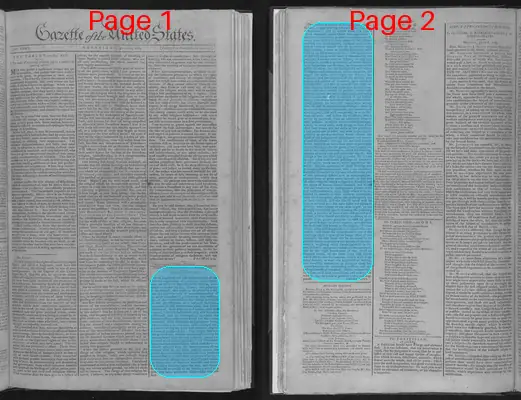
Gazette Of The United States
New York, New York County, New York
What is this article about?
This continued editorial argues for the establishment of a national judiciary under the US Constitution to interpret federal laws impartially, separate from state courts, ensuring justice, liberty, and property rights while addressing human passions and societal needs. Signed by AMERICANUS.
Merged-components note: Continuation of the sketch on the political state of America, including discussion of the national judiciary, across pages with sequential reading order.
Clippings
1 of 2
OCR Quality
Full Text
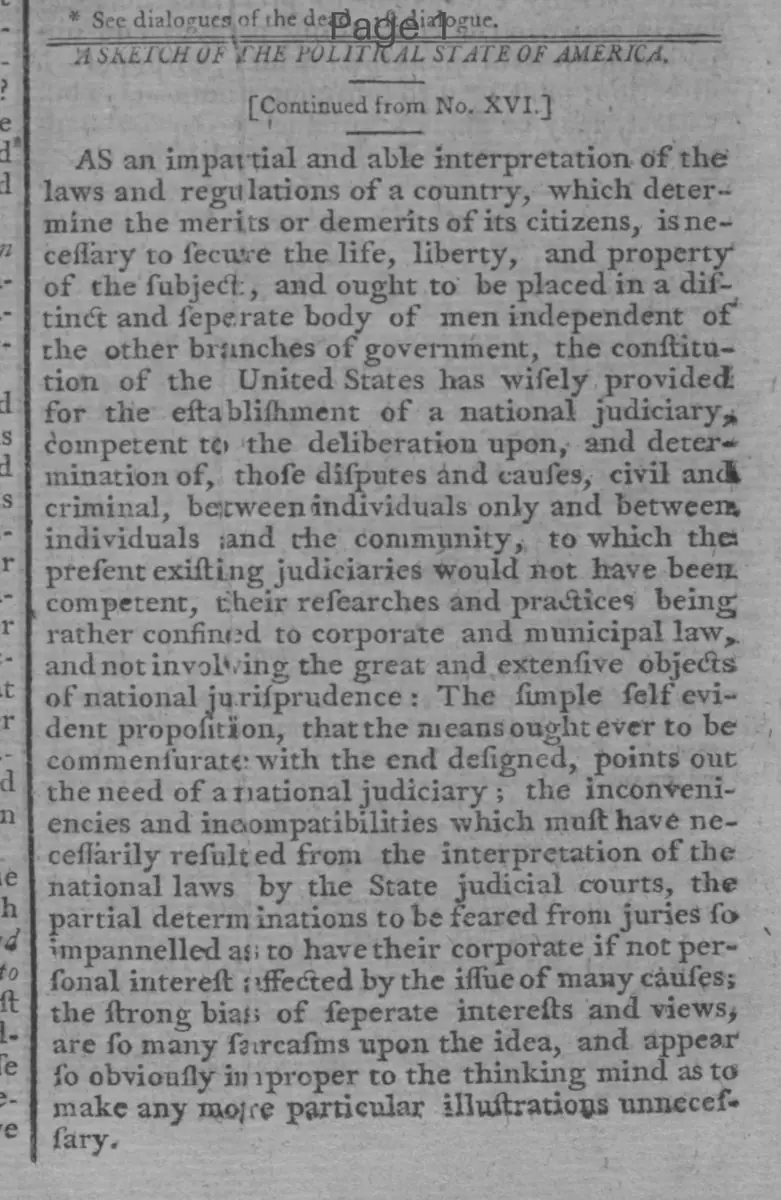
[Continued from No. XVI.]
As an impartial and able interpretation of the laws and regulations of a country, which determine the merits or demerits of its citizens, is necessary to secure the life, liberty, and property of the subject; and ought to be placed in a distinct and separate body of men independent of the other branches of government, the constitution of the United States has wisely provided for the establishment of a national judiciary, competent to the deliberation upon, and determination of, those disputes and causes, civil and criminal, between individuals only and between individuals and the community, to which the present existing judiciaries would not have been competent, their researches and practices being rather confined to corporate and municipal law, and not involving the great and extensive objects of national jurisprudence: The simple self-evident proposition, that the means ought ever to be commensurate with the end designed, points out the need of a national judiciary; the inconveniences and incompatibilities which must have necessarily resulted from the interpretation of the national laws by the State judicial courts, the partial determinations to be feared from juries so impannelled as to have their corporate if not personal interest affected by the issue of many causes; the strong bias of separate interests and views, are so many arguments upon the idea, and appear so obviously improper to the thinking mind as to make any more particular illustrations unnecessary.
The perfect propriety of having a national judiciary, to interpret the laws made by a national legislature; and to decide upon the causes which naturally come within the cognizance of those laws, intuitively produces conviction in the mind, from only a cursory glance of the subject; and that this establishment, co-equal with the objects it involves should also be co-existent with those objects, is what as readily strikes the mind with its necessity and propriety: The application of this will discover the need of commencing the judiciary with the revenue system, as that may perhaps be almost as productive of causes subject to its inspection and decision, as of income to the public treasury; but the multiplicity and variety of disputes and contentions, which the pride, the anger, the desire of revenge, the avarice, the knavery, and the operation of the diverse prejudices and passions of mankind, give rise to innumerable, and flow as natural from their various sources, as streams from their several fountains—and their recital (if possible) would only serve to torture the benevolent mind, and wring with anguish the softer sensations of the human heart: that every moment of time, presents additional reasons for laws and regulations, among men, all will be ready to acknowledge: How to form those laws and regulations, in a manner most advantageous, and most completely, so as to alleviate the evils, and often the ill effects, which accrue to mankind, from an unlimited way of their passions; as also to avoid the disadvantages, which, in many cases, must spring to them from these very forms, and the abuse of law practices; a task honorable in itself, and must be peculiarly grateful to the fine feelings which actuate the mind of the enlightened philosopher and accomplished statesman: Though the national Constitution, which is no more than general principles thrown into form, for the guide of our Legislators, and to be readily recurred to, could not take cognizance of every case and particular object; and though it has not explicitly provided for a trial by jury (that inestimable privilege of freemen) in all causes, yet it has no where opposed or forbid it: And the operation of those feelings and principles abovementioned, will, I am confident, from the characters of the men who have the plan of the judiciary system now in contemplation, prompt them to grant every latitude, in this and all other respects, which a regard to freedom and the rights of human nature demand, and which will not involve in its consequences greater evils and embarrassments, than those which it is intended to remedy;—their uniform patriotism, their tried integrity, claim this presumption upon their conduct, and the liberal mind will be hurt to withhold it:—But here suffer me again to observe, what cannot be too often urged, or too strongly inculcated, that in framing the judiciary system, a sacrifice of local views and partial prejudices, will be found peculiarly necessary, to establish it on proper grounds—to assist its great and good design—to avoid expense, and produce the most ease and benefit to the subject.—Private virtue, and public happiness, are inseparably connected; and while the comprehensive eye of the statesman takes a view of the happy effect of this principle, his able hand will be extended by all possible means to preserve the morals of the community, in giving every encouragement to virtue, industry, and good conduct, on the one hand, and by the rigid punishment of vice, in all its haggard forms, on the other;—he will nicely watch the various fluctuations, which arise from many sources, to mar the happiness of society, and carefully endeavour to preserve those balances between the contending passions and opposing interests of mankind; which, without such direction, must lead to confusion and misery, but with it, may be made to produce order and happiness.
AMERICANUS.
What sub-type of article is it?
What keywords are associated?
What entities or persons were involved?
Editorial Details
Primary Topic
Establishment Of A National Judiciary
Stance / Tone
Supportive Of National Judiciary And Constitutional Provisions
Key Figures
Key Arguments