Thank you for visiting SNEWPapers!
Sign up free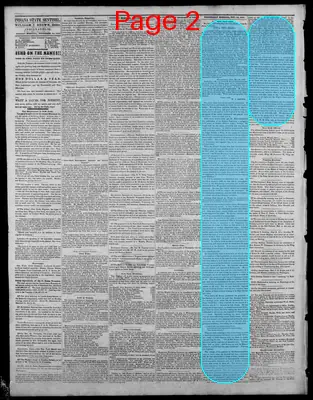
Editorial
November 27, 1851
Indiana State Sentinel
Indianapolis, Marion County, Indiana
What is this article about?
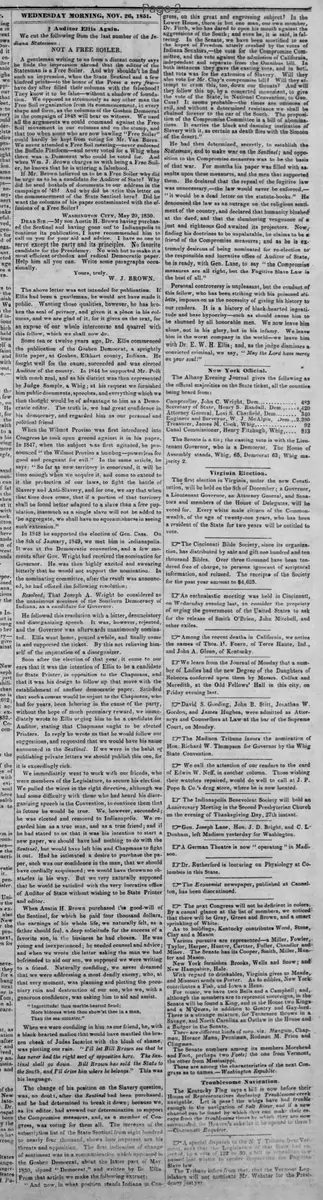
The editorial from the Indiana Statesman defends against accusations of being a Free Soiler, recounts the editor's opposition to the Free Soil movement, details Wm. J. Brown's support for Auditor Ellis's election, and criticizes Ellis for shifting stance on slavery compromises to sabotage the Democratic State Sentinel newspaper.
Clipping
OCR Quality
95%
Excellent
Full Text
Auditor Ellis Again.
We cut the following from the last number of the Indiana Statesman:
NOT A FREE SOILER.
A gentleman writing to us from a distant county says he finds the impression abroad that the editor of the Statesman is a Free Soiler. And why shouldn't he find such an impression, when the State Sentinel and a few kindred prints-to the honor of the Press a very few— have day after day filled their columns with the falsehood? They know it to be false-without a shadow of foundation. We opposed as strenuously as any other man the Free Soil organization from its commencement, in every shape and form, as the columns of the Goshen Democrat in the campaign of 1848 will bear us witness. We used all the arguments we could command against the Free Soil movement in our columns and on the stump, and that too when some who are now bawling "Free Soiler" could hardly be kept from voting for Mr. Van Buren. We never attended a Free Soil meeting—never endorsed the Buffalo Platform-and never voted for a Whig when there was a Democrat who could be voted for. And when Wm. J. Brown charges us with being a Free Soiler, he knows that he is uttering a falsehood.
If Mr. Brown believed us to be a Free Soiler why did he urge us to be a candidate for Auditor of State? Why did he send bushels of documents to our address in the campaign of '48? And why did he write this letter on the commencement of the State Sentinel here? Did he want the columns of his paper contaminated with the effusions of a Free Soiler?
Washington CITY, May 20, 1850.
DEAR SIR: My son Austin H. Brown having purchased the Sentinel and having gone out to Indianapolis to continue its publication, I have recommended him to call on you for your aid and advice. I have no one to serve except the party and its principles. No favorite candidate for the Presidency. No wish but to make it a most efficient orthodox and radical Democratic paper. Help him all you can. Write some paragraphs occasionally.
Yours, truly,
W. J. BROWN.
The above letter was not intended for publication. If Mr. Ellis had been a gentleman, he would not have made it public. Wanting those qualities, however, he has broken the seal of privacy, and given it a place in his columns, and we are glad of it, for it gives us the text, for an expose of our whole intercourse and apparel with this fellow, which we shall now do.
Some ten or twelve years ago, Dr. Ellis commenced the publication of the Goshen Democrat, a sprightly little paper, at Goshen, Elkhart county, Indiana. He fought well for the cause, succeeded and was elected Auditor of the county. In 1844 he supported Mr. Polk with much zeal, and as his district was then represented by Judge Sample, a Whig; at his request we furnished him public documents, speeches, and everything which we then thought would be of advantage to him as a Democratic editor. The truth is, we had great confidence in his democracy, and regarded him as our personal and political friend
When the Wilmot Proviso was first introduced into Congress he took open ground against it in his paper. In 1847, when the subject was first agitated, he pronounced " the Wilmot Proviso a humbug-powerless for good and pregnant for evil." In the same article, he says: " So far as new territory is concerned, it will be time enough when we acquire it, and come to extend to it the protection of our laws, to fight the battle of Slavery and Anti-Slavery, and for one, we say that when that time does come, that if a portion of that territory shall be found better adapted to a slave than a free population, inasmuch as a single slave will not be added to the aggregate, we shall have no squeamishness in seeing such extension."
In 1848 he supported the election of Gen. Cass. On the 8th of January, 1849, we met him in Indianapolis It was at the Democratic convention, and a few moments after Gov. Wright had received the nomination for Governor. He was then highly excited and swearing bitterly that he would not support the nomination. In the nominating committee, after the result was announced, he had offered the following resolution:
Resolved, That Joseph A. Wright be considered as the unanimous nominee of the Southern Democracy of Indiana, as a candidate for Governor.
He followed this resolution with a bitter, denunciatory and disorganizing speech. It was, however, rejected, and the Governor was afterwards unanimously nominated. Ellis went home, pouted awhile, and finally came in and supported the ticket. By this act relieving himself of the imputation of a disorganizer.
Soon after the election of that year, it came to our ears that it was the intention of Ellis to be a candidate for State Printer, in opposition to the Chapmans, and that it was his design to follow up that move with the establishment of another democratic paper. Satisfied that such a course would be unjust to the Chapmans, who had for years, been laboring in the cause of the party, without the hope of much pecuniary reward, we immediately wrote to Ellis urging him to be a candidate for Auditor, stating that Chapmans ought to be elected Printers. In reply he wrote us that he would follow our suggestions, and requested that we would have his name announced in the Sentinel. If we were in the habit of publishing private letters we should publish this one, for it is exceedingly rich.
We immediately went to work with our friends, who were members of the Legislature, to secure his election. We pulled the wires in the right direction, although we had some difficulty with those who had heard his disorganizing speech in the Convention, to convince them that in future he would be true. We, however, succeeded; he was elected and removed to Indianapolis. We regarded him as a true man, and as a true friend; and if he had stated to us that it was his intention to start a new paper, we should have had nothing to do with the Sentinel, but would have left him and Chapmans to fight it out. Had he intimated a desire to purchase the paper, such was our confidence in the man, that we should have cordially acquiesced; we would have thrown no obstacles in his way. But we very naturally supposed that he would be satisfied with the very lucrative office of Auditor of State without wishing to be State Printer and editor.
When Austin H. Brown purchased the good-will of the Sentinel, for which he paid four thousand dollars, the earnings of his whole life, we naturally felt, as a father should feel, a deep solicitude for the success of a favorite son, in the business he had chosen. He was young and inexperienced; he needed counsel and advice; and when we wrote the letter asking the man we had befriended to aid our son, we supposed we were writing to a friend. Naturally confiding, we never dreamed that we were addressing a most deadly enemy, who, at that very moment, was planning and plotting the pecuniary ruin and destruction of our son, who we, with a generous confidence, was asking him to aid and assist.
"Ingratitude! thou marble-hearted fiend;
More hideous when thou show'st thee in a man.
Than the sea-monster."
When we were confiding in him as our friend, he, with a black hearted malice that would have mantled the brazen cheek of Judas Iscariot with the blush of shame, was plotting our ruin. " I'll let Bill Brown see that he has never had the right sort of opposition here. The Sentinel shall go down. Bill Brown has sold the State to the South, and I'll drive him where he belongs." This was his language.
The change of his position on the Slavery question, was, no doubt, after the Sentinel had been purchased, and he had determined to break it down; because we, as its editor, had avowed our determination to support the Compromise measures, and, as a member of Congress, was voting for them all. The increase of the subscription list of the State Sentinel from eight hundred to nearly four thousand, shows how impotent are his threats and opposition. The first indication of change of sentiment was in a communication which appeared in the Goshen Democrat, about the latter part of May 1850, signed "Democrat," and written by Dr. Ellis From that article we make the following extract:
" And now, in what position stands Indiana in Congress, on this great and engrossing subject? In the Lower House, there is but one man, our own member, Dr. Fitch, who has dared to open his mouth against the aggressions of the South; and even he, it is said, is faltering. In the Senate, we have been mortified to see the hopes of Freedom utterly crushed by the votes of Indiana Senators, the vote of the Compromise Committee, and the vote against the admission of California, independent and separate from the Omnibus bill. In both instances they gave the casting vote, and in both that vote was for the extension of Slavery. Will they also vote for Mr. Clay's compromise bill? Will they attempt to cram this, too, down our throats? And will they follow this up, by a concerted movement, to give the vote of the State, in National Convention, to Gen. Cass? It seems probable the times are ominous of evil, and without a determined resistance we shall be chained forever to the car of the South. The proposition of the Compromise Committee is a bill of abominations. It carries the black and damning institution of Slavery with it, as certain as death flies with the Simoon of the desert."
We cut the following from the last number of the Indiana Statesman:
NOT A FREE SOILER.
A gentleman writing to us from a distant county says he finds the impression abroad that the editor of the Statesman is a Free Soiler. And why shouldn't he find such an impression, when the State Sentinel and a few kindred prints-to the honor of the Press a very few— have day after day filled their columns with the falsehood? They know it to be false-without a shadow of foundation. We opposed as strenuously as any other man the Free Soil organization from its commencement, in every shape and form, as the columns of the Goshen Democrat in the campaign of 1848 will bear us witness. We used all the arguments we could command against the Free Soil movement in our columns and on the stump, and that too when some who are now bawling "Free Soiler" could hardly be kept from voting for Mr. Van Buren. We never attended a Free Soil meeting—never endorsed the Buffalo Platform-and never voted for a Whig when there was a Democrat who could be voted for. And when Wm. J. Brown charges us with being a Free Soiler, he knows that he is uttering a falsehood.
If Mr. Brown believed us to be a Free Soiler why did he urge us to be a candidate for Auditor of State? Why did he send bushels of documents to our address in the campaign of '48? And why did he write this letter on the commencement of the State Sentinel here? Did he want the columns of his paper contaminated with the effusions of a Free Soiler?
Washington CITY, May 20, 1850.
DEAR SIR: My son Austin H. Brown having purchased the Sentinel and having gone out to Indianapolis to continue its publication, I have recommended him to call on you for your aid and advice. I have no one to serve except the party and its principles. No favorite candidate for the Presidency. No wish but to make it a most efficient orthodox and radical Democratic paper. Help him all you can. Write some paragraphs occasionally.
Yours, truly,
W. J. BROWN.
The above letter was not intended for publication. If Mr. Ellis had been a gentleman, he would not have made it public. Wanting those qualities, however, he has broken the seal of privacy, and given it a place in his columns, and we are glad of it, for it gives us the text, for an expose of our whole intercourse and apparel with this fellow, which we shall now do.
Some ten or twelve years ago, Dr. Ellis commenced the publication of the Goshen Democrat, a sprightly little paper, at Goshen, Elkhart county, Indiana. He fought well for the cause, succeeded and was elected Auditor of the county. In 1844 he supported Mr. Polk with much zeal, and as his district was then represented by Judge Sample, a Whig; at his request we furnished him public documents, speeches, and everything which we then thought would be of advantage to him as a Democratic editor. The truth is, we had great confidence in his democracy, and regarded him as our personal and political friend
When the Wilmot Proviso was first introduced into Congress he took open ground against it in his paper. In 1847, when the subject was first agitated, he pronounced " the Wilmot Proviso a humbug-powerless for good and pregnant for evil." In the same article, he says: " So far as new territory is concerned, it will be time enough when we acquire it, and come to extend to it the protection of our laws, to fight the battle of Slavery and Anti-Slavery, and for one, we say that when that time does come, that if a portion of that territory shall be found better adapted to a slave than a free population, inasmuch as a single slave will not be added to the aggregate, we shall have no squeamishness in seeing such extension."
In 1848 he supported the election of Gen. Cass. On the 8th of January, 1849, we met him in Indianapolis It was at the Democratic convention, and a few moments after Gov. Wright had received the nomination for Governor. He was then highly excited and swearing bitterly that he would not support the nomination. In the nominating committee, after the result was announced, he had offered the following resolution:
Resolved, That Joseph A. Wright be considered as the unanimous nominee of the Southern Democracy of Indiana, as a candidate for Governor.
He followed this resolution with a bitter, denunciatory and disorganizing speech. It was, however, rejected, and the Governor was afterwards unanimously nominated. Ellis went home, pouted awhile, and finally came in and supported the ticket. By this act relieving himself of the imputation of a disorganizer.
Soon after the election of that year, it came to our ears that it was the intention of Ellis to be a candidate for State Printer, in opposition to the Chapmans, and that it was his design to follow up that move with the establishment of another democratic paper. Satisfied that such a course would be unjust to the Chapmans, who had for years, been laboring in the cause of the party, without the hope of much pecuniary reward, we immediately wrote to Ellis urging him to be a candidate for Auditor, stating that Chapmans ought to be elected Printers. In reply he wrote us that he would follow our suggestions, and requested that we would have his name announced in the Sentinel. If we were in the habit of publishing private letters we should publish this one, for it is exceedingly rich.
We immediately went to work with our friends, who were members of the Legislature, to secure his election. We pulled the wires in the right direction, although we had some difficulty with those who had heard his disorganizing speech in the Convention, to convince them that in future he would be true. We, however, succeeded; he was elected and removed to Indianapolis. We regarded him as a true man, and as a true friend; and if he had stated to us that it was his intention to start a new paper, we should have had nothing to do with the Sentinel, but would have left him and Chapmans to fight it out. Had he intimated a desire to purchase the paper, such was our confidence in the man, that we should have cordially acquiesced; we would have thrown no obstacles in his way. But we very naturally supposed that he would be satisfied with the very lucrative office of Auditor of State without wishing to be State Printer and editor.
When Austin H. Brown purchased the good-will of the Sentinel, for which he paid four thousand dollars, the earnings of his whole life, we naturally felt, as a father should feel, a deep solicitude for the success of a favorite son, in the business he had chosen. He was young and inexperienced; he needed counsel and advice; and when we wrote the letter asking the man we had befriended to aid our son, we supposed we were writing to a friend. Naturally confiding, we never dreamed that we were addressing a most deadly enemy, who, at that very moment, was planning and plotting the pecuniary ruin and destruction of our son, who we, with a generous confidence, was asking him to aid and assist.
"Ingratitude! thou marble-hearted fiend;
More hideous when thou show'st thee in a man.
Than the sea-monster."
When we were confiding in him as our friend, he, with a black hearted malice that would have mantled the brazen cheek of Judas Iscariot with the blush of shame, was plotting our ruin. " I'll let Bill Brown see that he has never had the right sort of opposition here. The Sentinel shall go down. Bill Brown has sold the State to the South, and I'll drive him where he belongs." This was his language.
The change of his position on the Slavery question, was, no doubt, after the Sentinel had been purchased, and he had determined to break it down; because we, as its editor, had avowed our determination to support the Compromise measures, and, as a member of Congress, was voting for them all. The increase of the subscription list of the State Sentinel from eight hundred to nearly four thousand, shows how impotent are his threats and opposition. The first indication of change of sentiment was in a communication which appeared in the Goshen Democrat, about the latter part of May 1850, signed "Democrat," and written by Dr. Ellis From that article we make the following extract:
" And now, in what position stands Indiana in Congress, on this great and engrossing subject? In the Lower House, there is but one man, our own member, Dr. Fitch, who has dared to open his mouth against the aggressions of the South; and even he, it is said, is faltering. In the Senate, we have been mortified to see the hopes of Freedom utterly crushed by the votes of Indiana Senators, the vote of the Compromise Committee, and the vote against the admission of California, independent and separate from the Omnibus bill. In both instances they gave the casting vote, and in both that vote was for the extension of Slavery. Will they also vote for Mr. Clay's compromise bill? Will they attempt to cram this, too, down our throats? And will they follow this up, by a concerted movement, to give the vote of the State, in National Convention, to Gen. Cass? It seems probable the times are ominous of evil, and without a determined resistance we shall be chained forever to the car of the South. The proposition of the Compromise Committee is a bill of abominations. It carries the black and damning institution of Slavery with it, as certain as death flies with the Simoon of the desert."
What sub-type of article is it?
Partisan Politics
Slavery Abolition
What keywords are associated?
Free Soiler
Democratic Party
Slavery Compromise
Auditor Ellis
State Sentinel
Wilmot Proviso
Party Betrayal
What entities or persons were involved?
Auditor Ellis
Wm. J. Brown
Austin H. Brown
Gen. Cass
Joseph A. Wright
Dr. Fitch
State Sentinel
Goshen Democrat
Editorial Details
Primary Topic
Defense Against Free Soiler Accusations And Critique Of Auditor Ellis's Betrayal
Stance / Tone
Defensive Of Democratic Loyalty, Accusatory Towards Ellis For Ingratitude And Shift On Slavery
Key Figures
Auditor Ellis
Wm. J. Brown
Austin H. Brown
Gen. Cass
Joseph A. Wright
Dr. Fitch
State Sentinel
Goshen Democrat
Key Arguments
Opposed Free Soil Organization Strenuously Since 1848
Brown Urged And Supported Ellis For Auditor Of State
Ellis Initially Supported Polk, Cass, And Opposed Wilmot Proviso
Ellis Attempted To Disorganize Democratic Convention In 1849 But Later Supported Ticket
Brown's Letter Sought Ellis's Aid For Son, But Ellis Plotted Against The Sentinel
Ellis Changed Stance On Slavery Compromises To Undermine Pro Compromise Sentinel
Subscription Growth Of Sentinel Shows Failure Of Ellis's Opposition