Thank you for visiting SNEWPapers!
Sign up free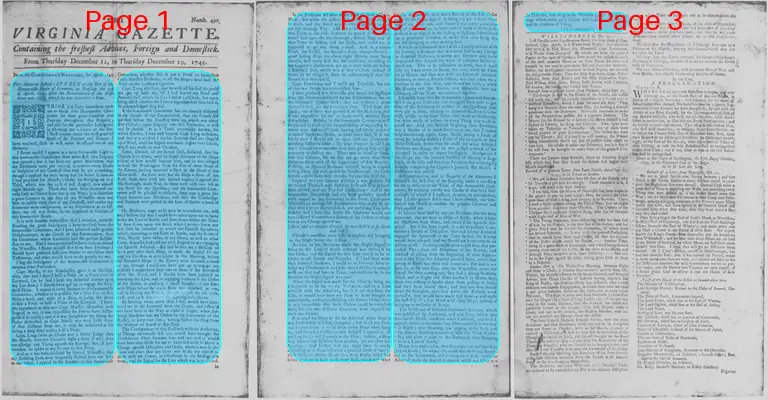
The Virginia Gazette
Richmond, Williamsburg, Richmond County, Virginia
What is this article about?
Vice-Admiral Lestock delivers a speech to the House of Commons on April 9, 1745, defending his conduct in a naval engagement involving British, Spanish, and French fleets near Hieres Bay. He addresses witness testimonies, sailing maneuvers, and Admiral Mathews's orders, arguing his innocence amid the inquiry into the battle's miscarriage.
Merged-components note: Merged image and text components across pages 1-3 as they form a single logical unit: Vice-Admiral Lestock's speech from the Gentleman's Magazine. Image overlaps spatially with the first text component and precedes it in reading order. Changed label from 'story' for the final segment to 'foreign_news' to match the overall content.
Clippings
1 of 3
OCR Quality
Full Text
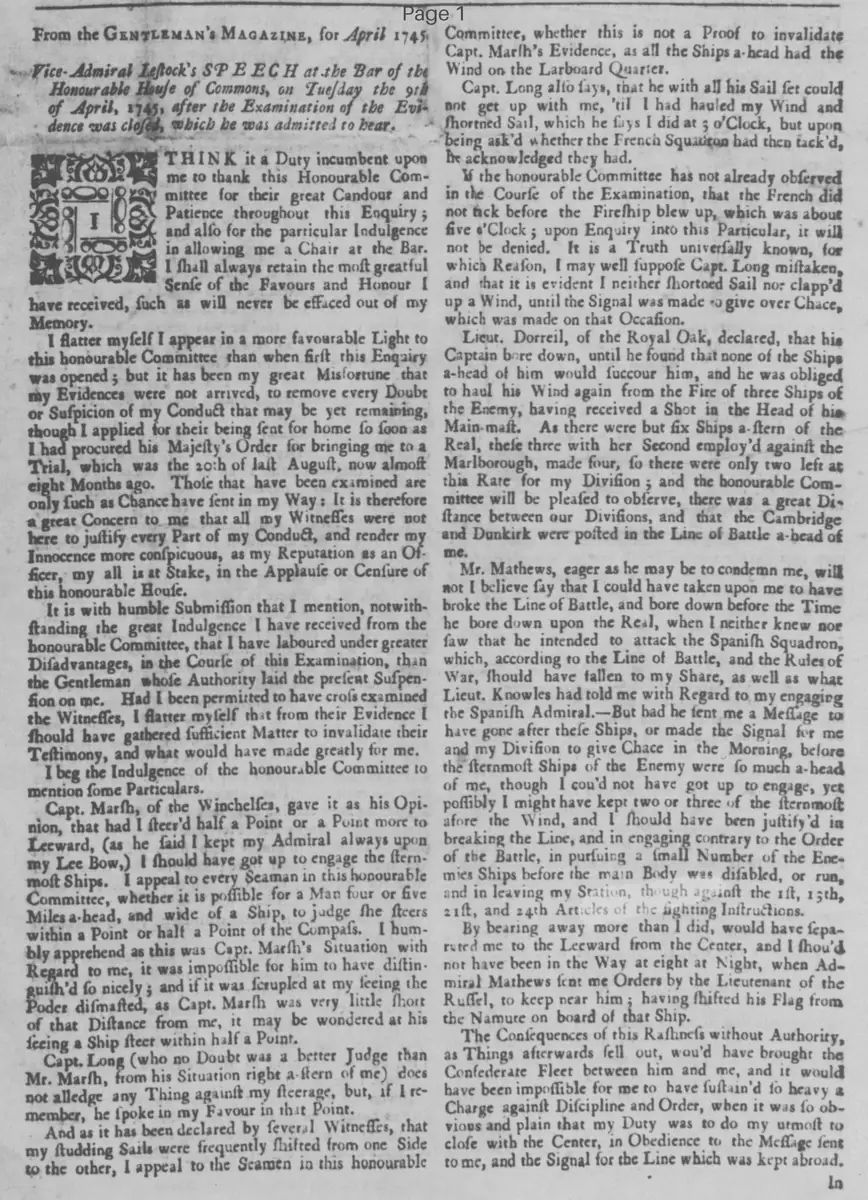
Vice-Admiral Lestock's Speech at the Bar of the Honourable House of Commons, on Tuesday the 9th of April, 1745, after the Examination of the Evidence was closed, which he was admitted to hear.
I think it a Duty incumbent upon me to thank this Honourable Committee for their great Candour and Patience throughout this Enquiry; and also for the particular Indulgence in allowing me a Chair at the Bar.
I shall always retain the most grateful Sense of the Favours and Honour I have received, such as will never be effaced out of my Memory.
I flatter myself I appear in a more favourable Light to this honourable Committee than when first this Enquiry was opened; but it has been my great Misfortune that my Evidences were not arrived, to remove every Doubt or Suspicion of my Conduct that may be yet remaining, though I applied for their being sent for home as soon as I had procured his Majesty's Order for bringing me to a Trial, which was the 20th of last August, now almost eight Months ago.
Those that have been examined are only such as Chance have sent in my Way: It is therefore a great Concern to me that all my Witnesses were not here to justify every Part of my Conduct, and render my Innocence more conspicuous, as my Reputation as an Officer, my all, is at Stake, in the Applause or Censure of this honourable House.
It is with humble Submission that I mention, notwithstanding the great Indulgence I have received from the honourable Committee, that I have laboured under greater Disadvantages, in the Course of this Examination, than the Gentleman whose Authority laid the present Suspicion on me.
Had I been permitted to have cross examined the Witnesses, I flatter myself that from their Evidence I should have gathered sufficient Matter to invalidate their Testimony, and what would have made greatly for me.
I beg the Indulgence of the honourable Committee to mention some Particulars.
Capt. Marsh, of the Winchelsea, gave it as his Opinion, that had I steer'd half a Point or a Point more to the Leeward, (as he said I kept my Admiral always upon the Lee Bow,) I should have got up to engage the sternmost Ships.
I appeal to every Seaman in this honourable Committee, whether it is possible for a Man four or five Miles a-head, and wide of a Ship, to judge She steers within a Point or half a Point of the Compass. I humbly beg Pardon for regarding to me, it was impossible for him to have distinctly apprehend as this was Capt. Marsh's Situation with regard so nicely; and if it was scrupled at my seeing the Poder dimasted, as Capt. Marsh was very little short of that Distance from me, it may be wondered at his seeing a Ship steer within half a Point.
Capt. Long (who no Doubt was a better Judge than Mr. Marsh, from his Situation right a-stern of me) does not allege any Thing against my steerage, but, if I remember, he spoke in my Favour in that Point.
My studding Sails were frequently Shifted from one Side to the other, and as it has been declared by several Witnesses, that all the Ships a-head had the Wind on the Larboard Quarter.
I appeal to the Seamen in this honourable Committee, whether this is not a Proof to invalidate Capt. Marsh's Evidence.
Capt. Long also says, that he with all his Sail set could not get up with me, 'til I had hauled my Wind and Shortened Sail, which he says I did at 3 o'Clock, but upon being ask'd whether the French Squadron had then tack'd, he acknowledged they had.
If the honourable Committee has not already observed in the Course of the Examination, that the French did not tack before the Fireship blew up, which was about five 'Clock; upon Enquiry into this Particular, it will not be denied. It is a Truth universally known, for which Reason, I may well suppose Capt. Long mistaken, and that it is evident I neither shortened Sail nor clapp'd up a Wind, until the Signal was made to give over Chase, which was made on that Occasion.
Lieut. Dorreil, of the Royal Oak, declared, that his Captain bore down, until he found that none of the Ships a-head of him would succour him, and he was obliged to haul his Wind again from the Fire of three Ships of the Enemy, having received a Shot in the Head of his Main-mast.
As there were but six Ships a-stern of the Royal, these three with her Second employ'd against the Marlborough, made four, so there were only two left at this Rate for my Division; and the honourable Committee will be pleased to observe, there was a great Distance between our Divisions, and that the Cambridge and Dunkirk were posted in the Line of Battle a-head of me.
Mr. Mathews, eager as he may be to condemn me, will not I believe say that I could have taken upon me to have broke the Line of Battle, and bore down before the Time he bore down upon the Real, when I neither knew nor saw that he intended to attack the Spanish Squadron, which, according to the Line of Battle, and the Rules of War, Should have fallen to my Share, as well as what Lieut. Knowles had told me with Regard to my engaging the Spanish Admiral. But had he sent me a Message to have gone after these Ships, or made the Signal for me and my Division to give Chase in the Morning, before the sternmost Ships of the Enemy were so much a-head of me, though I cou'd not have got up to engage, yet possibly I might have kept two or three of the sternmost afore the Wind, and I Should have been justify'd in breaking the Line, and in engaging contrary to the Order of the Battle, in pursuing a small Number of the Enemies Ships before the main Body was disabled, or run, and in leaving my Station, though against the 12th, 13th, 20th, and 24th Articles of the Fighting Instructions.
By bearing away more than I did, would have separated me to the Leeward from the Center, and I shou'd not have been in the Way at eight at Night, when Admiral Mathews sent me Orders by the Lieutenant of the Russell, to keep near him; having shifted his Flag from the Namur on board of that Ship.
The Consequences of this Rashness without Authority, as Things afterwards fell out, wou'd have brought the Confederate Fleet between him and me, and it would have been impossible for me to have sustain'd so heavy a Charge against Discipline and Order, when it was so obvious and plain that my Duty was to do my utmost to close with the Center, in Obedience to the Message sent to me, and the Signal for the Line which was kept abroad.
In the Forenoon we went at the Rate of three Miles an Hour; but when the Action began, the Wind declined so much, and the Swell was so very high, that we had but just Steerage Way: And what serves to corroborate this Truth is, the little Distance we gain'd in the Afternoon's Sail upon the Marlborough; which Ship was all that Time in Action, lost her Masts, and could not be supposed to go any thing a-head. And as a farther Proof, the Russell, my Second a-stern, always esteem'd a good sailing Ship, not above eight Months from being clean'd, had every Sail set, but could not, according to her Captain's Declaration, get up to close with me before I shortened Sail, which was at five o'Clock, instead of three, as he imagin'd, since he acknowledged that the French had then tacked.
Capt. Powlett has said I reef'd my Top-sails, but one of his own People has contradicted him.
I have produced five Witnesses who heard the Messages from Mr. Mathews deliver'd by his Lieutenant to me on the Neptune's Quarter-deck; they are positive I never shortened Sail, nor did I reef that Day. They kept the Deck; one of them was quarter'd in the Main-top, and it was impossible for me to have reef'd without their Knowledge. Besides, if the honourable Committee will be pleased to consider the Improbability of my reefing between nine and ten o'Clock, having just before received Admiral Mathews's Order to make more Sail, is it not likely that I should act in open Defiance of my commanding Officer's Order: To what Purpose should I do this? It could serve no other End than giving him an Opportunity to destroy me. There was no Wind to Occasion this Caution, for we did not go more than three Miles an Hour with all the Appearance of fine Weather.
Possibly, as Admiral Mathews himself, being in a good sailing Ship, did reef, as did the Marlborough, the Gentlemen a-stern have been thereby led into this Mistake.
I appeal to every Seaman whether it was possible for me to reef Top-sails with studding Sails and Top-gallant-Sails abroad, and my Top-sail Yards flung: And if the honourable Committee had not been perfectly satisfied with regard to my Innocence in this Point, I had more Witnesses in waiting last Examination Day ready to declare that I never shortened Sail, nor reef'd my Top-sails.
Besides, had I done this, surely Mr. Mathews would not have suffered so notorious a Breach of his Orders to escape him in his Charge against me.
[Here, and at another Period, he was desired to sit down and rest.]
I think it necessary more fully to explain my bringing to, the Night before the Action.
As soon as Mr. Mathews made the Night Signal to bring to, the Line of Battle a-breast was destroyed by that Order, and the Signal for that Line ceas'd to be an Order to all Intents and Purposes. If I had been wiser than Admiral Mathews, I could on no Pretence have refused my Obedience to an Order that I did see, to comply with one that had been in Force, and could not be so the Moment the Night Signal was made.
When the Signal was made for the Fleet to bring to, I happened to be far to the Westward, and in a Line a-breast with the Admiral; but had not that been the Case, it would have been my Duty to have brought to immediately, without considering any former Order, since it was impossible that both Orders could be complied with, because two different Situations were required by these two Orders.
It is usual for Ships to set the Admiral when there is any Probability of losing Company; but in all my Practice I never knew it to be done every Hour when lying to; and for what I assert on this Subject I appeal to all the Log books and Journals in the Fleet; besides, a Ship may increase her Distance from another, yet not alter her Bearings. And further, had my Sight been so nicely discerning as to have observed a gradual Drift of two or three Miles in eleven Hours in a dark Night, and I had taken upon me to have made more Sail, which was what I could not answer, as it was a Breach of the last Order received (the Night Signal to bring to) yet I must have hoisted my Boat out, and search'd out every particular Ship of my Division, to have order'd them to make Sail, as there is no Signal in the sailing or fighting Instructions for a particular Division to make Sail after lying by, nor for bringing to after making Sail.
It has been insinuated that I held a Correspondence with the Enemy, a Rumour that was never laid to my Charge by Admiral Mathews, however my Enemies may have propagated this Report for want of sufficient Matter against me. This is so ridiculous in itself, that I shall only say I was never on Shore, but once, while the Fleet lay at Hieres, and that was with the Leave of Admiral Mathews, to meet a French Officer, who had taken me a Prisoner in the late War, and treated me nobly; when Mr. Rowley and Mr. Martin, now Admirals, bore me Company all the Time we convers'd together.
I humbly hope that the honourable Committee has observed the great Difficulty and Struggles there were to get some of the Evidences to answer to the Questions that were put to them, relating to Admiral Mathews's Conduct, while, at the same Time, they made no Hesitation, but were ready to answer to every Thing that made against me: And this Method in giving their Evidence, was a Matter of so much Surprize to me, that I cannot help mentioning again, Capt. Marsh seeing a Fault of mine, by judging within a Point of the Compass at four Miles Distance, better than he could see what Admiral Mathews was doing, tho' he was posted a-breast of the Admiral in order to repeat his Signals. Neither can I let escape me, the indirect Practice of altering a Log-book, on the false and frivolous Pretences that were urg'd; since by comparing the Captain's Journal, and Mate's, a Difference was prov'd.
Self-preservation, and in Support of the Narrative I deliver'd the first Day of the Enquiry, make it necessary for me to trespass on the Time of this honourable Committee, by pointing out the true Causes of this fatal Miscarriage, in which if I palliate, deceive, or misrepresent, may I suffer greater Evils than I have already, the Censure of this House to confirm the popular Clamour and Fury against me.
It has not been said by any one Evidence that has been examined, that we were in Order of Battle, when Admiral Mathews bore down, and attack'd the Spanish Admiral. But it has been urged, in order to palliate so notorious a Breach of Discipline, that had not the Admiral engaged the Spaniards at the Time he did, the Enemy would have escaped, and we should not have come to an Action at all. Nothing can be more unjust than this pretended Plea; since the Behaviour of the Enemy, and Method of acting from the Beginning of their Appearance to the Time the Admiral attack'd them, prove that giving us Battle was their real Intention: For had it not been so, as the next Day, after the Winchelsea made the Signal for their coming out, they had a strong Westerly Wind, and at Night our Fleet anchor'd in Hieres Bay, there was nothing to hinder them from passing to Italy, had they been bound there; and had they been bound down the Streights, next Day when the Easterly wind prevail'd, they would have made Sail from us, and made the best Use of a fair Wind with clean Ships, instead of bringing to in Order of Battle.
The Substance of Admiral Mathews's Account, which was published by Authority, and now lying before this honourable House, confirms what I advance, and to it I appeal; where it mentions, 'our Fleet anchor'd in the Bay at Night; next Morning, our getting under Sail, and the Enemy standing towards us with the Wind Westerly; and when it came to the Eastward, their bringing to in a Line of Battle.'
Hence it is undeniable, that they came out on Purpose to give us Battle; for where else could they be bound stretching to the Southward, and making more Sail, when the Admiral made the Signal to engage while our Fleet was
in Disorder, but to gain the Weather-gauge? An Advantage which every good Officer will endeavour to obtain, and be cautious of losing.
[To be continued.]
What sub-type of article is it?
What keywords are associated?
What entities or persons were involved?
Where did it happen?
Foreign News Details
Primary Location
Hieres Bay
Event Date
Tuesday The 9th Of April, 1745
Key Persons
Outcome
fatal miscarriage of the action; marlborough lost her masts; royal oak received a shot in the head of her main-mast; no captures mentioned; ongoing parliamentary inquiry into conduct
Event Details
Vice-Admiral Lestock defends his conduct in a naval battle against Spanish and French fleets, addressing witness claims about steering, sail handling, and orders from Admiral Mathews. He argues against accusations of delaying engagement, explains maneuvers due to wind and swell, denies shortening sail prematurely, and asserts the enemy intended battle. The speech critiques Mathews's decisions and witness biases during the House of Commons inquiry.