Thank you for visiting SNEWPapers!
Sign up free
The Virginian
Lynchburg, Virginia
What is this article about?
A traveler's account of entering Constantinople amid recent tumults and massacres against Greeks, describing unsafe conditions, deserted Greek areas, a tour of ancient walls with historical reflections, oriental luxuries, ruined churches, mosques, seraglios, fountains, and bustling bazaars with diverse merchants and pilgrims.
Clipping
OCR Quality
Full Text
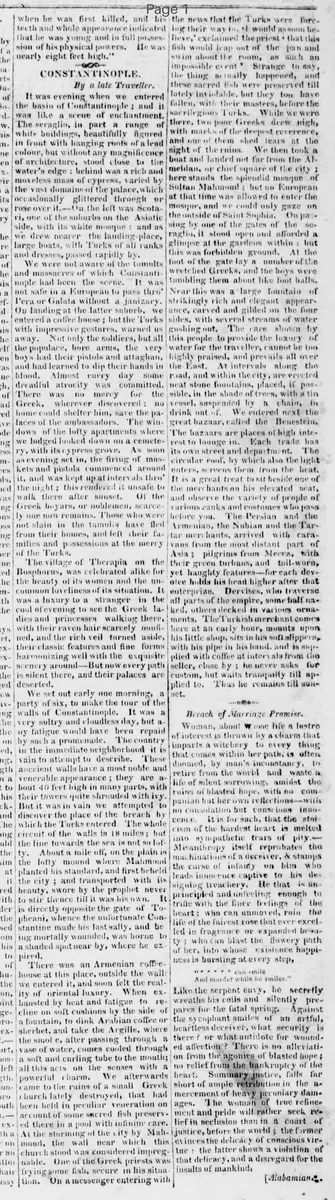
CONSTANTINOPLE.
By a late Traveller.
It was evening when we entered the basin of Constantinople; and it was like a scene of enchantment. The seraglio, in part a range of white buildings, beautifully figured in front with hanging roofs of a lead colour, but without any magnificence of architecture, stood close to the water's edge: behind was a rich and moveless mass of cypress, varied by the vast domains of the palace, which occasionally glittered through or rose over it.—On the left was Scutari, one of the suburbs on the Asiatic side, with its white mosque: and as we drew nearer the landing-place, large boats, with Turks of all ranks and dresses, passed rapidly by.
We were not aware of the tumults and massacres of which Constantinople had been the scene. It was not safe for a European to pass thro' Pera or Galata without a janizary. On landing at the latter suburb, we entered a coffee house; but the Turks with impressive gestures, warned us away. Not only the soldiers, but all the populace, bore arms, the very boys had their pistols and ataghan, and had learned to dip their hands in blood. Almost every day some dreadful atrocity was committed. There was no mercy for the Greek, wherever discovered: no home could shelter him, save the palaces of the ambassadors. The windows of the lofty apartments where we lodged looked down on a cemetery, with its cypress grove. As soon as evening set in, the firing of muskets and pistols commenced around it, and was kept up at intervals thro' the night; this rendered it unsafe to walk there after sunset. Of the Greek boyars, or noblemen, scarcely one now remains. Those who were not slain in the tumults have fled from their homes, and left their families and possessions at the mercy of the Turks.
The village of Therapia on the Bosphorus, was celebrated alike for the beauty of its women and the uncommon loveliness of its situation. It was a luxury to a stranger in the cool of evening to see the Greek ladies and princesses walking there, with their raven hair scarcely confined, and the rich veil turned aside, their classic features and fine forms harmonizing well with the exquisite scenery around—But now every path is silent there, and their palaces are deserted.
We set out early one morning, a party of six, to make the tour of the walls of Constantinople. It was a very sultry and cloudless day, but any fatigue would have been repaid by such a promenade. The country in the immediate neighborhood it is vain to attempt to describe. These ancient walls have a most noble and venerable appearance; they are about 40 feet high in many parts, with their towers quite shrouded with ivy. But it was in vain we attempted to discover the place of the breach by which the Turks entered. The whole circuit of the walls is 18 miles; but the line towards the sea is not so lofty. About a mile off, on the plain is the lofty mound where Mahomet planted his standard, and first beheld the city; and transported with its beauty, swore by the prophet never to stir thence till it was his own. It is directly opposite the gate of Topheani, whence the unfortunate Constantine made his last sally, and being mortally wounded, was borne to a shaded spot near by, where he expired.
There was an Armenian coffee-house at this place, outside the wall: we entered it, and soon felt the reality of oriental luxury. When exhausted by heat and fatigue to recline on soft cushions by the side of a fountain, to drink Arabian coffee or sherbet, and take the Argileh, where the smoke, after passing through a vase of water, comes cooled through a soft and curling tube to the mouth; all this acts on the senses with a powerful charm.
We afterwards came to the ruins of a small Greek church lately destroyed, that had been held in peculiar veneration on account of some sacred fish preserved there in a pool with infinite care. At the storming of the city by Mahomet, the wall near which this church stood was considered impregnable. One of the Greek priests was frying some fish, secure in his situation. On a messenger entering with the news that the Turks were forcing their way in. 'I would as soon believe,' exclaimed the priest ' that these fish would leap out of the pan and swim about the room, as such an impossible event' Strange to say, the thing actually happened, and these sacred fish were preserved till lately inviolable, but they too have fallen, with their masters, before the sacrilegious Turks. While we were there, two poor Greeks drew nigh, with marks of the deepest reverence, and one of them shed tears at the sight of the ruins. We then took a boat and landed not far from the Almeidan, or chief square of the city: here stands the splendid mosque of Sultan Mahmoud; but no European at that time was allowed to enter the mosque, and we could only gaze on the outside of Saint Sophia. On passing by one of the gates of the seraglio, it stood open and afforded a glimpse at the gardens within: but this was forbidden ground. At the foot of the gate lay a number of the wretched Greeks, and the boys were tumbling them about like foot balls. Near this was a large fountain of strikingly rich and elegant appearance, carved and gilded on the four sides, with several streams of water gushing out. The care shown by this people to provide the luxury of water for the traveller cannot be too highly praised, and prevails all over the East. At intervals along the road, and within the city, are erected neat stone fountains, placed, if possible, in the shade of trees, with a tin vessel, suspended by a chain, to drink out of. We entered next the great bazaar, called the Bezestein. The bazaars are places of high interest to lounge in. Each trade has its own street and department. The circular roof, by which also the light enters, screens them from the heat. It is a great treat to sit beside one of the merchants on his elevated seat, and observe the variety of people of various ranks and costumes who pass before you. The Persian and the Armenian, the Nubian and the Tartar merchants, arrived with caravans from the most distant part of Asia; pilgrims from Mecca, with their green turbans, and toil-worn, yet haughty features—for each devotee holds his head higher after that enterprize. Dervises, who traverse all parts of the empire, some half naked, others decked in various ornaments. The Turkish merchant comes here at an early hour, mounts upon his little shop, sits in his soft slippers, with his pipe in his hand, and is supplied with coffee at intervals from the seller, close by: he never asks for custom, but waits tranquilly till applied to. Thus he remains till sunset.
What sub-type of article is it?
What keywords are associated?
What entities or persons were involved?
Where did it happen?
Foreign News Details
Primary Location
Constantinople
Key Persons
Outcome
massacres and atrocities against greeks; greek boyars slain or fled, leaving families and possessions to turks; deserted palaces in therapia; greeks mistreated near seraglio.
Event Details
Traveler describes entering Constantinople amid tumults and massacres of Greeks, unsafe conditions requiring janizary escorts, armed populace, nightly firing near cemetery, deserted Therapia, tour of ancient walls with historical sites, oriental luxuries at coffee-house, ruins of venerated Greek church with sacred fish legend, views of mosques and seraglio, mistreatment of Greeks, elegant fountains, and vibrant bazaar with diverse merchants, pilgrims, and dervishes.