Thank you for visiting SNEWPapers!
Sign up free
Literary
June 20, 1826
The National Republican And Ohio Political Register
Cincinnati, Hamilton County, Ohio
What is this article about?
In this letter from Dover dated November 27, 1825, the author recounts a swift journey south through England from Gretna Green via Kendal, Liverpool, Preston, Ormskirk, Newcastle-under-Lyme, and Lichfield, en route to the continent. Observations include autumnal landscapes, agricultural life, manufacturing towns, canals, and historical sites like Lancaster Castle and Lichfield, birthplace of Dr. Johnson.
Clipping
OCR Quality
95%
Excellent
Full Text
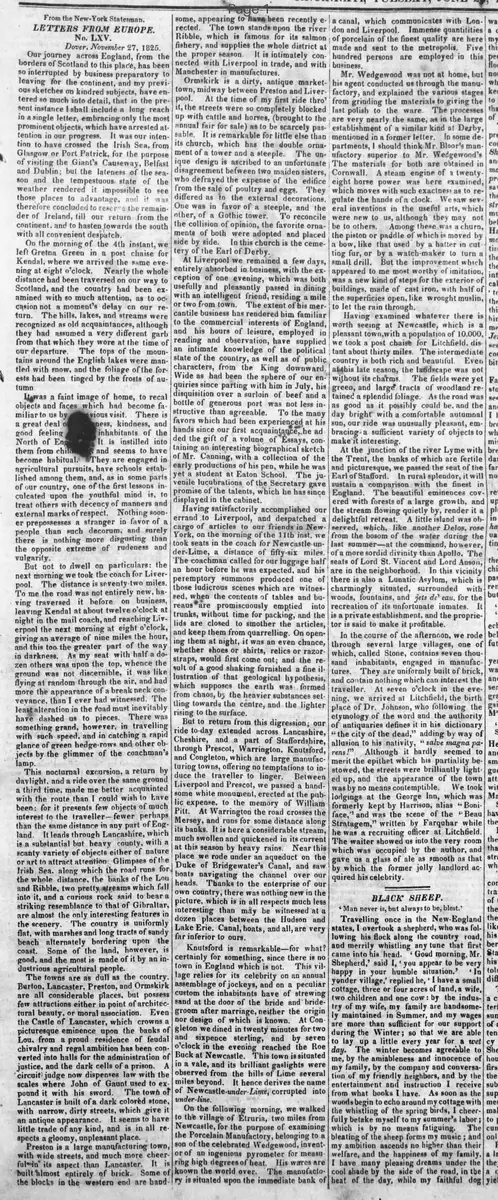
From the New-York Statesman.
LETTERS FROM EUROPE.
No. LXV.
Dover, November 27, 1825.
Our journey across England, from the borders of Scotland to this place, has been so interrupted by business preparatory to leaving for the continent, and my previous sketches on kindred subjects, have entered so much into detail, that in the present instance I shall include a long reach in a single letter, embracing only the most prominent objects, which have arrested attention in our progress. It was our intention to have crossed the Irish Sea, from Glasgow or Port Patrick, for the purpose of visiting the Giant's Causeway, Belfast and Dublin; but the lateness of the season and the tempestuous state of the weather rendered it impossible to see those places to advantage, and it was therefore concluded to reserve the remainder of Ireland till our return from the continent, and to hasten towards the south with all convenient despatch.
On the morning of the 4th instant, we left Gretna Green in a post chaise for Kendal, where we arrived the same evening at eight o'clock. Nearly the whole distance had been traversed on our way to Scotland, and the country had been examined with so much attention, as to occasion not a moment's delay on our return. The hills, lakes, and streams were recognized as old acquaintances, although they had assumed a very different garb from that which they wore at the time of our departure. The tops of the mountains around the English lakes were mantled with snow, and the foliage of the forests had been tinged by the frosts of autumn.
It was a faint image of home, to recall objects and faces which had become familiar to us by previous visit. There is a great deal of plainness, kindness, and good feeling among the inhabitants of the North of England. It is instilled into them from childhood and seems to have become habitual. They are engaged in agricultural pursuits, have schools established among them, and, as in some parts of our country, one of the first lessons inculcated upon the youthful mind is, to treat others with decency of manners and external marks of respect. Nothing sooner prepossesses a stranger in favor of a people than such decorum, and surely there is nothing more disgusting than the opposite extreme of rudeness and vulgarity.
But not to dwell on particulars: the next morning we took the coach for Liverpool. The distance is seventy-two miles. To me the road was not entirely new, having traversed it before on business, leaving Kendal at about twelve o'clock at night in the mail coach, and reaching Liverpool the next morning at eight o'clock, giving an average of nine miles the hour, and this too the greater part of the way in darkness. As my seat with half a dozen others was upon the top, whence the ground was not discernible, it was like flying at random through the air, and had more the appearance of a break-neck conveyance, than I ever had witnessed. The least alteration in the road must inevitably have dashed us to pieces. There was something grand, however, in travelling with such speed, and in catching a rapid glance of green hedge-rows and other objects by the glimmer of the coachman's lamp.
This nocturnal excursion, a return by daylight, and a ride over the same ground a third time, made me better acquainted with the route than I could wish to have been: for it presents few objects of much interest to the traveller—fewer perhaps than the same distance in any part of England. It leads through Lancashire, which is a substantial but heavy county, with a scanty variety of objects either of nature or art to attract attention: Glimpses of the Irish Sea, along which the road runs for the whole distance, the banks of the Lune and Ribble, two pretty streams which fall into it, and a curious rock said to bear a striking resemblance to that of Gibraltar, are almost the only interesting features in the scenery. The country is uniformly flat, with marshes and long tracts of sandy beach alternately bordering upon the coast. Some of the land, however, is good, and the most is made of it by an industrious agricultural people.
The towns are as dull as the country. Burton, Lancaster, Preston, and Ormskirk are all considerable places, but possess few attractions either in point of architectural beauty, or moral association. Even the Castle of Lancaster, which crowns a picturesque eminence upon the banks of the Lune, from a proud residence of feudal chivalry and regal ambition has been converted into halls for the administration of justice, and the dark cells of a prison. A circuit judge now dispenses law with the scales where John of Gaunt used to expound it with his sword. The town of Lancaster is built of a dark colored stone, with narrow, dirty streets, which give it an antique appearance. It seems to have little trade of any kind, and is in all respects a gloomy, unpleasant place.
Preston is a large manufacturing town, with wide streets, and much more cheerful in its aspect than Lancaster. It is built almost entirely of brick. Some of the blocks in the western end are handsome, appearing to have been recently erected. The town stands upon the river Ribble, which is famous for its salmon fishery, and supplies the whole district at the proper season. It is intimately connected with Liverpool in trade, and with Manchester in manufactures.
Ormskirk is a dirty, antique market town, midway between Preston and Liverpool. At the time of my first ride thro' it, the streets were so completely blocked up with cattle and horses, (brought to the annual fair for sale) as to be scarcely passable. It is remarkable for little else than its church, which has the double ornament of a tower and a steeple. The unique design is ascribed to an unfortunate disagreement between two maiden sisters, who defrayed the expense of the edifice from the sale of poultry and eggs. They differed as to the external decorations. One was in favor of a steeple, and the other, of a Gothic tower. To reconcile the collision of opinion, the favorite ornaments of both were adopted and placed side by side. In this church is the cemetery of the Earl of Derby.
At Liverpool we remained a few days, entirely absorbed in business, with the exception of one evening, which was both usefully and pleasantly passed in dining with an intelligent friend, residing a mile or two from town. The extent of his mercantile business has rendered him familiar to the commercial interests of England, and his hours of leisure, employed in reading and observation, have supplied an intimate knowledge of the political state of the country, as well as of public characters, from the King downward. Wide as had been the sphere of our enquiries since parting with him in July, his disquisition over a surloin of beef and a bottle of generous port was not less instructive than agreeable. To the many favors which had been experienced at his hands since our first acquaintance, he added the gift of a volume of Essays, containing an interesting biographical sketch of Mr. Canning, with a collection of the early productions of his pen, while he was yet a student at Eton School. The juvenile lucubrations of the Secretary gave promise of the talents, which he has since displayed in the cabinet.
Having satisfactorily accomplished our errand to Liverpool, and despatched a cargo of articles to our friends in New-York, on the morning of the 11th inst, we took seats in the coach for Newcastle-under-Lyme, a distance of fifty-six miles. The coachman called for our luggage half an hour before he was expected, and his peremptory summons produced one of those ludicrous scenes which are witnessed, when the contents of tables and bureaus are promiscuously emptied into trunks, without time for packing, and the lids are closed to smother the articles, and keep them from quarrelling. On opening them at night, it was an even chance, whether shoes or shirts, relics or razor-straps, would first come out; and the result of a good shaking furnished a fine illustration of that geological hypothesis, which supposes the earth was formed from chaos, by the heavier substances settling towards the centre, and the lighter rising to the surface.
But to return from this digression; our ride to-day extended across Lancashire, Cheshire, and a part of Staffordshire, through Prescot, Warrington, Knutsford, and Congleton, which are large manufacturing towns, offering no temptations to induce the traveller to linger. Between Liverpool and Prescot, we passed a handsome white monument, erected at the public expense, to the memory of William Pitt. At Warrington the road crosses the Mersey, and runs for some distance along its banks. It is here a considerable stream, much swollen and quickened in its current at this season by heavy rains. Near this place we rode under an aqueduct on the Duke of Bridgewater's Canal, and saw boats navigating the channel over our heads. Thanks to the enterprise of our own country, there was nothing new in the picture, which is in all respects much less interesting than may be witnessed at a dozen places between the Hudson and Lake Erie. Canal, boats, and all, are very far inferior to ours.
Knutsford is remarkable—for what? certainly for something, since there is no town in England which is not. This village relies for its celebrity on an annual assemblage of jockeys, and on a peculiar custom the inhabitants have of strewing sand at the door of the bride and bridegroom after marriage, neither the origin nor design of which is known. At Congleton we dined in twenty minutes for two and sixpence sterling, and by seven o'clock in the evening reached the Roe Buck at Newcastle. This town is situated in a vale, and its brilliant gaslights were observed from the hills of Lyme several miles beyond. It hence derives the name of Newcastle-under-Lyme, corrupted into under-line.
On the following morning, we walked to the village of Etruria, two miles from Newcastle, for the purpose of examining the Porcelain Manufactory, belonging to a son of the celebrated Wedgwood, inventor of an ingenious pyrometer for measuring high degrees of heat. His wares are known the world over. The manufactory is situated upon the immediate bank of a canal, which communicates with London and Liverpool. Immense quantities of porcelain of the finest quality are here made and sent to the metropolis. Five hundred persons are employed in this business.
Mr. Wedgwood was not at home, but his agent conducted us through the manufactory, and explained the various stages from grinding the materials to giving the last polish to the ware. The processes are very nearly the same, as in the large establishment of a similar kind at Derby, mentioned in a former letter. In some departments, I should think Mr. Bloor's manufactory superior to Mr. Wedgwood's. The materials for both are obtained in Cornwall. A steam engine of a twenty-eight horse power was here examined, which moves with such exactness as to regulate the hands of a clock. We saw several inventions in the useful arts, which were new to us, although they may not be to others. Among these was a churn, the piston or paddle of which is moved by a bow, like that used by a hatter in cutting fur, or by a watch-maker to turn a small drill. But the improvement which appeared to me most worthy of imitation, was a new kind of steps for the exterior of buildings, made of cast iron, with half of the superficies open, like wrought muslin, to let the rain through.
Having examined whatever there is worth seeing at Newcastle, which is a pleasant town, with a population of 10,000, we took a post chaise for Lichfield, distant about thirty miles. The intermediate country is both rich and beautiful. Even at this late season, the landscape was not without its charms. The fields were yet green, and large tracts of woodland retained a splendid foliage. As the road was as good as it possibly could be, and the day bright with a comfortable autumnal sun, our ride was unusually pleasant, embracing a sufficient variety of objects to make it interesting.
At the junction of the river Lyme with the Trent, the banks of which are fertile and picturesque, we passed the seat of the Earl of Stafford. In rural splendor, it will sustain a comparison with the finest in England. The beautiful eminences covered with forests of a large growth, and the stream flowing quietly by, render it a delightful retreat. A little island was observed, which, like another Delos, rose from the bosom of the water during the last summer—at the command, however, of a more sordid divinity than Apollo. The seats of Lord St. Vincent and Lord Anson, are in the neighborhood. In this vicinity there is also a Lunatic Asylum, which is charmingly situated, surrounded with woods, fountains, and jets d'eau, for the recreation of its unfortunate inmates. It is a private establishment, and the proprietor is said to make it profitable.
In the course of the afternoon, we rode through several large villages, one of which, called Stone, contains seven thousand inhabitants, engaged in manufactures. They are uniformly built of brick, and contain nothing which can interest the traveller. At seven o'clock in the evening, we arrived at Lichfield, the birth place of Dr. Johnson, who following the etymology of the word and the authority of antiquaries defines it in his dictionary "the city of the dead," adding by way of allusion to his nativity, "salve magna parens." Although it hardly seemed to merit the epithet which his partiality bestowed, the streets were brilliantly lighted up, and the appearance of the town was by no means contemptible. We took lodgings at the George Inn, which was formerly kept by Harrison, alias "Boniface," and was the scene of the "Beau Stratagem," written by Farquhar while he was a recruiting officer at Lichfield. The waiter showed us into the very room which was occupied by the author, and gave us a glass of ale as smooth as that by which the former jolly landlord acquired his celebrity.
LETTERS FROM EUROPE.
No. LXV.
Dover, November 27, 1825.
Our journey across England, from the borders of Scotland to this place, has been so interrupted by business preparatory to leaving for the continent, and my previous sketches on kindred subjects, have entered so much into detail, that in the present instance I shall include a long reach in a single letter, embracing only the most prominent objects, which have arrested attention in our progress. It was our intention to have crossed the Irish Sea, from Glasgow or Port Patrick, for the purpose of visiting the Giant's Causeway, Belfast and Dublin; but the lateness of the season and the tempestuous state of the weather rendered it impossible to see those places to advantage, and it was therefore concluded to reserve the remainder of Ireland till our return from the continent, and to hasten towards the south with all convenient despatch.
On the morning of the 4th instant, we left Gretna Green in a post chaise for Kendal, where we arrived the same evening at eight o'clock. Nearly the whole distance had been traversed on our way to Scotland, and the country had been examined with so much attention, as to occasion not a moment's delay on our return. The hills, lakes, and streams were recognized as old acquaintances, although they had assumed a very different garb from that which they wore at the time of our departure. The tops of the mountains around the English lakes were mantled with snow, and the foliage of the forests had been tinged by the frosts of autumn.
It was a faint image of home, to recall objects and faces which had become familiar to us by previous visit. There is a great deal of plainness, kindness, and good feeling among the inhabitants of the North of England. It is instilled into them from childhood and seems to have become habitual. They are engaged in agricultural pursuits, have schools established among them, and, as in some parts of our country, one of the first lessons inculcated upon the youthful mind is, to treat others with decency of manners and external marks of respect. Nothing sooner prepossesses a stranger in favor of a people than such decorum, and surely there is nothing more disgusting than the opposite extreme of rudeness and vulgarity.
But not to dwell on particulars: the next morning we took the coach for Liverpool. The distance is seventy-two miles. To me the road was not entirely new, having traversed it before on business, leaving Kendal at about twelve o'clock at night in the mail coach, and reaching Liverpool the next morning at eight o'clock, giving an average of nine miles the hour, and this too the greater part of the way in darkness. As my seat with half a dozen others was upon the top, whence the ground was not discernible, it was like flying at random through the air, and had more the appearance of a break-neck conveyance, than I ever had witnessed. The least alteration in the road must inevitably have dashed us to pieces. There was something grand, however, in travelling with such speed, and in catching a rapid glance of green hedge-rows and other objects by the glimmer of the coachman's lamp.
This nocturnal excursion, a return by daylight, and a ride over the same ground a third time, made me better acquainted with the route than I could wish to have been: for it presents few objects of much interest to the traveller—fewer perhaps than the same distance in any part of England. It leads through Lancashire, which is a substantial but heavy county, with a scanty variety of objects either of nature or art to attract attention: Glimpses of the Irish Sea, along which the road runs for the whole distance, the banks of the Lune and Ribble, two pretty streams which fall into it, and a curious rock said to bear a striking resemblance to that of Gibraltar, are almost the only interesting features in the scenery. The country is uniformly flat, with marshes and long tracts of sandy beach alternately bordering upon the coast. Some of the land, however, is good, and the most is made of it by an industrious agricultural people.
The towns are as dull as the country. Burton, Lancaster, Preston, and Ormskirk are all considerable places, but possess few attractions either in point of architectural beauty, or moral association. Even the Castle of Lancaster, which crowns a picturesque eminence upon the banks of the Lune, from a proud residence of feudal chivalry and regal ambition has been converted into halls for the administration of justice, and the dark cells of a prison. A circuit judge now dispenses law with the scales where John of Gaunt used to expound it with his sword. The town of Lancaster is built of a dark colored stone, with narrow, dirty streets, which give it an antique appearance. It seems to have little trade of any kind, and is in all respects a gloomy, unpleasant place.
Preston is a large manufacturing town, with wide streets, and much more cheerful in its aspect than Lancaster. It is built almost entirely of brick. Some of the blocks in the western end are handsome, appearing to have been recently erected. The town stands upon the river Ribble, which is famous for its salmon fishery, and supplies the whole district at the proper season. It is intimately connected with Liverpool in trade, and with Manchester in manufactures.
Ormskirk is a dirty, antique market town, midway between Preston and Liverpool. At the time of my first ride thro' it, the streets were so completely blocked up with cattle and horses, (brought to the annual fair for sale) as to be scarcely passable. It is remarkable for little else than its church, which has the double ornament of a tower and a steeple. The unique design is ascribed to an unfortunate disagreement between two maiden sisters, who defrayed the expense of the edifice from the sale of poultry and eggs. They differed as to the external decorations. One was in favor of a steeple, and the other, of a Gothic tower. To reconcile the collision of opinion, the favorite ornaments of both were adopted and placed side by side. In this church is the cemetery of the Earl of Derby.
At Liverpool we remained a few days, entirely absorbed in business, with the exception of one evening, which was both usefully and pleasantly passed in dining with an intelligent friend, residing a mile or two from town. The extent of his mercantile business has rendered him familiar to the commercial interests of England, and his hours of leisure, employed in reading and observation, have supplied an intimate knowledge of the political state of the country, as well as of public characters, from the King downward. Wide as had been the sphere of our enquiries since parting with him in July, his disquisition over a surloin of beef and a bottle of generous port was not less instructive than agreeable. To the many favors which had been experienced at his hands since our first acquaintance, he added the gift of a volume of Essays, containing an interesting biographical sketch of Mr. Canning, with a collection of the early productions of his pen, while he was yet a student at Eton School. The juvenile lucubrations of the Secretary gave promise of the talents, which he has since displayed in the cabinet.
Having satisfactorily accomplished our errand to Liverpool, and despatched a cargo of articles to our friends in New-York, on the morning of the 11th inst, we took seats in the coach for Newcastle-under-Lyme, a distance of fifty-six miles. The coachman called for our luggage half an hour before he was expected, and his peremptory summons produced one of those ludicrous scenes which are witnessed, when the contents of tables and bureaus are promiscuously emptied into trunks, without time for packing, and the lids are closed to smother the articles, and keep them from quarrelling. On opening them at night, it was an even chance, whether shoes or shirts, relics or razor-straps, would first come out; and the result of a good shaking furnished a fine illustration of that geological hypothesis, which supposes the earth was formed from chaos, by the heavier substances settling towards the centre, and the lighter rising to the surface.
But to return from this digression; our ride to-day extended across Lancashire, Cheshire, and a part of Staffordshire, through Prescot, Warrington, Knutsford, and Congleton, which are large manufacturing towns, offering no temptations to induce the traveller to linger. Between Liverpool and Prescot, we passed a handsome white monument, erected at the public expense, to the memory of William Pitt. At Warrington the road crosses the Mersey, and runs for some distance along its banks. It is here a considerable stream, much swollen and quickened in its current at this season by heavy rains. Near this place we rode under an aqueduct on the Duke of Bridgewater's Canal, and saw boats navigating the channel over our heads. Thanks to the enterprise of our own country, there was nothing new in the picture, which is in all respects much less interesting than may be witnessed at a dozen places between the Hudson and Lake Erie. Canal, boats, and all, are very far inferior to ours.
Knutsford is remarkable—for what? certainly for something, since there is no town in England which is not. This village relies for its celebrity on an annual assemblage of jockeys, and on a peculiar custom the inhabitants have of strewing sand at the door of the bride and bridegroom after marriage, neither the origin nor design of which is known. At Congleton we dined in twenty minutes for two and sixpence sterling, and by seven o'clock in the evening reached the Roe Buck at Newcastle. This town is situated in a vale, and its brilliant gaslights were observed from the hills of Lyme several miles beyond. It hence derives the name of Newcastle-under-Lyme, corrupted into under-line.
On the following morning, we walked to the village of Etruria, two miles from Newcastle, for the purpose of examining the Porcelain Manufactory, belonging to a son of the celebrated Wedgwood, inventor of an ingenious pyrometer for measuring high degrees of heat. His wares are known the world over. The manufactory is situated upon the immediate bank of a canal, which communicates with London and Liverpool. Immense quantities of porcelain of the finest quality are here made and sent to the metropolis. Five hundred persons are employed in this business.
Mr. Wedgwood was not at home, but his agent conducted us through the manufactory, and explained the various stages from grinding the materials to giving the last polish to the ware. The processes are very nearly the same, as in the large establishment of a similar kind at Derby, mentioned in a former letter. In some departments, I should think Mr. Bloor's manufactory superior to Mr. Wedgwood's. The materials for both are obtained in Cornwall. A steam engine of a twenty-eight horse power was here examined, which moves with such exactness as to regulate the hands of a clock. We saw several inventions in the useful arts, which were new to us, although they may not be to others. Among these was a churn, the piston or paddle of which is moved by a bow, like that used by a hatter in cutting fur, or by a watch-maker to turn a small drill. But the improvement which appeared to me most worthy of imitation, was a new kind of steps for the exterior of buildings, made of cast iron, with half of the superficies open, like wrought muslin, to let the rain through.
Having examined whatever there is worth seeing at Newcastle, which is a pleasant town, with a population of 10,000, we took a post chaise for Lichfield, distant about thirty miles. The intermediate country is both rich and beautiful. Even at this late season, the landscape was not without its charms. The fields were yet green, and large tracts of woodland retained a splendid foliage. As the road was as good as it possibly could be, and the day bright with a comfortable autumnal sun, our ride was unusually pleasant, embracing a sufficient variety of objects to make it interesting.
At the junction of the river Lyme with the Trent, the banks of which are fertile and picturesque, we passed the seat of the Earl of Stafford. In rural splendor, it will sustain a comparison with the finest in England. The beautiful eminences covered with forests of a large growth, and the stream flowing quietly by, render it a delightful retreat. A little island was observed, which, like another Delos, rose from the bosom of the water during the last summer—at the command, however, of a more sordid divinity than Apollo. The seats of Lord St. Vincent and Lord Anson, are in the neighborhood. In this vicinity there is also a Lunatic Asylum, which is charmingly situated, surrounded with woods, fountains, and jets d'eau, for the recreation of its unfortunate inmates. It is a private establishment, and the proprietor is said to make it profitable.
In the course of the afternoon, we rode through several large villages, one of which, called Stone, contains seven thousand inhabitants, engaged in manufactures. They are uniformly built of brick, and contain nothing which can interest the traveller. At seven o'clock in the evening, we arrived at Lichfield, the birth place of Dr. Johnson, who following the etymology of the word and the authority of antiquaries defines it in his dictionary "the city of the dead," adding by way of allusion to his nativity, "salve magna parens." Although it hardly seemed to merit the epithet which his partiality bestowed, the streets were brilliantly lighted up, and the appearance of the town was by no means contemptible. We took lodgings at the George Inn, which was formerly kept by Harrison, alias "Boniface," and was the scene of the "Beau Stratagem," written by Farquhar while he was a recruiting officer at Lichfield. The waiter showed us into the very room which was occupied by the author, and gave us a glass of ale as smooth as that by which the former jolly landlord acquired his celebrity.
What sub-type of article is it?
Epistolary
Journey Narrative
Essay
What themes does it cover?
Agriculture Rural
Commerce Trade
Social Manners
What keywords are associated?
Travel Letter
English Journey
Liverpool Commerce
Manufacturing Towns
Lichfield History
Wedgwood Porcelain
Agricultural Life
Northern England
Literary Details
Title
Letters From Europe. No. Lxv.
Subject
Journey Across England From Scotland To Dover, Preparatory To Crossing To The Continent
Key Lines
It Was A Faint Image Of Home, To Recall Objects And Faces Which Had Become Familiar To Us By Previous Visit.
There Is A Great Deal Of Plainness, Kindness, And Good Feeling Among The Inhabitants Of The North Of England.
The Juvenile Lucubrations Of The Secretary Gave Promise Of The Talents, Which He Has Since Displayed In The Cabinet.
Thanks To The Enterprise Of Our Own Country, There Was Nothing New In The Picture, Which Is In All Respects Much Less Interesting Than May Be Witnessed At A Dozen Places Between The Hudson And Lake Erie.
We Took Lodgings At The George Inn, Which Was Formerly Kept By Harrison, Alias "Boniface," And Was The Scene Of The "Beau Stratagem," Written By Farquhar While He Was A Recruiting Officer At Lichfield.