Thank you for visiting SNEWPapers!
Sign up free
Editorial
March 12, 1850
The Arkansas Banner
Little Rock, Pulaski County, Arkansas
What is this article about?
Ex-Governor G.M. Troup's letters from 1849 urge Southern states to prepare militarily against Northern abolitionist encroachments on slavery in territories, critiquing Lafayette's fanaticism, past compromises like Missouri, and advocating resistance or disunion if Congress restricts slave property rights.
Clipping
OCR Quality
95%
Excellent
Full Text
[From the Mobile Register.]
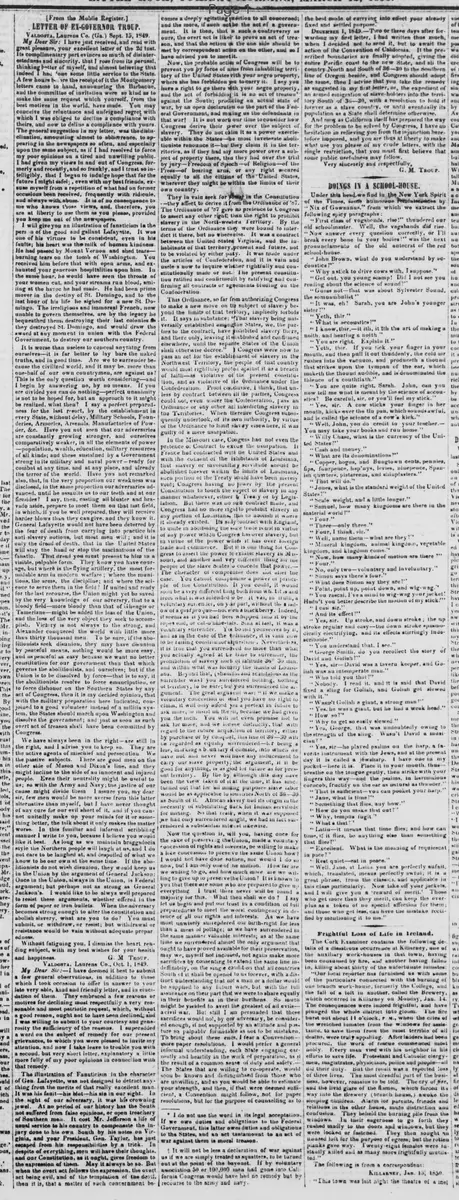
LETTER OF EX-GOVERNOR TROUP.
Valdosta, Laurens Co. (Ga.) Sept. 15, 1849.
My Dear Sir: I have just received, and read with great pleasure, your excellent letter of the 2d inst. Its complimentary part evinces so much of disinterestedness and sincerity, that I rose from its perusal, thinking better of myself, and almost believing that indeed I had done some little service to the State.
A few hours before the receipt of it the Montgomery letters came to hand, announcing the Barbecue, and the committee of invitation were so kind as to make the same request which yourself, from the best motives in the world, have made. You may conceive the reluctance and unfeigned regret with which I was obliged to decline a compliance with theirs, and now to decline a compliance with yours.
The general suggestion in my letter, was the disinclination, amounting almost to abhorrence, to appearing in the newspapers so often, and especially upon the same subject, as if I had resolved to force my poor opinions on a tired and unwilling public.
I had given my views in and out of Congress, formerly and recently, and so frankly, and I trust so intelligibly, that I began to indulge hope that for the future I might safely, even with my best friends, excuse myself from a repetition of what had on former occasions been received, frequently with ridicule, and always with abuse. It is of no consequence to me who knows those views, and, therefore, you are at liberty to use them as you please, provided you keep me out of the newspapers.
I will give you an illustration of fanaticism in the person of the good and gallant Lafayette. It was one of his virtues to be consistent, even in his faults; his heart was the milk of human kindness. He had passed by Mount Vernon and shed tears—burning tears on the tomb of Washington. You received him before that with open arms, and exhausted your generous hospitalities upon him. In the same hour, he would have seen the throats of your women cut, and your streams run blood, smiling at the havoc he had made. He had been prime mover in the destiny of St. Domingo, and to the last hour of his life he sighed for a new St. Domingo. The irreligious and immoral French, now unable to govern themselves, are by the legacy he bequeathed them, destroying their last colonies they destroyed St. Domingo, and would draw the sword at any moment in union with the Federal Government, to destroy our southern country.
It is worse than useless to conceal anything from ourselves—it is far better to lay bare the naked truths, and in good time. Are we to surrender because the civilized world, and it may be, more than one-half of our own countrymen, are against us?
This is the only question worth considering—and I begin by answering no, by no means. If you are divided you can do nothing—perfect unanimity is not to be hoped for, but an approach to it might be realized. What then? I say a perfect preparedness for the last resort, by the establishment in every State, without delay, Military Schools, Founderies, Armories, Arsenals, Manufactories of Powder, &c. Have you not seen that our adversaries are constantly growing stronger, and ourselves comparatively weaker, in all the elements of power—population, wealth, education, military resources of all kinds; and these sustained by a Government strong in its military and naval power—ready for combat at any time, and at any place, and already the terror of the world. Have you not remarked also, that, in the very proportion our weakness was disclosed, in the same proportion our adversaries advanced, until he assaults us to our teeth and at our firesides? I say, then, casting all bluster and bravado aside, prepare to meet them on that last field, in which, if you be well prepared, they will receive harder blows than they can give, and they know it.
General Lafayette would not have been deterred by the fear of death from carrying into practice his anti-slavery notions, but most men will; and it is only the dread of death, that in the United States will stay the hand or stop the machinations of the fanatic. That dread you must present to him in a visible, palpable form. They know you have courage, but where is the flying artillery, the most formidable arm in modern warfare; where the munitions, the arms, the discipline; and where the science to serve them in the field? If united and ready for the last recourse, the Union might yet be saved by the very knowledge of our adversary, that to a bloody field—more bloody than that of Gengis or Tamerlane—might be added the loss of the Union, and the loss of the very object they seek to accomplish. Victory is not always to the strong, and Alexander conquered the world with little more than thirty thousand men. To be sure, if the abolitionists seek disunion, they may have disunion by peaceful means, nothing would be more easy, and as peaceful as easy because we want no better constitution for our government than that which governs the abolitionists, and ourselves; but if the Union is to be dissolved by force—that is to say, if the abolitionists resolve to force emancipation, or to force dishonor on the Southern States by any act of Congress, then it is my decided opinion, that with the military preparation here indicated, conjoined to a good volunteer instead of a militia system, the States should march upon Washington and dissolve the government; and just as soon as such overt act of treason shall have been committed by Congress.
We have always been in the right—are still in the right, and I advise you to keep so. They are the active agents of mischief and persecution. We the passive subjects. There are good men on the other side of Mason and Dixon's line, and they might incline to the side of an innocent and injured people. Even their neutrality might be useful to us; so with the Army and Navy; the justice of our cause might divide them I assure you, my dear sir, few men would be more averse from this latter alternative than myself, but I have never thought of any cure for our evil short of it. and if you cannot unitedly make up your minds for it or something better, the talk about it only makes the matter worse. In this familiar and informal scribbling manner I write to you, because I believe you would like it best. As long as we maintain braggadocia style the Northern people will laugh at us, and I do not care to be laughed at, and despoiled of what we know to be our own at the same time. If the abolitionists do not wish disunion, they would keep us in the Union by the argument of General Jackson: Once in the Union, always in the Union, is Federal argument; but perhaps not as strong as General Jackson's. I would like to be always well prepared to resist these arguments, whether offered in the form of paper or iron bullets. When the adversary becomes strong enough to alter the constitution and abolish slavery, what are you to do? You must submit, or withdraw, or resist; but withdrawal or resistance would be vain without adequate preparedness.
Without fatiguing you, I dismiss the heart rending subject, with my best wishes for your health and happiness.
G. M. TROUP.
Valdosta, Laurens Co., Oct. 1, 1849.
My Dear Sir:—I have deemed it best to submit a few general observations, in addition to those which I took occasion to offer in answer to your late very able, kind and friendly letter, and in vindication of them. They embraced a few reasons or motives for declining most respectfully a very reasonable and most patriotic request, which, without a good reason, ought not to have been declined; and I was willing to submit to your courtesy and generosity the sufficiency of the reasons. I superadded a word on the subject of remedy for our present grievances, to which you were pleased to invite my attention, and now I take leave to trouble you with a second, but very short letter, explanatory a little more fully of my poor opinions in connection with that remedy.
The illustration of Fanaticism in the character of Gen. Lafayette, was not designed to detract anything from the merits of that really excellent man. It was his fault—his blot—his sin in our sight. In the sight of our adversary, it was his crowning jewel. At no period of our history has the South not suffered from false opinions, or open treachery of Southern men. It cost Mr. Jefferson a life of usual service to his country to compensate the injury done to his own South by his notes on Virginia, and your President, Gen. Taylor, has just escaped from his responsibilities by a trick. In despite of everything, men will have their thoughts, and our Constitution, as it ought, gives freedom to the expression of them. May it always be so. But when the overt act follows the expression, the overt act being evil, and of the temptation of the devil, then it is, that a matter of such concernment becomes a deeply agitating question to all concerned; and the more, if such act be the act of a government. It is then, that in such a controversy as ours, the overt act is likely to prove an act of treason, and that the action on the one side should be met by correspondent action on the other, and so I have advised you to meet it.
Now, the probable action of Congress will be to prevent you by force of arms from inhabiting territory of the United States with your negro property, where she has forbidden you to carry it. I say you have a right to go there with your negro property, and the act of forbidding it is an act of treason against the South; producing an actual state of war, by an open declaration on the part of the Federal Government, and making us the defendants in that war It is not worth our time to consider how Congress derive their power over the subject of slavery. They do not claim it as a power exercisable within the States—be most inveterate abolitionists renounce it—but they claim it in the territories, as if they had any more power over a subject of property there, than they had over the trial by jury—Freedom of Speech—of Religion—of the Press—of bearing arms, or any right secured equally to all the citizens of the United States, wherever they might be within the limits of their own country.
They in vain seek for power in the Constitution—they affect to derive it from the Ordinance of '87. The Ordinance of '87 gave no pretence to Congress to assert any other right; than the right to prohibit slavery in the North-west territory. By the terms of the Ordinance they were bound to interdict it there, but nowhere else. It was a contract between the United States Virginia, and the inhabitants of that territory, present and future, not to be violated by either party. It was made under the articles of Confederation, and it in vain and useless now to inquire whether rightfully and constitutionally made or not. The present constitution ratified and confirmed it by ratifying and confirming all contracts or agreements binding on the Confederation
This Ordinance, so far from authorizing Congress to make a new move on the subject of slavery beyond the limits of that territory, impliedly forbids it. It says in substance: 'That slavery being universally established amongst the States, we, the parties to the contract, have prohibited slavery there, and there only, leaving it established and confirmed elsewhere, until the separate States of the Union shall otherwise decree."
If Congress were now to pass an act for the establishment of slavery in the Northwest Territory, the people of that country would most rightfully protest against it as a breach of faith—as violative of the present constitution, and as violative of the Ordinance under the Confederation. Proof conclusive, I think, that unless by contract between all the parties, Congress could not, even under the Confederation, pass an Ordinance or any other act interdicting slavery in the Territories. When therefore Congress subsequently undertook, of its own authority, by virtue of the Ordinance to limit slavery elsewhere, it was guilty of a mere usurpation.
In the Missouri case, Congress had not even the pretence of Contract to excuse the usurpation. If France had contracted with the United States and with the consent of the inhabitants of Louisiana, that slavery or involuntary servitude should be abolished forever within the limits of Louisiana, such portion of the Treaty would have been merely void; Congress having no power by the present Constitution to touch the subject of slavery in any manner whatsoever, either by Treaty or by Legislation. But there was no such contract made, and Congress had no more right to prohibit slavery in any portion of Louisiana, than to abolish it where it already existed. Its only contract with England, to unite in abolishing the slave trade is not in virtue of any power which Congress has over slavery, but in virtue of the power which it has over foreign trade and commerce. But it is one thing for Congress to assert the power to exclude slavery in Missouri, and another and very different thing for the people of the slave States to concede that power.— The character of compromise does not alter the case. You cannot compromise a power or principle of the Constitution. If you could, it would soon be a very different thing both from what it is and from what it was intended to be. it was, in truth, a voluntary surrender, on your part, without the quid pro quo—but even a blackberry. Indeed, it seems as if you had been whipped into it by the ropes end, or cat-o nine-tails. Such at last, it was a voluntary surrender. You bound yourselves by it, and as in the case of the ordinance, it is vain now to be raising constitutional questions. Nevertheless, it is true that you surrendered no more than what you actually agreed at the line to surrender, the prohibition of slavery north of latitude 36 30 min. and within what was formerly the limits of Louisiana. Beyond that, (shameful and scandalous as the surrender was) you surrendered nothing, nothing of territory, to be sure; but you surrendered the argument. The great argument was: "If we make a voluntary concession of what you have no right to claim, it will only afford you a pretext in future to ask more; to insist on the right, because we had given you the inch. You will not even promise not to ask for more, and we insist distinctly, that with regard to the future acquisition of territory, either by purchase or by conquest, this line of 36-30 will be regarded as equally surrendered—for being a line, marking a boundary of climate, into which we have not and never will have any inducement to carry our slave property, the argument, if it be good for anything, is as good for future as for present territory. By the by although this may have been the view taken of it at the time, it has since turned out that for mining purposes slave labor would be as applicable to your territories North of 36-30 as South of it. "African slavery had its origin in the necessity of substituting Black for Indian servitude for mining. So that really, when it was supposed we had only surrendered a right, we had in fact surrendered a substantial interest likewise.
Now the question is, will you, having once for the sake of preserving the Union, made a voluntary concession of rights and interests, be willing to make a like concession to preserve the same Union now? I would not have done so then, nor would I do so now, but I am only one of ten million. How far are we willing to go, and how much more are we willing to give up to preserve the Union? It is known to you that there are some who are prepared to give up everything I trust there never will be found a majority for this. - What then shall we do? I say let us begin and put our trust in a condition of full preparedness to meet the worst contingency in defence of all our rights and interests. As we have most unwisely surrendered our birth-right for less than a mess of pottage; as we have surrendered in the same manner valuable interests; as at the same time we surrendered almost the only argument that ought to have proved available for their preservation, may we, myself not included, not again make more sacrifices by consenting to extend the same line indefinitely, on the single condition that all countries South of it shall be opened to us forever, with a distinct understanding that not a man or a dollar would be supplied to any future wars, but with the full assurance on their part that we were to share equally in their benefits as in their burdens So much might be yielded to avert the greatest of all evils— a civil war. But still I am persuaded that these sacrifices would not, by our adversary, be considered enough, if not supported by an attitude and posture so palpably formidable as not to be mistaken.
To bring about these ends, I fear a Convention—more paper resolutions. I would prefer a general informal understanding, each State engaging earnestly and heartily in the work of preparation, as the result of a common sense of duty and safety.— The States that are willing to co-operate, would soon be known and distinguished from those who are unwilling, and so you would be able to estimate your strength, and then, if that were deemed sufficient, a Convention might follow, not for paper resolutions, but for the purpose of counselling as to the best mode of carrying into effect your already fixed and settled purpose.
I do not use the word in its legal acceptation. If we owe duties and obligations to the Federal Government, this latter owes duties and obligations to the States, and an act tantamount to an act of war against them is moral treason.
It will not be less a declaration of war against us if we are simply treated as squatters, to be turned out at the point of the bayonet. If by voluntary association 50 or 100,000 men had gone into California Congress would have had no remedy but by recourse to the army and navy.
the best mode of carrying into effect your already fixed and settled purpose.
December 1, 1849.—Two or three days after forwarding my first letter, I had written three much, when I decided not to send it, but to await the action of the Convention of California. If the prescribed boundaries are finally adopted, giving the entire Pacific coast to the new State, and all the country North and South of 36—30 to the Southern line of Oregon beside, and Congress should adopt the same, then I advise that you take the remedy as suggested in my first letter, or, the expedient of an armed emigration of slave-holders into the territory South of 36-30, with a resolution to hold it forever as a slave country. or until eventually its population as a State shall determine otherwise.
And now as California itself has prepared the way for the problem to be solved by Congress, I have no hesitation in relieving you from the injunction heretofore imposed, and you are thus at liberty to make what use you please of my crude letters, with the single restriction, that you must first believe that some public usefulness may follow.
Very sincerely and respectfully,
G. M. TROUP.
LETTER OF EX-GOVERNOR TROUP.
Valdosta, Laurens Co. (Ga.) Sept. 15, 1849.
My Dear Sir: I have just received, and read with great pleasure, your excellent letter of the 2d inst. Its complimentary part evinces so much of disinterestedness and sincerity, that I rose from its perusal, thinking better of myself, and almost believing that indeed I had done some little service to the State.
A few hours before the receipt of it the Montgomery letters came to hand, announcing the Barbecue, and the committee of invitation were so kind as to make the same request which yourself, from the best motives in the world, have made. You may conceive the reluctance and unfeigned regret with which I was obliged to decline a compliance with theirs, and now to decline a compliance with yours.
The general suggestion in my letter, was the disinclination, amounting almost to abhorrence, to appearing in the newspapers so often, and especially upon the same subject, as if I had resolved to force my poor opinions on a tired and unwilling public.
I had given my views in and out of Congress, formerly and recently, and so frankly, and I trust so intelligibly, that I began to indulge hope that for the future I might safely, even with my best friends, excuse myself from a repetition of what had on former occasions been received, frequently with ridicule, and always with abuse. It is of no consequence to me who knows those views, and, therefore, you are at liberty to use them as you please, provided you keep me out of the newspapers.
I will give you an illustration of fanaticism in the person of the good and gallant Lafayette. It was one of his virtues to be consistent, even in his faults; his heart was the milk of human kindness. He had passed by Mount Vernon and shed tears—burning tears on the tomb of Washington. You received him before that with open arms, and exhausted your generous hospitalities upon him. In the same hour, he would have seen the throats of your women cut, and your streams run blood, smiling at the havoc he had made. He had been prime mover in the destiny of St. Domingo, and to the last hour of his life he sighed for a new St. Domingo. The irreligious and immoral French, now unable to govern themselves, are by the legacy he bequeathed them, destroying their last colonies they destroyed St. Domingo, and would draw the sword at any moment in union with the Federal Government, to destroy our southern country.
It is worse than useless to conceal anything from ourselves—it is far better to lay bare the naked truths, and in good time. Are we to surrender because the civilized world, and it may be, more than one-half of our own countrymen, are against us?
This is the only question worth considering—and I begin by answering no, by no means. If you are divided you can do nothing—perfect unanimity is not to be hoped for, but an approach to it might be realized. What then? I say a perfect preparedness for the last resort, by the establishment in every State, without delay, Military Schools, Founderies, Armories, Arsenals, Manufactories of Powder, &c. Have you not seen that our adversaries are constantly growing stronger, and ourselves comparatively weaker, in all the elements of power—population, wealth, education, military resources of all kinds; and these sustained by a Government strong in its military and naval power—ready for combat at any time, and at any place, and already the terror of the world. Have you not remarked also, that, in the very proportion our weakness was disclosed, in the same proportion our adversaries advanced, until he assaults us to our teeth and at our firesides? I say, then, casting all bluster and bravado aside, prepare to meet them on that last field, in which, if you be well prepared, they will receive harder blows than they can give, and they know it.
General Lafayette would not have been deterred by the fear of death from carrying into practice his anti-slavery notions, but most men will; and it is only the dread of death, that in the United States will stay the hand or stop the machinations of the fanatic. That dread you must present to him in a visible, palpable form. They know you have courage, but where is the flying artillery, the most formidable arm in modern warfare; where the munitions, the arms, the discipline; and where the science to serve them in the field? If united and ready for the last recourse, the Union might yet be saved by the very knowledge of our adversary, that to a bloody field—more bloody than that of Gengis or Tamerlane—might be added the loss of the Union, and the loss of the very object they seek to accomplish. Victory is not always to the strong, and Alexander conquered the world with little more than thirty thousand men. To be sure, if the abolitionists seek disunion, they may have disunion by peaceful means, nothing would be more easy, and as peaceful as easy because we want no better constitution for our government than that which governs the abolitionists, and ourselves; but if the Union is to be dissolved by force—that is to say, if the abolitionists resolve to force emancipation, or to force dishonor on the Southern States by any act of Congress, then it is my decided opinion, that with the military preparation here indicated, conjoined to a good volunteer instead of a militia system, the States should march upon Washington and dissolve the government; and just as soon as such overt act of treason shall have been committed by Congress.
We have always been in the right—are still in the right, and I advise you to keep so. They are the active agents of mischief and persecution. We the passive subjects. There are good men on the other side of Mason and Dixon's line, and they might incline to the side of an innocent and injured people. Even their neutrality might be useful to us; so with the Army and Navy; the justice of our cause might divide them I assure you, my dear sir, few men would be more averse from this latter alternative than myself, but I have never thought of any cure for our evil short of it. and if you cannot unitedly make up your minds for it or something better, the talk about it only makes the matter worse. In this familiar and informal scribbling manner I write to you, because I believe you would like it best. As long as we maintain braggadocia style the Northern people will laugh at us, and I do not care to be laughed at, and despoiled of what we know to be our own at the same time. If the abolitionists do not wish disunion, they would keep us in the Union by the argument of General Jackson: Once in the Union, always in the Union, is Federal argument; but perhaps not as strong as General Jackson's. I would like to be always well prepared to resist these arguments, whether offered in the form of paper or iron bullets. When the adversary becomes strong enough to alter the constitution and abolish slavery, what are you to do? You must submit, or withdraw, or resist; but withdrawal or resistance would be vain without adequate preparedness.
Without fatiguing you, I dismiss the heart rending subject, with my best wishes for your health and happiness.
G. M. TROUP.
Valdosta, Laurens Co., Oct. 1, 1849.
My Dear Sir:—I have deemed it best to submit a few general observations, in addition to those which I took occasion to offer in answer to your late very able, kind and friendly letter, and in vindication of them. They embraced a few reasons or motives for declining most respectfully a very reasonable and most patriotic request, which, without a good reason, ought not to have been declined; and I was willing to submit to your courtesy and generosity the sufficiency of the reasons. I superadded a word on the subject of remedy for our present grievances, to which you were pleased to invite my attention, and now I take leave to trouble you with a second, but very short letter, explanatory a little more fully of my poor opinions in connection with that remedy.
The illustration of Fanaticism in the character of Gen. Lafayette, was not designed to detract anything from the merits of that really excellent man. It was his fault—his blot—his sin in our sight. In the sight of our adversary, it was his crowning jewel. At no period of our history has the South not suffered from false opinions, or open treachery of Southern men. It cost Mr. Jefferson a life of usual service to his country to compensate the injury done to his own South by his notes on Virginia, and your President, Gen. Taylor, has just escaped from his responsibilities by a trick. In despite of everything, men will have their thoughts, and our Constitution, as it ought, gives freedom to the expression of them. May it always be so. But when the overt act follows the expression, the overt act being evil, and of the temptation of the devil, then it is, that a matter of such concernment becomes a deeply agitating question to all concerned; and the more, if such act be the act of a government. It is then, that in such a controversy as ours, the overt act is likely to prove an act of treason, and that the action on the one side should be met by correspondent action on the other, and so I have advised you to meet it.
Now, the probable action of Congress will be to prevent you by force of arms from inhabiting territory of the United States with your negro property, where she has forbidden you to carry it. I say you have a right to go there with your negro property, and the act of forbidding it is an act of treason against the South; producing an actual state of war, by an open declaration on the part of the Federal Government, and making us the defendants in that war It is not worth our time to consider how Congress derive their power over the subject of slavery. They do not claim it as a power exercisable within the States—be most inveterate abolitionists renounce it—but they claim it in the territories, as if they had any more power over a subject of property there, than they had over the trial by jury—Freedom of Speech—of Religion—of the Press—of bearing arms, or any right secured equally to all the citizens of the United States, wherever they might be within the limits of their own country.
They in vain seek for power in the Constitution—they affect to derive it from the Ordinance of '87. The Ordinance of '87 gave no pretence to Congress to assert any other right; than the right to prohibit slavery in the North-west territory. By the terms of the Ordinance they were bound to interdict it there, but nowhere else. It was a contract between the United States Virginia, and the inhabitants of that territory, present and future, not to be violated by either party. It was made under the articles of Confederation, and it in vain and useless now to inquire whether rightfully and constitutionally made or not. The present constitution ratified and confirmed it by ratifying and confirming all contracts or agreements binding on the Confederation
This Ordinance, so far from authorizing Congress to make a new move on the subject of slavery beyond the limits of that territory, impliedly forbids it. It says in substance: 'That slavery being universally established amongst the States, we, the parties to the contract, have prohibited slavery there, and there only, leaving it established and confirmed elsewhere, until the separate States of the Union shall otherwise decree."
If Congress were now to pass an act for the establishment of slavery in the Northwest Territory, the people of that country would most rightfully protest against it as a breach of faith—as violative of the present constitution, and as violative of the Ordinance under the Confederation. Proof conclusive, I think, that unless by contract between all the parties, Congress could not, even under the Confederation, pass an Ordinance or any other act interdicting slavery in the Territories. When therefore Congress subsequently undertook, of its own authority, by virtue of the Ordinance to limit slavery elsewhere, it was guilty of a mere usurpation.
In the Missouri case, Congress had not even the pretence of Contract to excuse the usurpation. If France had contracted with the United States and with the consent of the inhabitants of Louisiana, that slavery or involuntary servitude should be abolished forever within the limits of Louisiana, such portion of the Treaty would have been merely void; Congress having no power by the present Constitution to touch the subject of slavery in any manner whatsoever, either by Treaty or by Legislation. But there was no such contract made, and Congress had no more right to prohibit slavery in any portion of Louisiana, than to abolish it where it already existed. Its only contract with England, to unite in abolishing the slave trade is not in virtue of any power which Congress has over slavery, but in virtue of the power which it has over foreign trade and commerce. But it is one thing for Congress to assert the power to exclude slavery in Missouri, and another and very different thing for the people of the slave States to concede that power.— The character of compromise does not alter the case. You cannot compromise a power or principle of the Constitution. If you could, it would soon be a very different thing both from what it is and from what it was intended to be. it was, in truth, a voluntary surrender, on your part, without the quid pro quo—but even a blackberry. Indeed, it seems as if you had been whipped into it by the ropes end, or cat-o nine-tails. Such at last, it was a voluntary surrender. You bound yourselves by it, and as in the case of the ordinance, it is vain now to be raising constitutional questions. Nevertheless, it is true that you surrendered no more than what you actually agreed at the line to surrender, the prohibition of slavery north of latitude 36 30 min. and within what was formerly the limits of Louisiana. Beyond that, (shameful and scandalous as the surrender was) you surrendered nothing, nothing of territory, to be sure; but you surrendered the argument. The great argument was: "If we make a voluntary concession of what you have no right to claim, it will only afford you a pretext in future to ask more; to insist on the right, because we had given you the inch. You will not even promise not to ask for more, and we insist distinctly, that with regard to the future acquisition of territory, either by purchase or by conquest, this line of 36-30 will be regarded as equally surrendered—for being a line, marking a boundary of climate, into which we have not and never will have any inducement to carry our slave property, the argument, if it be good for anything, is as good for future as for present territory. By the by although this may have been the view taken of it at the time, it has since turned out that for mining purposes slave labor would be as applicable to your territories North of 36-30 as South of it. "African slavery had its origin in the necessity of substituting Black for Indian servitude for mining. So that really, when it was supposed we had only surrendered a right, we had in fact surrendered a substantial interest likewise.
Now the question is, will you, having once for the sake of preserving the Union, made a voluntary concession of rights and interests, be willing to make a like concession to preserve the same Union now? I would not have done so then, nor would I do so now, but I am only one of ten million. How far are we willing to go, and how much more are we willing to give up to preserve the Union? It is known to you that there are some who are prepared to give up everything I trust there never will be found a majority for this. - What then shall we do? I say let us begin and put our trust in a condition of full preparedness to meet the worst contingency in defence of all our rights and interests. As we have most unwisely surrendered our birth-right for less than a mess of pottage; as we have surrendered in the same manner valuable interests; as at the same time we surrendered almost the only argument that ought to have proved available for their preservation, may we, myself not included, not again make more sacrifices by consenting to extend the same line indefinitely, on the single condition that all countries South of it shall be opened to us forever, with a distinct understanding that not a man or a dollar would be supplied to any future wars, but with the full assurance on their part that we were to share equally in their benefits as in their burdens So much might be yielded to avert the greatest of all evils— a civil war. But still I am persuaded that these sacrifices would not, by our adversary, be considered enough, if not supported by an attitude and posture so palpably formidable as not to be mistaken.
To bring about these ends, I fear a Convention—more paper resolutions. I would prefer a general informal understanding, each State engaging earnestly and heartily in the work of preparation, as the result of a common sense of duty and safety.— The States that are willing to co-operate, would soon be known and distinguished from those who are unwilling, and so you would be able to estimate your strength, and then, if that were deemed sufficient, a Convention might follow, not for paper resolutions, but for the purpose of counselling as to the best mode of carrying into effect your already fixed and settled purpose.
I do not use the word in its legal acceptation. If we owe duties and obligations to the Federal Government, this latter owes duties and obligations to the States, and an act tantamount to an act of war against them is moral treason.
It will not be less a declaration of war against us if we are simply treated as squatters, to be turned out at the point of the bayonet. If by voluntary association 50 or 100,000 men had gone into California Congress would have had no remedy but by recourse to the army and navy.
the best mode of carrying into effect your already fixed and settled purpose.
December 1, 1849.—Two or three days after forwarding my first letter, I had written three much, when I decided not to send it, but to await the action of the Convention of California. If the prescribed boundaries are finally adopted, giving the entire Pacific coast to the new State, and all the country North and South of 36—30 to the Southern line of Oregon beside, and Congress should adopt the same, then I advise that you take the remedy as suggested in my first letter, or, the expedient of an armed emigration of slave-holders into the territory South of 36-30, with a resolution to hold it forever as a slave country. or until eventually its population as a State shall determine otherwise.
And now as California itself has prepared the way for the problem to be solved by Congress, I have no hesitation in relieving you from the injunction heretofore imposed, and you are thus at liberty to make what use you please of my crude letters, with the single restriction, that you must first believe that some public usefulness may follow.
Very sincerely and respectfully,
G. M. TROUP.
What sub-type of article is it?
Slavery Abolition
Constitutional
War Or Peace
What keywords are associated?
Slavery Defense
Southern Rights
Military Preparation
Abolitionism
Territorial Compromise
Disunion Threat
Congressional Usurpation
Missouri Compromise
What entities or persons were involved?
G. M. Troup
Lafayette
Washington
Jefferson
Gen. Taylor
Congress
Southern States
Abolitionists
General Jackson
Editorial Details
Primary Topic
Southern Military Preparation Against Abolitionist Threats To Slavery In Territories
Stance / Tone
Defensive Pro Southern Rights, Advocating Armed Resistance And Preparation
Key Figures
G. M. Troup
Lafayette
Washington
Jefferson
Gen. Taylor
Congress
Southern States
Abolitionists
General Jackson
Key Arguments
Southerners Must Prepare Militarily With Schools, Armories, And Powder Manufactories To Deter Northern Aggression.
Critique Of Lafayette's Anti Slavery Fanaticism As Destructive.
Congressional Restrictions On Slavery In Territories Constitute Treason And War Against The South.
Northwest Ordinance And Missouri Compromise Were Usurpations; No Constitutional Power Over Slavery In Territories.
Past Compromises Surrendered Rights Without Gain; Further Concessions Unwise Without Military Readiness.
If Congress Forces Emancipation Or Dishonor, Southern States Should March On Washington To Dissolve The Government.
Prefer Peaceful Disunion If Sought, But Resist Forced Emancipation With Force.
Armed Emigration To Hold Slave Territories South Of 36°30' As Alternative.