Thank you for visiting SNEWPapers!
Sign up free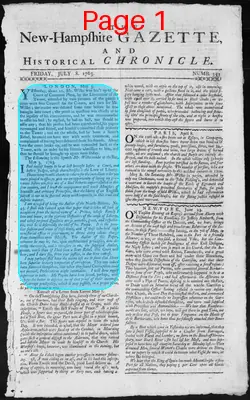
The New Hampshire Gazette And Historical Chronicle
Portsmouth, Greenland, Rockingham County, New Hampshire
What is this article about?
In London on May 4, 1763, Mr. Wilkes appeared before the Court of Common Pleas challenging the legality of his commitment to the Tower for allegedly authoring North-Briton No. 45. He refused bail, complained of harsh treatment, and was remanded until the next Friday. Excerpt of his May 3 speech defending liberty and accusing ministers included.
Clipping
OCR Quality
Full Text
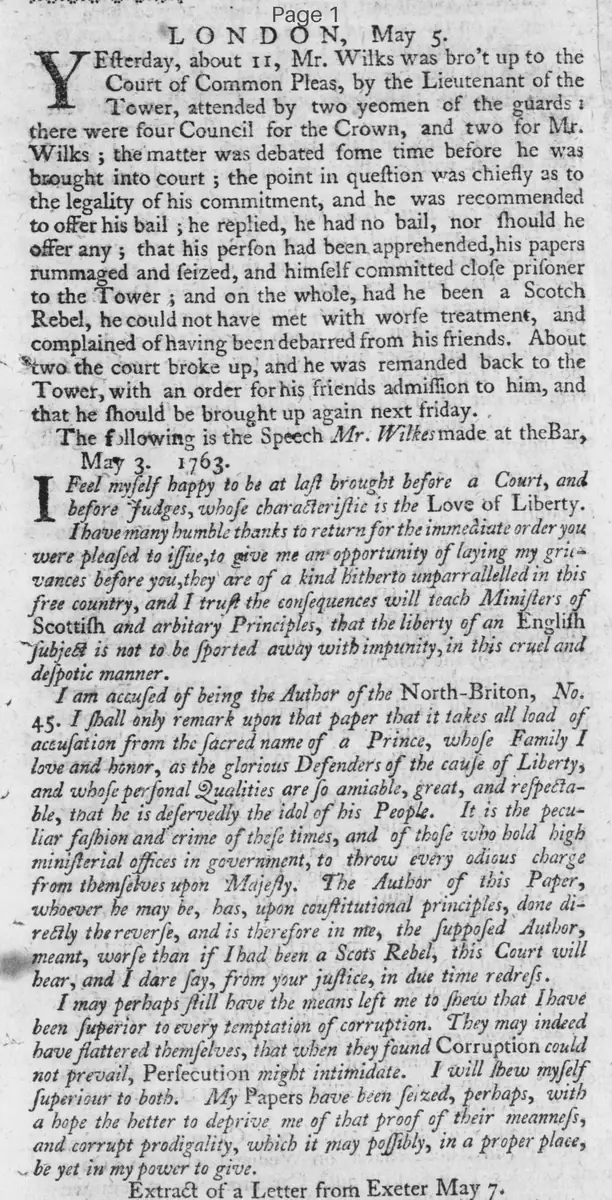
Yesterday, about noon, Mr. Wilkes was brought up to the Court of Common Pleas, by the Lieutenant of the Tower, attended by two yeomen of the guards: There were four Counsel for the Crown, and two for Mr. Wilkes; the matter was debated some time before he was brought into court; the point in question was chiefly as to the legality of his commitment, and he was recommended to offer his bail; he replied, he had no bail; nor should he offer any; that his person had been apprehended, his papers rummaged and seized: and himself committed close prisoner to the Tower: and on the whole, had he been a Scotch Rebel, he could not have met with worse treatment, and complained of having been debarred from his friends. About two the court broke up, and he was remanded back to the Tower, with an order for his friends admission to him, and that he should be brought up again next Friday.
The following is the Speech Mr. Wilkes made at the Bar, May 3, 1763.
I feel myself happy to be at last brought before a Court, and before Judges, whose characteristic is the Love of Liberty. I have many humble thanks to return for the immediate order you were pleased to issue, to give me an opportunity of laying my grievances before you, they are of a kind hitherto unparallelled in this free country, and I trust the consequences will teach Ministers of Scottish and arbitrary Principles, that the liberty of an English Subject is not to be sported away with impunity, in this cruel and despotic manner.
I am accused of being the Author of the North-Briton, No. 45. I shall only remark upon that paper that it takes all load of accusation from the sacred name of a Prince, whose Family I love and honor, as the glorious Defenders of the cause of Liberty; and whose personal Qualities are so amiable, great, and respectable, that he is deservedly the idol of his People. It is the peculiar fashion and crime of these times, and of those who hold high ministerial offices in government, to throw every odious charge from themselves upon Majesty. The Author of this Paper, whoever he may be, has, upon constitutional principles, done directly the reverse, and is therefore in me, the supposed Author, meant, worse than if I had been a Scots Rebel, this Court will hear, and I dare say, from your justice, in due time redress.
I may perhaps still have the means left me to shew that I have been superior to every temptation of corruption. They may indeed have flattered themselves, that when they found Corruption could not prevail, Persecution might intimidate. I will shew myself superiour to both. My Papers have been seized, perhaps, with a hope the better to deprive me of that proof of their meanness, and corrupt prodigality, which it may possibly, in a proper place, be yet in my power to give.
What sub-type of article is it?
What keywords are associated?
What entities or persons were involved?
Where did it happen?
Foreign News Details
Primary Location
London
Event Date
May 3, 1763
Key Persons
Outcome
remanded back to the tower, with an order for his friends admission to him, and that he should be brought up again next friday
Event Details
Yesterday, about noon, Mr. Wilkes was brought up to the Court of Common Pleas, by the Lieutenant of the Tower, attended by two yeomen of the guards: There were four Counsel for the Crown, and two for Mr. Wilkes; the matter was debated some time before he was brought into court; the point in question was chiefly as to the legality of his commitment, and he was recommended to offer his bail; he replied, he had no bail; nor should he offer any; that his person had been apprehended, his papers rummaged and seized: and himself committed close prisoner to the Tower: and on the whole, had he been a Scotch Rebel, he could not have met with worse treatment, and complained of having been debarred from his friends. About two the court broke up. The following is the Speech Mr. Wilkes made at the Bar, May 3, 1763: I feel myself happy to be at last brought before a Court, and before Judges, whose characteristic is the Love of Liberty. I have many humble thanks to return for the immediate order you were pleased to issue, to give me an opportunity of laying my grievances before you, they are of a kind hitherto unparallelled in this free country, and I trust the consequences will teach Ministers of Scottish and arbitrary Principles, that the liberty of an English Subject is not to be sported away with impunity, in this cruel and despotic manner. I am accused of being the Author of the North-Briton, No. 45. I shall only remark upon that paper that it takes all load of accusation from the sacred name of a Prince, whose Family I love and honor, as the glorious Defenders of the cause of Liberty; and whose personal Qualities are so amiable, great, and respectable, that he is deservedly the idol of his People. It is the peculiar fashion and crime of these times, and of those who hold high ministerial offices in government, to throw every odious charge from themselves upon Majesty. The Author of this Paper, whoever he may be, has, upon constitutional principles, done directly the reverse, and is therefore in me, the supposed Author, meant, worse than if I had been a Scots Rebel, this Court will hear, and I dare say, from your justice, in due time redress. I may perhaps still have the means left me to shew that I have been superior to every temptation of corruption. They may indeed have flattered themselves, that when they found Corruption could not prevail, Persecution might intimidate. I will shew myself superiour to both. My Papers have been seized, perhaps, with a hope the better to deprive me of that proof of their meanness, and corrupt prodigality, which it may possibly, in a proper place, be yet in my power to give.