Thank you for visiting SNEWPapers!
Sign up free
Norfolk Gazette And Publick Ledger
Norfolk, Virginia
What is this article about?
Trial of William Cobbett in the Court of King's Bench on May 24 for libels against the Irish government, including criticisms of Lord Lieutenant Earl of Hardwicke, Lord Chancellor Redesdale, Justice Charles Osborne, and Secretary Marsden, published in Cobbett's Weekly Political Register in 1803.
Merged-components note: These components continue the article on the trial of William Cobbett for libels against the Irish government, with sequential reading orders and text flowing directly from one to the other; relabeled to foreign_news as it fits international political reporting better than editorial.
Clippings
1 of 2
OCR Quality
Full Text
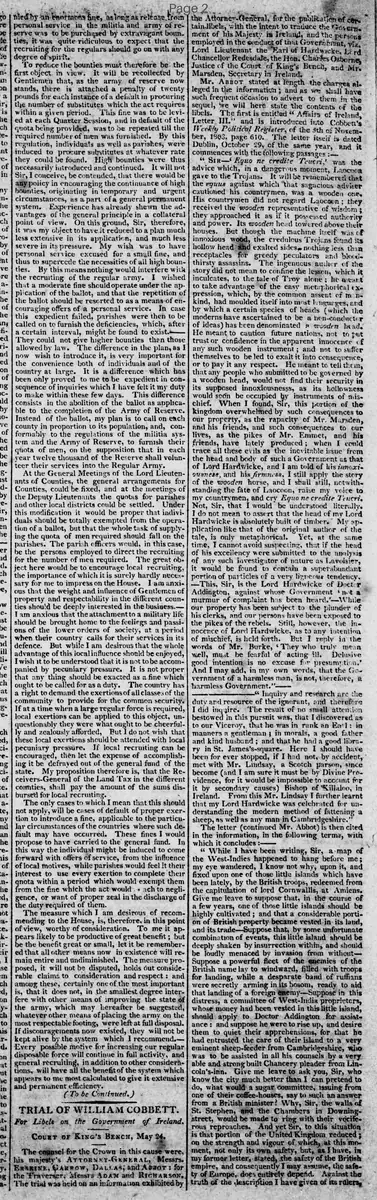
For Libels on the Government of Ireland.
Court of King's Bench, May 24
The counsel for the Crown in this cause were, his majesty's ATTORNEY-GENERAL, Messrs. Erskine, Garrow, Dallas, and Abbot: for the Traverser; Messrs. Adam and Richardson.
The trial was held on an information exhibited by the Attorney General, for the publication of certain libels, with the intent to traduce the Government of his Majesty in Ireland, and the persons employed in the conduct of that Government, viz. Lord Lieutenant the Earl of Hardwicke, Lord Chancellor Redesdale, the Hon. Charles Osborne Justice of the Court of King's Bench, and Mr. Marsden, Secretary in Ireland.
Mr. Abbot stated at length the charges alleged in the information; and as we shall have such frequent occasion to advert to them in the sequel, we will here state the contents of the libels. The first is entitled "Affairs of Ireland, Letter III." and is introduced into Cobbett's Weekly Political Register, of the 5th of November, 1803. page 610. The letter itself is dated Dublin, October 29th of the same year, and it commences with the following passages:—
"SIR— 'Equo ne credite Teucri,' was the advice which, in a dangerous moment, Laocoon gave to the Trojans. It will be remembered that the argus against which that sagacious adviser cautioned his countrymen, was a wooden one, His countrymen did not regard Laocoon; they received the wooden representative of wisdom; they approached it as if it possessed authority and power. Its wooden head towered above their houses. But though the machine itself was of innoxious wood, the credulous Trojans found its hollow head and exalted sides nothing less than receptacles for greedy peculators and blood-thirsty assassins. The ingenuous author of the story did not mean to confine the lesson, which it inculcates, to the tale of Troy alone; he meant to take advantage of the easy metaphorical expression, which, by the common assent of mankind, had moulded itself into most languages, and by which a certain species of heads (which the moderns have ascertained to be a non-conductor of ideas) has been denominated a wooden head. He meant to caution future nations, not to put trust or confidence in the apparent innocence of any such wooden instrument; and not to suffer themselves to be led to exalt it into consequence, or to pay it any respect. He meant to tell them, that any people who submitted to be governed by a wooden head, would not find their security in its supposed innoxiousness, as its hollowness would soon be occupied by instruments of mischief. When I found, Sir, this portion of the kingdom overwhelmed by such consequences to our property, as the rapacity of Mr. Marsden, and his friends, and such consequences to our lives, as the pikes of Mr. Emmet, and his friends, have lately produced; when I could trace all these evils as the inevitable issue from the head and body of such a Government as that of Lord Hardwicke, and I am told of his innoxiousness, and his firmness, I still apply the story of the wooden horse, and I shall still, notwithstanding the fate of Laocoon, raise my voice to my countrymen, and cry Equo ne credite Teucri. Not, Sir, that I would be understood literally. I do not mean to assert that the head of my Lord Hardwicke is absolutely built of timber. My application like that of the original author of the tale, is only metaphorical. Yet, at the same time, I cannot avoid suspecting, that if the head of his excellency were submitted to the analysis of any such investigator of nature as Lavoisier, it would be found to contain a superabundant portion of particles of a very ligneous tendency. —This, Sir, is the Lord Hardwicke of Doctor Addington, against whose Government not a murmur of complaint has been heard.'—While our property has been subject to the plunder of his clerks, and our persons have been exposed to the pikes of the rebels. Still, however, the innocence of Lord Hardwicke, as to any intention of mischief, is held forth. But I reply in the words of Mr. Burke, They who truly mean well, must be fearful of acting ill. Delusive good intention is no excuse for presumption.' And I may add, in my own words, that the Government of a harmless man, is not, therefore, a harmless Government."
"Inquiry and research are the duty and resource of the ignorant, and therefore I did inquire. The result of no small attention bestowed in this pursuit was, that I discovered as to our Viceroy, that he was in rank an Earl: in manners a gentleman; in morals, a good father and kind husband; and that he had a good library in St. James's-square. Here I should have been for ever stopped, if I had not, by accident, met with Mr. Lindsay, a Scotch parson, since become (and I am sure it must be by Divine Providence, for it would be impossible to account for it by secondary causes) Bishop of Kildare, in Ireland. From this Mr. Lindsay I further learnt that my Lord Hardwicke was celebrated for understanding the modern method of fattening a sheep, as well as any man in Cambridgeshire."
The letter (continued Mr. Abbot) is then cited in the information, in the following terms, with which it concludes:
"While I have been writing, Sir, a map of the West-Indies happened to hang before me; my eye wandered, I know not why, upon it, and fixed upon one of those little islands which have been lately, by the British troops, redeemed from the capitulation of lord Cornwallis, at Amiens. Give me leave to suppose that, in the course of a few years, one of those little islands should be highly cultivated; and that a considerable portion of British property became vested in its land, and its trade—Suppose that, by some unfortunate combination of events, this little island should be deeply shaken by insurrection within, and should be loudly menaced by invasion from without—Suppose a powerful fleet of the enemies of the British name lay to windward, filled with troops for landing, while a desperate band of ruffians were secretly arming in its bosom, ready to aid that landing of a foreign enemy—Suppose in this distress, a committee of West-India proprietors, whose money had been vested in this little island, should apply to Doctor Addington for assistance: and suppose he were to rise up, and desire them to quiet their apprehensions, for that he had entrusted the care of their island to a very eminent sheep-feeder from Cambridgeshire, who was to be assisted in all his counsels by a very able and strong built Chancery pleader from Lincoln's-inn. Give me leave to ask you, Sir, who know the city much better than I can pretend to do, what would a sugar committee, issuing from one of their coffee-houses, say to such an answer from a British minister? Why, Sir, the walls of St. Stephen, and the Chambers in Downing-street, would be made to ring with their vociferous reproaches. And yet Sir, to this situation is that portion of the United Kingdom reduced; on the strength and vigour of which, at this moment, not only its own safety, but, as I have, in my former letter, stated, the safety of the British empire, and consequently I may assume, the safety of Europe. does entirely depend. Against the truth of the description I have given of its rulers,
I may challenge the most daring supporter of the present Government to produce one single act in the lives of those truly great characters of the Doctor which can entitle them to claim one particle of merit or confidence from the publick, beyond the bounds and limits within which I have encircled their exploits. On the Chancery pleader, perhaps I may have laid too great a stress; he is not of the first consequence, though in a future letter I may, perhaps, point out to you the mischief which the intermeddling of such a man, in a matter out of the course of his practice, may occasion. But with respect to Lord Hardwicke, it may be replied, that my challenge is unfair, because it is impossible to justify his having been appointed to the government of Ireland, by any instances of former political ability, as the acceptance of his present office was his first essay. What. Is he one of the tribe of the Hobarts, Westmorelands, and Camdens? Is he one of that tribe who have been sent over to us to be trained up here in Politicians, as they train the Surgeons-apprentices in the hospitals, by setting them first to the pauper patients? Is this a time for a continuation of such experiments? The gift of Lord Hardwicke to us, at such a period, cannot be compared to any thing else than the prank of Hotspur, at the battle of Shrewsbury, when the King handed over his pistol to the Prince. From hence, sir, by the present to us of Lord Hardwicke, that sentence has been proved to us in sad truth, which Falstaff said in a good-humoured 'Here's what will sack a city.' The two following passages bear the same title of affairs of Ireland. They occur in the Register, letter 4, page 804, and are expressed in the following terms:
"What I have now to touch upon must be done with a delicate hand. I will confine myself to a bare narrative of facts, and will not presume to give any opinion. As soon as Government had fully recovered its recollection, a commission, directed to five of the Judges, issued for the trial of those rebels, who had been arrested for treason committed in the county and city of Dublin. This commission having issued while the Judges were on the circuit, was filled up (and very properly filled up) with the names of the five senior of those Judges who were then on the circuits which were likely to terminate at the earliest period of time. Such was the reason given by Government for the particular selection of the Judges named in that commission, and it certainly was a good reason. In some time after this commission had been sitting, it became necessary to issue a new commission for the trial of the rebels in the shires of Antrim and Down. In the appointment of this second commission, the principle which directed the selection in the first was not adhered to. On the contrary, the junior Judge of the twelve was very anxiously called out, and placed in this new commission, over the heads of a number of his seniors. This, however, could not, and ought not, to have given offence to any of these senior Judges, because, whatever opinion of them the Government may have manifested in such an appointment, the opinion of the present Government upon such a subject (known to be influenced by motives very different from general justice), is too contemptible to have any effect upon any of the learned Judges in the publick mind. The circumstance, therefore, was not at first attended to. There is published in this city a news-paper, called The Dublin Journal. It is in general, conducted with good sense, loyalty, and a regard to truth: but, in particular deviations, it is known to be under the controul and immediate direction of Government. In that paper, of the 20th October last, a publication appeared, which purported to be a charge by the junior Judge above alluded to, to the Grand Jury of the county of Antrim. In this place I beg now to declare, that I am far from attempting to assert, that the learned Judge did not pronounce any such charge: and when I speak of his charge, I request you will understand I mean only the news-paper publication: the Learned Judge is made to tell the Grand Jury, that 'through the well-timed efforts and strenuous exertions of a wise and energetick Government, &c. the progress of such crimes as lately disgraced this country, had been effectually checked.' If the Learned Justice did make any such assertion (which I am far from supposing, with what amazement the Grand Jury must have received such a broadside, poured upon the truth of the fact, I cannot, as I was not present, know: but I can very well imagine what the feelings of 23 well-informed gentlemen must have been. Their respect, and a thorough knowledge of their duty, would necessarily keep them silent. But though men remain silent under the proper awe and controul of a Court of Justice, their language only becomes more strenuous when that restraint is taken off, and they meet together in private confidence."
(TO BE CONTINUED.)
What sub-type of article is it?
What keywords are associated?
What entities or persons were involved?
Where did it happen?
Foreign News Details
Primary Location
Ireland
Event Date
May 24
Key Persons
Event Details
The trial of William Cobbett for publishing libels in his Weekly Political Register criticizing the Irish government under Lord Lieutenant Earl of Hardwicke and associates, including metaphorical attacks likening Hardwicke to a 'wooden head' and references to recent Irish rebellion events. Mr. Abbot presented the charges, quoting extensively from Letters III and IV on Affairs of Ireland dated October 29, 1803, and later passages on judicial commissions and government influence on newspapers.