Thank you for visiting SNEWPapers!
Sign up free
Letter to Editor
June 13, 1796
Gazette Of The United States
Philadelphia, Philadelphia County, Pennsylvania
What is this article about?
An anonymous letter to Mr. Fenno criticizes Benjamin Bache of the Aurora for past attacks on private characters while defending the writer's view that morally vicious individuals should not be authorities on moral or religious subjects, separate from politics, and challenges Bache to expose vices in public officials.
Clipping
OCR Quality
85%
Good
Full Text
For the Gazette of the United States.
MR. FENNO,
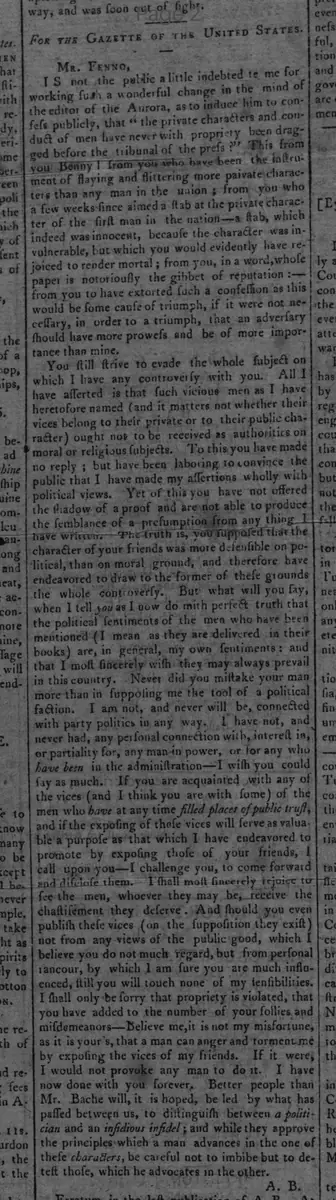
Is not the public a little indebted to me for working such a wonderful change in the mind of the editor of the Aurora, as to induce him to confess publicly, that "the private characters and conduct of men have never with propriety been dragged before the tribunal of the press?" This from you Bache! From you who have been the instrument of flaying and slittering more private characters than any man in the union; from you who but a few weeks since aimed a stab at the private character of the first man in the nation—a stab, which indeed was innocent, because the character was invulnerable, but which you would evidently have rejoiced to render mortal; from you, in a word, whose paper is notoriously the gibbet of reputation:—from you to have extorted such a confession as this would be some cause of triumph, if it were not necessary, in order to a triumph, that an adversary should have more prowess and be of more importance than mine.
You still strive to evade the whole subject on which I have asserted is that such vicious men as I have any controversy with you. All I have heretofore named (and it matters not whether their vices belong to their private or to their public character) ought not to be received as authorities on moral or religious subjects. To this you have made no reply; but have been laboring to convince the public that I have made my assertions wholly with political views. Yet of this you have not offered the shadow of a proof and are not able to produce the semblance of a presumption from any thing I have written. The truth is, you supposed that the character of your friends was more defensible on political, than on moral ground, and therefore have endeavored to draw to the former of these grounds the whole controversy. But what will you say, when I tell you as I now do with perfect truth that the political sentiments of the men who have been mentioned (I mean as they are delivered in their books) are, in general, my own sentiments: and that I most sincerely wish they may always prevail in this country. Never did you mistake your man more than in supposing me the tool of a political faction. I am not, and never will be, connected with party politics in any way. I have not, and never had, any personal connection with, interest in, or partiality for, any man in power, or for any who have been in the administration—I wish you could say as much. If you are acquainted with any of the vices (and I think you are with some) of the men who have at any time filled places of public trust, and if the exposing of these vices will serve as valuable a purpose as that which I have endeavored to promote by exposing those of your friends, I call upon you—I challenge you, to come forward and disclose them. I shall most sincerely rejoice to see the men, whoever they may be, receive the chastisement they deserve. And should you even publish these vices on the supposition they exist) not from any views of the public good, which I believe you do not much regard, but from personal rancour, by which I am sure you are much influenced, still you will touch none of my sensibilities. I shall only be sorry that propriety is violated, that you have added to the number of your follies and misdemeanors—Believe me, it is not my misfortune, as it is yours, that a man can anger and torment me by exposing the vices of my friends. If it were, I would not provoke any man to do it. I have now done with you forever. Better people than Mr. Bache will, it is hoped, be led by what has passed between us, to distinguish between a politician and an insidious infidel; and while they approve the principles which a man advances in the one of these characters, be careful not to imbibe but to detest those, which he advocates in the other.
MR. FENNO,
Is not the public a little indebted to me for working such a wonderful change in the mind of the editor of the Aurora, as to induce him to confess publicly, that "the private characters and conduct of men have never with propriety been dragged before the tribunal of the press?" This from you Bache! From you who have been the instrument of flaying and slittering more private characters than any man in the union; from you who but a few weeks since aimed a stab at the private character of the first man in the nation—a stab, which indeed was innocent, because the character was invulnerable, but which you would evidently have rejoiced to render mortal; from you, in a word, whose paper is notoriously the gibbet of reputation:—from you to have extorted such a confession as this would be some cause of triumph, if it were not necessary, in order to a triumph, that an adversary should have more prowess and be of more importance than mine.
You still strive to evade the whole subject on which I have asserted is that such vicious men as I have any controversy with you. All I have heretofore named (and it matters not whether their vices belong to their private or to their public character) ought not to be received as authorities on moral or religious subjects. To this you have made no reply; but have been laboring to convince the public that I have made my assertions wholly with political views. Yet of this you have not offered the shadow of a proof and are not able to produce the semblance of a presumption from any thing I have written. The truth is, you supposed that the character of your friends was more defensible on political, than on moral ground, and therefore have endeavored to draw to the former of these grounds the whole controversy. But what will you say, when I tell you as I now do with perfect truth that the political sentiments of the men who have been mentioned (I mean as they are delivered in their books) are, in general, my own sentiments: and that I most sincerely wish they may always prevail in this country. Never did you mistake your man more than in supposing me the tool of a political faction. I am not, and never will be, connected with party politics in any way. I have not, and never had, any personal connection with, interest in, or partiality for, any man in power, or for any who have been in the administration—I wish you could say as much. If you are acquainted with any of the vices (and I think you are with some) of the men who have at any time filled places of public trust, and if the exposing of these vices will serve as valuable a purpose as that which I have endeavored to promote by exposing those of your friends, I call upon you—I challenge you, to come forward and disclose them. I shall most sincerely rejoice to see the men, whoever they may be, receive the chastisement they deserve. And should you even publish these vices on the supposition they exist) not from any views of the public good, which I believe you do not much regard, but from personal rancour, by which I am sure you are much influenced, still you will touch none of my sensibilities. I shall only be sorry that propriety is violated, that you have added to the number of your follies and misdemeanors—Believe me, it is not my misfortune, as it is yours, that a man can anger and torment me by exposing the vices of my friends. If it were, I would not provoke any man to do it. I have now done with you forever. Better people than Mr. Bache will, it is hoped, be led by what has passed between us, to distinguish between a politician and an insidious infidel; and while they approve the principles which a man advances in the one of these characters, be careful not to imbibe but to detest those, which he advocates in the other.
What sub-type of article is it?
Persuasive
Provocative
Ethical Moral
What themes does it cover?
Morality
Press Freedom
Religion
What keywords are associated?
Benjamin Bache
Aurora
Private Character
Moral Authorities
Political Sentiments
Public Trust Vices
Infidel
What entities or persons were involved?
Mr. Fenno
Letter to Editor Details
Recipient
Mr. Fenno
Main Argument
vicious individuals, regardless of their political views, should not be regarded as authorities on moral or religious subjects; the writer challenges bache to expose vices among public officials and emphasizes separating political sentiments from moral character.
Notable Details
Criticism Of Bache's Attacks On Private Characters
Reference To Stab At The 'First Man In The Nation'
Aurora As 'Gibbet Of Reputation'
Distinction Between Politician And Insidious Infidel