Thank you for visiting SNEWPapers!
Sign up free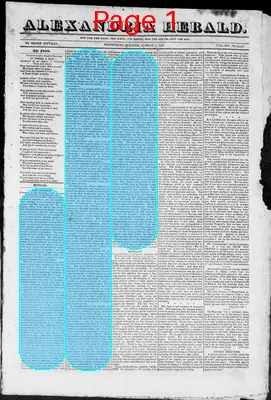
Editorial
August 4, 1824
The Alexandria Herald
Alexandria, Virginia
What is this article about?
Address by Mr. Fitzhugh to the Jackson Convention in Fredericksburg, Va., presenting electoral ticket for Andrew Jackson and John C. Calhoun. Criticizes congressional caucus as undemocratic, defends current administration's policies including national bank, fortifications, navy, and internal improvements. Urges support for Jackson and Calhoun to ensure free elections and national welfare.
Clipping
OCR Quality
97%
Excellent
Full Text
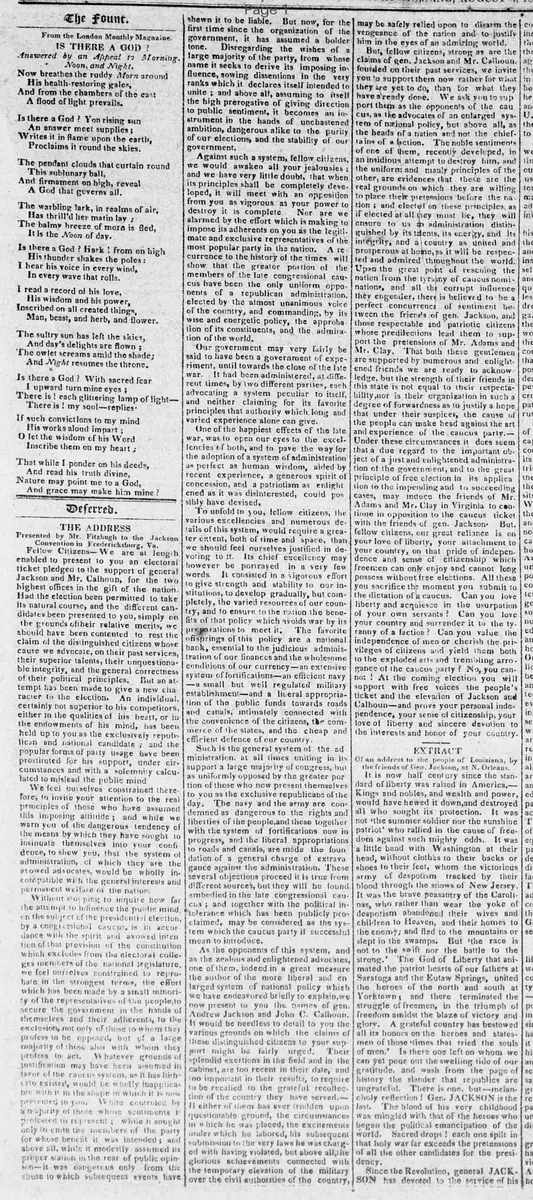
THE ADDRESS
Presented by Mr. Fitzhugh to the Jackson Convention in Fredericksburg, Va.
Fellow Citizens--We are at length enabled to present to you an electoral ticket pledged to the support of general Jackson and Mr. Calhoun, for the two highest offices in the gift of the nation.
Had the election been permitted to take its natural course, and the different candidates been presented to you, simply on the grounds of their relative merits, we should have been contented to rest the claim of the distinguished citizens whose cause we advocate, on their past services, their superior talents, their unquestionable integrity, and the general correctness of their political principles. But an attempt has been made to give a new character to the election. An individual, certainly not superior to his competitors, either in the qualities of his heart, or in the endowments of his mind, has been held up to you as the exclusively republican and national candidate; and the popular forms of party usage have been prostituted for his support, under circumstances and with a solemnity calculated to mislead the public mind.
We feel ourselves constrained therefore, to invite your attention to the real principles of those who have assumed this imposing attitude; and while we warn you of the dangerous tendency of the means by which they have sought to insinuate themselves into your confidence, to shew you, that the system of administration, of which they are the avowed advocates, would be wholly incompatible with the general interests and permanent welfare of the nation.
Without stopping to inquire how far the attempt to influence the public mind on the subject of the presidential election, by a congressional caucus, is in accordance with the spirit and avowed intention of that provision of the constitution which excludes from the electoral colleges members of the national legislature, we feel ourselves constrained to reprobate in the strongest terms, the effort which has been made by a small minority of the representatives of the people, to secure the government in the hands of themselves and their adherents, to the exclusion, not only of those to whom they profess to be opposed, but of a large majority of those also with whom they profess to act.
Whatever grounds of justification may have been assumed in favor of the caucus system, as it has hitherto existed, would be wholly inapplicable with it in the shape in which it is now presented to you. While controlled by a majority of those whose sentiments it professed to represent; while it sought only to unite the members of the party for whose benefit it was intended; and above all, while it modestly assumed its proper station in the rear of public opinion--it was dangerous only from the abuse to which subsequent events have shewn it to be liable. But now, for the first time since the organization of the government, it has assumed a bolder tone.
Disregarding the wishes of a large majority of the party, from whose name it seeks to derive its imposing influence, sowing dissentions in the very ranks which it declares itself intended to unite; and above all, assuming to itself the high prerogative of giving direction to public sentiment, it becomes an instrument in the hands of unchastened ambition, dangerous alike to the purity of our elections, and the stability of our government.
Against such a system, fellow citizens, we would awaken all your jealousies; and we have very little doubt, that when its principles shall be completely developed, it will meet with an opposition from you as vigorous as your power to destroy it is complete. Nor are we alarmed by the effort which is making to impose its adherents on you as the legitimate and exclusive representatives of the most popular party in the nation. A recurrence to the history of the times will show that the greater portion of the members of the late congressional caucus have been the only uniform opponents of a republican administration, elected by the almost unanimous voice of the country, and commanding, by its wise and energetic policy, the approbation of its constituents, and the admiration of the world.
Our government may very fairly be said to have been a government of experiment, until towards the close of the late war. It had been administered, at different times, by two different parties, each advocating a system peculiar to itself, and neither claiming for its favorite principles that authority which long and varied experience alone can give.
One of the happiest effects of the late war, was to open our eyes to the excellencies of both, and to pave the way for the adoption of a system of administration as perfect as human wisdom, aided by recent experience, a generous spirit of concession, and a patriotism as enlightened as it was disinterested, could possibly have devised.
To unfold to you, fellow citizens, the various excellencies and numerous details of this system, would require a greater extent, both of time and space, than we should feel ourselves justified in devoting to it. Its chief excellency may however be portrayed in a very few words. It consisted in a rigorous effort to give strength and stability to our institutions, to develop gradually, but completely, the varied resources of our country, and to ensure to the nation the benefits of that policy which avoids war by its preparations to meet it. The favorite offsprings of this policy are a national bank, essential to the judicious administration of our finances and the wholesome conditions of our currency--an extensive system of fortifications--an efficient navy--a small but well regulated military establishment--and a liberal appropriation of the public funds towards roads and canals, intimately connected with the convenience of the citizens, the commerce of the states, and the cheap and efficient defence of our country.
Such is the general system of the administration, at all times uniting in its support a large majority of congress, but as uniformly opposed by the greater portion of those who now present themselves to you as the exclusive republicans of the day. The navy and the army are condemned as dangerous to the rights and liberties of the people, and these together with the system of fortifications now in progress, and the liberal appropriations to roads and canals, are made the foundation of a general charge of extravagance against the administration.
These several objections proceed it is true from different sources, but they will be found embodied in the late congressional caucus; and together with the political intolerance which has been publicly proclaimed, may be considered as the system which the caucus party if successful mean to introduce.
As the opponents of this system, and as the zealous and enlightened advocates, one of them indeed in a great measure the author of the more liberal and enlarged system of national policy which we have endeavored briefly to explain, we now present to you the names of Gen. Andrew Jackson and John C. Calhoun.
It would be needless to detail to you the various grounds on which the claims of these distinguished citizens to your support might be fairly urged. Their splendid exertions in the field and in the cabinet, are too recent in their date, and too important in their results, to require to be recalled to the grateful recollection of the country they have served.
If either of them has ever trodden upon questionable ground, the circumstances in which he was placed, the excitements under which he labored, his subsequent submission to the very laws he was charged with having violated, but above all, the glorious achievements connected with the temporary elevation of the military over the civil authorities of the country, may be safely relied upon to disarm the vengeance of the nation and to justify him in the eyes of an admiring world.
But, fellow citizens, strong as are the claims of Gen. Jackson and Mr. Calhoun, founded on their past services, we invite you to support them now rather for what they are yet to do: than for what they have already done. We ask you to support them as the opponents of the caucus, as the advocates of an enlarged system of national policy, but above all, as the heads of a nation and not the chieftains of a faction. The noble sentiments of one of them, recently developed, in an insidious attempt to destroy him, and the uniform and manly principles of the other, are evidences that these are the real grounds on which they are willing to place their pretensions before the nation: and elected on these principles, as if elected at all they must be, they will ensure to us an administration distinguished by its talents, its energy, and its integrity, and a country as united and prosperous at home, as it will be respected and admired throughout the world.
Upon the great point of rescuing the nation from the tyranny of caucus nominations, and all the corrupt influence they engender, there is believed to be a perfect concurrence of sentiment between the friends of Gen. Jackson, and those respectable and patriotic citizens whose predilections lead them to support the pretensions of Mr. Adams and Mr. Clay. That both these gentlemen are supported by numerous and enlightened friends we are ready to acknowledge. but the strength of their friends in this state is not equal to their respectability, nor is their organization in such a degree of forwardness as to justify a hope that under their auspices, the cause of the people can make head against the art and experience of the caucus party.
Under these circumstances it does seem that a due regard to the important object of a just and enlightened administration of the government, and to the great principle of free election in its application to the impending and to succeeding cases, may induce the friends of Mr. Adams and Mr. Clay in Virginia to continue in opposition to the caucus ticket with the friends of Gen. Jackson-- But, fellow citizens, our great reliance is on your love of liberty, your attachment to your country, on that pride of independence and sense of citizenship which freemen can only enjoy and cannot long possess without free elections. All these you sacrifice the moment you submit to the dictation of a caucus. Can you love liberty and acquiesce in the usurpation of your own servants? Can you love your country and surrender it to the tyranny of a faction? Can you value the independence of men or cherish the privileges of citizens and yield them both to the exploded arts and trembling arrogance of the caucus party? No, you cannot! At the coming election you will support with free voices the people's ticket and the elevation of Jackson and Calhoun--and prove your personal independence, your sense of citizenship, your love of liberty and sincere devotion to the interests and honor of your country.
Presented by Mr. Fitzhugh to the Jackson Convention in Fredericksburg, Va.
Fellow Citizens--We are at length enabled to present to you an electoral ticket pledged to the support of general Jackson and Mr. Calhoun, for the two highest offices in the gift of the nation.
Had the election been permitted to take its natural course, and the different candidates been presented to you, simply on the grounds of their relative merits, we should have been contented to rest the claim of the distinguished citizens whose cause we advocate, on their past services, their superior talents, their unquestionable integrity, and the general correctness of their political principles. But an attempt has been made to give a new character to the election. An individual, certainly not superior to his competitors, either in the qualities of his heart, or in the endowments of his mind, has been held up to you as the exclusively republican and national candidate; and the popular forms of party usage have been prostituted for his support, under circumstances and with a solemnity calculated to mislead the public mind.
We feel ourselves constrained therefore, to invite your attention to the real principles of those who have assumed this imposing attitude; and while we warn you of the dangerous tendency of the means by which they have sought to insinuate themselves into your confidence, to shew you, that the system of administration, of which they are the avowed advocates, would be wholly incompatible with the general interests and permanent welfare of the nation.
Without stopping to inquire how far the attempt to influence the public mind on the subject of the presidential election, by a congressional caucus, is in accordance with the spirit and avowed intention of that provision of the constitution which excludes from the electoral colleges members of the national legislature, we feel ourselves constrained to reprobate in the strongest terms, the effort which has been made by a small minority of the representatives of the people, to secure the government in the hands of themselves and their adherents, to the exclusion, not only of those to whom they profess to be opposed, but of a large majority of those also with whom they profess to act.
Whatever grounds of justification may have been assumed in favor of the caucus system, as it has hitherto existed, would be wholly inapplicable with it in the shape in which it is now presented to you. While controlled by a majority of those whose sentiments it professed to represent; while it sought only to unite the members of the party for whose benefit it was intended; and above all, while it modestly assumed its proper station in the rear of public opinion--it was dangerous only from the abuse to which subsequent events have shewn it to be liable. But now, for the first time since the organization of the government, it has assumed a bolder tone.
Disregarding the wishes of a large majority of the party, from whose name it seeks to derive its imposing influence, sowing dissentions in the very ranks which it declares itself intended to unite; and above all, assuming to itself the high prerogative of giving direction to public sentiment, it becomes an instrument in the hands of unchastened ambition, dangerous alike to the purity of our elections, and the stability of our government.
Against such a system, fellow citizens, we would awaken all your jealousies; and we have very little doubt, that when its principles shall be completely developed, it will meet with an opposition from you as vigorous as your power to destroy it is complete. Nor are we alarmed by the effort which is making to impose its adherents on you as the legitimate and exclusive representatives of the most popular party in the nation. A recurrence to the history of the times will show that the greater portion of the members of the late congressional caucus have been the only uniform opponents of a republican administration, elected by the almost unanimous voice of the country, and commanding, by its wise and energetic policy, the approbation of its constituents, and the admiration of the world.
Our government may very fairly be said to have been a government of experiment, until towards the close of the late war. It had been administered, at different times, by two different parties, each advocating a system peculiar to itself, and neither claiming for its favorite principles that authority which long and varied experience alone can give.
One of the happiest effects of the late war, was to open our eyes to the excellencies of both, and to pave the way for the adoption of a system of administration as perfect as human wisdom, aided by recent experience, a generous spirit of concession, and a patriotism as enlightened as it was disinterested, could possibly have devised.
To unfold to you, fellow citizens, the various excellencies and numerous details of this system, would require a greater extent, both of time and space, than we should feel ourselves justified in devoting to it. Its chief excellency may however be portrayed in a very few words. It consisted in a rigorous effort to give strength and stability to our institutions, to develop gradually, but completely, the varied resources of our country, and to ensure to the nation the benefits of that policy which avoids war by its preparations to meet it. The favorite offsprings of this policy are a national bank, essential to the judicious administration of our finances and the wholesome conditions of our currency--an extensive system of fortifications--an efficient navy--a small but well regulated military establishment--and a liberal appropriation of the public funds towards roads and canals, intimately connected with the convenience of the citizens, the commerce of the states, and the cheap and efficient defence of our country.
Such is the general system of the administration, at all times uniting in its support a large majority of congress, but as uniformly opposed by the greater portion of those who now present themselves to you as the exclusive republicans of the day. The navy and the army are condemned as dangerous to the rights and liberties of the people, and these together with the system of fortifications now in progress, and the liberal appropriations to roads and canals, are made the foundation of a general charge of extravagance against the administration.
These several objections proceed it is true from different sources, but they will be found embodied in the late congressional caucus; and together with the political intolerance which has been publicly proclaimed, may be considered as the system which the caucus party if successful mean to introduce.
As the opponents of this system, and as the zealous and enlightened advocates, one of them indeed in a great measure the author of the more liberal and enlarged system of national policy which we have endeavored briefly to explain, we now present to you the names of Gen. Andrew Jackson and John C. Calhoun.
It would be needless to detail to you the various grounds on which the claims of these distinguished citizens to your support might be fairly urged. Their splendid exertions in the field and in the cabinet, are too recent in their date, and too important in their results, to require to be recalled to the grateful recollection of the country they have served.
If either of them has ever trodden upon questionable ground, the circumstances in which he was placed, the excitements under which he labored, his subsequent submission to the very laws he was charged with having violated, but above all, the glorious achievements connected with the temporary elevation of the military over the civil authorities of the country, may be safely relied upon to disarm the vengeance of the nation and to justify him in the eyes of an admiring world.
But, fellow citizens, strong as are the claims of Gen. Jackson and Mr. Calhoun, founded on their past services, we invite you to support them now rather for what they are yet to do: than for what they have already done. We ask you to support them as the opponents of the caucus, as the advocates of an enlarged system of national policy, but above all, as the heads of a nation and not the chieftains of a faction. The noble sentiments of one of them, recently developed, in an insidious attempt to destroy him, and the uniform and manly principles of the other, are evidences that these are the real grounds on which they are willing to place their pretensions before the nation: and elected on these principles, as if elected at all they must be, they will ensure to us an administration distinguished by its talents, its energy, and its integrity, and a country as united and prosperous at home, as it will be respected and admired throughout the world.
Upon the great point of rescuing the nation from the tyranny of caucus nominations, and all the corrupt influence they engender, there is believed to be a perfect concurrence of sentiment between the friends of Gen. Jackson, and those respectable and patriotic citizens whose predilections lead them to support the pretensions of Mr. Adams and Mr. Clay. That both these gentlemen are supported by numerous and enlightened friends we are ready to acknowledge. but the strength of their friends in this state is not equal to their respectability, nor is their organization in such a degree of forwardness as to justify a hope that under their auspices, the cause of the people can make head against the art and experience of the caucus party.
Under these circumstances it does seem that a due regard to the important object of a just and enlightened administration of the government, and to the great principle of free election in its application to the impending and to succeeding cases, may induce the friends of Mr. Adams and Mr. Clay in Virginia to continue in opposition to the caucus ticket with the friends of Gen. Jackson-- But, fellow citizens, our great reliance is on your love of liberty, your attachment to your country, on that pride of independence and sense of citizenship which freemen can only enjoy and cannot long possess without free elections. All these you sacrifice the moment you submit to the dictation of a caucus. Can you love liberty and acquiesce in the usurpation of your own servants? Can you love your country and surrender it to the tyranny of a faction? Can you value the independence of men or cherish the privileges of citizens and yield them both to the exploded arts and trembling arrogance of the caucus party? No, you cannot! At the coming election you will support with free voices the people's ticket and the elevation of Jackson and Calhoun--and prove your personal independence, your sense of citizenship, your love of liberty and sincere devotion to the interests and honor of your country.
What sub-type of article is it?
Partisan Politics
Constitutional
Economic Policy
What keywords are associated?
Jackson Calhoun Ticket
Anti Caucus
Presidential Election
Republican Administration
National Bank
Fortifications
Free Elections
Partisan Intrigue
What entities or persons were involved?
Mr. Fitzhugh
Gen. Andrew Jackson
John C. Calhoun
Mr. Adams
Mr. Clay
Congressional Caucus
Editorial Details
Primary Topic
Support For Jackson And Calhoun Against Congressional Caucus Nominations
Stance / Tone
Strongly Pro Jackson And Anti Caucus, Advocating Enlarged National Policy
Key Figures
Mr. Fitzhugh
Gen. Andrew Jackson
John C. Calhoun
Mr. Adams
Mr. Clay
Congressional Caucus
Key Arguments
Congressional Caucus Undermines Democratic Elections And Constitutional Intent
Current Republican Administration's Policies Like National Bank, Fortifications, Navy, And Internal Improvements Strengthen The Nation
Jackson And Calhoun Represent Integrity, Past Services, And Opposition To Factionalism
Caucus System Sows Dissent And Serves Unchastened Ambition
Support Jackson To Rescue Nation From Caucus Tyranny And Ensure Free Elections