Thank you for visiting SNEWPapers!
Sign up free
Letter to Editor
February 18, 1812
The New Hampshire Gazette
Portsmouth, Rockingham County, New Hampshire
What is this article about?
J.J. Boudier, an artist in Pittsburgh, proposes using glass plates with chemical etching for printing banknotes to prevent counterfeiting, claiming they cannot be imitated and offer superior durability over copper plates.
Clipping
OCR Quality
82%
Good
Full Text
MISCELLANY.
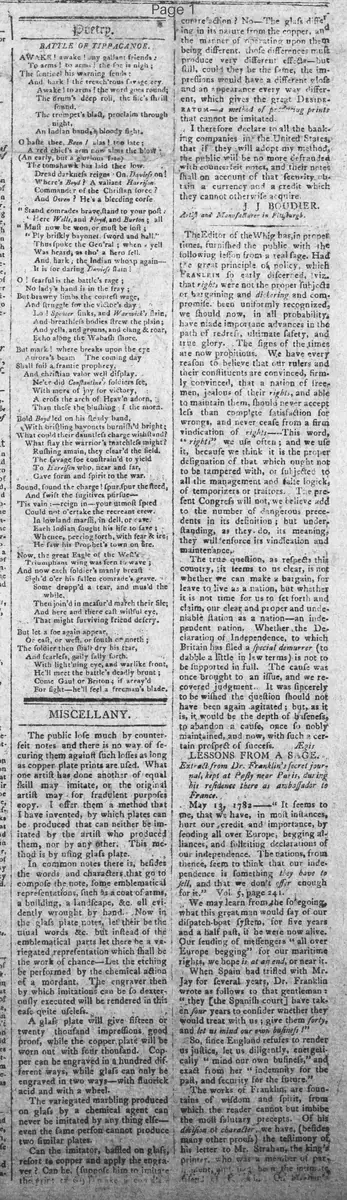
The public lose much by counterfeit notes and there is no way of securing them against such loss as long as copper plate prints are used. What one artist has done another of equal skill may imitate, or the original artist may—for fraudulent purposes copy. I offer them a method that I have invented, by which plates can be produced that can neither be imitated by the artist who produced them, nor by any other. This method is by using glass plate.
In common notes there is, besides the words and characters that go to compose the note, some emblematical representations, such as a coat of arms, a building, a landscape, &c. all evidently wrought by hand. Now in the glass plate notes, let there be the usual words &c. but instead of the emblematical parts let there be a variegated representation which shall be the work of chance. Let the etching be performed by the chemical action of a mordant. The engraver then by which imitations can be so dexterously executed will be rendered in this case quite useless.
A glass plate will give fifteen or twenty thousand impressions, good proof, while the copper plate will be worn out with four thousand. Copper can be engraved in a hundred different ways, while glass can only be engraved in two ways—with fluorick acid and with a wheel.
The variegated marbling produced on glass by a chemical agent can never be imitated by any thing else even the same person cannot produce two similar plates.
Can the imitator, baffled on glass, resort to copper and apply the engraver? Can he suppose him to imitate their first er—(make scans corner section? No—The glass differing in its nature from the copper, and the manner of operating upon them being different, those differences must produce very different effects—but still, could they be the same, the impressions would have a different close and an appearance every way different, which gives the great desideratum—a method of preserving prints that cannot be imitated.
I therefore declare to all the banking companies in the United States, that if they will adopt my method, the public will be no more defrauded with counterfeit notes, and their notes shall on account of that security obtain a currency and a credit which they cannot otherwise acquire.
J. J. BOUDIER.
Artist and Manufacturer in Pittsburgh.
The public lose much by counterfeit notes and there is no way of securing them against such loss as long as copper plate prints are used. What one artist has done another of equal skill may imitate, or the original artist may—for fraudulent purposes copy. I offer them a method that I have invented, by which plates can be produced that can neither be imitated by the artist who produced them, nor by any other. This method is by using glass plate.
In common notes there is, besides the words and characters that go to compose the note, some emblematical representations, such as a coat of arms, a building, a landscape, &c. all evidently wrought by hand. Now in the glass plate notes, let there be the usual words &c. but instead of the emblematical parts let there be a variegated representation which shall be the work of chance. Let the etching be performed by the chemical action of a mordant. The engraver then by which imitations can be so dexterously executed will be rendered in this case quite useless.
A glass plate will give fifteen or twenty thousand impressions, good proof, while the copper plate will be worn out with four thousand. Copper can be engraved in a hundred different ways, while glass can only be engraved in two ways—with fluorick acid and with a wheel.
The variegated marbling produced on glass by a chemical agent can never be imitated by any thing else even the same person cannot produce two similar plates.
Can the imitator, baffled on glass, resort to copper and apply the engraver? Can he suppose him to imitate their first er—(make scans corner section? No—The glass differing in its nature from the copper, and the manner of operating upon them being different, those differences must produce very different effects—but still, could they be the same, the impressions would have a different close and an appearance every way different, which gives the great desideratum—a method of preserving prints that cannot be imitated.
I therefore declare to all the banking companies in the United States, that if they will adopt my method, the public will be no more defrauded with counterfeit notes, and their notes shall on account of that security obtain a currency and a credit which they cannot otherwise acquire.
J. J. BOUDIER.
Artist and Manufacturer in Pittsburgh.
What sub-type of article is it?
Informative
Persuasive
What themes does it cover?
Commerce Trade
Economic Policy
What keywords are associated?
Counterfeit Notes
Glass Plate Printing
Chemical Etching
Banknote Security
Pittsburgh Inventor
What entities or persons were involved?
J. J. Boudier. Artist And Manufacturer In Pittsburgh.
Letter to Editor Details
Author
J. J. Boudier. Artist And Manufacturer In Pittsburgh.
Main Argument
proposes inventing a glass plate printing method using chemical etching to create un-imitatable banknotes, superior to copper plates in durability and security against counterfeiting, urging u.s. banking companies to adopt it to prevent fraud and enhance note credibility.
Notable Details
Glass Plates Yield 15 20 Thousand Impressions Vs. 4 Thousand For Copper.
Engraving Glass Only Possible With Fluorick Acid Or Wheel.
Variegated Marbling By Chemical Agent Cannot Be Replicated Even By The Same Person.
Addresses Potential Imitation Attempts Using Copper And Explains Why They Would Fail.