Thank you for visiting SNEWPapers!
Sign up free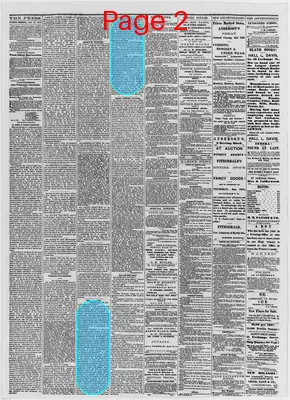
Letter to Editor
January 27, 1874
The Portland Daily Press
Portland, Cumberland County, Maine
What is this article about?
Report from Augusta on Jan. 24, 1874, details the Maine Legislature's third week: slow committees, financial review praising ex-Treasurer Caldwell but suggesting detailed town tax reporting to prevent fraud like Peck's, capital punishment debate, and commendations for Speaker Thomas and Messenger Walker. (248 characters)
Clipping

OCR Quality
95%
Excellent
Full Text
Affairs at Augusta
Augusta, Jan. 24th, 1874
To the Editor of the Press:—
The Legislature is now well into the third week of its session. An unusually large number of petitions and orders have been introduced and referred to the appropriate committees. As yet, however, few bills have been reported back. From some cause, the committees are moving very slowly, and if they do not improve their speed, it will be impossible to obtain an adjournment as early as February 25th, if the business already before it is well done.
The indications are that more public and less private legislation will be accomplished this winter than last.
The Financial Committee are still deep in their examination of the accounts of the late Treasurer. As might be expected, the books and accounts are found correct and the committee compliment Mr. Caldwell for the faithful and efficient manner in which he has filled his responsible position. The committee however, while they express themselves highly satisfied with the system in its general features used in this department, have discovered one defect in it that has evidently escaped the eyes of previous committees. It is this: The Treasurer is by law required to publish annually, a report of the business of his department. In this report, the total alone of all the money received from the several towns in the State, is published. For instance, the total receipts for the year from towns for taxes paid to the State may be $500,000. Now the committee wish to see how that total is made and they examine the cash book for the details. They find that Portland for instance paid $30,000, Bangor $20,000, and so on; but there is no possible manner in which they can decide whether Portland may not have paid $35,000, and the Treasurer have pocketed the $5,000, unless they write to the City Treasurer and ascertain. The City Treasurer of course has in his possession the State Treasurer's receipt for the $35,000. This process of inquiring would involve the necessity of corresponding with every town in the State, involving a vast deal of time and labor. It was by means of this loose system that Peck was enabled to use the State's money for his private purpose. It is true, after a few years. discovery would ensue. because the diminished resources of the State would lead to inquiry and investigation in Peck's case. . The Committee wisely think that the credit given to towns, should be published annually in detail. To this end, one member of the committee, Mr. Reed of Bath, introduced an order to the House this morning. requiring the State Treasurer hereafter to publish, in his report the detailed credits of the towns and cities, In doing this, they desire it to be distinctly understood that not the slightest reflection is cast upon, either the retiring Treasurer, or the incoming one, both of whom are gentlemen of the strictest integrity and most thorough business habits.
The capital punishment question brought to public attention by the hearing on Mr. Talbot's bill, is the prominent one, and is discussed in all circles. At the adjourned hearing which comes off Tuesday, a large number of prominent legal gentlemen from various parts of the State will be present and give their views at length in opposition to the bill,
Hon. W. W. Thomas, Jr., Speaker of the House, is realizing the most sanguine expectations of his friends. With a strong, clear voice, a thorough acquaintance with the duties of his position and a courteous bearing, he is making himself a very popular presiding officer, especially as he adds to these qualifications, the faculty of despatching business. Thus far, except in matters of little importance, there has been no discussion. The bills are but just beginning to flow back from the Committees.
The busiest man in the House is Mr. J. B. Walker, the efficient and popular Messenger, who was the only officer of that branch that received the high compliment of a unanimous election without regard to party. Although the nominee of the Republicans, the Democrats placed his name upon their ticket for Messenger. He is always at his post, always busy and the comfort of the members to say nothing of the business of the House, is greatly enhanced by his faithfulness and efficiency.
Augusta, Jan. 24th, 1874
To the Editor of the Press:—
The Legislature is now well into the third week of its session. An unusually large number of petitions and orders have been introduced and referred to the appropriate committees. As yet, however, few bills have been reported back. From some cause, the committees are moving very slowly, and if they do not improve their speed, it will be impossible to obtain an adjournment as early as February 25th, if the business already before it is well done.
The indications are that more public and less private legislation will be accomplished this winter than last.
The Financial Committee are still deep in their examination of the accounts of the late Treasurer. As might be expected, the books and accounts are found correct and the committee compliment Mr. Caldwell for the faithful and efficient manner in which he has filled his responsible position. The committee however, while they express themselves highly satisfied with the system in its general features used in this department, have discovered one defect in it that has evidently escaped the eyes of previous committees. It is this: The Treasurer is by law required to publish annually, a report of the business of his department. In this report, the total alone of all the money received from the several towns in the State, is published. For instance, the total receipts for the year from towns for taxes paid to the State may be $500,000. Now the committee wish to see how that total is made and they examine the cash book for the details. They find that Portland for instance paid $30,000, Bangor $20,000, and so on; but there is no possible manner in which they can decide whether Portland may not have paid $35,000, and the Treasurer have pocketed the $5,000, unless they write to the City Treasurer and ascertain. The City Treasurer of course has in his possession the State Treasurer's receipt for the $35,000. This process of inquiring would involve the necessity of corresponding with every town in the State, involving a vast deal of time and labor. It was by means of this loose system that Peck was enabled to use the State's money for his private purpose. It is true, after a few years. discovery would ensue. because the diminished resources of the State would lead to inquiry and investigation in Peck's case. . The Committee wisely think that the credit given to towns, should be published annually in detail. To this end, one member of the committee, Mr. Reed of Bath, introduced an order to the House this morning. requiring the State Treasurer hereafter to publish, in his report the detailed credits of the towns and cities, In doing this, they desire it to be distinctly understood that not the slightest reflection is cast upon, either the retiring Treasurer, or the incoming one, both of whom are gentlemen of the strictest integrity and most thorough business habits.
The capital punishment question brought to public attention by the hearing on Mr. Talbot's bill, is the prominent one, and is discussed in all circles. At the adjourned hearing which comes off Tuesday, a large number of prominent legal gentlemen from various parts of the State will be present and give their views at length in opposition to the bill,
Hon. W. W. Thomas, Jr., Speaker of the House, is realizing the most sanguine expectations of his friends. With a strong, clear voice, a thorough acquaintance with the duties of his position and a courteous bearing, he is making himself a very popular presiding officer, especially as he adds to these qualifications, the faculty of despatching business. Thus far, except in matters of little importance, there has been no discussion. The bills are but just beginning to flow back from the Committees.
The busiest man in the House is Mr. J. B. Walker, the efficient and popular Messenger, who was the only officer of that branch that received the high compliment of a unanimous election without regard to party. Although the nominee of the Republicans, the Democrats placed his name upon their ticket for Messenger. He is always at his post, always busy and the comfort of the members to say nothing of the business of the House, is greatly enhanced by his faithfulness and efficiency.
What sub-type of article is it?
Informative
Political
What themes does it cover?
Politics
Economic Policy
Crime Punishment
What keywords are associated?
Maine Legislature
Augusta Session
Financial Audit
State Treasurer
Capital Punishment
Speaker Thomas
Messenger Walker
Town Credits
Peck Embezzlement
What entities or persons were involved?
Editor Of The Press
Letter to Editor Details
Recipient
Editor Of The Press
Main Argument
provides an update on the maine legislature's session in augusta, noting slow committee progress, financial audit findings recommending detailed town credit publications, upcoming capital punishment debate, and praise for the speaker and messenger.
Notable Details
Financial Committee Compliments Mr. Caldwell But Identifies Defect In Reporting System, Referencing Peck's Embezzlement
Mr. Reed Of Bath Introduced Order For Detailed Credits
Opposition To Mr. Talbot's Capital Punishment Bill
Hon. W. W. Thomas, Jr. As Effective Speaker
Mr. J. B. Walker As Efficient Messenger Unanimously Elected