Thank you for visiting SNEWPapers!
Sign up free
The Daily Madisonian
Washington, District Of Columbia
What is this article about?
The Turkish Empire is rapidly adopting mechanical arts and establishing factories like woollen, silk, and cotton mills near Constantinople, aided by British engineer William Fairbairn and Armenian director Ohanis Dadian. This development, initiated under late Sultan Mahmoud in 1839, may significantly affect British commercial relations with Turkey due to skilled Armenian workforce.
Clipping
OCR Quality
Full Text
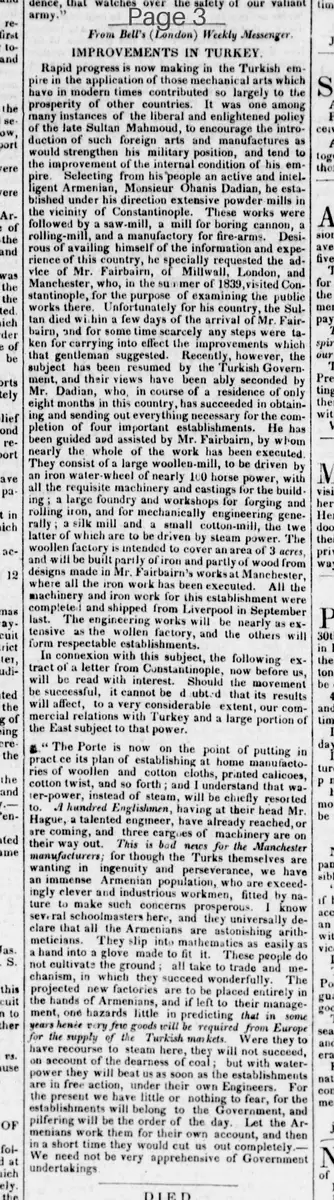
IMPROVEMENTS IN TURKEY.
Rapid progress is now making in the Turkish empire in the application of those mechanical arts which have in modern times contributed so largely to the prosperity of other countries. It was one among many instances of the liberal and enlightened policy of the late Sultan Mahmoud, to encourage the introduction of such foreign arts and manufactures as would strengthen his military position, and tend to the improvement of the internal condition of his empire. Selecting from his people an active and intelligent Armenian, Monsieur Ohanis Dadian, he established under his direction extensive powder mills in the vicinity of Constantinople. These works were followed by a saw-mill, a mill for boring cannon, a rolling-mill, and a manufactory for fire-arms. Desirous of availing himself of the information and experience of this country, he specially requested the advice of Mr. Fairbairn, of Millwall, London, and Manchester, who, in the summer of 1839, visited Constantinople, for the purpose of examining the public works there. Unfortunately for his country, the Sultan died within a few days of the arrival of Mr. Fairbairn, and for some time scarcely any steps were taken for carrying into effect the improvements which that gentleman suggested. Recently, however, the subject has been resumed by the Turkish Government, and their views have been ably seconded by Mr. Dadian, who, in course of a residence of only eight months in this country, has succeeded in obtaining and sending out everything necessary for the completion of four important establishments. He has been guided and assisted by Mr. Fairbairn, by whom nearly the whole of the work has been executed. They consist of a large woollen-mill, to be driven by an iron water-wheel of nearly 100 horse power, with all the requisite machinery and castings for the building; a large foundry and workshops for forging and rolling iron, and for mechanically engineering generally; a silk mill and a small cotton-mill, the two latter of which are to be driven by steam power. The woollen factory is intended to cover an area of 3 acres, and will be built partly of iron and partly of wood from designs made in Mr. Fairbairn's works at Manchester, where all the iron work has been executed. All the machinery and iron work for this establishment were completed and shipped from Liverpool in September last. The engineering works will be nearly as extensive as the woollen factory, and the others will form respectable establishments.
In connexion with this subject, the following extract of a letter from Constantinople, now before us, will be read with interest. Should the movement be successful, it cannot be doubted that its results will affect, to a very considerable extent, our commercial relations with Turkey and a large portion of the East subject to that power.
"The Porte is now on the point of putting in practice its plan of establishing at home manufactories of woollen and cotton cloths, printed calicoes, cotton twist, and so forth; and I understand that water-power, instead of steam, will be chiefly resorted to. A hundred Englishmen, having at their head Mr. Hague, a talented engineer, have already reached, or are coming, and three cargoes of machinery are on their way out. This is bad news for the Manchester manufacturers; for though the Turks themselves are wanting in ingenuity and perseverance, we have an immense Armenian population, who are exceedingly clever and industrious workmen, fitted by nature to make such concerns prosperous. I know several schoolmasters here, and they universally declare that all the Armenians are astonishing arithmeticians. They slip into mathematics as easily as a hand into a glove made to fit it. These people do not cultivate the ground; all take to trade and mechanism, in which they succeed wonderfully. The projected new factories are to be placed entirely in the hands of Armenians, and if left to their management, one hazards little in predicting that in some years hence very few goods will be required from Europe for the supply of the Turkish markets. Were they to have recourse to steam here, they will not succeed, on account of the dearness of coal; but with water-power they will beat us as soon as the establishments are in free action, under their own Engineers. For the present we have little or nothing to fear, for the establishments will belong to the Government, and pilfering will be the order of the day. Let the Armenians work them for their own account, and then in a short time they would cut us out completely. We need not be very apprehensive of Government undertakings."
What sub-type of article is it?
What keywords are associated?
What entities or persons were involved?
Where did it happen?
Foreign News Details
Primary Location
Constantinople, Turkish Empire
Event Date
Summer Of 1839 And Recently
Key Persons
Outcome
establishment of woollen-mill, foundry, silk mill, and cotton-mill; potential reduction in european goods demand in turkish markets, affecting british commercial relations
Event Details
The Turkish Government, resuming initiatives from late Sultan Mahmoud, is establishing manufactories including a large woollen-mill, foundry and workshops, silk mill, and cotton-mill near Constantinople, with machinery from Britain executed by Mr. Fairbairn and directed by Armenian Mr. Dadian. A letter from Constantinople notes arrival of English engineers led by Mr. Hague and machinery cargoes, highlighting Armenian workforce's potential to make factories prosperous using water-power, possibly impacting Manchester manufacturers.