Thank you for visiting SNEWPapers!
Sign up free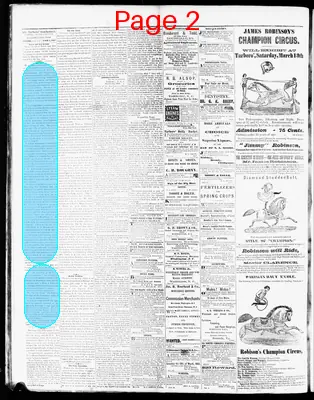
Editorial
March 4, 1869
The Tarboro' Southerner
Tarboro, Edgecombe County, North Carolina
What is this article about?
Editorial criticizes Supreme Court's decision declaring the Stay Law unconstitutional for impairing contracts, while upholding retrospective Homestead exemption as constitutional, arguing inconsistency, lack of dignity, and harm to post-war debt resolution. (214 characters)
Clipping

OCR Quality
95%
Excellent
Full Text
Stay Law.
We publish on our outside the opinion of the Supreme Court on this law; and the obiter dictum on the Homestead exemption. The subject is very important to the public, and the opinion will be read with deep interest by all. We frankly confess our surprise and mortification, at the retrograde in judicial dignity and consistency, which this opinion exhibits. The style and tone is better adapted to the hustings than to the forum. Its inconsistency with a principle of constitutional law, to assuage public clamor and avert public denunciation, is glaring and indefensible.
It invokes and deserves criticism and we fearlessly condemn the time, manner and mode of its enunciation.
No one is surprised that the court should decide a law unconstitutional which impairs the obligation of a contract, by postponing its enforcement for four years, and which discriminates between classes of debts. The opinion truly says "The obligation of a contract is the duty of its performance-a full and complete compliance with its terms. Any statute which relieves a party from the duty or enables him to evade it, is void."
It is very unfortunate, however, and that time exceedingly unpropitious when Court is compelled to declare this law unconstitutional. There is no doubt the stay laws commencing 1861 have done infinitely more harm than good; but the people, since the war, were conforming themselves to the law provided by the Convention of 1865: and the old debts were being rapidly liquidated. It is true an alarming demoralization had overspread many of the debtor class, and many of the creditors were hard and exacting, but compromises were very general, and growing more frequent.
The result of the decision is to throw everything into confusion, and add greatly to the public demoralization. The relentless creditor thinks he will now put on the screw upon his reckless debtor, but the dishonest debtor is told that although the Constitution prohibits any statute which "enables him to evade" or postpone payment, yet the Legislature may exempt all the property he owned when he contracted the debt; and this does not, intimate the Court, "impair the obligation of his contract"-If $1,500 can be exempted (and in a large number of cases this would be all) certainly all can be exempted! "Now, no one can reasonably object to a Homestead-the purpose and policy of such an exemption is humane and judicious,--but to give such a law a retrospective operation is unjust, iniquitous, and clearly unconstitutional-unless to deprive a creditor of a remedy to collect his debt or to postpone the time of its collection is unconstitutional-and to deprive him of any property the debtor has to pay the debt after judgment, is constitutional-which, in our judgment, is utterly irreconcilable and inconsistent and yet, such we understand to be the extraordinary decision.
And to make us satisfied with the "reason of the thing" we are told our new constitution was approved by Congress "the guardian of the United States Constitution"! (we thought the Courts were the guardian) but above all, the Judicial department must provide every man with "a Home, a house for his wife and children-a home to adorn and to love-his home his castle- From turret to foundation stone."
Was this the "Home" the Judge as President of the Convention indulged the hope we were going to?
The Judge seems to think his opinion is 'an unusual discourse of the subject by the Court'-and well he may--for we venture to say, the like has ne'er been seen before. Many of the sentences we read in sorrow and sadness for the manifest deterioration of the independence, integrity, and dignity of the Judiciary.
But times change-men change-judges change-constitutions change-laws change-means of some change, "But truth and honesty are eternal!"
We publish on our outside the opinion of the Supreme Court on this law; and the obiter dictum on the Homestead exemption. The subject is very important to the public, and the opinion will be read with deep interest by all. We frankly confess our surprise and mortification, at the retrograde in judicial dignity and consistency, which this opinion exhibits. The style and tone is better adapted to the hustings than to the forum. Its inconsistency with a principle of constitutional law, to assuage public clamor and avert public denunciation, is glaring and indefensible.
It invokes and deserves criticism and we fearlessly condemn the time, manner and mode of its enunciation.
No one is surprised that the court should decide a law unconstitutional which impairs the obligation of a contract, by postponing its enforcement for four years, and which discriminates between classes of debts. The opinion truly says "The obligation of a contract is the duty of its performance-a full and complete compliance with its terms. Any statute which relieves a party from the duty or enables him to evade it, is void."
It is very unfortunate, however, and that time exceedingly unpropitious when Court is compelled to declare this law unconstitutional. There is no doubt the stay laws commencing 1861 have done infinitely more harm than good; but the people, since the war, were conforming themselves to the law provided by the Convention of 1865: and the old debts were being rapidly liquidated. It is true an alarming demoralization had overspread many of the debtor class, and many of the creditors were hard and exacting, but compromises were very general, and growing more frequent.
The result of the decision is to throw everything into confusion, and add greatly to the public demoralization. The relentless creditor thinks he will now put on the screw upon his reckless debtor, but the dishonest debtor is told that although the Constitution prohibits any statute which "enables him to evade" or postpone payment, yet the Legislature may exempt all the property he owned when he contracted the debt; and this does not, intimate the Court, "impair the obligation of his contract"-If $1,500 can be exempted (and in a large number of cases this would be all) certainly all can be exempted! "Now, no one can reasonably object to a Homestead-the purpose and policy of such an exemption is humane and judicious,--but to give such a law a retrospective operation is unjust, iniquitous, and clearly unconstitutional-unless to deprive a creditor of a remedy to collect his debt or to postpone the time of its collection is unconstitutional-and to deprive him of any property the debtor has to pay the debt after judgment, is constitutional-which, in our judgment, is utterly irreconcilable and inconsistent and yet, such we understand to be the extraordinary decision.
And to make us satisfied with the "reason of the thing" we are told our new constitution was approved by Congress "the guardian of the United States Constitution"! (we thought the Courts were the guardian) but above all, the Judicial department must provide every man with "a Home, a house for his wife and children-a home to adorn and to love-his home his castle- From turret to foundation stone."
Was this the "Home" the Judge as President of the Convention indulged the hope we were going to?
The Judge seems to think his opinion is 'an unusual discourse of the subject by the Court'-and well he may--for we venture to say, the like has ne'er been seen before. Many of the sentences we read in sorrow and sadness for the manifest deterioration of the independence, integrity, and dignity of the Judiciary.
But times change-men change-judges change-constitutions change-laws change-means of some change, "But truth and honesty are eternal!"
What sub-type of article is it?
Constitutional
Legal Reform
Economic Policy
What keywords are associated?
Stay Law
Homestead Exemption
Supreme Court Opinion
Contract Obligations
Constitutional Law
Post War Debts
Judicial Dignity
What entities or persons were involved?
Supreme Court
Convention Of 1865
Congress
Editorial Details
Primary Topic
Critique Of Supreme Court Decision On Stay Law And Homestead Exemption
Stance / Tone
Strongly Critical And Condemnatory
Key Figures
Supreme Court
Convention Of 1865
Congress
Key Arguments
The Stay Law Impairs Contract Obligations By Postponing Enforcement And Discriminating Between Debts, Making It Unconstitutional.
The Homestead Exemption, When Applied Retrospectively, Unjustly Deprives Creditors Of Remedies And Is Inconsistent With Constitutional Principles.
The Court's Opinion Lacks Judicial Dignity, Consistency, And Is Influenced By Public Clamor.
The Decision Causes Public Confusion And Demoralization Amid Post War Debt Liquidation.
The Court Erroneously Prioritizes Providing A 'Home' Over Constitutional Contract Protections.