Thank you for visiting SNEWPapers!
Sign up free
Poem
August 1, 1833
Litchfield Enquirer
Litchfield, Litchfield County, Connecticut
What is this article about?
The poem reflects on an infant's beauty and innocence, a child's gentle pursuit of knowledge echoing Christ's words, and the same person's transformation into a wealthy, honorable man who oppresses others and forgets God, lamenting the loss of perfection.
Clipping
OCR Quality
95%
Excellent
Full Text
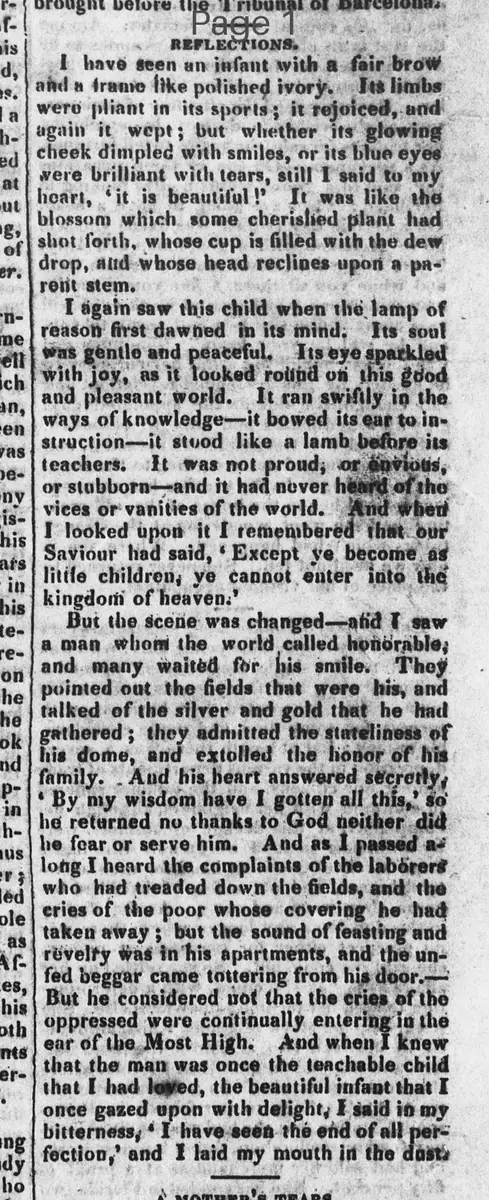
REFLECTIONS.
I have seen an infant with a fair brow
and a frame like polished ivory. Its limbs
were pliant in its sports; it rejoiced,--and
again it wept; but whether its glowing
cheek dimpled with smiles, or its blue eyes
were brilliant with tears, still I said to my
heart, 'it is beautiful!' It was like the
blossom which some cherished plant had
shot forth, whose cup is filled with the dew
drop, and whose head reclines upon a parent stem.
I again saw this child when the lamp of
reason first dawned in its mind: Its soul
was gentle and peaceful. Its eye sparkled
with joy, as it looked round on this good
and pleasant world. It ran swiftly in the
ways of knowledge--it bowed its ear to instruction--it stood like a lamb before its
teachers. It was not proud; or envious.
or stubborn--and it had never heard of the
vices or vanities of the world. And when
I looked upon it I remembered that our
Saviour had said, 'Except ye become as
little children, ye cannot enter into the
kingdom of heaven.'
But the scene was changed--and I saw
a man whom the world called honorable.
and many waited for his smile. They
pointed out the fields that were his, and
talked of the silver and gold that he had
gathered; they admired the stateliness of
his dome, and extolled the honor of his
family. And his heart answered secretly
'By my wisdom have I gotten all this,' so
he returned no thanks to God neither did
he fear or serve him. And as I passed along I heard the complaints of the laborers
who had tilled down the fields, and the
cries of the poor whose covering he had
taken away; but the sound of feasting and
revelry was in his apartments, and the un-
fed beggar came tottering from his door.
But he considered not that the cries of the
oppressed were continually entering in the
ear of the Most High. And when I knew
that the man was once the teachable child
that I had loved, the beautiful infant that I
once gazed upon with delight, I said in my
bitterness, "I have seen the end of all perfection,' and I laid my mouth in the dust.
I have seen an infant with a fair brow
and a frame like polished ivory. Its limbs
were pliant in its sports; it rejoiced,--and
again it wept; but whether its glowing
cheek dimpled with smiles, or its blue eyes
were brilliant with tears, still I said to my
heart, 'it is beautiful!' It was like the
blossom which some cherished plant had
shot forth, whose cup is filled with the dew
drop, and whose head reclines upon a parent stem.
I again saw this child when the lamp of
reason first dawned in its mind: Its soul
was gentle and peaceful. Its eye sparkled
with joy, as it looked round on this good
and pleasant world. It ran swiftly in the
ways of knowledge--it bowed its ear to instruction--it stood like a lamb before its
teachers. It was not proud; or envious.
or stubborn--and it had never heard of the
vices or vanities of the world. And when
I looked upon it I remembered that our
Saviour had said, 'Except ye become as
little children, ye cannot enter into the
kingdom of heaven.'
But the scene was changed--and I saw
a man whom the world called honorable.
and many waited for his smile. They
pointed out the fields that were his, and
talked of the silver and gold that he had
gathered; they admired the stateliness of
his dome, and extolled the honor of his
family. And his heart answered secretly
'By my wisdom have I gotten all this,' so
he returned no thanks to God neither did
he fear or serve him. And as I passed along I heard the complaints of the laborers
who had tilled down the fields, and the
cries of the poor whose covering he had
taken away; but the sound of feasting and
revelry was in his apartments, and the un-
fed beggar came tottering from his door.
But he considered not that the cries of the
oppressed were continually entering in the
ear of the Most High. And when I knew
that the man was once the teachable child
that I had loved, the beautiful infant that I
once gazed upon with delight, I said in my
bitterness, "I have seen the end of all perfection,' and I laid my mouth in the dust.
What sub-type of article is it?
Elegy
What themes does it cover?
Moral Virtue
Religious Faith
What keywords are associated?
Infant Beauty
Child Innocence
Moral Corruption
Wealth Oppression
Religious Reflection
Poem Details
Title
Reflections.
Key Lines
Except Ye Become As Little Children, Ye Cannot Enter Into The Kingdom Of Heaven.
By My Wisdom Have I Gotten All This,
The Cries Of The Oppressed Were Continually Entering In The Ear Of The Most High.
I Have Seen The End Of All Perfection,