Thank you for visiting SNEWPapers!
Sign up free
Literary
March 31, 1870
The Working Christian
York, Charleston, Columbia, York County, Charleston County, Richland County, South Carolina
What is this article about?
Biographical narrative by John S. C. Abbot tracing the Washington family's migration from England to Virginia, focusing on George Washington's birth on February 22, 1732, his noble lineage, upbringing, and early display of honesty in the cherry tree incident.
Clipping
OCR Quality
95%
Excellent
Full Text
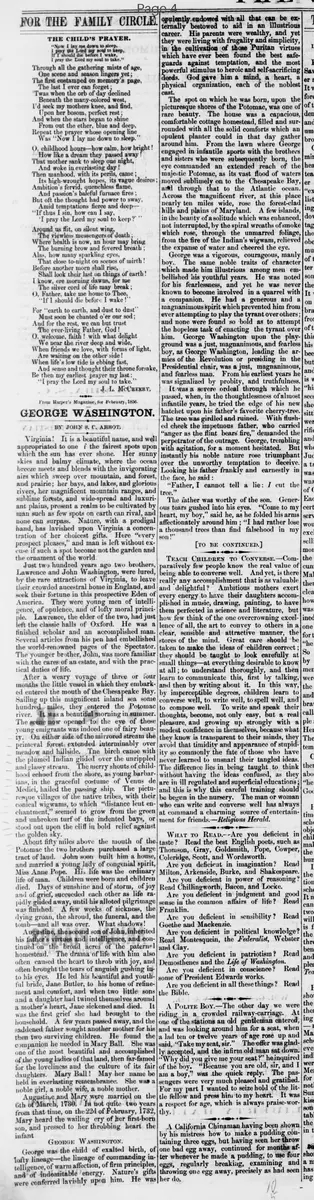
GEORGE WASHINGTON.
BY JOHN S. C. ABBOT
Virginia! It is a beautiful name, and well appropriated to one in the fairest spots upon which the sun has ever shone. Her sunny skies and balmy climate, where the ocean breeze meets and blends with the invigorating airs which sweep over mountain, and forest and prairie; her bays, and lakes, and glorious rivers, her magnificent mountain ranges, and sublime forests, and wide-spread and luxuriant plains, present a realm to be cultivated by man such as few spots on earth can rival, and none can surpass. Nature, with a prodigal hand, has lavished upon Virginia a concentration of her choicest gifts. Here "every prospect pleases," and man is left without excuse if such a spot become not the garden and the ornament of the world.
Just two hundred years ago two brothers, Lawrence and John Washington, were lured by the rare attractions of Virginia, to leave their crowded ancestral home in England, and seek their fortune in this prospective Eden of America. They were young men of intelligence, of opulence, and of lofty moral principle. Lawrence, the elder of the two, had just left the classic halls of Oxford. He was a finished scholar and an accomplished man. Several articles from his pen had embellished the world-renowned pages of the Spectator. The younger brother, John, was more familiar with the cares of an estate, and with the practical duties of life.
After a weary voyage of three or four months the little vessel in which they embarked entered the mouth of the Chesapeake Bay. Sailing up this magnificent inland sea some hundred miles, they entered the Potomac river. It was a beautiful morning in summer. The scene now opened to the eye of these young emigrants was indeed one of fairy beauty. On either side of the mirrored stream the primeval forests extended interminably over meadow and hillside. The birch canoe with the plumed Indian glided over the unrippled and glassy stream. The merry shouts of childhood echoed from the shore, as young barbarians, in the graceful costume of Venus de Medici, hailed the passing ship. The picturesque villages of the native tribes, with their conical wigwams, to which "distance lent enchantment," seemed to grow from the green and unbroken turf of the indented bays, or stood out upon the cliff in bold relief against the golden sky.
About fifty miles above the mouth of the Potomac the two brothers purchased a large tract of land. John soon built him a house and married a young lady of congenial spirit, Miss Anne Pope. His life was the ordinary life of man. Children were born and children died. Days of sunshine and of storm, of joy and of grief, succeeded each other as life rapidly glided away, until his allotted pilgrimage was finished. A few weeks of sickness, the dying groan, the shroud, the funeral, and the tomb—and all was over. What shadows!
Augustine, the second son of John, inherited his father's virtues and intelligence, and continued on the broad acres of the paternal homestead. The drama of life with him also often caused the heart to throb with joy, and often brought the tears of anguish gushing into his eyes. He led his beautiful and youthful bride, Jane Butler, to his home of refinement and comfort, and when two little sons and a daughter had twined themselves around a mother's heart, Jane sickened and died. It was the first grief she had brought to the household. A few years passed away, and the saddened father sought another mother for his then two surviving children. He found the companion he needed in Mary Ball. She was one of the most beautiful and accomplished of the young ladies of that land, then far-famed for the loveliness and the culture of its fair daughters. Mary Ball! May her name be held in everlasting remembrance. She was a noble girl, a noble wife, a noble mother.
Augustine and Mary were married on the 6th of March, 1731. In not quite two years from that time, on the 22d of February, 1732, Mary heard the wailing cry of her first-born son, and pressed to her throbbing heart the infant George Washington.
George was the child of exalted birth, of lofty lineage—the lineage of commanding intelligence, of warm affection, of firm principles and of indomitable energy. Nature's gifts were conferred lavishly upon him. He was opulently endowed with all that can be externally bestowed to aid in an illustrious career. His parents were wealthy, and yet they were living with frugality and simplicity, in the cultivation of those Puritan virtues which have ever been found the best safeguards against temptation, and the most powerful stimulus to heroic and self-sacrificing deeds. God gave him a mind, a heart, a physical organization, each of the noblest cast.
The spot on which he was born, upon the picturesque shores of the Potomac, was one of rare beauty. The house was a capacious, comfortable cottage homestead, filled and surrounded with all the solid comforts which an opulent planter could in that day gather around him. From the lawn where George engaged in infantile sports with the brothers and sisters who were subsequently born, the eye commanded an extended reach of the majestic Potomac, as its vast flood of waters moved sublimely on to the Chesapeake Bay, and through that to the Atlantic ocean. Across the magnificent river, at this place nearly ten miles wide, rose the forest-clad hills and plains of Maryland. A few islands, in the beauty of a solitude which was enhanced, not interrupted, by the spiral wreaths of smoke which rose, through the unmarred foliage from the fire of the Indian's wigwam, relieved the expanse of water and cheered the eye.
George was a vigorous, courageous, manly boy. The same noble traits of character which made him illustrious among men embellished his youthful years. He was noted for his fearlessness, and yet he was never known to become involved in a quarrel with a companion. He had a generous and a magnanimous spirit which prevented him from ever attempting to play the tyrant over others; and none were found so bold as to attempt the hopeless task of enacting the tyrant over him. George Washington upon the playground was a just, magnanimous, and fearless boy, as George Washington, leading the armies of the Revolution or presiding in the Presidential chair, was a just, magnanimous and fearless man. From his earliest years he was signalized by probity, and truthfulness. It was a severe ordeal through which he passed, when, in the thoughtlessness of almost infantile years, he tried the edge of his new hatchet upon his father's favorite cherry-tree. The tree was girdled and ruined. With flushed cheek the impetuous father, who carried "anger as the flint bears fire," demanded the perpetrator of the outrage. George, trembling with agitation, for a moment hesitated. But instantly his noble nature rose triumphant over the unworthy temptation to deceive. Looking his father frankly and earnestly in the face, he said:
"Father, I cannot tell a lie: I cut the tree."
The father was worthy of the son. Generous tears gushed into his eyes. "Come to my heart, my boy," said he, as he folded his arms affectionately around him: "I had rather lose a thousand trees than find falsehood in my son!"
[TO BE CONTINUED.]
BY JOHN S. C. ABBOT
Virginia! It is a beautiful name, and well appropriated to one in the fairest spots upon which the sun has ever shone. Her sunny skies and balmy climate, where the ocean breeze meets and blends with the invigorating airs which sweep over mountain, and forest and prairie; her bays, and lakes, and glorious rivers, her magnificent mountain ranges, and sublime forests, and wide-spread and luxuriant plains, present a realm to be cultivated by man such as few spots on earth can rival, and none can surpass. Nature, with a prodigal hand, has lavished upon Virginia a concentration of her choicest gifts. Here "every prospect pleases," and man is left without excuse if such a spot become not the garden and the ornament of the world.
Just two hundred years ago two brothers, Lawrence and John Washington, were lured by the rare attractions of Virginia, to leave their crowded ancestral home in England, and seek their fortune in this prospective Eden of America. They were young men of intelligence, of opulence, and of lofty moral principle. Lawrence, the elder of the two, had just left the classic halls of Oxford. He was a finished scholar and an accomplished man. Several articles from his pen had embellished the world-renowned pages of the Spectator. The younger brother, John, was more familiar with the cares of an estate, and with the practical duties of life.
After a weary voyage of three or four months the little vessel in which they embarked entered the mouth of the Chesapeake Bay. Sailing up this magnificent inland sea some hundred miles, they entered the Potomac river. It was a beautiful morning in summer. The scene now opened to the eye of these young emigrants was indeed one of fairy beauty. On either side of the mirrored stream the primeval forests extended interminably over meadow and hillside. The birch canoe with the plumed Indian glided over the unrippled and glassy stream. The merry shouts of childhood echoed from the shore, as young barbarians, in the graceful costume of Venus de Medici, hailed the passing ship. The picturesque villages of the native tribes, with their conical wigwams, to which "distance lent enchantment," seemed to grow from the green and unbroken turf of the indented bays, or stood out upon the cliff in bold relief against the golden sky.
About fifty miles above the mouth of the Potomac the two brothers purchased a large tract of land. John soon built him a house and married a young lady of congenial spirit, Miss Anne Pope. His life was the ordinary life of man. Children were born and children died. Days of sunshine and of storm, of joy and of grief, succeeded each other as life rapidly glided away, until his allotted pilgrimage was finished. A few weeks of sickness, the dying groan, the shroud, the funeral, and the tomb—and all was over. What shadows!
Augustine, the second son of John, inherited his father's virtues and intelligence, and continued on the broad acres of the paternal homestead. The drama of life with him also often caused the heart to throb with joy, and often brought the tears of anguish gushing into his eyes. He led his beautiful and youthful bride, Jane Butler, to his home of refinement and comfort, and when two little sons and a daughter had twined themselves around a mother's heart, Jane sickened and died. It was the first grief she had brought to the household. A few years passed away, and the saddened father sought another mother for his then two surviving children. He found the companion he needed in Mary Ball. She was one of the most beautiful and accomplished of the young ladies of that land, then far-famed for the loveliness and the culture of its fair daughters. Mary Ball! May her name be held in everlasting remembrance. She was a noble girl, a noble wife, a noble mother.
Augustine and Mary were married on the 6th of March, 1731. In not quite two years from that time, on the 22d of February, 1732, Mary heard the wailing cry of her first-born son, and pressed to her throbbing heart the infant George Washington.
George was the child of exalted birth, of lofty lineage—the lineage of commanding intelligence, of warm affection, of firm principles and of indomitable energy. Nature's gifts were conferred lavishly upon him. He was opulently endowed with all that can be externally bestowed to aid in an illustrious career. His parents were wealthy, and yet they were living with frugality and simplicity, in the cultivation of those Puritan virtues which have ever been found the best safeguards against temptation, and the most powerful stimulus to heroic and self-sacrificing deeds. God gave him a mind, a heart, a physical organization, each of the noblest cast.
The spot on which he was born, upon the picturesque shores of the Potomac, was one of rare beauty. The house was a capacious, comfortable cottage homestead, filled and surrounded with all the solid comforts which an opulent planter could in that day gather around him. From the lawn where George engaged in infantile sports with the brothers and sisters who were subsequently born, the eye commanded an extended reach of the majestic Potomac, as its vast flood of waters moved sublimely on to the Chesapeake Bay, and through that to the Atlantic ocean. Across the magnificent river, at this place nearly ten miles wide, rose the forest-clad hills and plains of Maryland. A few islands, in the beauty of a solitude which was enhanced, not interrupted, by the spiral wreaths of smoke which rose, through the unmarred foliage from the fire of the Indian's wigwam, relieved the expanse of water and cheered the eye.
George was a vigorous, courageous, manly boy. The same noble traits of character which made him illustrious among men embellished his youthful years. He was noted for his fearlessness, and yet he was never known to become involved in a quarrel with a companion. He had a generous and a magnanimous spirit which prevented him from ever attempting to play the tyrant over others; and none were found so bold as to attempt the hopeless task of enacting the tyrant over him. George Washington upon the playground was a just, magnanimous, and fearless boy, as George Washington, leading the armies of the Revolution or presiding in the Presidential chair, was a just, magnanimous and fearless man. From his earliest years he was signalized by probity, and truthfulness. It was a severe ordeal through which he passed, when, in the thoughtlessness of almost infantile years, he tried the edge of his new hatchet upon his father's favorite cherry-tree. The tree was girdled and ruined. With flushed cheek the impetuous father, who carried "anger as the flint bears fire," demanded the perpetrator of the outrage. George, trembling with agitation, for a moment hesitated. But instantly his noble nature rose triumphant over the unworthy temptation to deceive. Looking his father frankly and earnestly in the face, he said:
"Father, I cannot tell a lie: I cut the tree."
The father was worthy of the son. Generous tears gushed into his eyes. "Come to my heart, my boy," said he, as he folded his arms affectionately around him: "I had rather lose a thousand trees than find falsehood in my son!"
[TO BE CONTINUED.]
What sub-type of article is it?
Essay
Prose Fiction
What themes does it cover?
Patriotism
Moral Virtue
Political
What keywords are associated?
George Washington
Biography
Virginia
Washington Family
Cherry Tree
Moral Virtue
Potomac River
What entities or persons were involved?
By John S. C. Abbot
Literary Details
Title
George Washington
Author
By John S. C. Abbot
Subject
Biography Of George Washington's Ancestry And Early Life
Form / Style
Biographical Narrative In Prose
Key Lines
Father, I Cannot Tell A Lie: I Cut The Tree.
I Had Rather Lose A Thousand Trees Than Find Falsehood In My Son!