Thank you for visiting SNEWPapers!
Sign up free
Letter to Editor
February 13, 1947
Smyrna Times
Smyrna, Kent County, Delaware
What is this article about?
Continuation of Mr. McFarlane's letter detailing the 1896 Delaware election disputes, Constitutional Convention outcomes, legislative changes, key political figures, and surviving participants from Kent County and surrounding areas.
Clipping
OCR Quality
95%
Excellent
Full Text
LETTERS
TO THE EDITOR
(The following is a continuation of Mr. McFarlane's letter from the issue of January 30.)
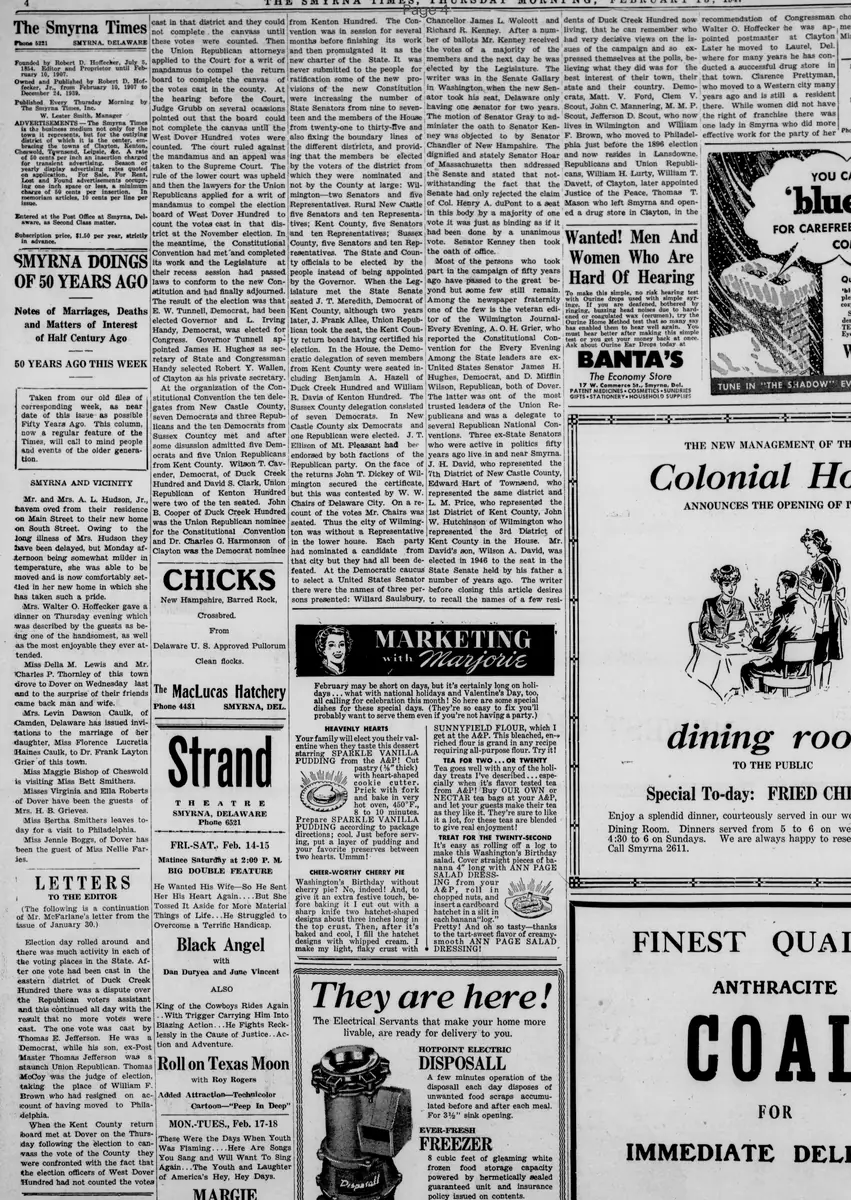
Election day rolled around and there was much activity in each of the voting places in the State. After one vote had been cast in the eastern district of Duck Creek Hundred there was a dispute over the Republican voters assistant and this continued all day with the result that no more votes were cast. The one vote was cast by Thomas E. Jefferson. He was a Democrat, while his son, ex-Post Master Thomas Jefferson was a staunch Union Republican. Thomas McCoy was the judge of election, taking the place of William F. Brown who had resigned on account of having moved to Philadelphia.
When the Kent County return board met at Dover on the Thursday following the election to canvass the vote of the County they were confronted with the fact that the election officers of West Dover Hundred had not counted the votes cast in that district and they could not complete the canvass until these votes were counted. Then the Union Republican attorneys applied to the Court for a writ of mandamus to compel the return board to complete the canvass of the votes cast in the county. At the hearing before the Court, Judge Grubb on several occasions pointed out that the board could not complete the canvass until the West Dover Hundred votes were counted. The court ruled against the mandamus and an appeal was taken to the Supreme Court. The rule of the lower court was upheld and then the lawyers for the Union Republicans applied for a writ of mandamus to compel the election board of West Dover Hundred to count the votes cast in that district at the November election. In the meantime the Constitutional Convention had met and completed its work and the Legislature at their recess session had passed laws to conform to the new Constitution and had finally adjourned.
The result of the election was that E. W. Tunnell, Democrat, had been elected Governor and L. Irving Handy, Democrat, was elected for Congress. Governor Tunnell appointed James H. Hughes as secretary of State and Congressman Handy selected Robert Y. Wallen, of Clayton as his private secretary.
At the organization of the Constitutional Convention the ten delegates from New Castle County, seven Democrats and three Republicans and the ten Democrats from Sussex County met and after some discussion admitted five Democrats and five Union Republicans from Kent County. Wilson T. Cavender, Democrat, of Duck Creek Hundred and David S. Clark, Union Republican of Kenton Hundred were two of the ten seated. John B. Cooper of Duck Creek Hundred was the Union Republican nominee for the Constitutional Convention and Dr. Charles G. Harmonson of Clayton was the Democrat nominee.
from Kenton Hundred. The Convention was in session for several months before finishing its work and then promulgated it as the new charter of the State. It was never submitted to the people for ratification some of the new provisions of the new Constitution were increasing the number of State Senators from nine to seventeen and the members of the House from twenty-one to thirty-five and also fixing the boundary lines of the different districts, and providing that the members be elected by the voters of the district from which they were nominated and not by the County at large: Wilmington—two Senators and five Representatives. Rural New Castle five Senators and ten Representatives; Kent County, five Senators and ten Representatives; Sussex County, five Senators and ten Representatives. The State and County officials to be elected by the people instead of being appointed by the Governor. When the Legislature met the State Senate seated J. T. Meredith, Democrat of Kent County, although two years later, J. Frank Allee, Union Republican took the seat, the Kent County return board having certified his election. In the House, the Democratic delegation of seven members from Kent County were seated including Benjamin A. Hazell of Duck Creek Hundred and William R. Davis of Kenton Hundred. The Sussex County delegation consisted of seven Democrats. In New Castle County six Democrats and one Republican were elected. J. T. Ellison of Mt. Pleasant had been endorsed by both factions of the Republican party. On the face of the returns John T. Dickey of Wilmington secured the certificate, but this was contested by W. W. Chairs of Delaware City. On a recount of the votes Mr. Chairs was seated. Thus the city of Wilmington was without a Representative in the lower house. Each party had nominated a candidate from that city but they had all been defeated. At the Democratic caucus to select a United States Senator there were the names of three persons presented: Willard Saulsbury, Chancellor James L. Wolcott and Richard R. Kenney. After a number of ballots Mr. Kenney received the votes of a majority of the members and the next day he was elected by the Legislature. The writer was in the Senate Gallery in Washington when the new Senator took his seat, Delaware only having one senator for two years. The motion of Senator Gray to administer the oath to Senator Kenney was objected to by Senator Chandler of New Hampshire. The dignified and stately Senator Hoar of Massachusetts then addressed the Senate and stated that notwithstanding the fact that the Senate had only rejected the claim of Col. Henry A. duPont to a seat in this body by a majority of one vote it was just as binding as if it had been done by a unanimous vote. Senator Kenney then took the oath of office.
Most of the persons who took part in the campaign of fifty years ago have passed to the great beyond but some few still remain. Among the newspaper fraternity one of the few is the veteran editor of the Wilmington Journal Every Evening, A. O. H. Grier, who reported the Constitutional Convention for the Every Evening. Among the State leaders are ex-United States Senator James H. Hughes, Democrat, and D. Mifflin Wilson, Republican, both of Dover. The latter was one of the most trusted leaders of the Union Republicans and was a delegate to several Republican National Conventions. Three ex-State Senators who were active in politics fifty years ago live in and near Smyrna. J. H. David, who represented the 7th District of New Castle County, Edward Hart of Townsend, who represented the same district and L. M. Price, who represented the 1st District of Kent County, John W. Hutchinson of Wilmington who represented the 3rd District of Kent County in the House. Mr. David's son, Wilson A. David, was elected in 1946 to the seat in the State Senate held by his father a number of years ago. The writer before closing this article desires to recall the names of a few residents of Duck Creek Hundred now living, that he can remember who had very decisive views on the issues of the campaign and so expressed themselves at the polls, believing what they did was for the best interest of their town, their state and their country. Democrats, Matt. V. Ford, Clem V. Scout, John C. Mannering, M. M. P. Scout, Jefferson D. Scout, who now lives in Wilmington and William F. Brown, who moved to Philadelphia just before the 1896 election and now resides in Lansdowne. Republicans and Union Republicans, William H. Lurty, William T. Davett, of Clayton, later appointed Justice of the Peace, Thomas T. Mason who left Smyrna and opened a drug store in Clayton, in the recommendation of Congressman Walter O. Hoffecker he was appointed postmaster at Clayton. Later he moved to Laurel, Del. where for many years he has conducted a successful drug store in that town. Clarence Prettyman, who moved to a Western city many years ago and is still a resident there. While women did not have the right of franchise there was one lady in Smyrna who did more effective work for the party of her choice than any man in the district.
TO THE EDITOR
(The following is a continuation of Mr. McFarlane's letter from the issue of January 30.)
Election day rolled around and there was much activity in each of the voting places in the State. After one vote had been cast in the eastern district of Duck Creek Hundred there was a dispute over the Republican voters assistant and this continued all day with the result that no more votes were cast. The one vote was cast by Thomas E. Jefferson. He was a Democrat, while his son, ex-Post Master Thomas Jefferson was a staunch Union Republican. Thomas McCoy was the judge of election, taking the place of William F. Brown who had resigned on account of having moved to Philadelphia.
When the Kent County return board met at Dover on the Thursday following the election to canvass the vote of the County they were confronted with the fact that the election officers of West Dover Hundred had not counted the votes cast in that district and they could not complete the canvass until these votes were counted. Then the Union Republican attorneys applied to the Court for a writ of mandamus to compel the return board to complete the canvass of the votes cast in the county. At the hearing before the Court, Judge Grubb on several occasions pointed out that the board could not complete the canvass until the West Dover Hundred votes were counted. The court ruled against the mandamus and an appeal was taken to the Supreme Court. The rule of the lower court was upheld and then the lawyers for the Union Republicans applied for a writ of mandamus to compel the election board of West Dover Hundred to count the votes cast in that district at the November election. In the meantime the Constitutional Convention had met and completed its work and the Legislature at their recess session had passed laws to conform to the new Constitution and had finally adjourned.
The result of the election was that E. W. Tunnell, Democrat, had been elected Governor and L. Irving Handy, Democrat, was elected for Congress. Governor Tunnell appointed James H. Hughes as secretary of State and Congressman Handy selected Robert Y. Wallen, of Clayton as his private secretary.
At the organization of the Constitutional Convention the ten delegates from New Castle County, seven Democrats and three Republicans and the ten Democrats from Sussex County met and after some discussion admitted five Democrats and five Union Republicans from Kent County. Wilson T. Cavender, Democrat, of Duck Creek Hundred and David S. Clark, Union Republican of Kenton Hundred were two of the ten seated. John B. Cooper of Duck Creek Hundred was the Union Republican nominee for the Constitutional Convention and Dr. Charles G. Harmonson of Clayton was the Democrat nominee.
from Kenton Hundred. The Convention was in session for several months before finishing its work and then promulgated it as the new charter of the State. It was never submitted to the people for ratification some of the new provisions of the new Constitution were increasing the number of State Senators from nine to seventeen and the members of the House from twenty-one to thirty-five and also fixing the boundary lines of the different districts, and providing that the members be elected by the voters of the district from which they were nominated and not by the County at large: Wilmington—two Senators and five Representatives. Rural New Castle five Senators and ten Representatives; Kent County, five Senators and ten Representatives; Sussex County, five Senators and ten Representatives. The State and County officials to be elected by the people instead of being appointed by the Governor. When the Legislature met the State Senate seated J. T. Meredith, Democrat of Kent County, although two years later, J. Frank Allee, Union Republican took the seat, the Kent County return board having certified his election. In the House, the Democratic delegation of seven members from Kent County were seated including Benjamin A. Hazell of Duck Creek Hundred and William R. Davis of Kenton Hundred. The Sussex County delegation consisted of seven Democrats. In New Castle County six Democrats and one Republican were elected. J. T. Ellison of Mt. Pleasant had been endorsed by both factions of the Republican party. On the face of the returns John T. Dickey of Wilmington secured the certificate, but this was contested by W. W. Chairs of Delaware City. On a recount of the votes Mr. Chairs was seated. Thus the city of Wilmington was without a Representative in the lower house. Each party had nominated a candidate from that city but they had all been defeated. At the Democratic caucus to select a United States Senator there were the names of three persons presented: Willard Saulsbury, Chancellor James L. Wolcott and Richard R. Kenney. After a number of ballots Mr. Kenney received the votes of a majority of the members and the next day he was elected by the Legislature. The writer was in the Senate Gallery in Washington when the new Senator took his seat, Delaware only having one senator for two years. The motion of Senator Gray to administer the oath to Senator Kenney was objected to by Senator Chandler of New Hampshire. The dignified and stately Senator Hoar of Massachusetts then addressed the Senate and stated that notwithstanding the fact that the Senate had only rejected the claim of Col. Henry A. duPont to a seat in this body by a majority of one vote it was just as binding as if it had been done by a unanimous vote. Senator Kenney then took the oath of office.
Most of the persons who took part in the campaign of fifty years ago have passed to the great beyond but some few still remain. Among the newspaper fraternity one of the few is the veteran editor of the Wilmington Journal Every Evening, A. O. H. Grier, who reported the Constitutional Convention for the Every Evening. Among the State leaders are ex-United States Senator James H. Hughes, Democrat, and D. Mifflin Wilson, Republican, both of Dover. The latter was one of the most trusted leaders of the Union Republicans and was a delegate to several Republican National Conventions. Three ex-State Senators who were active in politics fifty years ago live in and near Smyrna. J. H. David, who represented the 7th District of New Castle County, Edward Hart of Townsend, who represented the same district and L. M. Price, who represented the 1st District of Kent County, John W. Hutchinson of Wilmington who represented the 3rd District of Kent County in the House. Mr. David's son, Wilson A. David, was elected in 1946 to the seat in the State Senate held by his father a number of years ago. The writer before closing this article desires to recall the names of a few residents of Duck Creek Hundred now living, that he can remember who had very decisive views on the issues of the campaign and so expressed themselves at the polls, believing what they did was for the best interest of their town, their state and their country. Democrats, Matt. V. Ford, Clem V. Scout, John C. Mannering, M. M. P. Scout, Jefferson D. Scout, who now lives in Wilmington and William F. Brown, who moved to Philadelphia just before the 1896 election and now resides in Lansdowne. Republicans and Union Republicans, William H. Lurty, William T. Davett, of Clayton, later appointed Justice of the Peace, Thomas T. Mason who left Smyrna and opened a drug store in Clayton, in the recommendation of Congressman Walter O. Hoffecker he was appointed postmaster at Clayton. Later he moved to Laurel, Del. where for many years he has conducted a successful drug store in that town. Clarence Prettyman, who moved to a Western city many years ago and is still a resident there. While women did not have the right of franchise there was one lady in Smyrna who did more effective work for the party of her choice than any man in the district.
What sub-type of article is it?
Historical
Informative
Reflective
What themes does it cover?
Politics
Constitutional Rights
What keywords are associated?
1896 Delaware Election
Constitutional Convention
Union Republicans
Kent County Politics
E W Tunnell
Richard R Kenney
Duck Creek Hundred
What entities or persons were involved?
Mr. Mcfarlane
The Editor
Letter to Editor Details
Author
Mr. Mcfarlane
Recipient
The Editor
Main Argument
recounts the events, disputes, and outcomes of the 1896 delaware election and constitutional convention, highlighting key figures and changes in state governance.
Notable Details
Dispute In Duck Creek Hundred Allowing Only One Vote
Mandamus Proceedings For Vote Counting
New Constitution Not Ratified By People
Election Of Richard R. Kenney To U.S. Senate Amid Controversy
Surviving Participants From 1896 Campaign