Thank you for visiting SNEWPapers!
Sign up free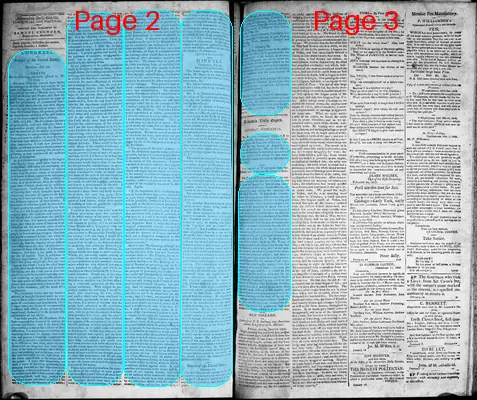
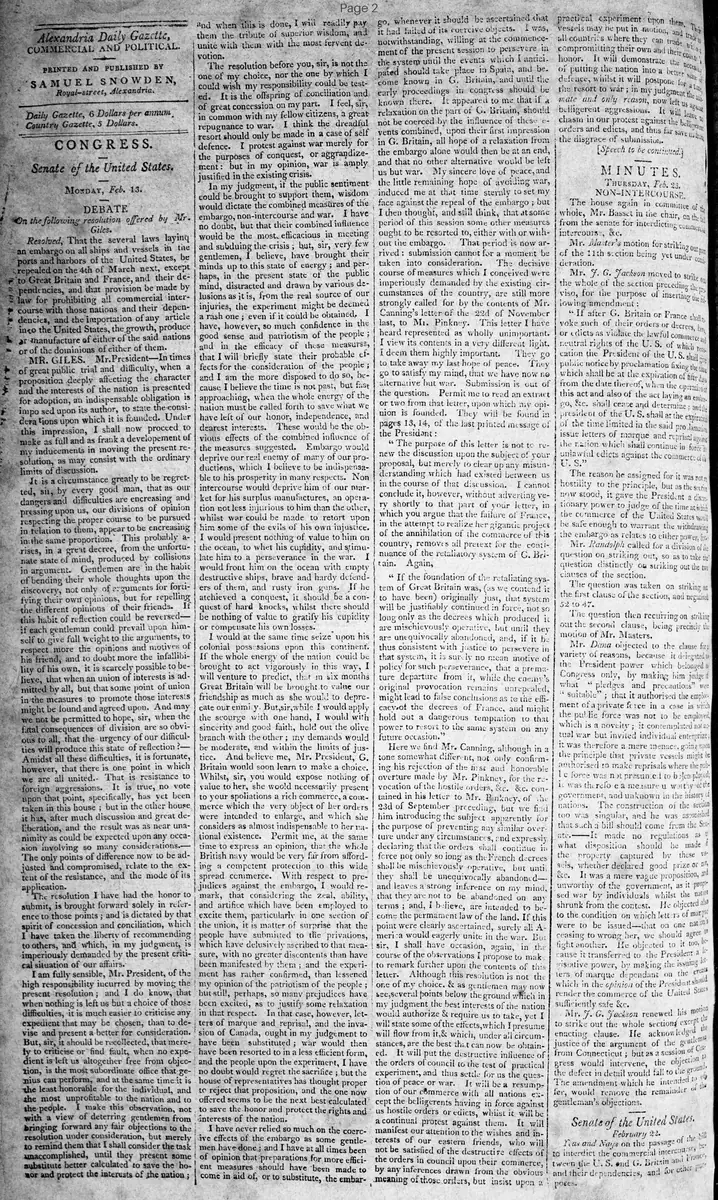
Alexandria Daily Gazette, Commercial & Political
Alexandria, Virginia
What is this article about?
US congressional proceedings in February 1811 on foreign policy: Senate debate led by Mr. Giles on repealing embargo except against Britain and France, proposing non-intercourse; House committee discussions on related bill, amendments debated; Senate passes non-intercourse act 19-12; other nominations and rumors noted.
Merged-components note: Merged congressional proceedings from pages 2 and 3 into a single story component, as they form a continuous narrative on Senate and House debates, votes, and related news.
Clippings
1 of 2
OCR Quality
Full Text
Senate of the United States
MONDAY, Feb. 13.
DEBATE
On the following resolution offered by Mr. Giles.
Resolved, That the several laws laying an embargo on all ships and vessels in the ports and harbors of the United States, be repealed on the 4th of March next, except to Great Britain and France, and their dependencies, and that provision be made, by law for prohibiting all commercial intercourse with those nations and their dependencies, and the importation of any article into the United States, the growth, produce or manufacture of either of the said nations or of the dominions of either of them.
MR. GILES. Mr. President--In times of great public trial and difficulty, when a proposition deeply affecting the character and the interests of the nation is presented for adoption, an indispensable obligation is imposed upon its author, to state the considerations upon which it is founded. Under this impression, I shall now proceed to make as full and as frank a development of my inducements in moving the present resolution, as may consist with the ordinary limits of discussion.
It is a circumstance greatly to be regretted, sir, by every good man, that as our dangers and difficulties are increasing and respecting the proper course to be pursued pressing upon us, our divisions of opinion in relation to them, appear to be increasing in the same proportion. This probably arises, in a great degree, from the unfortunate state of mind, produced by collisions in argument. Gentlemen are in the habit of bending their whole thoughts upon the discovery, not only of arguments for fortifying their own opinions, but for repelling the different opinions of their friends. If this habit of reflection could be reversed--if each gentleman could prevail upon himself to give full weight to the arguments, to respect more the opinions and motives of his friend, and to doubt more the infallibility of his own, it is scarcely possible to believe, that when an union of interests is admitted by all, but that some point of union in the measures to promote those interests might be found and agreed upon. And may we not be permitted to hope, sir, when the fatal consequences of division are so obvious to all, that the urgency of our difficulties will produce this state of reflection ?---
Amidst all these difficulties, it is fortunate, however, that there is one point in which we are all united. That is resistance to foreign aggressions. It is true, no vote upon that point, specifically, has yet been taken in this house ; but in the other house it has, after much discussion and great deliberation, and the result was as near unanimity as could be expected upon any occasion involving so many considerations.---
The only points of difference now to be adjusted and compromised, relate to the extent of the resistance, and the mode of its application.
The resolution I have had the honor to submit, is brought forward solely in reference to those points ; and is dictated by that spirit of concession and conciliation, which I have taken the liberty of recommending to others, and which, in my judgment, is imperiously demanded by the present critical situation of our affairs.
I am fully sensible, Mr. President, of the high responsibility incurred by moving the present resolution; and I do know, that when nothing is left us but a choice of those difficulties, it is much easier to criticise any expedient that may be chosen, than to devise and present a better for consideration.
But, sir, it should be recollected, that merely to criticise or find fault, when no expedient is let us altogether free from objection, is the most subordinate office that genius can perform, and at the same time it is the least honorable for the individual, and the most unprofitable to the nation and to the people. I make this observation, not with a view of deterring gentlemen from bringing forward any fair objections to the resolution under consideration, but merely to remind them that I shall consider the task unaccomplished, until they present some substitute better calculated to save the honor and protect the interests of the nation ; and when this is done, I will readily pay them the tribute of superior wisdom, and unite with them with the most fervent devotion.
The resolution before you, sir, is not the one of my choice, nor the one by which I could wish my responsibility could be tested. It is the offspring of conciliation and of great concession on my part. I feel, sir, in common with my fellow citizens, a great repugnance to war. I think the dreadful resort should only be made in a case of self defence. I protest against war merely for the purposes of conquest, or aggrandizement: but in my opinion, war is amply justified in the existing crisis.
In my judgment, if the public sentiment could be brought to support them, wisdom would dictate the combined measures of the embargo, non-intercourse and war. I have no doubt, but that their combined influence would be the most efficacious in meeting and subduing the crisis ; but, sir, very few gentlemen, I believe, have brought their minds up to this state of energy ; and perhaps, in the present state of the public mind, distracted and drawn by various delusions as it is, from the real source of our injuries, the experiment might be deemed a rash one ; even if it could be obtained, I have, however, so much confidence in the good sense and patriotism of the people ; and in the efficacy of these measures, that I will briefly state their probable effects for the consideration of the people ; and I am the more disposed to do so, because I believe the time is not past, but fast approaching, when the whole energy of the nation must be called forth to save what we have left of our honor, independence, and dearest interests. These would be the obvious effects of the combined influence of the measures suggested. Embargo would deprive our real enemy of many of our productions, which I believe to be indispensable to his prosperity in many respects. Non intercourse would deprive him of our market for his surplus manufactures, an operation not less injurious to him than the other, whilst war could be made to retort upon him some of the evils of his own injustice.
I would present nothing of value to him on the ocean, to whet his cupidity, and stimulate him to a perseverance in the war. I would front him on the ocean with empty destructive ships. brave and hardy defenders of them, and rusty iron guns. If he achieved a conquest, it should be a conquest of hard knocks, whilst there should be nothing of value to gratify his cupidity or compensate his own losses.
I would at the same time seize upon his colonial possessions upon this continent. If the whole energy of the nation could be brought to act vigorously in this way, I will venture to predict, that in six months Great Britain will be brought to value our friendship as much as she would to depreciate our enmity. But,sir,while I would apply the scourge with one hand, I would with sincerity and good faith, hold out the olive branch with the other; my demands would be moderate, and within the limits of justice. And believe me, Mr. President, G. Britain would soon learn to make a choice.
Whilst, sir, you would expose nothing of value to her, she would necessarily present to your spoliations a rich commerce, a commerce which the very object of her orders were intended to enlarge, and which she considers as almost indispensable to her national existence. Permit me, at the same time to express an opinion, that the whole British navy would be very far from affording a competent protection to this wide spread commerce. . With respect to prejudices against the embargo, I would remark, that considering the zeal, ability, and artifice which have been employed to excite them, particularly in one section of the union, it is matter of surprise that the people have submitted to those privations, which have delusively ascribed to that measure, with no greater discontents than have been manifested by them : and the experiment has rather confirmed, than lessened my opinion of the patriotism of the people ; but still, perhaps, so many prejudices have been excited, as to justify some relaxation in that respect. In that case, however, letters of marque and reprisal, and the invasion of Canada, ought in my judgement to have been substituted; war would then have been resorted to in a less efficient form, and the people upon the experiment, I have no doubt would regret the sacrifice ; but the house of representatives has thought proper to reject that proposition, and the one now offered seems to be the next best calculated to save the honor and protect the rights and interests of the nation.
I have never relied so much on the coercive effects of the embargo as some gentlemen have done ; and I have at all times been of opinion that preparations for more efficient measures 'should have been made to come in aid of, or to substitute, the embargo, whenever it should be ascertained that it had failed of its coercive objects. I was, notwithstanding, willing at the commencement of the present session to persevere in the system until the events which I anticipated should take place in Spain, and become known in G. Britain, and until the early proceedings in congress should be known there. It appeared to me that if a relaxation on the part of G. Britain, should not be coerced by the influence of these events combined, upon their first impression in G. Britain, all hope of a relaxation from the embargo alone would then be at an end, and that no other alternative would be left us but war. My sincere love of peace, and the little remaining hope of avoiding war, induced me at that time sternly to set my face against the repeal of the embargo ; but I then thought, and still think, that at some period of this session some other measures ought to be resorted to, either with or without the embargo. : That period is now arrived: submission cannot for a moment be taken into consideration. The decisive course of measures which I conceived were imperiously demanded by the existing circumstances of the country, are still more strongly called for by the contents of Mr. Canning's letter of the 22d of November last, to M. Pinkney. This letter I have heard represented as wholly unimportant. I view its contents in a very different light. I deem them highly important. They go to take away my last hope of peace. They go to satisfy my mind, that we have now no alternative but war. Submission is out of the question. Permit me to read an extract or two from that letter, upon which my opinion is founded. They will be found in pages 13, 14, of the last printed message of the President :
" The purpose of this letter is not to renew the discussion upon the subject of your proposal, but merely to clear up any misunderstanding which had existed between us in the course of that discussion. I cannot conclude it, however, without adverting very shortly to that part of your letter, in which you argue that the failure of France, in the attempt to realize her gigantic project of the annihilation of the commerce of this country, removes all pretext for the continuance of the retaliatory system of G. Britain. Again,
" If the foundation of the retaliating system of Great Britain was, (as we contend it to have been) originally just, that system will be justifiably continued in force, not so long only as the decrees which produced it are mischievously operative, but until they are unequivocally abandoned, and, if it be thus consistent with justice to persevere in that system, it is surely no mean motive of policy for such perseverance, that a premature departure from it, while the enemy's original provocation remains unrepealed, might lead to false conclusions as to the efficacy of the decrees of France, and might hold out a dangerous temptation to that power to resort to the same system on any future occasion."
Here we find Mr. Canning, although in a tone somewhat different, not only confirming his rejection of the first and honorable overture made by Mr. Pinkney, for the revocation of the hostile orders, &c. &c. contained in his letter to Mr. Pinkney, of the 23d of September preceding, but we find him introducing the subject apparently for the purpose of preventing any similar overture under any circumstances, and expressly declaring that the orders shall continue in force not only so long as the French decrees shall be mischievously operative, but until they shall be unequivocally abandoned-- and leaves a strong inference on my mind, that they are not to be abandoned on any terms ; and, I believe, are intended to become the permanent law of the land. If this point were clearly ascertained, surely all America would eagerly unite in the war. But sir, I shall have occasion, again, in the course of the observations I propose to make, to remark further upon the contents of this letter. Although this resolution is not the one of my choice. & as gentlemen may now see,several points below the ground which in my judgment the best interests of the nation would authorize & require us to take, yet I will state some of the effects,which I presume will flow from it,& which, under all circumstances, are the best that can now be obtained. It will put the destructive influence of the orders of council to the test of practical experiment, and thus settle for us the question of peace or war. It will be a resumption of our commerce with all nations except the belligerents having in force against us hostile orders or edicts, whilst it will be a continual protest against them. It will manifest our attention to the wishes and interests of our eastern friends, who will not be satisfied of the destructive effects of the orders in council upon their commerce, by any inferences drawn from the obvious meaning of those orders, but insist upon a practical experiment upon them. It will demonstrate the necessity of putting the nation into a better state of defence, whilst it will postpone for a time the resort to war; in my judgment the belligerent mate and only reason now. It will leave no chasm in our protest against the belligerent orders and edicts, and thus save the disgrace of submission.
[Speech to be continued.]
MINUTES.
THURSDAY, Feb. 23.
NON-INTERCOURSE.
The house again in committee of the whole, Mr. Basset in the chair, on the bill from the senate for interdicting commercial intercourse, &c.
Mr. Master's motion for striking out part of the 11th section being yet under consideration.
Mr. F. G. Jackson moved to strike out the whole of the section preceding the proviso, for the purpose of inserting the following amendment :
" If after G. Britain or France shall revoke such of their orders or decrees, laws or edicts as violate the lawful commerce and neutral rights of the U. S. of which revocation the President of the U.S. shall public notice by proclamation fixing the time which shall be at the expiration of fifty days from the date thereof, when the operation of this act and also of the act laying an embargo, &c. shall cease and determine ; and the president of the U. S. shall at the expiration of the time limited in the said proclamation issue letters of marque and reprisal against the nation which shall continue in force its unlawful edicts against the commerce of the U. S."
The reason he assigned for it was not a hostility to the principle, but as the section now stood, it gave the President a discretionary power to judge of the time at which the commerce of the United States would be safe enough to warrant the withdrawing the embargo as relates to either power, &c.
Mr. Randolph called for a division of the question on striking out, so as to take the question distinctly on striking out the two clauses of the section.
The question was taken on striking out the first clause of the section, and negatived 52 to 47.
The question then recurring on striking out the second clause, being precisely the motion of Mr. Masters.
Mr. Dana objected to the clause for a variety of reasons, because it delegated to the President power which belonged to Congress only, by making him judge of what " pledges and precautions" were " suitable" ; that it authorised the employment of a private force in a case in which the public force was not to be employed which is a novelty ; it contemplated not actual war but invited individual enterprize; it was therefore a mere menace, going upon the principle that private vessels might be authorised to make reprisals where the public force was not presumed to be employed; it was therefore a measure unworthy of the government, and unknown in the history of nations. The construction of the section too was singular, and he was astonished that such a bill should come from the Senate.--It made no regulations as to what disposition should be made in the property captured by these vessels, whether declared good prize or not, &c. It was a mere vague proposition, and unworthy of the government, as it proposed war by individuals whilst the nation shrunk from the contest. He objected also to the condition on which letters of marque were to be issued--that on one nation's ceasing to wrong her, we should agree to cause it transferred to the President a right another. He objected to it too, because letters of marque dependant on the events legislative power, by making the issuing let. which in the opinion of the President should render the commerce of the United States sufficiently safe &c. to strike out the whole section except the enacting clause.
Mr. Y. G. Jackson renewed his motion justice of the argument of the gentleman from Connecticut ; but as a session of Congress would intervene, the defect in detail would fall to the ground the objection fer, would remove The amendment which he the remainder of the intended to ofy gentleman's objections.
Senate of the United States.
Yeas and Nays on the passage of the bill between the U. S. and G. Britain and France
February 22.
An act to interdict the commercial intercourse between the United States and Great Britain and France and their dependencies, and for other purposes.
Nays—Messrs. Anderson, Condit, Franklin, Leib, Matthewson, Meigs, Milledge, Pope, Robinson, Smith of N. Y., Smith of Ten., Thurston.
Nays—Messrs. Bayard, Crawford, Giles, and Tiffin. 21.
Yeas—Messrs. Goodrich, Hillhouse, Lloyd, Parker, Pickering, Reed, Sumter, Turner and White. 12.
Resolved, That the surveyor of the public buildings do cause to be prepared for the accommodation of the Senate, at the next session of Congress, the room called the library room, in the manner stated in the surveyor's report, with as little expense as may consist with the reasonable comfort of the members and the convenience of spectators.
Read a third time and passed. - [This bill freeing from postage all letters and packets to Thomas Jefferson was passed the house.]
February 13.
The act from the house of representatives, for imposing additional duties upon all goods, wares, and merchandise, imported from any foreign port or place, passed, with amendments, to a third reading. Yeas 20; Nays 9.
The President yesterday nominated to the Senate Mr. Short, as minister plenipotentiary to the Emperor of Russia. Mr. Short was the bearer of dispatches to France in the Union. We should like to know whether this is intended as a reward for the fidelity with which he has made confidential communications to the emperor Napoleon.
It is rumored at Washington that Mr. Gallatin is to be the next Secretary of State.
The House of Representatives was yesterday engaged till after five o'clock, on the bill from the Senate for interdicting intercourse between France, Great Britain, and this country, and raising the embargo on the 4th of March. It passed the committee of the whole house with but one amendment of importance. That was striking out so much of one of the sections as gives the power to the president to grant letters of marque and reprisal. It was then reported to the house, immediately taken up and the amendments made in committee of the whole confirmed by large majorities. Various motions were made to fix the time for raising the embargo at a more distant day than the 4th of March, on the ground that the time was too short between this and the 4th of March, that it would not be giving an equal chance to the remote parts of the U. S. In the course of some observations made by Mr. Troup of Georgia in favor of a distant day he said that the Embargo was a wise, prudent and politic measure, intended to preserve our ships, seamen and property which it had done--- that the ports adjacent to the seat of government (Alexandria for instance) had experienced the great benefits arising from that measure. at a much earlier day than the ports in Georgia, and that it would be the greatest injustice to allow them also the indisputable advantages which would be derived from the Embargo's being raised on the fourth of March.--Mr. Randolph in reply, said he thought it would be no more than fair that as the citizens of Alexandria and other adjacent ports, had possessed such immense advantages at the time of laying the embargo, over their more distant brethren, that they should experience some of the disadvantages which the gentleman had said would result from raising it at an early day.
What sub-type of article is it?
What themes does it cover?
What keywords are associated?
What entities or persons were involved?
Where did it happen?
Story Details
Key Persons
Location
United States Senate And House Of Representatives, Washington
Event Date
February 1811
Story Details
Debate in US Senate on resolution by Mr. Giles to repeal embargo except against Britain and France, proposing non-intercourse; Giles' speech argues for resistance to foreign aggressions, critiques British policy via Canning's letter, advocates combined measures including war if needed. House debates amendments to non-intercourse bill, objections to presidential powers on letters of marque; Senate passes bill 19-12 on Feb 22; additional proceedings on duties, nominations, and rumors.