Thank you for visiting SNEWPapers!
Sign up free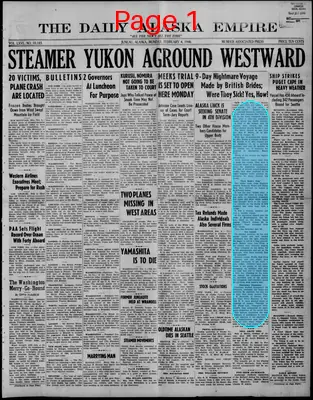
Story
February 4, 1946
The Daily Alaska Empire
Juneau, Juneau County, Alaska
What is this article about?
The first group of 451 British war brides and 175 children arrived in New York on February 4 aboard the Army transport Argentina after a stormy nine-day voyage from Southampton, enduring severe seasickness and risks, destined for homes across 44 U.S. states.
Clipping

OCR Quality
95%
Excellent
Full Text
NEW YORK. Feb. 4. - Storm-tossed and tired, but radiant with anticipation, the first group of "British brides" - English women who married American soldiers during the war - reached New York today on the Army transport Argentina, after a nine-day nightmare voyage across the North Atlantic.
A total of 451 women and 175 children were aboard the ship which docked shortly before 7 a.m.
The wives ranged in age from Mrs. Ben F. Butler, 16, to Mrs. Harold N. Cooper, 44.
With her 13-months-old daughter, Mrs. Butler is enroute to Roanoke Rapids, N. C. Mrs. Cooper and her daughter, 17, by a previous marriage, and son, 15 months by the present one, is rejoining her husband in Manhattan Beach, Calif.
Thirty of the women are expectant mothers.
Three literally risked their lives to make the voyage. They were in advanced stages of pregnancy, and when the Argentina encountered the first of several record-breaking storms, they were confined to the ship's hospital under constant observation by Army doctors and nurses.
"First Bride's Ship"
The brides came from England, Ireland, Scotland, Wales and Malta. They were destined for homes in 44 different states.
It was the first "brides' ship" in more than 200 years to bring British girls to American husbands. Not since the days when sailing ships brought wives to the American colonists on the shores of New England has there been such a voyage.
It was a strange, pathetic and even a terrible voyage.
As the Argentina slipped past the docks in Southampton, the women, lined on the decks, began singing "There'll Always Be An England." Tears streamed down their cheeks.
That was Saturday, Jan. 26.
Get Seasick
On Sunday morning, as the ship passed land's end and headed northward into the open Atlantic, she began to roll in a long ground-swell. Before noon, four-fifths of the women were violently seasick.
They collapsed on the decks, fell in the passageways, and sat on the staircases, with faces averted, limp and miserable.
Doctors, nurses, WACs, Red Cross personnel and the ship's crew worked frantically to get them to their cabins. Children were abandoned in the cabins, or left alone, screaming, by mothers who were too weak and sick to reach them.
A little boy, climbing on the deck-rail, almost fell overboard before the horrified eyes of his mother who struggled, half-crawling, across the pitching deck toward him.
Emergency Inspection
Crewmen worked throughout the afternoon, swabbing the decks and corridors. By nightfall, the ship was so dirty that Army doctors, Capt. L. E. Reynolds, of Denver, Colo., and Capt. Peter Bisconti, of Sea-ford, N. Y., were worried about an outbreak of disease. Through Lt. Col. Floyd Lyle, Transport Commander, they announced an emergency inspection of the entire ship.
The doctors attributed the high incidence of seasickness to nervous strain, reaction to the emotions of fear, apprehension and high excitement that beset women who were leaving their homes to go to a new and unfamiliar country.
A total of 451 women and 175 children were aboard the ship which docked shortly before 7 a.m.
The wives ranged in age from Mrs. Ben F. Butler, 16, to Mrs. Harold N. Cooper, 44.
With her 13-months-old daughter, Mrs. Butler is enroute to Roanoke Rapids, N. C. Mrs. Cooper and her daughter, 17, by a previous marriage, and son, 15 months by the present one, is rejoining her husband in Manhattan Beach, Calif.
Thirty of the women are expectant mothers.
Three literally risked their lives to make the voyage. They were in advanced stages of pregnancy, and when the Argentina encountered the first of several record-breaking storms, they were confined to the ship's hospital under constant observation by Army doctors and nurses.
"First Bride's Ship"
The brides came from England, Ireland, Scotland, Wales and Malta. They were destined for homes in 44 different states.
It was the first "brides' ship" in more than 200 years to bring British girls to American husbands. Not since the days when sailing ships brought wives to the American colonists on the shores of New England has there been such a voyage.
It was a strange, pathetic and even a terrible voyage.
As the Argentina slipped past the docks in Southampton, the women, lined on the decks, began singing "There'll Always Be An England." Tears streamed down their cheeks.
That was Saturday, Jan. 26.
Get Seasick
On Sunday morning, as the ship passed land's end and headed northward into the open Atlantic, she began to roll in a long ground-swell. Before noon, four-fifths of the women were violently seasick.
They collapsed on the decks, fell in the passageways, and sat on the staircases, with faces averted, limp and miserable.
Doctors, nurses, WACs, Red Cross personnel and the ship's crew worked frantically to get them to their cabins. Children were abandoned in the cabins, or left alone, screaming, by mothers who were too weak and sick to reach them.
A little boy, climbing on the deck-rail, almost fell overboard before the horrified eyes of his mother who struggled, half-crawling, across the pitching deck toward him.
Emergency Inspection
Crewmen worked throughout the afternoon, swabbing the decks and corridors. By nightfall, the ship was so dirty that Army doctors, Capt. L. E. Reynolds, of Denver, Colo., and Capt. Peter Bisconti, of Sea-ford, N. Y., were worried about an outbreak of disease. Through Lt. Col. Floyd Lyle, Transport Commander, they announced an emergency inspection of the entire ship.
The doctors attributed the high incidence of seasickness to nervous strain, reaction to the emotions of fear, apprehension and high excitement that beset women who were leaving their homes to go to a new and unfamiliar country.
What sub-type of article is it?
Historical Event
Journey
Survival
What themes does it cover?
Family
Survival
Triumph
What keywords are associated?
British Brides
War Wives
Atlantic Voyage
Seasickness
Army Transport
New York Arrival
Pregnant Mothers
Historical Voyage
What entities or persons were involved?
Mrs. Ben F. Butler
Mrs. Harold N. Cooper
Capt. L. E. Reynolds
Capt. Peter Bisconti
Lt. Col. Floyd Lyle
Where did it happen?
New York; North Atlantic; Southampton
Story Details
Key Persons
Mrs. Ben F. Butler
Mrs. Harold N. Cooper
Capt. L. E. Reynolds
Capt. Peter Bisconti
Lt. Col. Floyd Lyle
Location
New York; North Atlantic; Southampton
Event Date
Feb. 4; Jan. 26
Story Details
451 British war brides and 175 children arrived in New York on the Argentina after a stormy voyage from Southampton, facing severe seasickness, pregnancy risks, and near-accidents, marking the first such ship in over 200 years.