Thank you for visiting SNEWPapers!
Sign up free
The Rhode Islander
Newport, Newport County, Rhode Island
What is this article about?
Daniel Webster opposes the annexation of Texas to the United States in a detailed letter, arguing constitutional limits, lack of necessity unlike Louisiana and Florida acquisitions, and moral opposition to extending slavery. He references Texas minister Memucan Hunt's 1837 proposition and Secretary Forsyth's response, warning of risks to the Union.
Merged-components note: Merged continuation of Daniel Webster's letter on the annexation of Texas across columns on page 1 and into page 2
Clippings
1 of 2
OCR Quality
Full Text
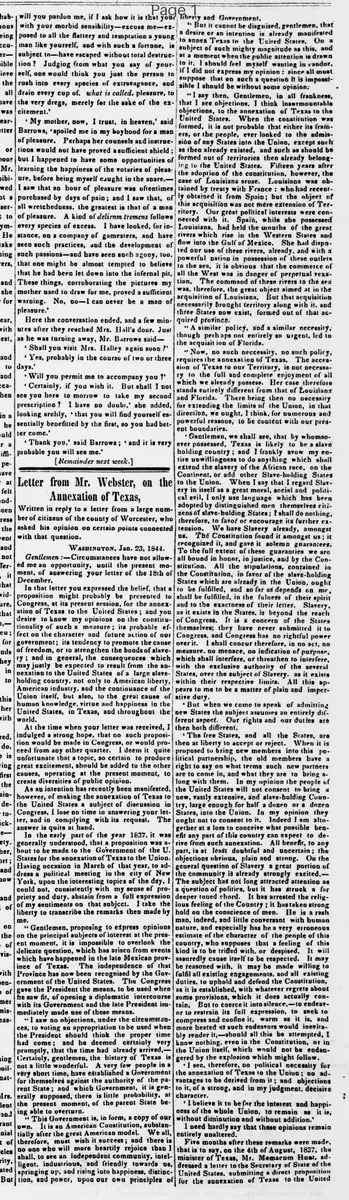
"But it cannot be disguised, gentlemen, that a desire or an intention is already manifested to annex Texas to the United States. On a subject of such mighty magnitude as this, and at a moment when the public attention is drawn to it; I should feel myself wanting in candor, if I did not express my opinion: since all must suppose that on such a question it is impossible I should be without some opinion:
I say then, Gentlemen, in all frankness, that I see objections. I think insurmountable objections, to the annexation of Texas to the United States. When the constitution was formed, it is not probable that either its framers, or the people, ever looked to the admission of any States into the Union, except such as they already existed. and such as should be formed out of territories then already belonging to the United States. Fifteen years after the adoption of the constitution, however, the case of Louisiana arose. Louisiana was obtained by treaty with France: who had recently obtained it from Spain; but the object of this acquisition was not mere extension of Territory. Our great political interests were connected with it. Spain, while she possessed Louisiana, had held the mouths of the great rivers which rise in the Western States and flow into the Gulf of Mexico. She had disputed our use of these rivers already. and with a powerful nation in possession of these outlets to the sea, it is obvious that the commerce of all the West was in danger of perpetual vexation. The command of these rivers to the sea was, therefore, the great object aimed at in the acquisition of Louisiana. But that acquisition necessarily brought territory along with it, and three States now exist, formed out of that acquired province.
"A similar policy, and a similar necessity, though perhaps not entirely so urgent, led to the acquisition of Florida.
"Now, no such necessity, no such policy, requires the annexation of Texas. The accession of Texas to our Territory, is not necessary to the full and complete enjoyment of all which we already possess. Her case therefore stands entirely different from that of Louisiana and Florida. There being then no necessity for extending the limits of the Union, in that direction, we ought, I think, for numerous and powerful reasons, to be content with our present boundaries.
Gentlemen, we shall see, that by whomsoever possessed, 'Texas is likely to be a slave holding country; and I frankly avow my entire unwillingness to do anything which shall extend the slavery of the African race, on the Continent, or add other Slave-holding States to the Union. When I say that I regard Slavery in itself as a great moral, social and political evil, I only use language which has been adopted by distinguished men themselves citizens of slave-holding States; I shall do nothing, therefore, to favor or encourage its further extension. We have Slavery already, amongst us. The Constitution found it amongst us; it recognized it, and gave it solemn guarantees. To the full extent of these guarantees we are all bound in honor, in justice, and by the Constitution. All the stipulations, contained in the Constitution, in favor of the slave-holding States which are already in the Union, ought to be fulfilled, and so far as depends on me, shall be fulfilled, in the fulness of their spirit and to the exactness of their letter. Slavery, as it exists in the States, is beyond the reach of Congress. It is a concern of the States themselves; they have never submitted it to Congress, and Congress has no rightful power over it. I shall concur therefore, in no act, no measure, no menace, no indication of purpose, which shall interfere, or threaten to interfere, with the exclusive authority of the several States, over the subject of Slavery, as it exists within their respective limits. All this appears to me to be a matter of plain and imperative duty.
But when we come to speak of admitting new States the subject assumes an entirely different aspect. Our rights and our duties are then both different.
The free States, and all the States, are then at liberty to accept or reject. When it is proposed to bring new members into this political partnership, the old members have a right to say on what terms such new partners are to come in, and what they are to bring along with them. In my opinion the people of the United States will not consent to bring a new, vastly extensive, and slave-holding Country, large enough for half a dozen or a dozen States, into the Union. In my opinion they ought not to consent to it. Indeed I am altogether at a loss to conceive what possible benefit any part of this country can expect to derive from such annexation. All benefit, to any part, is at least doubtful and uncertain; the objections obvious, plain and strong. On the general question of Slavery a great portion of the community is already strongly excited,—The subject has not long attracted attention as a question of politics, but it has struck a far deeper toned chord. It has arrested the religious feeling of the Country; it has taken strong hold on the conscience of men. He is a rash man, indeed, and little conversant with human nature, and especially has he a very erroneous estimate of the character of the people of this country, who supposes that a feeling of this kind is to be trifled with, or despised. It will assuredly cause itself to be respected. It may be reasoned with, it may be made willing to fulfill all existing engagements, and all existing duties, to uphold and defend the Constitution, as it is established, with whatever regrets about some provisions, which it does actually contain: But to coerce it into silence,—to endeavor to restrain its full expression, to seek to compress and confine it, warm as it is, and more heated as such endeavors would inevitably render it;—should all this be attempted, I know nothing, even in the Constitution, or in the Union itself, which would not be endangered by the explosion which might follow.
I see, therefore, no political necessity for the annexation of Texas in the Union: no advantages to be derived from it; and objections to it, of a strong, and in my judgment, decisive character.
I believe it to be for the interest and happiness of the whole Union, to remain as it is, without diminution and without addition.
I need hardly say that these opinions remain entirely unaltered.
Five months after these remarks were made, that is to say, on the 4th of August, 1837, the minister of Texas, Mr. Memucan Hunt, addressed a letter to the Secretary of State of the United States, submitting a direct proposition for the annexation of Texas to the United States. On a subject of such mighty magnitude as this, and at a moment when the public attention is drawn to it; I should feel myself wanting in candor, if I did not express my opinion: since all must suppose that on such a question it is impossible I should be without some opinion:
I say then, Gentlemen, in all frankness, that I see objections. I think insurmountable objections, to the annexation of Texas to the United States. When the constitution was formed, it is not probable that either its framers, or the people, ever looked to the admission of any States into the Union, except such as they already existed. and such as should be formed out of territories then already belonging to the United States. Fifteen years after the adoption of the constitution, however, the case of Louisiana arose. Louisiana was obtained by treaty with France: who had recently obtained it from Spain; but the object of this acquisition was not mere extension of Territory. Our great political interests were connected with it. Spain, while she possessed Louisiana, had held the mouths of the great rivers which rise in the Western States and flow into the Gulf of Mexico. She had disputed our use of these rivers already. and with a powerful nation in possession of these outlets to the sea, it is obvious that the commerce of all the West was in danger of perpetual vexation. The command of these rivers to the sea was, therefore, the great object aimed at in the acquisition of Louisiana. But that acquisition necessarily brought territory along with it, and three States now exist, formed out of that acquired province.
"A similar policy, and a similar necessity, though perhaps not entirely so urgent, led to the acquisition of Florida.
"Now, no such necessity, no such policy, requires the annexation of Texas. The accession of Texas to our Territory, is not necessary to the full and complete enjoyment of all which we already possess. Her case therefore stands entirely different from that of Louisiana and Florida. There being then no necessity for extending the limits of the Union, in that direction, we ought, I think, for numerous and powerful reasons, to be content with our present boundaries.
Gentlemen, we shall see, that by whomsoever possessed, 'Texas is likely to be a slave holding country; and I frankly avow my entire unwillingness to do anything which shall extend the slavery of the African race, on the Continent, or add other Slave-holding States to the Union. When I say that I regard Slavery in itself as a great moral, social and political evil, I only use language which has been adopted by distinguished men themselves citizens of slave-holding States; I shall do nothing, therefore, to favor or encourage its further extension. We have Slavery already, amongst us. The Constitution found it amongst us; it recognized it, and gave it solemn guarantees. To the full extent of these guarantees we are all bound in honor, in justice, and by the Constitution. All the stipulations, contained in the Constitution, in favor of the slave-holding States which are already in the Union, ought to be fulfilled, and so far as depends on me, shall be fulfilled, in the fulness of their spirit and to the exactness of their letter. Slavery, as it exists in the States, is beyond the reach of Congress. It is a concern of the States themselves; they have never submitted it to Congress, and Congress has no rightful power over it. I shall concur therefore, in no act, no measure, no menace, no indication of purpose, which shall interfere, or threaten to interfere, with the exclusive authority of the several States, over the subject of Slavery, as it exists within their respective limits. All this appears to me to be a matter of plain and imperative duty.
But when we come to speak of admitting new States the subject assumes an entirely different aspect. Our rights and our duties are then both different.
The free States, and all the States, are then at liberty to accept or reject. When it is proposed to bring new members into this political partnership, the old members have a right to say on what terms such new partners are to come in, and what they are to bring along with them. In my opinion the people of the United States will not consent to bring a new, vastly extensive, and slave-holding Country, large enough for half a dozen or a dozen States, into the Union. In my opinion they ought not to consent to it. Indeed I am altogether at a loss to conceive what possible benefit any part of this country can expect to derive from such annexation. All benefit, to any part, is at least doubtful and uncertain; the objections obvious, plain and strong. On the general question of Slavery a great portion of the community is already strongly excited,—The subject has not long attracted attention as a question of politics, but it has struck a far deeper toned chord. It has arrested the religious feeling of the Country; it has taken strong hold on the conscience of men. He is a rash man, indeed, and little conversant with human nature, and especially has he a very erroneous estimate of the character of the people of this country, who supposes that a feeling of this kind is to be trifled with, or despised. It will assuredly cause itself to be respected. It may be reasoned with, it may be made willing to fulfill all existing engagements, and all existing duties, to uphold and defend the Constitution, as it is established, with whatever regrets about some provisions, which it does actually contain: But to coerce it into silence,—to endeavor to restrain its full expression, to seek to compress and confine it, warm as it is, and more heated as such endeavors would inevitably render it;—should all this be attempted, I know nothing, even in the Constitution, or in the Union itself, which would not be endangered by the explosion which might follow.
I see, therefore, no political necessity for the annexation of Texas in the Union: no advantages to be derived from it; and objections to it, of a strong, and in my judgment, decisive character.
I believe it to be for the interest and happiness of the whole Union, to remain as it is, without diminution and without addition.
I need hardly say that these opinions remain entirely unaltered.
Five months after these remarks were made, that is to say, on the 4th of August, 1837, the minister of Texas, Mr. Memucan Hunt, addressed a letter to the Secretary of State of the United States, submitting a direct proposition for the annexation of Texas to the United States. This letter received, at much length, the history of the separation of Texas from Mexico, and set forth, very fully, the advantages, which it was supposed would accrue to the United States from such an annexation.
On the 24th of August Mr. Forsyth, the Secretary of State, answered this letter:--and the following is an extract from that answer.
"The question of the annexation of a foreign independent State to the United States has never before been presented to this government. Since the adoption of their Constitution, two large additions have been made to the domain originally claimed by the United States. In acquiring them this Government was not actuated by a mere thirst for sway over a broader space. Paramount interests of many members of the confederacy, and the permanent well being of all, imperatively urged upon this Government the necessity of an extension of its jurisdiction over Louisiana and Florida. As peace, however, was our cherished policy, never to be departed from unless honor should be periled by adhering to it, we patiently endured for a time serious inconveniences and privations, and sought a transfer of those regions, (by negotiations and not by conquest,)
'The issue of those negotiations was a conditional cession of these countries to the United States. The circumstances, however, of their being colonial possessions of France and Spain, and therefore dependent on the metropolitan Governments, renders those transactions materially different from that which would be presented by the question of the annexation of Texas. The latter is a State with an independent Government, acknowledged as such by the United States, and claiming a territory beyond, though bordering on the region ceded by France, in the treaty of April, 1803. Whether the constitution of the United States contemplated the annexation of such a state, and if so, in what manner that object is to be effected, are questions, in the opinion of the President, it would be inexpedient, under existing circumstances, to agitate.
So long as Texas shall remain at war, while the United States are at peace with her adversary, the proposition of the Texas Minister Plenipotentiary necessarily involves the question of war with that adversary. The United States are bound to Mexico by a treaty of amity and commerce, which will be scrupulously observed on their part, so long as it can be reasonably hoped that Mexico will perform her duties and respect our rights under it. The United States might justly be suspected of a disregard of the friendly purposes of the compact if the overture of General Hunt were to be even received for future consideration, as this would imply a disposition on our part to espouse the quarrel of Texas with Mexico; a disposition wholly at variance with the spirit of the treaty, with the uniform policy and the obvious welfare of the United States.
From that time until quite recently, the subject has been withdrawn from public attention. The war between Mexico and Texas is not yet concluded; although active hostilities have ceased, and a truce is understood to have been agreed upon. In the mean time, Texas has maintained itself, as an independent sovereignty, and has extended its relations with the nations of the world. If in the judgment of the government of the United States, there were insuperable objections, even to entertaining any negotiation on the subject of annexation, seven years ago, it seems to me that time and events have served only to strengthen such objections. The Constitutional authority of Congress to admit new States into the Union formed of territories not belonging to any of the States at the adoption of the present form of government, is an important point in your inquiries.
The Constitution of the United States provides, that 'New States may be admitted by Congress into this Union, but no new States shall be formed or erected within the jurisdiction of any other State; nor any State be formed by the junction of two or more States, or parts of States, without the consent of the legislatures of the States concerned, as well as of the Congress.' It would seem very reasonable to confine this provision to States to be formed out of territories already belonging to the United States and in regard to which the old Congress, by accepting the cession of territory from individual States, and agreeing to the proposed terms of cession, had already stipulated that they might be created and admitted into the Union. Any other construction would be forced and unnatural; and it would imply, that the framers of the Constitution, and the people were looking to the extension of their territories, although those which they then held were, one half a wilderness and the other half very thinly peopled. It is not at all probable, from the history of the States, from the circumstances in which they were placed in 1789, or from all that is to be learned of men's opinions and expectations at that day, that any idea was entertained, by anybody, of bringing into the Union, at any time, States, formed out of the territories of foreign powers. Indeed much jealousy was felt towards the new Government from fears of its over-bearing weight, and strength, when proposed to be established over the thirteen States. This jealousy, it is easy to believe, would have been heated into more decisive, and perhaps successful opposition, if it had been understood that projects of enlargement of boundaries, or territorial aggrandisement, had been among the objects contemplated by its establishment. And it is one of the unaccountable eccentricities, and apparent inconsistencies of opinion, that those who hold the Constitution of the United States to be a compact between States, should think, nevertheless, that the Government created by that Constitution, is at liberty to introduce new States, formed out of foreign territory, with or without the consent of those who are regarded as original parties.
By the Convention with France of the 30th of April, 1803, Louisiana was ceded to the United States, with this condition: "The inhabitants of the ceded territory shall be incorporated in the Union of the United States, and admitted as soon as possible, according to the principles of the federal constitution, to the enjoyment of all the rights, advantages and immunities of citizens of the United States; and in the meantime they shall be maintained and protected in the free enjoyment of their liberty, property, and the religion which they profess."
It is now known to have been Mr. Jefferson's own opinion, at the time, that an amendment of the Constitution was necessary, in order to carry this stipulation into effect; and it is known, also, that such was the opinion, ably and earnestly maintained by many distinguished persons in the government. The treaty, however, was ratified. No amendment of the Constitution was proposed, and in 1812, Louisiana was admitted into the Union as a State, upon the same footing as the original States.--All the branches of the government concurred in this act, and the country acquiesced in it.
In the year 1819, a treaty was concluded with Spain, for the cession of Florida. This treaty followed the precedent of that with France, and contained this stipulation: "The inhabitants of the territories which his Catholic Majesty cedes to the United States, by this Treaty, shall be incorporated in the Union of the United States, as soon as may be consistent with the principles of the federal constitution, and admitted to the enjoyment of all the privileges, rights, and immunities of the citizens of the United States." Florida has not yet been admitted into the Union, but the treaty was ratified, the cession accepted, according to its terms, and the people, as well as the public authorities, have acquiesced in the contract for twenty years, and given it the sanction of their approbation.
Louisiana and Florida, therefore, are settled cases. The admission of one, and the agreement to admit the other, at a proper time, are facts, are acts done, and as such must have their full effect. But it does not follow that they are precedents for the annexation of Texas. Important differences are pointed out, between the cases, in Mr. Forsyth's letter; and others might be suggested. But it is enough to say, that what has been done, on, at best, a very questionable right, and in a case of strong and urgent necessity, is no sufficient warrant for a similar proceeding, in a case in which no such necessity exists, and in which both the right and the expediency may be very properly considered, on the original and independent grounds belonging to them.
I am certainly of opinion with Mr. Jefferson, Mr. Madison, Mr. J. Q. Adams, and other eminent men, that the Constitution never contemplated the admission of new States, formed out of the territories of foreign nations; and while I admit that what has been done in regard to Louisiana and Florida must now be considered as legally done, yet I do not admit the propriety of proceeding farther, and admitting, not a territory ceded by a foreign nation, but a foreign nation itself, with all its obligations and treaties, its laws and its institutions, into the number of the States which compose this Union.
The broad question proposed by you, of the probable general influence of the annexation of Texas upon American liberty and industry, the continuance of our Union, and the universal cause of knowledge, virtue, liberty, and happiness, is a question full of intense interest, and which suggests thoughts and reflections, well worthy to engage the deepest attention of intelligent minds. It is not to be doubted, that the continuance of the American Union, and its prosperity and success under its present form of government, is a matter of high moment to all mankind. It is one of the most cherished hopes and reliances of that universal cause of which you speak; the cause of human knowledge, virtue, liberty and happiness. And he is a bolder reasoner than I am, who has satisfied himself that this government may be extended indefinitely, either to the North or to the South, without endangering its stability and its duration.
It is true, that under the beneficent operation of the practical principles of maintaining local governments for local purposes, and confiding general interests to a general government, the ends of political society are capable of being fulfilled, by the same free and popular system, and the same administration, over a large portion of the earth. This is the result of our experience; but our experience is the only instance of such a result. A monarchical and arbitrary government may extend itself to the full limit of its military means. Under such a government, society is kept together by pressure from above, by the weight of the government itself, and the strength of its arm. But how obvious is it, that, in free, elective systems, the political society exists and coheres, and must exist and cohere, not by superincumbent pressure on its several parts, but by the internal and mutual attraction of those parts; by the assimilation of interests and feelings; by a sense of common country, common political family, common character, fortune, and destiny.
Not only the organization of such systems, but also their continuance and means of periodical popular elections, necessarily requires intercourse, mutual conference and understanding, and a general acquaintance, among those who are to unite in such elections. When individuals are to be selected for high situations in government, and to exercise an influence over the happiness of all, it would seem indispensable, that a general, if not a universal confidence should be inspired, by knowledge of their character, their virtues and patriotism. It certainly may be very well questioned, with how much of mutual intelligence, and how much of a spirit of conciliation and harmony, those who live on the St. Lawrence and the St. John, might be expected ordinarily, to unite in the choice of a President, with the inhabitants of the Banks of the Rio Grande del Norte, and the Colorado. It is evident, at least, that there must be some boundary, or some limits to a Republic which is to have a common centre. Free and ardent speculations may lead to the indulgence of an idea, that such a Republic may be extended over a whole hemisphere.
On the other hand, minds less sanguine, or more chastened by the examples of history, may fear, that extension often produces weakness, rather than strength; and that political attraction, like other attractions, is less and less powerful, as the parts become more and more distant. In this difference, between ardent speculations, and cautious fears, it seems to me to be the truest wisdom to abide by the present state of things, since that state of things is acknowledged on all hands, to be singularly happy, prosperous and honorable. In all points of view, therefore, in which I can regard the subject, my judgment is decidedly unfavorable to the project of annexing Texas to the United States. 'You have a Sparta'--such was the admonition of the ancient prudence--'embellish it!' We have a Republic, Gentlemen, of vast extent and unequalled natural advantages; a Republic full of interest in its origin, its history, its present condition, and its prospects for the future. Instead of aiming to enlarge its boundaries, let us seek, rather, to strengthen its union, to draw out its resources, to maintain and improve its institutions of Religion and Liberty, and thus to push it forward in its career of prosperity and glory.
I am, gentlemen, with most true regard,
Your obliged friend,
And obedient servant,
DANIEL WEBSTER.
What sub-type of article is it?
What keywords are associated?
What entities or persons were involved?
Domestic News Details
Event Date
4th Of August, 1837
Key Persons
Outcome
expression of insurmountable objections to texas annexation, emphasizing risks to union stability and opposition to slavery extension; no immediate action taken.
Event Details
Daniel Webster articulates opposition to annexing Texas, contrasting it with Louisiana and Florida acquisitions due to lack of necessity and slavery implications; references Hunt's proposition and Forsyth's response highlighting constitutional and diplomatic issues.