Thank you for visiting SNEWPapers!
Sign up free
Editorial
October 31, 1836
Alexandria Gazette
Alexandria, Alexandria County, District Of Columbia
What is this article about?
An editorial quotes George M. Dallas's letter advocating broad powers for a Pennsylvania convention to reform government, including potentially restoring slavery or suspending rights. The Georgia Journal comments, denying such powers and warning that they could lead to anarchy like the French Revolution's Reign of Terror.
Clipping
OCR Quality
95%
Excellent
Full Text
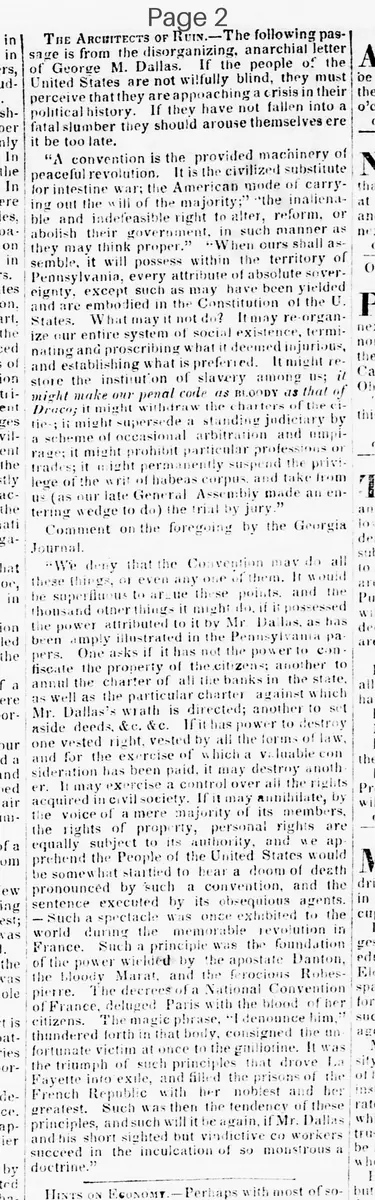
The Architects of Ruin.—The following passage is from the disorganizing, anarchial letter of George M. Dallas. If the people of the United States are not wilfully blind, they must perceive that they are approaching a crisis in their political history. If they have not fallen into a fatal slumber they should arouse themselves ere it be too late.
"A convention is the provided machinery of peaceful revolution. It is the civilized substitute for intestine war; the American mode of carrying out the will of the majority;" "the inalienable and indefeasible right to alter, reform, or abolish their government, in such manner as they may think proper." "When curs shall assemble, it will possess within the territory of Pennsylvania, every attribute of absolute sovereignty, except such as may have been yielded and are embodied in the Constitution of the U. States. What may it not do? It may re-organize our entire system of social existence, terminating and proscribing what it deemed injurious, and establishing what is preferred. It might restore the institution of slavery among us; it might make our penal code as bloody as that of Draco; it might withdraw the charters of the cities; it might supersede a standing judiciary by a scheme of occasional arbitration and omphirage; it might prohibit particular professions or trades; it might permanently suspend the privilege of the writ of habeas corpus, and take from us (as our late General Assembly made an entering wedge to do) the trial by jury."
Comment on the foregoing by the Georgia Journal.
"We deny that the Convention may do all these things, or even any one of them. It would be superfluous to argue these points, and the thousand other things it might do, if it possessed the power attributed to it by Mr. Dallas, as has been amply illustrated in the Pennsylvania papers. One asks if it has not the power to confiscate the property of the citizens; another to annul the charter of all the banks in the state, as well as the particular charter against which Mr. Dallas’s wrath is directed; another to set aside deeds, &c. &c. If it has power to destroy one vested right, vested by all the forms of law, and for the exercise of which a valuable consideration has been paid, it may destroy another. It may exercise a control over all the rights acquired in civil society. If it may annihilate, by the voice of a mere majority of its members, the rights of property, personal rights are equally subject to its authority, and we apprehend the People of the United States would be somewhat startled to hear a doom of death pronounced by such a convention, and the sentence executed by its obsequious agents. Such a spectacle was once exhibited to the world during the memorable revolution in France. Such a principle was the foundation of the power wielded by the apostate Danton, the Bloody Marat, and the ferocious Robespierre. The decrees of a National Convention of France, deluged Paris with the blood of her citizens. The magic phrase, "I denounce him," thundered forth in that body, consigned the unfortunate victim at once to the guillotine. It was the triumph of such principles that drove La Fayette into exile, and filled the prisons of the French Republic with her noblest and best. Such was then the tendency of these principles, and such will it be again, if Mr. Dallas and his short sighted but vindictive co-workers succeed in the inculcation of so monstrous a doctrine."
"A convention is the provided machinery of peaceful revolution. It is the civilized substitute for intestine war; the American mode of carrying out the will of the majority;" "the inalienable and indefeasible right to alter, reform, or abolish their government, in such manner as they may think proper." "When curs shall assemble, it will possess within the territory of Pennsylvania, every attribute of absolute sovereignty, except such as may have been yielded and are embodied in the Constitution of the U. States. What may it not do? It may re-organize our entire system of social existence, terminating and proscribing what it deemed injurious, and establishing what is preferred. It might restore the institution of slavery among us; it might make our penal code as bloody as that of Draco; it might withdraw the charters of the cities; it might supersede a standing judiciary by a scheme of occasional arbitration and omphirage; it might prohibit particular professions or trades; it might permanently suspend the privilege of the writ of habeas corpus, and take from us (as our late General Assembly made an entering wedge to do) the trial by jury."
Comment on the foregoing by the Georgia Journal.
"We deny that the Convention may do all these things, or even any one of them. It would be superfluous to argue these points, and the thousand other things it might do, if it possessed the power attributed to it by Mr. Dallas, as has been amply illustrated in the Pennsylvania papers. One asks if it has not the power to confiscate the property of the citizens; another to annul the charter of all the banks in the state, as well as the particular charter against which Mr. Dallas’s wrath is directed; another to set aside deeds, &c. &c. If it has power to destroy one vested right, vested by all the forms of law, and for the exercise of which a valuable consideration has been paid, it may destroy another. It may exercise a control over all the rights acquired in civil society. If it may annihilate, by the voice of a mere majority of its members, the rights of property, personal rights are equally subject to its authority, and we apprehend the People of the United States would be somewhat startled to hear a doom of death pronounced by such a convention, and the sentence executed by its obsequious agents. Such a spectacle was once exhibited to the world during the memorable revolution in France. Such a principle was the foundation of the power wielded by the apostate Danton, the Bloody Marat, and the ferocious Robespierre. The decrees of a National Convention of France, deluged Paris with the blood of her citizens. The magic phrase, "I denounce him," thundered forth in that body, consigned the unfortunate victim at once to the guillotine. It was the triumph of such principles that drove La Fayette into exile, and filled the prisons of the French Republic with her noblest and best. Such was then the tendency of these principles, and such will it be again, if Mr. Dallas and his short sighted but vindictive co-workers succeed in the inculcation of so monstrous a doctrine."
What sub-type of article is it?
Constitutional
Partisan Politics
What keywords are associated?
Constitutional Convention
George Dallas
Pennsylvania
French Revolution
Vested Rights
Anarchy
What entities or persons were involved?
George M. Dallas
Georgia Journal
Danton
Marat
Robespierre
La Fayette
Editorial Details
Primary Topic
Powers Of State Constitutional Conventions
Stance / Tone
Critical Opposition To Expansive Convention Powers
Key Figures
George M. Dallas
Georgia Journal
Danton
Marat
Robespierre
La Fayette
Key Arguments
A Convention Possesses Absolute Sovereignty Except As Limited By The U.S. Constitution
Convention Could Restore Slavery, Alter Penal Code, Withdraw City Charters, Suspend Habeas Corpus And Jury Trials
Denial That Convention Has Power To Do These Things Or Destroy Vested Rights
Such Powers Would Lead To Anarchy Like The French Revolution's Reign Of Terror
Expansive Convention Authority Could Confiscate Property, Annul Bank Charters, And Endanger Personal Rights