Thank you for visiting SNEWPapers!
Sign up free
The Portland Gazette
Portland, Cumberland County, Maine
What is this article about?
A layman's biblical exposition on Mark 2:27 defends the Sabbath's ongoing validity for Christians, rooted in creation and Mosaic law. It urges diligent work six days, holy rest and worship on the seventh, with works of mercy allowed, promising spiritual rewards.
Merged-components note: These components form a single religious opinion essay on the Sabbath (Mark 2:27), continued across pages; merged and labeled as editorial due to its interpretive and opinionated tone on scripture and duty.
Clippings
1 of 2
OCR Quality
Full Text
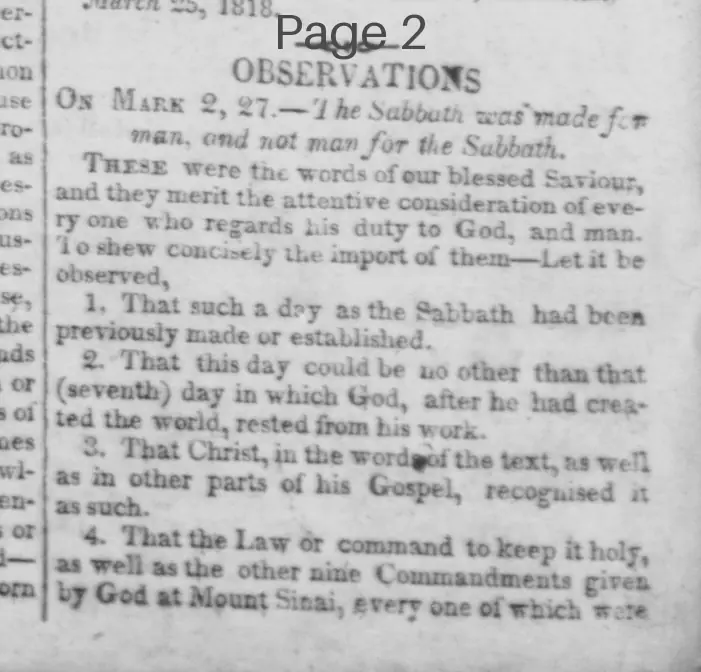
On Mark 2, 27.—The Sabbath was made for man, and not man for the Sabbath.
These were the words of our blessed Saviour, and they merit the attentive consideration of every one who regards his duty to God, and man.
To shew concisely the import of them Let it be observed,
1. That such a day as the Sabbath had been previously made or established.
2. That this day could be no other than that (seventh) day in which God, after he had created the world, rested from his work.
3. That Christ, in the words of the text, as well as in other parts of his Gospel, recognised it as such.
4. That the Law or command to keep it holy, as well as the other nine Commandments given by God at Mount Sinai, every one of which were
also in some manner recognized by Christ while he was on earth, were in full force at that time; and neither of them has ever been repealed, nor can they be annulled but by the authority of Him who made them. They are all therefore to be equally regarded as much now as at any former period of the world.
5. That because no re-establishment of the Sabbath is mentioned in the New Testament it is not binding upon Christians, is an argument as weak as it is derogatory to the great Lawgiver. As well might the same argument apply to all the other moral laws, which Christ said he came into the world, not to destroy, but to fulfill. They were then "in full force" and there was no need of re-enacting them.
6. But For what purpose was it established? Read the command, "Remember the sabbath-day to keep it holy. Six days shalt thou labour and do all thy work, but the seventh day is the Sabbath of the Lord thy God, in it thou shalt not do any work," &c.
So sacred and important was the duty required by this command, that the breach of it was punished by death; and though under the christian dispensation the violator of it is not subject to this penalty; yet we should consider that there is a state of retribution, in which judgment will be passed upon all men according to their deeds in this.
7. And for whom was it made? Not, as some say, for the Jews only, for when it was first instituted, there was no particular nation or class of men, but "the Sabbath was made for man"-for Adam and his posterity-to all who should come to the knowledge of God's will.
It has accordingly been observed by Christians as well as Jews, by all who fear God and respect His authority.
8. The Sabbath was made for man, but "not man for the sabbath," Man was made before the sabbath. He was made on the sixth and last day in which the work of creation was accomplished. On the seventh day, which He afterwards called the Sabbath. God rested from his work, and blessed it and sanctified it.
9. As God blessed the seventh day as well as sanctified it, may it not be reasonably expected that he will bless those who carefully observe it. It has been thought by some pious and observing men, that even worldly benefits attend those who pay a religious regard to this holy day and particularly to the public worship of God thereon- but whether this great Giver of all we have and enjoy, bestows worldly favours or not, we may promise ourselves much richer enjoyments ; "spiritual blessings in heavenly things in Christ Jesus." It is undoubtedly true that few, if any, who in other respects devoutly acknowledge the Son of God as the Redeemer of men profane the sabbath or keep away from the house of worship on that day, where he dispenses to his attendant servants, the riches of his grace.
From what has been said, it may be inferred.
1 That in imitation of the Great Creator we should employ six days out of seven, to our work, to be diligent in our secular business, and instead of being idle or spending it in an unprofitable or licentious manner, to do "whatsoever our hands find to do" for the good of ourselves and others.
2. That on the "Sabbath of the Lord our God" we should abstain from all such work, and from worldly visits and conversation, and from all pleasures which may be lawful on other days, and keep it holy. Works of necessity and mercy. are however allowable, and not only so but it is our duty to perform them : for this we have the example of Christ himself-and God delighteth not so much in sacrifice, as in shewing mercy.
3. As ministers were appointed, under the authority of the great head of the Church to preach his Gospel, and as the Sabbath (the Lord's Day) is set apart, and was by his Disciples, improved for the purpose, we should not "forsake the assembling of ourselves together," but like holy David (who was glad when it was said unto him "Let us go up into the House of the Lord") delight to meet with those who go to the House of God, to hear his word and celebrate his praise.
A neglect of this duty manifests a disregard to the worship due to God, and is a contempt of his authority.
Let every reader therefore of this short piece, who may have been inattentive hitherto, seriously consider these things. Let him pay a constant regard to this day of God, and instead of an unholy employment of his time, enter cheerfully and devoutly into the sanctuary of the most high, that by hearing and observing the truth of his sacred word, in the way prescribed. he may through the sanctifying influences of the Holy Spirit and in fulfillment of the divine promise of Him who is faithful and true, become prepared for that eternal Sabbath of rest in heaven where he will receive the rewards of his obedience, from that King of Kings whose throne is surrounded by the blessed Angels who celebrate his praise, saying Amen, blessing and glory and wisdom and thanksgiving and honor and power and might be unto our God forever and ever. Amen.
BY A LAYMAN.
What sub-type of article is it?
What keywords are associated?
What entities or persons were involved?
Editorial Details
Primary Topic
Sabbath Observance Based On Mark 2:27
Stance / Tone
Advocacy For Christian Sabbath Keeping
Key Figures
Key Arguments