Thank you for visiting SNEWPapers!
Sign up free
Editorial
April 28, 1807
Virginia Argus
Richmond, Virginia
What is this article about?
Concluding editorial on the Virginia General Assembly's acts, emphasizing public revenue challenges due to financial deficits and 1806 crop failures. Praises legislators for not increasing taxes to prevent oppression, contrasts republican sensitivity to public burdens with monarchical indifference, and evaluates revenue-raising measures and expenditure controls.
Clipping
OCR Quality
95%
Excellent
Full Text
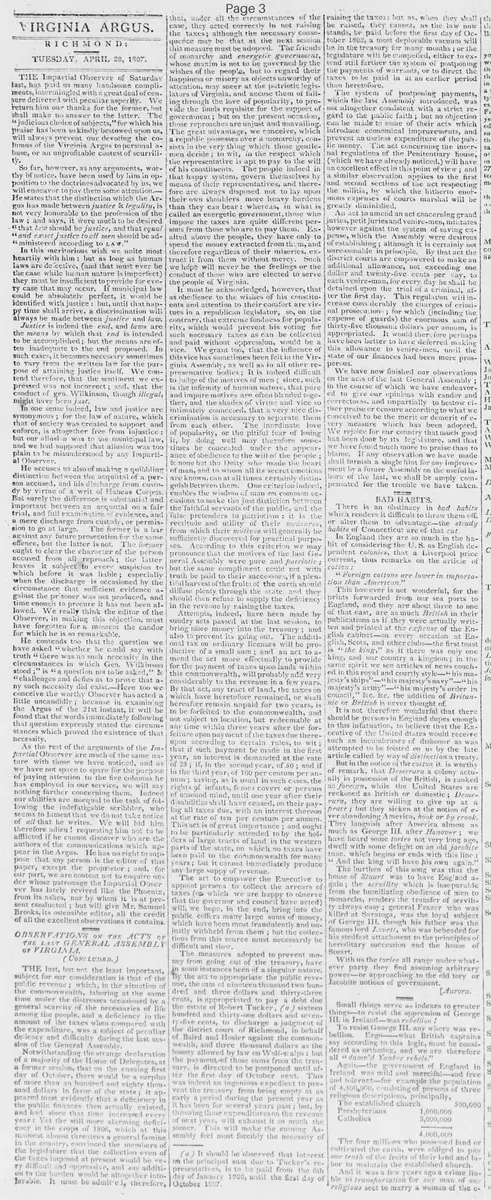
OBSERVATIONS ON THE ACTS OF THE LAST GENERAL ASSEMBLY OF VIRGINIA. (Concluded.)
THE last, but not the least important, subject for our consideration is that of the public revenue; which, in the situation of the commonwealth, laboring at the same time under the distresses occasioned by a general scarcity of the necessaries of life among the people, and a deficiency in the amount of the taxes when compared with the expenditure, was a subject of peculiar delicacy and difficulty during the last session of the General Assembly.
Notwithstanding the strange declaration of a majority of the House of Delegates, at a former session, that on the ensuing first day of October, there would be a surplus of more than an hundred and eighty thousand dollars in favor of the state; it appeared most evidently that a deficiency in the public finances then actually existed, and had since that time increased every year: Yet the still more alarming deficiency in the crops of 1806, which at this moment almost threatens a general famine in the country, convinced the members of the legislature that the collection even of the taxes imposed at present would be very difficult and oppressive, and any addition to the burden would be altogether intolerable. It must be admitted, therefore, that, under all the circumstances of the case, they acted correctly in not raising the taxes: although the necessary consequence may be that at the next session this measure must be adopted.
The friends of monarchy and energetic government, whose maxim is not to be governed by the wishes of the people, but to regard their happiness or misery as objects unworthy of attention, may sneer at the patriotic legislators of Virginia, and accuse them of failing through the love of popularity, to provide the funds requisite for the support of government; but on the present occasion, those reproaches are unjust and unavailing.
The great advantage, we conceive, which a republic possesses over a monarchy, consists in the very thing which those gentlemen deride; to wit, in the respect which the representative is apt to pay to the will of his constituents. The people indeed in that happy system, govern themselves by means of their representatives, and therefore are always disposed not to lay upon their own shoulders more heavy burdens than they can bear: whereas, in what is called an energetic government, those who impose the taxes are quite different persons from those who are to pay them. Exalted above the people, they have only to spend the money extracted from them, and therefore regardless of their miseries, extract it from them without mercy. Such we hope will never be the feelings or the conduct of those who are elected to serve the people of Virginia.
It must be acknowledged, however, that as obedience to the wishes of his constituents and attention to their comfort are virtues in a republican legislator, so, on the contrary, that extreme fondness for popularity, which would prevent his voting for such necessary taxes as can be collected and paid without oppression, would be a vice. We grant too, that the influence of this vice has sometimes been felt in the Virginia Assembly, as well as in all other representative bodies; It is indeed difficult to judge of the motives of men; since, such is the infirmity of human nature, that pure and impure motives are often blended together, and the shades of virtue and vice so intimately connected, that a very nice discrimination is necessary to separate them from each other. The inordinate love of popularity, or the pitiful fear of losing it, by doing well may therefore sometimes be concealed under the appearance of obedience to the will of the people; & none but the Deity who made the heart of man, and to whom all its secret emotions are known, can at all times certainly distinguish between them.
One criterion indeed, enables the wisdom of man on common occasions to make the just distinction between the faithful servants of the public, and the false pretenders to patriotism: it is the rectitude and utility of their measures, from which their motives will generally be sufficiently discovered for practical purposes. According to this criterion we may pronounce that the motives of the last General Assembly were pure and patriotic; but the same compliment could not with truth be paid to their successors, if a plentiful harvest of the fruits of the earth should diffuse plenty through the state and they should then refuse to supply the deficiency in the revenue by raising the taxes.
Attempts, indeed, have been made by sundry acts passed at the last session, to bring more money into the treasury; and also to prevent its going out. The additional tax on ordinary licenses will be productive of a small sum; and an act to amend the act more effectually to provide for the payment of taxes upon lands within this commonwealth, will probably add very considerably to the revenue in a few years. By that act, any tract of land, the taxes on which have heretofore remained, or shall hereafter remain unpaid for two years, is to be forfeited to the commonwealth, and not subject to location, but redeemable at any time within three years after the forfeiture upon payment of the taxes due thereon according to certain rules, to wit; that if such payment be made in the first year, an interest is demanded at the rate of 25; if, in the second year, of 50; and if in the third year, of 100 per centum per annum; saving, as is usual in such cases, the rights of infants, femes covert or persons of unsound mind, until one year after their disabilities shall have ceased, on their paying all taxes due, with an interest thereon at the rate of ten per centum per annum.
This act is of great importance; and ought to be particularly attended to by the holders of large tracts of land in the western parts of the state, on which no taxes have been paid to the commonwealth for many years; but it cannot immediately produce any large supply of revenue.
The act to empower the Executive to appoint persons to collect the arrears of taxes (on which we are happy to observe that the governor and council have acted) will, we hope, in the end, bring into the public coffers many large sums of money, which have been most fraudulently and unjustly withheld from them; but the collections from this source must necessarily be difficult and slow.
The measures adopted to prevent money from going out of the treasury, have in some instances been of a singular nature. By the act to appropriate the public revenue, the sum of nineteen thousand two hundred and three dollars and thirty-three cents, is appropriated to pay a debt due the estate of Robert Tucker, (a) sixteen hundred and thirty-one dollars and seventy-five cents, to discharge a judgment of the district court of Richmond, in behalf of Baird and Hosier against the commonwealth, and three thousand dollars as the bounty allowed by law on Wolf-scalps: but the payment of those sums from the treasury, is directed to be postponed until after the first day of October next. Thus was indeed an ingenious expedient to prevent the treasury from being empty at as early a period during the present year as it has been for several years past; but, by throwing those expenditures on the revenue of next year, will exhaust it so much the sooner. This will make the ensuing Assembly feel most forcibly the necessity of raising the taxes: but as, when they shall be raised, they cannot, as the law now stands, be paid before the first day of October 1808, a most deplorable vacuum will be in the treasury for many months; or the legislature will be compelled, either to extend still farther the system of postponing the payments of warrants, or to direct the taxes to be paid in at an earlier period than heretofore.
The system of postponing payments, which the last Assembly introduced, was not altogether consistent with a strict regard to the public faith; but no objection can be made to some of their acts which introduce economical improvements, and prevent an useless expenditure of the public money. The act concerning the internal regulations of the Penitentiary house, (which we have already noticed,) will have an excellent effect in this point of view; and a similar observation applies to the first and second sections of the act respecting the militia, by which the hitherto enormous expenses of courts martial will be greatly diminished.
An act to amend an act concerning grand juries, petit juries and venire-men, militates however against the system of saving expense, which the Assembly were desirous of establishing; although it is certainly not unreasonable in principle. By that act the district courts are empowered to make an additional allowance, not exceeding one dollar and twenty-five cents per day, to each venire-man, for every day he shall be detained upon the trial of a criminal, after the first day. This regulation will increase considerably the charges of criminal prosecutions; for which (including the expense of guards) the enormous sum of thirty-five thousand dollars per annum, is appropriated. It would therefore perhaps have been better to have deferred making this allowance to venire-men, until the state of our finances had been more prosperous.
We have now finished our observations on the acts of the last General Assembly; in the course of which we have endeavored to give our opinions with candor and correctness, and impartially to bestow either praise or censure according to what we conceived to be the merit or demerit of every measure which has been adopted. We rejoice for our country that much good has been done by its legislature, and that we have found much more to praise than to blame. If any observation we have made shall furnish a single hint for any improvement by a future Assembly on the useful labors of the last, we shall be amply compensated for the trouble we have taken.
THE last, but not the least important, subject for our consideration is that of the public revenue; which, in the situation of the commonwealth, laboring at the same time under the distresses occasioned by a general scarcity of the necessaries of life among the people, and a deficiency in the amount of the taxes when compared with the expenditure, was a subject of peculiar delicacy and difficulty during the last session of the General Assembly.
Notwithstanding the strange declaration of a majority of the House of Delegates, at a former session, that on the ensuing first day of October, there would be a surplus of more than an hundred and eighty thousand dollars in favor of the state; it appeared most evidently that a deficiency in the public finances then actually existed, and had since that time increased every year: Yet the still more alarming deficiency in the crops of 1806, which at this moment almost threatens a general famine in the country, convinced the members of the legislature that the collection even of the taxes imposed at present would be very difficult and oppressive, and any addition to the burden would be altogether intolerable. It must be admitted, therefore, that, under all the circumstances of the case, they acted correctly in not raising the taxes: although the necessary consequence may be that at the next session this measure must be adopted.
The friends of monarchy and energetic government, whose maxim is not to be governed by the wishes of the people, but to regard their happiness or misery as objects unworthy of attention, may sneer at the patriotic legislators of Virginia, and accuse them of failing through the love of popularity, to provide the funds requisite for the support of government; but on the present occasion, those reproaches are unjust and unavailing.
The great advantage, we conceive, which a republic possesses over a monarchy, consists in the very thing which those gentlemen deride; to wit, in the respect which the representative is apt to pay to the will of his constituents. The people indeed in that happy system, govern themselves by means of their representatives, and therefore are always disposed not to lay upon their own shoulders more heavy burdens than they can bear: whereas, in what is called an energetic government, those who impose the taxes are quite different persons from those who are to pay them. Exalted above the people, they have only to spend the money extracted from them, and therefore regardless of their miseries, extract it from them without mercy. Such we hope will never be the feelings or the conduct of those who are elected to serve the people of Virginia.
It must be acknowledged, however, that as obedience to the wishes of his constituents and attention to their comfort are virtues in a republican legislator, so, on the contrary, that extreme fondness for popularity, which would prevent his voting for such necessary taxes as can be collected and paid without oppression, would be a vice. We grant too, that the influence of this vice has sometimes been felt in the Virginia Assembly, as well as in all other representative bodies; It is indeed difficult to judge of the motives of men; since, such is the infirmity of human nature, that pure and impure motives are often blended together, and the shades of virtue and vice so intimately connected, that a very nice discrimination is necessary to separate them from each other. The inordinate love of popularity, or the pitiful fear of losing it, by doing well may therefore sometimes be concealed under the appearance of obedience to the will of the people; & none but the Deity who made the heart of man, and to whom all its secret emotions are known, can at all times certainly distinguish between them.
One criterion indeed, enables the wisdom of man on common occasions to make the just distinction between the faithful servants of the public, and the false pretenders to patriotism: it is the rectitude and utility of their measures, from which their motives will generally be sufficiently discovered for practical purposes. According to this criterion we may pronounce that the motives of the last General Assembly were pure and patriotic; but the same compliment could not with truth be paid to their successors, if a plentiful harvest of the fruits of the earth should diffuse plenty through the state and they should then refuse to supply the deficiency in the revenue by raising the taxes.
Attempts, indeed, have been made by sundry acts passed at the last session, to bring more money into the treasury; and also to prevent its going out. The additional tax on ordinary licenses will be productive of a small sum; and an act to amend the act more effectually to provide for the payment of taxes upon lands within this commonwealth, will probably add very considerably to the revenue in a few years. By that act, any tract of land, the taxes on which have heretofore remained, or shall hereafter remain unpaid for two years, is to be forfeited to the commonwealth, and not subject to location, but redeemable at any time within three years after the forfeiture upon payment of the taxes due thereon according to certain rules, to wit; that if such payment be made in the first year, an interest is demanded at the rate of 25; if, in the second year, of 50; and if in the third year, of 100 per centum per annum; saving, as is usual in such cases, the rights of infants, femes covert or persons of unsound mind, until one year after their disabilities shall have ceased, on their paying all taxes due, with an interest thereon at the rate of ten per centum per annum.
This act is of great importance; and ought to be particularly attended to by the holders of large tracts of land in the western parts of the state, on which no taxes have been paid to the commonwealth for many years; but it cannot immediately produce any large supply of revenue.
The act to empower the Executive to appoint persons to collect the arrears of taxes (on which we are happy to observe that the governor and council have acted) will, we hope, in the end, bring into the public coffers many large sums of money, which have been most fraudulently and unjustly withheld from them; but the collections from this source must necessarily be difficult and slow.
The measures adopted to prevent money from going out of the treasury, have in some instances been of a singular nature. By the act to appropriate the public revenue, the sum of nineteen thousand two hundred and three dollars and thirty-three cents, is appropriated to pay a debt due the estate of Robert Tucker, (a) sixteen hundred and thirty-one dollars and seventy-five cents, to discharge a judgment of the district court of Richmond, in behalf of Baird and Hosier against the commonwealth, and three thousand dollars as the bounty allowed by law on Wolf-scalps: but the payment of those sums from the treasury, is directed to be postponed until after the first day of October next. Thus was indeed an ingenious expedient to prevent the treasury from being empty at as early a period during the present year as it has been for several years past; but, by throwing those expenditures on the revenue of next year, will exhaust it so much the sooner. This will make the ensuing Assembly feel most forcibly the necessity of raising the taxes: but as, when they shall be raised, they cannot, as the law now stands, be paid before the first day of October 1808, a most deplorable vacuum will be in the treasury for many months; or the legislature will be compelled, either to extend still farther the system of postponing the payments of warrants, or to direct the taxes to be paid in at an earlier period than heretofore.
The system of postponing payments, which the last Assembly introduced, was not altogether consistent with a strict regard to the public faith; but no objection can be made to some of their acts which introduce economical improvements, and prevent an useless expenditure of the public money. The act concerning the internal regulations of the Penitentiary house, (which we have already noticed,) will have an excellent effect in this point of view; and a similar observation applies to the first and second sections of the act respecting the militia, by which the hitherto enormous expenses of courts martial will be greatly diminished.
An act to amend an act concerning grand juries, petit juries and venire-men, militates however against the system of saving expense, which the Assembly were desirous of establishing; although it is certainly not unreasonable in principle. By that act the district courts are empowered to make an additional allowance, not exceeding one dollar and twenty-five cents per day, to each venire-man, for every day he shall be detained upon the trial of a criminal, after the first day. This regulation will increase considerably the charges of criminal prosecutions; for which (including the expense of guards) the enormous sum of thirty-five thousand dollars per annum, is appropriated. It would therefore perhaps have been better to have deferred making this allowance to venire-men, until the state of our finances had been more prosperous.
We have now finished our observations on the acts of the last General Assembly; in the course of which we have endeavored to give our opinions with candor and correctness, and impartially to bestow either praise or censure according to what we conceived to be the merit or demerit of every measure which has been adopted. We rejoice for our country that much good has been done by its legislature, and that we have found much more to praise than to blame. If any observation we have made shall furnish a single hint for any improvement by a future Assembly on the useful labors of the last, we shall be amply compensated for the trouble we have taken.
What sub-type of article is it?
Taxation
Economic Policy
Partisan Politics
What keywords are associated?
Public Revenue
Virginia Assembly
Taxation Policy
Crop Deficiency
Republican Governance
Financial Deficiency
Tax Collection Acts
What entities or persons were involved?
General Assembly Of Virginia
House Of Delegates
Governor And Council
Robert Tucker
Baird And Hosier
Editorial Details
Primary Topic
Handling Of Public Revenue And Taxes By Virginia General Assembly Amid Financial Distress
Stance / Tone
Supportive Of Assembly's Fiscal Restraint And Republican Principles, Critical Of Monarchical Governance
Key Figures
General Assembly Of Virginia
House Of Delegates
Governor And Council
Robert Tucker
Baird And Hosier
Key Arguments
Financial Deficiency Exists Despite Prior Surplus Claims, Worsened By 1806 Crop Failures
Legislators Correctly Avoided Raising Taxes To Prevent Oppression
Republican Government Respects Constituents' Burdens Unlike Monarchical Systems
Motives Of Assembly Deemed Pure Based On Measure Utility
Specific Acts Like Land Tax Forfeiture And Arrears Collection Will Aid Revenue Slowly
Postponing Expenditures Delays But Does Not Solve Treasury Shortages
Economical Acts Praised, But Jury Allowances Criticized For Increasing Costs