Thank you for visiting SNEWPapers!
Sign up free
The New Hampshire Gazette And General Advertiser
Portsmouth, Rockingham County, New Hampshire
What is this article about?
Proceedings of the U.S. House of Representatives on September 16-17, 1789, covering bills on post-office, judicial salaries, crimes punishment (postponed), acts signed by President Washington, his message on Wabash Indian hostilities suggesting militia provisions, debates on judicial bill (passed 37-16), Vice-President salary, permanent seat of government, and more.
Merged-components note: Merged across columns as a single continued narrative of congressional proceedings. Relabeled from 'story' to 'domestic_news' as it fits national non-story news reporting on government proceedings.
Clipping
OCR Quality
Full Text
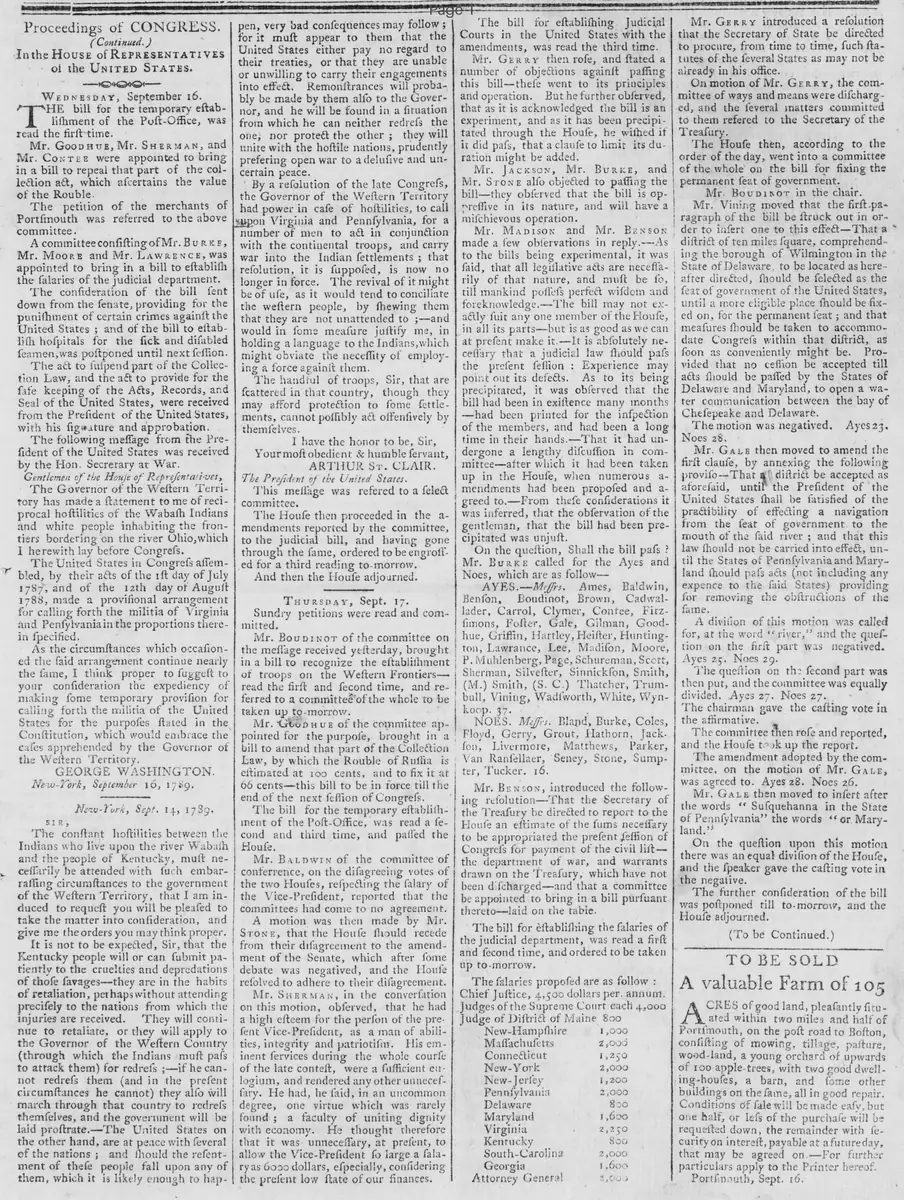
(Continued.)
In the House of Representatives of the United States.
Wednesday, September 16.
The bill for the temporary establishment of the Post-Office, was read the first time.
Mr. Goodhue, Mr. Sherman, and Mr. Contee were appointed to bring in a bill to repeal that part of the collection act, which ascertains the value of the Rouble.
The petition of the merchants of Portsmouth was referred to the above committee.
A committee consisting of Mr. Burke, Mr. Moore and Mr. Lawrence, was appointed to bring in a bill to establish the salaries of the judicial department.
The consideration of the bill sent down from the senate, providing for the punishment of certain crimes against the United States: and of the bill to establish hospitals for the sick and disabled seamen, was postponed until next session.
The act to suspend part of the Collection Law, and the act to provide for the safe keeping of the Acts, Records, and Seal of the United States, were received from the President of the United States, with his signature and approbation.
The following message from the President of the United States was received by the Hon. Secretary at War.
Gentlemen of the House of Representatives,
The Governor of the Western Territory has made a statement to me of reciprocal hostilities of the Wabash Indians and white people inhabiting the frontiers bordering on the river Ohio, which I herewith lay before Congress.
The United States in Congress assembled, by their acts of the 1st day of July 1787, and of the 12th day of August 1788, made a provisional arrangement for calling forth the militia of Virginia and Pennsylvania in the proportions therein specified.
As the circumstances which occasioned the said arrangement continue nearly the same, I think proper to suggest to your consideration the expediency of making some temporary provision for calling forth the militia of the United States for the purposes stated in the Constitution, which would embrace the cases apprehended by the Governor of the Western Territory.
GEORGE WASHINGTON.
New-York, September 16, 1789.
New-York, Sept. 14, 1789.
SIR,
The constant hostilities between the Indians who live upon the river Wabash and the people of Kentucky, must necessarily be attended with such embarrassing circumstances to the government of the Western Territory, that I am induced to request you will be pleased to take the matter into consideration, and give me the orders you may think proper.
It is not to be expected, Sir, that the Kentucky people will or can submit patiently to the cruelties and depredations of those savages--they are in the habits of retaliation, perhaps without attending precisely to the nations from which the injuries are received. They will continue to retaliate, or they will apply to the Governor of the Western Country (through which the Indians must pass to attack them) for redress ;--if he cannot redress them (and in the present circumstances he cannot) they also will march through that country to redress themselves, and the government will be laid prostrate.--The United States on the other hand, are at peace with several of the nations : and should the resentment of these people fall upon any of them, which it is likely enough to happen
pen, very bad consequences may follow ; for it must appear to them that the United States either pay no regard to their treaties, or that they are unable or unwilling to carry their engagements into effect. Remonstrances will probably be made by them also to the Governor, and he will be found in a situation from which he can neither redress the one; nor protect the other ; they will unite with the hostile nations, prudently preferring open war to a delusive and uncertain peace.
By a resolution of the late Congress, the Governor of the Western Territory had power in case of hostilities, to call upon Virginia and Pennsylvania, for a number of men to act in conjunction with the continental troops, and carry war into the Indian settlements ; that resolution, it is supposed, is now no longer in force. The revival of it might be of use. as it would tend to conciliate the western people, by shewing them that they are not unattended to ;-and would in some measure justify me, in holding a language to the Indians,which might obviate the necessity of employing a force against them.
The handful of troops, Sir, that are scattered in that country, though they may afford protection to some settlements, cannot possibly act offensively by themselves.
I have the honor to be, Sir.
Your most obedient & humble servant,
ARTHUR ST. CLAIR.
The President of the United States.
This message was referred to a select committee.
The House then proceeded in the amendments reported by the committee, to the judicial bill, and having gone through the same, ordered to be engrossed for a third reading to-morrow.
And then the House adjourned.
THURSDAY, Sept. 17.
Sundry petitions were read and committed.
Mr. Boudinot of the committee on the message received yesterday, brought in a bill to recognize the establishment of troops on the Western Frontiers--read the first and second time. and referred to a committee of the whole to be taken up to-morrow.
Mr. Goodhue of the committee appointed for the purpose, brought in a bill to amend that part of the Collection Law, by which the Rouble of Russia is estimated at 100 cents, and to fix it at 66 cents-this bill to be in force till the end of the next session of Congress.
The bill for the temporary establishment of the Post-Office. was read a second and third time, and passed the House.
Mr. Baldwin of the committee of conference, on the disagreeing votes of the two Houses, respecting the salary of the Vice-President, reported that the committees had come to no agreement.
A motion was then made by Mr. Stone, that the House should recede from their disagreement to the amendment of the Senate, which after some debate was negatived, and the House resolved to adhere to their disagreement.
Mr. Sherman. in the conversation on this motion, observed. that he had a high esteem for the person of the present Vice-President. as a man of abilities, integrity and patriotism. His eminent services during the whole course of the late contest, were a sufficient eulogium, and rendered any other unnecessary. He had, he said, in an uncommon degree, one virtue which was rarely found ; a faculty of uniting dignity with economy. He thought therefore that it was unnecessary, at present, to allow the Vice-President so large a salary as 6000 dollars, especially, considering the present low state of our finances.
The bill for establishing Judicial Courts in the United States with the amendments, was read the third time.
Mr. Gerry then rose. and stated a number of objections against passing this bill--these went to its principles and operation. But he further observed, that as it is acknowledged the bill is an experiment, and as it has been precipitated through the House, he wished if it did pass, that a clause to limit its duration might be added.
Mr. Jackson, Mr. Burke, and Mr. Stone also objected to passing the bill-they observed that the bill is oppressive in its nature, and will have a mischievous operation.
Mr. Madison and Mr. Benson made a few observations in reply.---As to the bills being experimental, it was said. that all legislative acts are necessarily of that nature, and must be so, till mankind possess perfect wisdom and foreknowledge.--The bill may not exactly suit any one member of the House, in all its parts--but is as good as we can at present make it.--It is absolutely necessary that a judicial law should pass the present session : Experience may point out its defects. As to its being precipitated, it was observed that the bill had been in existence many months --had been printed for the inspection of the members, and had been a long time in their hands.--That it had undergone a lengthy discussion in committee-after which it had been taken up in the House, when numerous amendments had been proposed and agreed to.--From these considerations it was inferred, that the observation of the gentleman, that the bill had been precipitated was unjust.
On the question, Shall the bill pass ?
Mr. Burke called for the Ayes and Noes, which are as follow--
AYES.-Messrs. Ames, Baldwin, Benson, Boudinot, Brown, Cadwallader, Carrol, Clymer, Contee, Fitzsimons, Foster, Gale, Gilman, Goodhue, Griffin, Hartley, Heister, Huntington, Lawrence, Lee, Madison, Moore, P. Muhlenberg, Page, Schureman, Scott, Sherman, Sylvester, Sinnickson, Smith, (M.) Smith, (S. C.) Thatcher, Trumbull, Vining, Wadsworth, White, Wynkoop. 37.
NOES. Messrs. Bland, Burke, Coles, Floyd, Gerry, Grout, Hathorn, Jackson, Livermore, Matthews, Parker, Van Rensselaer, Seney, Stone, Sumter, Tucker. 16.
Mr. Benson, introduced the following resolution--That the Secretary of the Treasury be directed to report to the House an estimate of the sums necessary to be appropriated the present session of Congress for payment of the civil list- the department of war, and warrants drawn on the Treasury, which have not been discharged--and that a committee be appointed to bring in a bill pursuant thereto--laid on the table.
The bill for establishing the salaries of the judicial department, was read a first and second time, and ordered to be taken up to-morrow.
The salaries proposed are as follow :
Chief Justice, 4500 dollars per annum.
Judges of the Supreme Court each 4000
Judge of District of Maine 800
New-Hampshire 1000
Massachusetts 2000
Connecticut 1250
New-York 2000
New-Jersey 1200
Pennsylvania 2000
Delaware 800
Maryland 1600
Virginia 2250
Kentucky 800
South-Carolina 2000
Georgia 1600
Attorney General 2000
Mr. Gerry introduced a resolution that the Secretary of State be directed to procure, from time to time, such statutes of the several States as may not be already in his office.
On motion of Mr. Gerry. the committee of ways and means were discharged, and the several matters committed to them referred to the Secretary of the Treasury.
The House then, according to the order of the day. went into a committee of the whole on the bill for fixing the permanent seat of government.
Mr. Boudinot in the chair.
Mr. Vining moved that the first paragraph of the bill be struck out in order to insert one to this effect--That a district of ten miles square, comprehending the borough of Wilmington in the State of Delaware, to be located as hereafter directed, should be selected as the seat of government of the United States, until a more eligible place should be fixed on, for the permanent seat ; and that measures should be taken to accommodate Congress within that district. as soon as conveniently might be. Provided that no cession be accepted till acts should be passed by the States of Delaware and Maryland, to open a water communication between the bay of Chesapeake and Delaware.
The motion was negatived. Ayes 23. Noes 28.
Mr. Gale then moved to amend the first clause, by annexing the following proviso--That no district be accepted as aforesaid, until the President of the United States shall be satisfied of the practicability of effecting a navigation from the seat of government to the mouth of the said river : and that this law should not be carried into effect, until the States of Pennsylvania and Maryland should pass acts (not including any expense to the said States) providing for removing the obstructions of the same.
A division of this motion was called for, at the word " river," and the question on the first part was negatived. Ayes 25. Noes 29.
The question on the second part was then put, and the committee was equally divided. Ayes 27. Noes 27.
The chairman gave the casting vote in the affirmative.
The committee then rose and reported, and the House took up the report.
The amendment adopted by the committee, on the motion of Mr. Gale, was agreed to. Ayes 28. Noes 26.
Mr. Gale then moved to insert after the words " Susquehanna in the State of Pennsylvania" the words " or Maryland."
On the question upon this motion there was an equal division of the House, and the speaker gave the casting vote in the negative.
The further consideration of the bill was postponed till to-morrow, and the House adjourned.
(To be Continued.)
What sub-type of article is it?
What keywords are associated?
What entities or persons were involved?
Where did it happen?
Domestic News Details
Primary Location
New York
Event Date
September 16 17, 1789
Key Persons
Outcome
judicial courts bill passed 37-16; post-office bill passed; vice-president salary disagreement adhered to; motions on government seat debated with mixed votes; president's message on indian hostilities referred to committee; bill for troops on western frontiers introduced.
Event Details
The House considered and passed bills on post-office establishment and judicial courts; received and referred President's message from Governor St. Clair on Wabash Indian hostilities and militia needs; debated Vice-President salary and permanent seat of government location; introduced bills on judicial salaries, Rouble valuation, and western troops; postponed crimes and seamen hospitals bills.