Thank you for visiting SNEWPapers!
Sign up free
Literary
June 24, 1936
Atlanta Daily World
Atlanta, Fulton County, Georgia
What is this article about?
In this mystery installment, Tyler uses Ruth's psychic foresight to trap Mrs. Gordon, revealed as Gaudio's inside ally plotting family murders. Caught knife in hand, she suicides. Tyler explains her betrayals and innocence of others like Doris.
Clipping
OCR Quality
95%
Excellent
Full Text
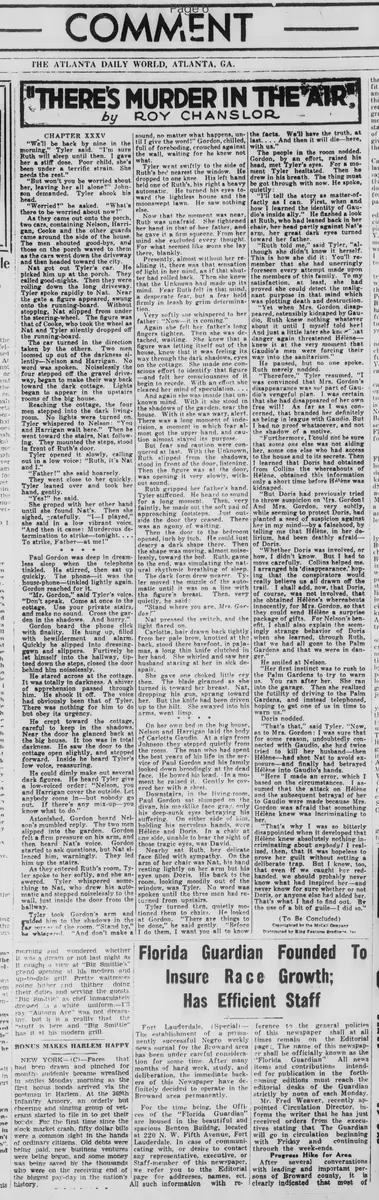
COMMENT
THE
ATLANTA
DAILY
WORLD. ATLANTA. GA.
THERE'S MURDER IN THE AIR
by
ROY
CHANSLOR
"We'll be back by nine in the morning," Tyler said. "I'm sure Ruth will sleep until then. I gave her a stiff dose. Poor child. She's been under a terrific strain. She needs the rest."
"But won't you be worried about her, leaving her all alone?" Johnson demanded. Tyler shook his head.
"Worried?" he asked. "What's there to be worried about now?"
As they came out onto the porch, two cars, containing Nelson, Harrigan, Cooke and the other guards came around the side of the house. The men shouted good-bys, and those on the porch waved to them as the cars went down the driveway and then headed toward the city.
Nat got out Tyler's car. He picked him up at the porch. They called good-nights. Then they were rolling down the long driveway.
Tyler spoke rapidly to Nat. Near the gate a figure appeared, swung onto the running-board. Without stopping, Nat slipped from under the steering-wheel. The figure was that of Cooke, who took the wheel as Nat and Tyler silently dropped off the running-board.
The car turned in the direction taken by the others. Two men loomed up out of the darkness silently—Nelson and Harrigan. No word was spoken. Noiselessly the four stepped off the gravel driveway, began to make their way back toward the dark cottage. Lights began to appear in the upstairs rooms of the big house.
Reaching the cottage, the four men stepped into the dark living-room. No lights were turned on.
Tyler whispered to Nelson: "You and Harrigan wait here." Then he went toward the stairs. Nat following. They mounted the steps, stood in front of Ruth's door.
Tyler opened it slowly, calling out in a low voice: "Ruth, it's Nat and I."
"Father!" she said hoarsely.
They went close to her quickly. Tyler leaned over and took her hand, gently.
"Yes?" he said.
She groped with her other hand until she found Nat's. Then she sighed, gratefully. "I-I played," she said in a low vibrant voice. "And then it came: Murderous determination to strike—tonight. To strike, Father—at me!"
Paul Gordon was deep in dreamless sleep when the telephone tinkled. He stirred, then sat up quickly. The phone—it was the house-phone—tinkled lightly again.
Gordon reached for it.
"Mr. Gordon," said Tyler's voice. "Don't speak. Come at once to the cottage. Use your private stairs, and make no sound. Cross the garden in the shadows. And hurry."
Gordon heard the phone click with finality. He hung up, filled with bewilderment and alarm.
Quickly he slipped into dressing-gown and slippers. Furtively he let himself into the hallway, tip-toed down the steps, closed the door behind him noiselessly.
He stared across at the cottage. It was totally in darkness. A shiver of apprehension passed through him. He shook it off. The voice had obviously been that of Tyler. There was nothing for him to do but obey its urgency.
He crept toward the cottage, careful to keep in the shadows. Near the door he glanced back at the big house. It too was in total darkness. He saw the door to the cottage open slightly, and stepped forward. Inside he heard Tyler's low voice, reassuring.
He could dimly make out several dark figures. He heard Tyler give a low-voiced order: "Nelson, you and Harrigan cover the outside. Let anybody come in—but nobody go out. If there's any mix-up—you know what to do."
Astonished, Gordon heard Nelson's mumbled reply. The two men slipped into the garden. Gordon felt a firm pressure on his arm, and then heard Nat's voice. Gordon started to ask questions, but Nat silenced him, warningly. They led him up the stairs.
As they entered Ruth's room, Tyler spoke to her softly, and she answered. Tyler whispered something to Nat, who drew his automatic and stepped noiselessly to the wall, just inside the door from the hallway.
Tyler took Gordon's arm and guided him to the shadows in the far corner of the room. "Stand by," he whispered. "And don't make a sound, no matter what happens, until I give the word!" Gordon, chilled, full of foreboding, crouched against the wall, waiting for he knew not what.
Tyler went swiftly to the side of Ruth's bed nearest the window. He dropped to one knee. His left hand held one of Ruth's, his right a heavy automatic. He turned his eyes toward the lightless house and the moonswept lawn. He saw nothing else.
Now that the moment was near, Ruth was unafraid. She tightened her hand in that of her father, and he gave it a firm squeeze. From her mind she excluded every thought. For what seemed like eons she lay there, blankly.
Presently, almost without her realizing it, there was that sensation of light in her mind, as if that shutter had rolled back. Then she knew that the Unknown had made up its mind. Fear Ruth felt in that mind, a desperate fear, but a fear held firmly in leash by grim determination.
Very softly she whispered to her father: "Now—it is coming."
Again she felt her father's long fingers tighten. Then she was detached, waiting. She knew that a figure was letting itself out of the house, knew that it was feeling its way through the dark shadows, eyes on the cottage. She made one conscious effort to identify that figure—and felt her consciousness of it begin to recede. With an effort she cleared her mind of speculation. . . .
And again she was inside that unknown mind. With it she stood in the shadows of the garden, near the house. With it she was wary, alert. There was a long moment of indecision, a moment in which fear almost got the upper hand, and caution almost stayed its purpose.
But fear and caution were conquered at last. With the Unknown, Ruth slipped from the shadows, stood in front of the door, listening.
Then the figure was at the door, was opening it very slowly, without sound.
Ruth gripped her father's hand. Tyler stiffened. He heard no sound for a long moment. Then, very faintly, he made out the soft pad of approaching footsteps. Just outside the door they ceased. There was an agony of waiting.
Then the door to the bedroom opened, inch by inch. He could just descry a dark shape there. Then the shape was moving, almost noiselessly, toward the bed. Ruth, game to the end, was simulating the natural rhythmic breathing of sleep.
The dark form drew nearer. Tyler moved the muzzle of the automatic until it was on a line with it. Then, very quietly, he said:
"Stand where you are, Mrs. Gordon!"
Nat pressed the switch, and the light flared on.
Carlotta, hair drawn back tightly from her pale brow, knotted at the back, stood there barefoot, in pajamas, a long thin knife clutched in her hand. She whirled and saw her husband staring at her in sick despair.
She gave one choked little cry then. The blade gleamed as she turned it toward her breast. Nat, dropping his gun, sprang toward her. But the knife had been driven up to the hilt. She swayed into his arms, went limp.
On her own bed in the big house, Nelson and Harrigan laid the body of Carlotta Gaudio. At a sign from Johnson they stepped quietly from the room. The man who had spent the best years of his life in the service of Paul Gordon and his family looked down broodingly at the dead face. He bowed his head. In a moment he raised it. Gently he covered her with a sheet.
Downstairs, in the living-room, Paul Gordon sat slumped on the divan, his masklike face gray, only his deep-sunk eyes betraying his suffering. On either side of him, holding his nerveless hands, were Hélène and Doris. In a chair at one side, unable to bear the sight of those tragic eyes, was David.
Nearby sat Ruth, her delicate face filled with sympathy. On the arm of her chair was Nat, his hand resting lightly on her arm but his eyes upon Doris. His back to the room, looking moodily out of the window, was Tyler. No word was spoken until the three men had returned from upstairs.
Tyler turned then, quietly motioned them to chairs. He looked at Gordon. "There are things to be done," he said gently. "Before I do them, I want you all to know the facts. We'll have the truth, at last. . . . And then it will die—here, with us."
The people in the room nodded. Gordon, by an effort, raised his head, met Tyler's eyes. For a moment Tyler hesitated. Then he drew in his breath. The thing must be got through with now. He spoke, quietly:
"I'll tell the story as matter-of-fact as I can. First, when and how I learned the identity of Gaudio's inside ally." He flashed a look at Ruth, who had leaned back in her chair, her head partly against Nat's arm, her great dark eyes turned toward her father.
"Ruth told me," said Tyler, "although she didn't know it herself. This is how she did it: You'll remember that she had unerringly foreseen every attempt made upon the members of this family. To my satisfaction, at least, she had proved she could detect the malignant purpose in that mind which was plotting death and destruction.
"Yet when Mrs. Gordon disappeared, ostensibly kidnapped by Gaudio, Ruth knew nothing whatever about it until I myself told her! And just a little later she knew that danger again threatened Hélène—knew it at the very moment that Gaudio's men were forcing their way into the sanitarium."
He paused, but no one spoke. Ruth merely nodded.
"Therefore," Tyler resumed, "I was convinced that Mrs. Gordon's disappearance was not part of Gaudio's vengeful plan. I was certain that she had disappeared of her own free will! As far as I was concerned, that branded her definitely as being in league with Gaudio. But I had no proof whatsoever, and not the shadow of a motive.
"Furthermore, I could not be sure that some one else was not aiding her, some one else who had access to the house and to its secrets. Then I learned that Doris had obtained from Collins the whereabouts of Hélène, obtained this information only a short time before Hélène was kidnapped.
"But Doris had previously tried to throw suspicion on Mrs. Gordon! And Mrs. Gordon, very subtly, while seeming to protect Doris, had planted a seed of suspicion against her in my mind—by a falsehood, by telling me that Hélène, in her delirium, had been deathly afraid of Doris.
"Whether Doris was involved, or how, I didn't know. But I had to move carefully. Collins helped me. I arranged his 'disappearance,' hoping that the conspirators would really believe us all drawn off the trail. I shall add, now, that Doris, of course, was not involved, that she obtained Hélène's whereabouts innocently, for Mrs. Gordon, so that they could send Hélène a surprise package of gifts. For Nelson's benefit, I shall also explain the seemingly strange behavior of Doris when she learned, through Ruth, that we had all gone to the Palm Gardens and that we were in danger."
He smiled at Nelson.
"Her first instinct was to rush to the Palm Gardens to try to warn us. You ran after her. She ran into the garage. Then she realized the futility of driving to the Palm Gardens, and instead telephoned, hoping to get one of us in time to warn us."
Doris nodded.
"That's that," said Tyler. "Now, as to Mrs. Gordon: I was sure that for some reason, undoubtedly connected with Gaudio, she had twice tried to kill her husband—then Hélène—had shot Nat to avoid exposure—and finally had betrayed Hélène into Gaudio's hands.
"Here I made an error, which I based on the circumstances. I assumed that the attack on Hélène and the subsequent betrayal of her to Gaudio were made because Mrs. Gordon was afraid that something Hélène knew was incriminating to her.
"That's why I was so bitterly disappointed when it developed that Hélène knew absolutely nothing incriminating about anybody. I realized, then, that it was hopeless to prove her guilt without setting a deliberate trap. But I knew, too, that even if we caught her red-handed, we should probably never know what had inspired her—and never know for sure whether or not Doris, or anyone else had aided her. That's what I had to find out. By the use of a bit of guile—I did so."
(To Be Concluded)
Copyrighted by the McCall Company
Distributed by King Features Syndicate Inc.
THE
ATLANTA
DAILY
WORLD. ATLANTA. GA.
THERE'S MURDER IN THE AIR
by
ROY
CHANSLOR
"We'll be back by nine in the morning," Tyler said. "I'm sure Ruth will sleep until then. I gave her a stiff dose. Poor child. She's been under a terrific strain. She needs the rest."
"But won't you be worried about her, leaving her all alone?" Johnson demanded. Tyler shook his head.
"Worried?" he asked. "What's there to be worried about now?"
As they came out onto the porch, two cars, containing Nelson, Harrigan, Cooke and the other guards came around the side of the house. The men shouted good-bys, and those on the porch waved to them as the cars went down the driveway and then headed toward the city.
Nat got out Tyler's car. He picked him up at the porch. They called good-nights. Then they were rolling down the long driveway.
Tyler spoke rapidly to Nat. Near the gate a figure appeared, swung onto the running-board. Without stopping, Nat slipped from under the steering-wheel. The figure was that of Cooke, who took the wheel as Nat and Tyler silently dropped off the running-board.
The car turned in the direction taken by the others. Two men loomed up out of the darkness silently—Nelson and Harrigan. No word was spoken. Noiselessly the four stepped off the gravel driveway, began to make their way back toward the dark cottage. Lights began to appear in the upstairs rooms of the big house.
Reaching the cottage, the four men stepped into the dark living-room. No lights were turned on.
Tyler whispered to Nelson: "You and Harrigan wait here." Then he went toward the stairs. Nat following. They mounted the steps, stood in front of Ruth's door.
Tyler opened it slowly, calling out in a low voice: "Ruth, it's Nat and I."
"Father!" she said hoarsely.
They went close to her quickly. Tyler leaned over and took her hand, gently.
"Yes?" he said.
She groped with her other hand until she found Nat's. Then she sighed, gratefully. "I-I played," she said in a low vibrant voice. "And then it came: Murderous determination to strike—tonight. To strike, Father—at me!"
Paul Gordon was deep in dreamless sleep when the telephone tinkled. He stirred, then sat up quickly. The phone—it was the house-phone—tinkled lightly again.
Gordon reached for it.
"Mr. Gordon," said Tyler's voice. "Don't speak. Come at once to the cottage. Use your private stairs, and make no sound. Cross the garden in the shadows. And hurry."
Gordon heard the phone click with finality. He hung up, filled with bewilderment and alarm.
Quickly he slipped into dressing-gown and slippers. Furtively he let himself into the hallway, tip-toed down the steps, closed the door behind him noiselessly.
He stared across at the cottage. It was totally in darkness. A shiver of apprehension passed through him. He shook it off. The voice had obviously been that of Tyler. There was nothing for him to do but obey its urgency.
He crept toward the cottage, careful to keep in the shadows. Near the door he glanced back at the big house. It too was in total darkness. He saw the door to the cottage open slightly, and stepped forward. Inside he heard Tyler's low voice, reassuring.
He could dimly make out several dark figures. He heard Tyler give a low-voiced order: "Nelson, you and Harrigan cover the outside. Let anybody come in—but nobody go out. If there's any mix-up—you know what to do."
Astonished, Gordon heard Nelson's mumbled reply. The two men slipped into the garden. Gordon felt a firm pressure on his arm, and then heard Nat's voice. Gordon started to ask questions, but Nat silenced him, warningly. They led him up the stairs.
As they entered Ruth's room, Tyler spoke to her softly, and she answered. Tyler whispered something to Nat, who drew his automatic and stepped noiselessly to the wall, just inside the door from the hallway.
Tyler took Gordon's arm and guided him to the shadows in the far corner of the room. "Stand by," he whispered. "And don't make a sound, no matter what happens, until I give the word!" Gordon, chilled, full of foreboding, crouched against the wall, waiting for he knew not what.
Tyler went swiftly to the side of Ruth's bed nearest the window. He dropped to one knee. His left hand held one of Ruth's, his right a heavy automatic. He turned his eyes toward the lightless house and the moonswept lawn. He saw nothing else.
Now that the moment was near, Ruth was unafraid. She tightened her hand in that of her father, and he gave it a firm squeeze. From her mind she excluded every thought. For what seemed like eons she lay there, blankly.
Presently, almost without her realizing it, there was that sensation of light in her mind, as if that shutter had rolled back. Then she knew that the Unknown had made up its mind. Fear Ruth felt in that mind, a desperate fear, but a fear held firmly in leash by grim determination.
Very softly she whispered to her father: "Now—it is coming."
Again she felt her father's long fingers tighten. Then she was detached, waiting. She knew that a figure was letting itself out of the house, knew that it was feeling its way through the dark shadows, eyes on the cottage. She made one conscious effort to identify that figure—and felt her consciousness of it begin to recede. With an effort she cleared her mind of speculation. . . .
And again she was inside that unknown mind. With it she stood in the shadows of the garden, near the house. With it she was wary, alert. There was a long moment of indecision, a moment in which fear almost got the upper hand, and caution almost stayed its purpose.
But fear and caution were conquered at last. With the Unknown, Ruth slipped from the shadows, stood in front of the door, listening.
Then the figure was at the door, was opening it very slowly, without sound.
Ruth gripped her father's hand. Tyler stiffened. He heard no sound for a long moment. Then, very faintly, he made out the soft pad of approaching footsteps. Just outside the door they ceased. There was an agony of waiting.
Then the door to the bedroom opened, inch by inch. He could just descry a dark shape there. Then the shape was moving, almost noiselessly, toward the bed. Ruth, game to the end, was simulating the natural rhythmic breathing of sleep.
The dark form drew nearer. Tyler moved the muzzle of the automatic until it was on a line with it. Then, very quietly, he said:
"Stand where you are, Mrs. Gordon!"
Nat pressed the switch, and the light flared on.
Carlotta, hair drawn back tightly from her pale brow, knotted at the back, stood there barefoot, in pajamas, a long thin knife clutched in her hand. She whirled and saw her husband staring at her in sick despair.
She gave one choked little cry then. The blade gleamed as she turned it toward her breast. Nat, dropping his gun, sprang toward her. But the knife had been driven up to the hilt. She swayed into his arms, went limp.
On her own bed in the big house, Nelson and Harrigan laid the body of Carlotta Gaudio. At a sign from Johnson they stepped quietly from the room. The man who had spent the best years of his life in the service of Paul Gordon and his family looked down broodingly at the dead face. He bowed his head. In a moment he raised it. Gently he covered her with a sheet.
Downstairs, in the living-room, Paul Gordon sat slumped on the divan, his masklike face gray, only his deep-sunk eyes betraying his suffering. On either side of him, holding his nerveless hands, were Hélène and Doris. In a chair at one side, unable to bear the sight of those tragic eyes, was David.
Nearby sat Ruth, her delicate face filled with sympathy. On the arm of her chair was Nat, his hand resting lightly on her arm but his eyes upon Doris. His back to the room, looking moodily out of the window, was Tyler. No word was spoken until the three men had returned from upstairs.
Tyler turned then, quietly motioned them to chairs. He looked at Gordon. "There are things to be done," he said gently. "Before I do them, I want you all to know the facts. We'll have the truth, at last. . . . And then it will die—here, with us."
The people in the room nodded. Gordon, by an effort, raised his head, met Tyler's eyes. For a moment Tyler hesitated. Then he drew in his breath. The thing must be got through with now. He spoke, quietly:
"I'll tell the story as matter-of-fact as I can. First, when and how I learned the identity of Gaudio's inside ally." He flashed a look at Ruth, who had leaned back in her chair, her head partly against Nat's arm, her great dark eyes turned toward her father.
"Ruth told me," said Tyler, "although she didn't know it herself. This is how she did it: You'll remember that she had unerringly foreseen every attempt made upon the members of this family. To my satisfaction, at least, she had proved she could detect the malignant purpose in that mind which was plotting death and destruction.
"Yet when Mrs. Gordon disappeared, ostensibly kidnapped by Gaudio, Ruth knew nothing whatever about it until I myself told her! And just a little later she knew that danger again threatened Hélène—knew it at the very moment that Gaudio's men were forcing their way into the sanitarium."
He paused, but no one spoke. Ruth merely nodded.
"Therefore," Tyler resumed, "I was convinced that Mrs. Gordon's disappearance was not part of Gaudio's vengeful plan. I was certain that she had disappeared of her own free will! As far as I was concerned, that branded her definitely as being in league with Gaudio. But I had no proof whatsoever, and not the shadow of a motive.
"Furthermore, I could not be sure that some one else was not aiding her, some one else who had access to the house and to its secrets. Then I learned that Doris had obtained from Collins the whereabouts of Hélène, obtained this information only a short time before Hélène was kidnapped.
"But Doris had previously tried to throw suspicion on Mrs. Gordon! And Mrs. Gordon, very subtly, while seeming to protect Doris, had planted a seed of suspicion against her in my mind—by a falsehood, by telling me that Hélène, in her delirium, had been deathly afraid of Doris.
"Whether Doris was involved, or how, I didn't know. But I had to move carefully. Collins helped me. I arranged his 'disappearance,' hoping that the conspirators would really believe us all drawn off the trail. I shall add, now, that Doris, of course, was not involved, that she obtained Hélène's whereabouts innocently, for Mrs. Gordon, so that they could send Hélène a surprise package of gifts. For Nelson's benefit, I shall also explain the seemingly strange behavior of Doris when she learned, through Ruth, that we had all gone to the Palm Gardens and that we were in danger."
He smiled at Nelson.
"Her first instinct was to rush to the Palm Gardens to try to warn us. You ran after her. She ran into the garage. Then she realized the futility of driving to the Palm Gardens, and instead telephoned, hoping to get one of us in time to warn us."
Doris nodded.
"That's that," said Tyler. "Now, as to Mrs. Gordon: I was sure that for some reason, undoubtedly connected with Gaudio, she had twice tried to kill her husband—then Hélène—had shot Nat to avoid exposure—and finally had betrayed Hélène into Gaudio's hands.
"Here I made an error, which I based on the circumstances. I assumed that the attack on Hélène and the subsequent betrayal of her to Gaudio were made because Mrs. Gordon was afraid that something Hélène knew was incriminating to her.
"That's why I was so bitterly disappointed when it developed that Hélène knew absolutely nothing incriminating about anybody. I realized, then, that it was hopeless to prove her guilt without setting a deliberate trap. But I knew, too, that even if we caught her red-handed, we should probably never know what had inspired her—and never know for sure whether or not Doris, or anyone else had aided her. That's what I had to find out. By the use of a bit of guile—I did so."
(To Be Concluded)
Copyrighted by the McCall Company
Distributed by King Features Syndicate Inc.
What sub-type of article is it?
Prose Fiction
What themes does it cover?
Moral Virtue
Death Mortality
What keywords are associated?
Murder Plot
Family Betrayal
Psychic Foresight
Conspiracy Reveal
Suicide
Inside Ally
What entities or persons were involved?
By Roy Chanslor
Literary Details
Title
There's Murder In The Air
Author
By Roy Chanslor
Key Lines
"Stand Where You Are, Mrs. Gordon!"
"Ruth Told Me," Said Tyler, "Although She Didn't Know It Herself."
"We'll Have The Truth, At Last. . . . And Then It Will Die—Here, With Us."