Thank you for visiting SNEWPapers!
Sign up free
The New Hampshire Gazette And General Advertiser
Portsmouth, Rockingham County, New Hampshire
What is this article about?
In October 1787, Robert Sawney shares a conversation with Squire Traverse critiquing the proposed US Constitution for its high costs, excessive power to Congress, risk of losing liberty through longer terms, and preference for the current equal-footed government with self-sufficient economy over uncertain trade. The author, initially supportive, now feels uncertain about ratification.
Clipping
OCR Quality
Full Text
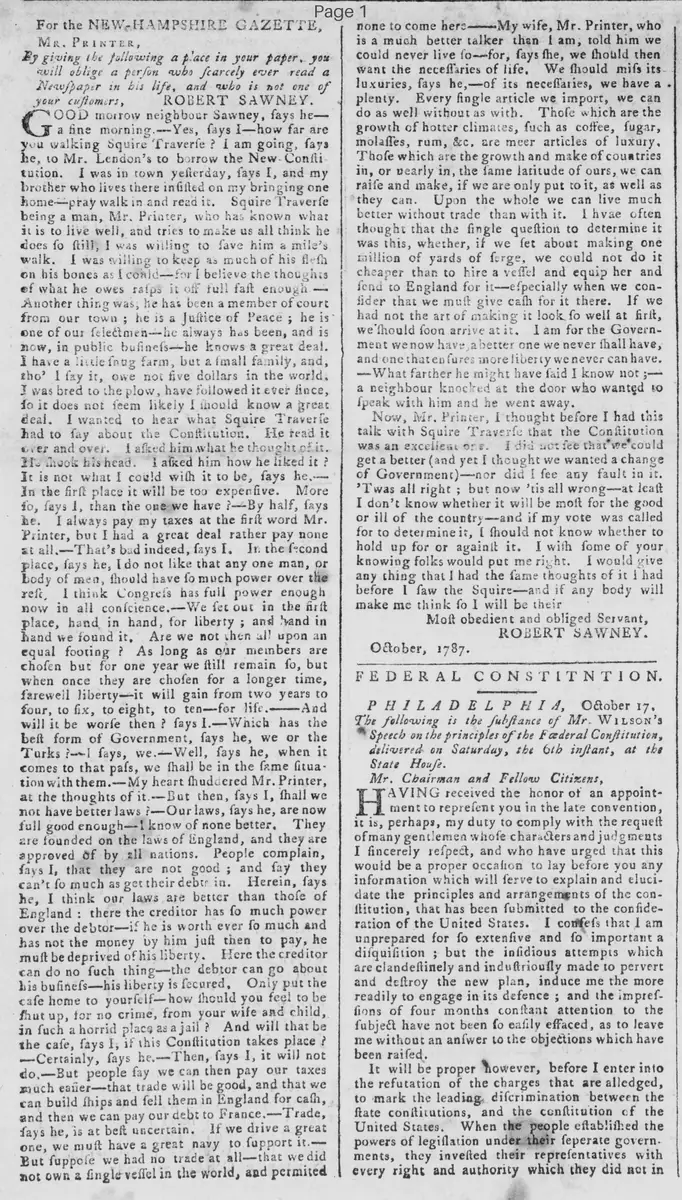
MR. PRINTER,
By giving the following a place in your paper, you will oblige a person who scarcely ever read a Newspaper in his life, and who is not one of your customers,
ROBERT SAWNEY.
GOOD morrow neighbour Sawney, says he--
A fine morning.--Yes, says I--how far are you walking Squire Traverse? I am going, says he, to Mr. Lendon's to borrow the New-Constitution. I was in town yesterday, says I, and my brother who lives there insisted on my bringing one home--pray walk in and read it. Squire Traverse being a man, Mr. Printer, who has known what it is to live well, and tries to make us all think he does so still. I was willing to save him a mile's walk. I was willing to keep as much of his flesh on his bones as I could--for I believe the thoughts of what he owes rubs it off full fast enough--
Another thing was, he has been a member of court from our town: he is a Justice of Peace; he is one of our selectmen---he always has been, and is now, in public business--he knows a great deal.
I have a little snug farm, but a small family, and, tho' I say it, owe not five dollars in the world.
I was bred to the plow, have followed it ever since. do it does not seem likely I should know a great deal. I wanted to hear what Squire Traverse had to say about the Constitution. He read it over and over. I asked him what he thought of it. He shook his head. I asked him how he liked it?
It is not what I could wish it to be, says he.---
In the first place it will be too expensive. More, says I, than the one we have?--By half, says he. I always pay my taxes at the first word Mr. Printer, but I had a great deal rather pay none at all,--
That's bad indeed, says I. In the second place, says he, I do not like that any one man, or body of men, should have so much power over the rest. I think Congress has full power enough now in all conscience.--
We set out in the first place, hand in hand, for liberty: and hand in hand we found it. Are we not then all upon an equal footing? As long as our members are chosen but for one year we still remain so, but when once they are chosen for a longer time, farewell liberty--it will gain from two years to four, to six, to eight, to ten--for life.---
And will it be worse then? says I. Which has the best form of Government, says he, we or the Turks?--I says, we.--Well, says he, when it comes to that pass, we shall be in the same situation with them.--
My heart shuddered Mr. Printer, at the thoughts of it.--But then, says I, shall we not have better laws?--Our laws, says he, are now full good enough-I know of none better. They are founded on the laws of England, and they are approved of by all nations. People complain, says I, that they are not good; and say they can't so much as get their debts in. Herein, says he, I think our laws are better than those of England: there the creditor has so much power over the debtor--if he is worth ever so much and has not the money by him just then to pay, he must be deprived of his liberty. Here the creditor can do no such thing--the debtor can go about his business-his liberty is secured. Only put the case home to yourself-how should you feel to be shut up, for no crime, from your wife and child, in such a horrid place as a jail? And will that be the case, says I, if this Constitution takes place? --Certainly, says he.--Then, says I, it will not do.--But people say we can then pay our taxes much easier--that trade will be good, and that we can build ships and sell them in England for cash, and then we can pay our debt to France.--Trade, says he, is at best uncertain. If we drive a great one, we must have a great navy to support it.-- But suppose we had no trade at all--that we did not own a single vessel in the world, and permitted none to come here-My wife, Mr. Printer, who is a much better talker than I am, told him we could never live so--for, says he, we should then want the necessaries of life. We should miss its luxuries, says he,--of its necessaries, we have a plenty. Every single article we import, we can do as well without as with. Those which are the growth of hotter climates, such as coffee, sugar, molasses, rum, &c, are mere articles of luxury. Those which are the growth and make of countries in, or nearly in, the same latitude of ours, we can raise and make, if we are only put to it, as well as they can. Upon the whole we can live much better without trade than with it. I have often thought that the single question to determine it was this, whether, if we set about making one million of yards of serge, we could not do it cheaper than to hire a vessel and equip her and send to England for it--especially when we consider that we must give cash for it there. If we had not the art of making it look so well at first, we should soon arrive at it. I am for the Government we now have a better one we never shall have, and one that ensures more liberty we never can have. -What farther he might have said I know not ;- a neighbour knocked at the door who wanted to speak with him and he went away.
Now, Mr. Printer. I thought before I had this talk with Squire Traverse that the Constitution was an excellent one. I did not see that we could get a better (and yet I thought we wanted a change of Government)--nor did I see any fault in it. 'Twas all right: but now 'tis all wrong--at least I don't know whether it will be most for the good or ill of the country--and if my vote was called for to determine it, I should not know whether to hold up for or against it. I wish some of your knowing folks would put me right. I would give any thing that I had the same thoughts of it I had before I saw the Squire--and if any body will make me think so I will be their
Most obedient and obliged Servant,
ROBERT SAWNEY.
October, 1787.
What sub-type of article is it?
What themes does it cover?
What keywords are associated?
What entities or persons were involved?
Letter to Editor Details
Author
Robert Sawney
Recipient
Mr. Printer
Main Argument
through a dialogue with squire traverse, the author expresses doubts about the proposed us constitution, citing its potential expense, concentration of power leading to loss of liberty, and preference for the current government's equality and self-sufficiency without extensive trade.
Notable Details