Thank you for visiting SNEWPapers!
Sign up free
The New Hampshire Gazette
Portsmouth, Rockingham County, New Hampshire
What is this article about?
In the U.S. House of Representatives from December 28 to 31, members exposed a bribery scheme by Robert Randall and Charles Whitney to petition for a 20 million acre land grant from Indians bordering Lakes Erie, Huron, and Michigan, offering shares to congressmen. Randall and Whitney were arrested and examined amid debates on proceedings. Other resolutions addressed fortifications, naval expenses, penal convictions, and import duties.
Clipping
OCR Quality
Full Text
Of the United States.
HOUSE OF REPRESENTATIVES,
December 28.
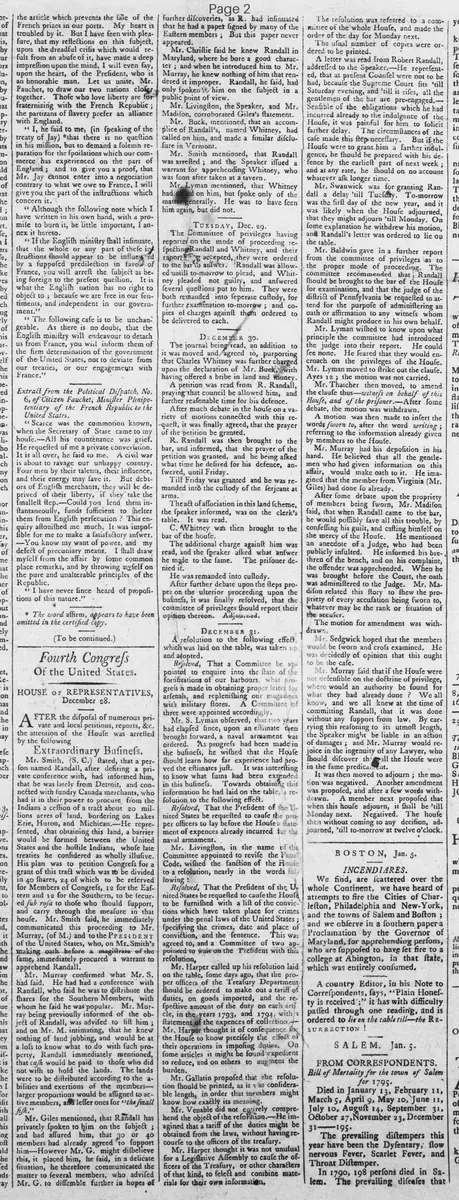
After the disposal of numerous private and local petitions, reports, &c. the attention of the House was arrested by the following
Extraordinary Business.
Mr. Smith, (S. C.) stated, that a person named Randall, after desiring a private conference with, had informed him, that he was lately from Detroit, and connected with sundry Canada merchants, who had it in their power to procure from the Indians a cession of a tract about 20 millions acres of land, bordering on Lakes Erie, Huron, and Michigan.--He represented, that obtaining this land, a barrier would be formed between the United States and the hostile Indians, whose late treaties he considered as wholly illusive. His plan was to petition Congress for a grant of this tract which was to be divided in 40 shares, 24 of which to be reserved for Members of Congress, 12 for the Eastern and 16 for the Southern, to be secured sub rosa to those who should support, and carry through the measure in that house. Mr. Smith said, he immediately communicated this proceeding to Mr. Murray, (of M.) and to the PRESIDENT of the United States, who, on Mr. Smith's making oath before a magistrate of the same, immediately procured a warrant to apprehend Randall.
Mr. Murray confirmed what Mr. S. had said. He had had a conference with Randall. who said he was to distribute the shares for the Southern Members, with whom he said he was popular. Mr. Murray being previously informed of the object of Randall, was advised to sift him; and on Mr. M. intimating, that he knew nothing of land jobbing, and would be at a loss to know what to do with such property, Randall immediately mentioned, that cash would be paid to those who did not wish to hold the lands. The lands were to be distributed according to the abilities and exertions of the members-- larger proportions would be assigned to active members, and lesser ones for "the small fry."
Mr. Giles mentioned, that Randall has privately spoken to him on the subject; and had assured him, that 30 or 40 members had already agreed to support him--However Mr. G. might disbelieve this, it placed him. he said, in a delicate situation, he therefore communicated the matter to several members, who advised Mr. G. to dissemble further in hopes of further discoveries, as R. had insinuated that he had a paper signed by many of the Eastern members; But this paper never appeared.
Mr. Christie said he knew Randall in Maryland, where he bore a good character ; and when he introduced him to Mr. Murray, he knew nothing of him that rendered it improper. Randall, he said, had only spoken him on the subject in a public point of view.
Mr. Livingston. the Speaker, and Mr. Madison, corroborated Giles's statement.
Mr. Buck, mentioned, that an accomplice of Randall's, named Whitney, had called on him, and made a similar disclosure in Vermont.
Mr. Smith mentioned, that Randall was arrested; and the Speaker issued a warrant for apprehending Whitney, who was soon after taken at a tavern.
Mr. Lyman mentioned, that Whitney had called on him, but spoke only of the matter generally. He was to have seen him again, but did not.
Tuesday, Dec. 29.
The Committee of privileges having reported on the mode of proceeding respecting Randall and Whitney, and their report being accepted, they were ordered to the bar to answer. Randall was allowed until to-morrow to plead, and Whitney pleaded not guilty, and answered several questions put to him. They were both remanded into separate custody, for further examination to-morrow ; and copies of charges against them ordered to be delivered to each.
DECEMBER 30.
The journal being read, an addition to it was moved and agreed to, purporting that Charles Whitney was further charged upon the declaration of Mr. Buck, with having offered a bribe in land and money.
A petition was read from R. Randall, praying that council be allowed him, and further reasonable time for his defence.
After much debate in the house on a variety of motions connected with this request, it was finally agreed, that the prayer of the petition be granted.
R. Randall was then brought to the bar, and informed, that the prayer of the petition was granted, and he being asked what time he desired for his defence, answered, until Friday.
Till Friday was granted and he was remanded into the custody of the sergeant at arms.
The association in this land scheme, the speaker informed, was on the clerk's table. It was read.
C. Whitney was then brought to the bar of the house.
The additional charge against him was read, and the speaker asked what answer he made to the same. The prisoner denied it.
He was remanded into custody.
After further debate upon the steps proper on the ulterior proceeding upon the business, it was finally resolved, that the committee of privileges should report their opinion thereon. Adjourned.
December 31.
A resolution to the following effect, which was laid on the table, was taken up and adopted.
Resolved, That a Committee be appointed to enquire into the state of the fortifications of our harbours, what progress is made in obtaining proper sites for arsenals, and replenishing our magazines with military stores. A Committee of three were appointed accordingly.
Mr. S. Lyman observed, that two years had elapsed since, upon an estimate then brought forward, a naval armament was ordered. As progress had been made in the business, he wished that the House should learn how far experience had proved the estimates just. It was interesting to know what sums had been expended in this business. Towards obtaining this information he had laid on the table, a resolution to the following effect.
Resolved, That the President of the United States be requested to cause the proper officers to lay before the House: statement of expences already incurred for the naval armament.
Mr. Livingston, in the name of the Committee appointed to revise the Penal Code, wished the sanction of the House to a resolution, nearly in the words following:
Resolved, That the President of the United States be requested to cause the House to be furnished with a list of the convictions which have taken place for crimes under the penal laws of the United States ; specifying the crimes, date and place of conviction, and the sentence. This was agreed to, and a Committee of two appointed to wait on the President with this resolution,
Mr. Harper called up his resolution laid on the table, some days ago, that the proper officers of the Treasury Department should be ordered to make out a tariff of duties, on goods imported, and the respective amount of the duty on each article, in the years 1793, and 1794, with a statement of the expences of collection.
Mr. Harper thought it of consequence the House to know precisely the effect of their operations in imposing duties. On some articles it might be found expedient to reduce, and on others to augment the burden.
Mr. Gallatin proposed that the resolution should be printed, as it was considerable length, in order that members might know how exactly its meaning.
Mr. Venable did not entirely comprehend the object of the resolution.--He imagined that a tariff of the duties might be obtained from the laws, without having recourse to the officers of the treasury.
Mr. Harper thought it was not unusual for a Legislative Assembly to cause the officers of the Treasury, or other characters of that kind, to select and combine materials for their own information.
The resolution was referred to a committee of the whole House, and made the order of the day for Monday next.
The usual number of copies were ordered to be printed.
A letter was read from Robert Randall. addressed to the Speaker.-He represented, that at present Counsel were not to be had, because the Supreme Court sits 'till Saturday evening, and 'till it rises, all the gentlemen of the bar are pre-engaged.- Sensible of the obligations which he had incurred already to the indulgence of the House, it was painful for him to solicit farther delay. The circumstances of the case made this step necessary. But if the House were to grant him a farther indulgence, he should be prepared with his defence by the earliest part of next week ; and at any rate, he should on no account whatever ask longer time.
Mr. Swanwick was for granting Randall a delay 'till Tuesday. To-morrow was the first day of the new year, and it was likely when the House adjourned, that they might adjourn 'till Monday. On some explanation he withdrew his motion, and Randall's letter was ordered to lie on the table.
Mr. Baldwin gave in a further report from the committee of privileges as to the proper mode of proceeding. The committee recommended that Randall should be brought to the bar of the House for examination, and that the judge of the district of Pennsylvania be requested to attend for the purpose of administering an oath or affirmation to any witness whom Randall might produce in his own behalf.
Mr. Lyman wished to know upon what principle the committee had introduced the judge into their report. He could see none. He feared that they would encroach on the privileges of the House.
Mr. Lyman moved to strike out the clause. Ayes 16; the motion was not carried.
Mr. Thatcher then moved, to amend the clause thus-witness on behalf of this House, and of the prisoner.-After some debate, the motion was withdrawn.
A motion was then made to insert the words sworn to, after the word writing ; referring to the information already given by members to the House.
Mr. Murray had his deposition in his hand. He believed that all the gentlemen who had given information on this affair, would make oath to it. He imagined that the member from Virginia (Mr. Giles) had done so already.
After some debate upon the propriety of members being sworn, Mr. Madison said, that when Randall came to the bar, he would possibly save all this trouble, by confessing his guilt, and casting himself on the mercy of the House. He mentioned an anecdote of a Judge, who had been publicly insulted. He informed his brethren of the bench, and on his complaint, the offender was apprehended. When he was brought before the Court, the oath was administered to the Judge. Mr. Madison related this story to shew the propriety of every accusation being sworn to, whatever may be the rank or situation of the accuser.
The motion for amendment was withdrawn.
Mr. Sedgwick hoped that the members would be sworn and cross examined. He was decidedly of opinion that this ought to be the case.
Mr. Murray said that if the House were not defensible on the doctrine of privilege, where would an authority be found for what they had already done ? We all know, and we all knew at the time of committing Randall, that it was done without any support from law. By carrying this reasoning to its utmost length, the Speaker might be liable in an action of damages ; and Mr. Murray would rejoice in the ingenuity of any Lawyer, who should discover the pass the House were in the same predicament.
It was then moved to adjourn ; the motion was negatived. Another amendment was proposed, and after a few words withdrawn. A member next proposed that when this house adjourn, it shall be 'till Monday next. Negatived. The house then without coming to any decision, adjourned, 'till to-morrow at twelve o'clock.
What sub-type of article is it?
What keywords are associated?
What entities or persons were involved?
Domestic News Details
Event Date
December 28 To December 31
Key Persons
Outcome
randall and whitney arrested, remanded into custody, granted time for defense; ongoing examinations and debates on proceedings; resolutions adopted on fortifications, naval expenses, penal convictions, and import duties.
Event Details
Robert Randall approached members of Congress with a scheme to petition for a 20 million acre land grant from Indians bordering Lakes Erie, Huron, and Michigan, to form a barrier against hostile tribes, dividing the land into 40 shares with 24 reserved sub rosa for supportive congressmen (12 Eastern, 16 Southern), offering cash alternatives and larger shares to active members. Members reported the bribery attempt, leading to Randall's arrest on warrant from the President and Whitney's apprehension. House proceedings included confirmations, petitions for counsel and time, readings of charges and association paper, debates on oaths, judges, and modes of examination; Whitney denied charges. Interspersed resolutions requested information on harbor fortifications, arsenals, military stores; naval armament expenses; list of penal convictions; and tariff of duties for 1793-1794 with collection expenses.