Thank you for visiting SNEWPapers!
Sign up free
The Helena Independent
Helena, Lewis And Clark County, Montana
What is this article about?
Francis Galton proposes using fingerprint patterns for infallible human identification, based on their lifelong persistence. He explains the anatomical basis and historical use by Sir William Herschel in Bengal to prevent personation. Applications include crime detection, passports, and verifying identities after long absences.
Clipping
OCR Quality
Full Text
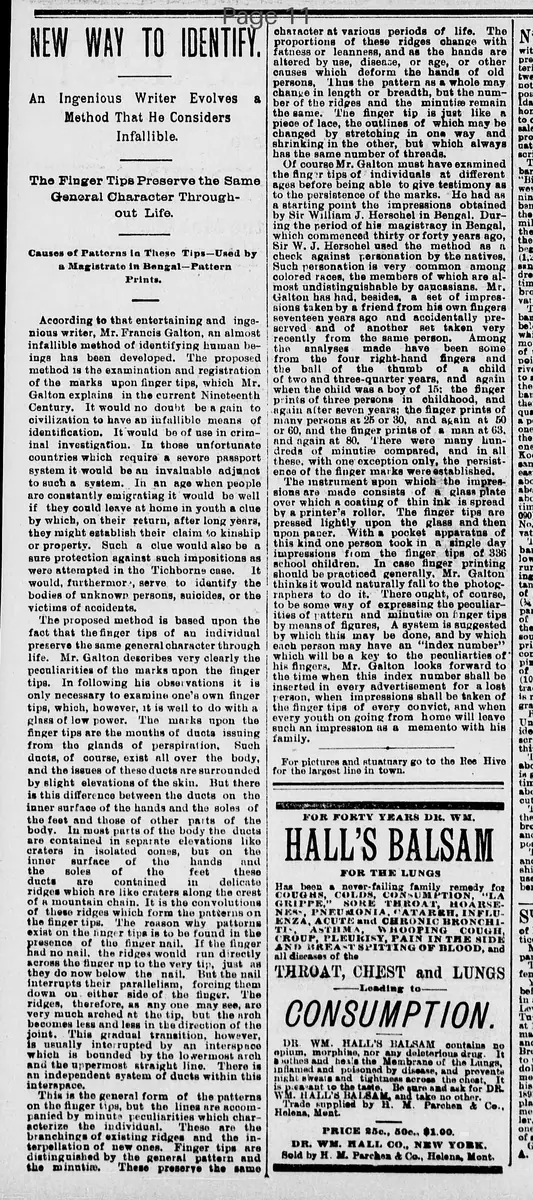
An Ingenious Writer Evolves a Method That He Considers Infallible.
The Finger Tips Preserve the Same General Character Throughout Life.
Causes of Patterns in These Tips—Used by a Magistrate in Bengal—Pattern Prints.
According to that entertaining and ingenious writer, Mr. Francis Galton, an almost infallible method of identifying human beings has been developed. The proposed method is the examination and registration of the marks upon finger tips, which Mr. Galton explains in the current Nineteenth Century. It would no doubt be a gain to civilization to have an infallible means of identification. It would be of use in criminal investigation. In those unfortunate countries which require a severe passport system it would be an invaluable adjunct to such a system. In an age when people are constantly emigrating it would be well if they could leave at home in youth a clue by which, on their return, after long years, they might establish their claim to kinship or property. Such a clue would also be a sure protection against such impositions as were attempted in the Tichborne case. It would, furthermore, serve to identify the bodies of unknown persons, suicides, or the victims of accidents.
The proposed method is based upon the fact that the finger tips of an individual preserve the same general character through life. Mr. Galton describes very clearly the peculiarities of the marks upon the finger tips. In following his observations it is only necessary to examine one's own finger tips, which, however, it is well to do with a glass of low power. The marks upon the finger tips are the mouths of ducts issuing from the glands of perspiration. Such ducts, of course, exist all over the body, and the issues of these ducts are surrounded by slight elevations of the skin. But there is this difference between the ducts on the inner surface of the hands and the soles of the feet and those of other parts of the body. In most parts of the body the ducts are contained in separate elevations like craters in isolated cones, but on the inner surface of the hands and the soles of the feet these ducts are contained in delicate ridges which are like craters along the crest of a mountain chain. It is the convolutions of these ridges which form the patterns on the finger tips. The reason why patterns exist on the finger tips is to be found in the presence of the finger nail. If the finger had no nail, the ridges would run directly across the finger up to the very tip, just as they do now below the nail. But the nail interrupts their parallelism, forcing them down on either side of the finger. The ridges, therefore, as any one may see, are very much arched at the tip, but the arch becomes less and less in the direction of the joint. This gradual transition, however, is usually interrupted by an interspace which is bounded by the lowermost arch and the uppermost straight line. There is an independent system of ducts within this interspace.
This is the general form of the patterns on the finger tips, but the lines are accompanied by minute peculiarities which characterize the individual. These are the branchings of existing ridges and the interpolation of new ones. Finger tips are distinguished by the general pattern and the minutiae. These preserve the same character at various periods of life. The proportions of these ridges change with fatness or leanness, and as the hands are altered by use, disease, or age, or other causes which deform the hands of old persons. Thus the pattern as a whole may change in length or breadth, but the number of the ridges and the minutiae remain the same. The finger tip is just like a piece of lace, the outlines of which may be changed by stretching in one way and shrinking in the other, but which always has the same number of threads.
Of course Mr. Galton must have examined the finger tips of individuals at different ages before being able to give testimony as to the persistence of the marks. He had as a starting point the impressions obtained by Sir William J. Herschel in Bengal. During the period of his magistracy in Bengal, which commenced thirty or forty years ago, Sir W. J. Herschel used the method as a check against personation by the natives. Such personation is very common among colored races, the members of which are almost undistinguishable by Caucasians. Mr. Galton has had, besides, a set of impressions taken by a friend from his own fingers seventeen years ago and accidentally preserved, and of another set taken very recently from the same person. Among the analyses made have been some from the four right-hand fingers and the ball of the thumb of a child of two and three-quarter years, and again when the child was a boy of 15; the finger prints of three persons in childhood, and again after seven years; the finger prints of many persons at 25 or 30, and again at 50 or 60, and the finger prints of a man at 63, and again at 80. There were many hundreds of minutiae compared, and in all these, with one exception only, the persistence of the finger marks were established.
The instrument upon which the impressions are made consists of a glass plate over which a coating of thin ink is spread by a printer's roller. The finger tips are pressed lightly upon the glass and then upon paper. With a pocket apparatus of this kind one person took in a single day impressions from the finger tips of 336 school children. In case finger printing should be practiced generally, Mr. Galton thinks it would naturally fall to the photographers to do it. There ought, of course, to be some way of expressing the peculiarities of pattern and minutiae on finger tips by means of figures. A system is suggested by which this may be done, and by which each person may have an 'index number' which will be a key to the peculiarities of his fingers. Mr. Galton looks forward to the time when this index number shall be inserted in every advertisement for a lost person, when impressions shall be taken of the finger tips of every convict, and when every youth on going from home will leave such an impression as a memento with his family.
What sub-type of article is it?
What themes does it cover?
What keywords are associated?
What entities or persons were involved?
Where did it happen?
Story Details
Key Persons
Location
Bengal
Event Date
Thirty Or Forty Years Ago
Story Details
Mr. Francis Galton develops a method of identification using persistent fingerprint patterns on finger tips, explaining their anatomical formation due to sweat ducts and nails. Based on Sir William Herschel's use in Bengal to prevent personation, Galton verifies persistence through comparisons over years and ages. He proposes printing techniques and index numbers for applications in crime, passports, emigration, and identification of bodies.