Thank you for visiting SNEWPapers!
Sign up free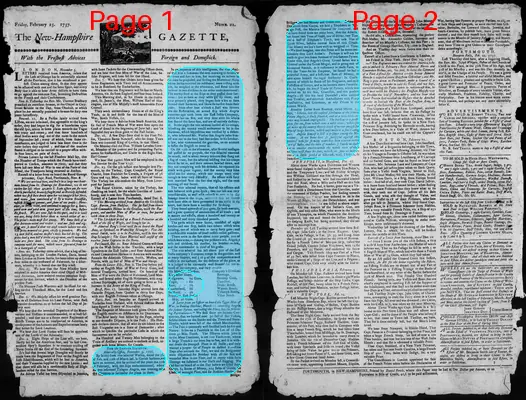
The New Hampshire Gazette
Portsmouth, Rockingham County, New Hampshire
What is this article about?
In 1756, Vice Admiral Watson's British squadron captured the pirate stronghold of Geriah from Tulagee Angria, destroying his fleet, seizing treasure, and garrisoning the fort with minimal losses. Additional letters detail spoils and Angria's piratical history.
Merged-components note: This is a single continuous full narrative story from the London Gazette about Vice Admiral Watson's capture of Geriah from the pirate Angria, including the embedded table listing the ships involved and the detailed continuation on the next page with additional letters and background information.
Clippings
1 of 2
OCR Quality
Full Text
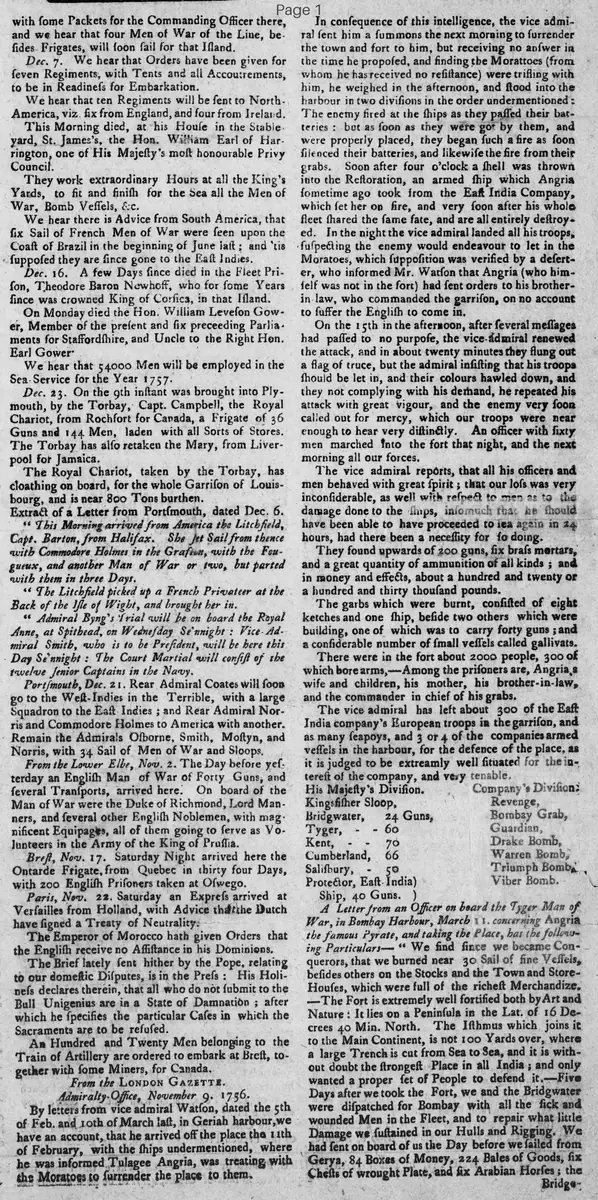
Admiralty-Office, November 9. 1756.
By letters from vice admiral Watson, dated the 5th of Feb. and 10th of March last, in Geriah harbour, we have an account, that he arrived off the place the 11th of February, with the ships undermentioned, where he was informed Tulagee Angria, was treating with the Marattoes to surrender the place to them.
In consequence of this intelligence, the vice admiral sent him a summons the next morning to surrender the town and fort to him, but receiving no answer in the time he proposed, and finding the Marattoes (from whom he has received no resistance) were trifling with him, he weighed in the afternoon, and stood into the harbour in two divisions in the order undermentioned:
The enemy fired at the ships as they passed their batteries: but as soon as they were got by them, and were properly placed, they began such a fire as soon silenced their batteries, and likewise the fire from their grabs. Soon after four o'clock a shell was thrown into the Restoration, an armed ship which Angria sometime ago took from the East India Company, which set her on fire, and very soon after his whole fleet shared the same fate, and are all entirely destroyed. In the night the vice admiral landed all his troops, suspecting the enemy would endeavour to let in the Marattoes, which supposition was verified by a deserter, who informed Mr. Watson that Angria (who himself was not in the fort) had sent orders to his brother-in-law, who commanded the garrison, on no account to suffer the English to come in.
On the 15th in the afternoon, after several messages had passed to no purpose, the vice-admiral renewed the attack, and in about twenty minutes they flung out a flag of truce, but the admiral insisting that his troops should be let in, and their colours hauled down, and they not complying with his demand, he repeated his attack with great vigour, and the enemy very soon called out for mercy, which our troops were near enough to hear very distinctly. An officer with sixty men marched into the fort that night, and the next morning all our forces.
The vice admiral reports, that all his officers and men behaved with great spirit; that our loss was very inconsiderable, as well with respect to men as to the damage done to the ships, insomuch that he should have been able to have proceeded to sea again in 24 hours, had there been a necessity for so doing.
They found upwards of 200 guns, six brass mortars, and a great quantity of ammunition of all kinds; and in money and effects, about a hundred and twenty or a hundred and thirty thousand pounds.
The grabs which were burnt, consisted of eight ketches and one ship, beside two others which were building, one of which was to carry forty guns; and a considerable number of small vessels called gallivats.
There were in the fort about 2000 people, 300 of which bore arms. --Among the prisoners are, Angria's wife and children, his mother, his brother-in-law, and the commander in chief of his grabs.
The vice admiral has left about 200 of the East India company's European troops in the garrison, and as many seapoys, and 3 or 4 of the company's armed vessels in the harbour, for the defence of the place, as it is judged to be extremely well situated for the interest of the company, and very tenable.
His Majesty's Division
Company's Division:
Revenge,
Bombay Grab,
Guardian,
Drake Bomb,
Warren Bomb,
Triumph Bomb,
Viper Bomb.
Ship, 40 Guns.
A Letter from an Officer on board the Tyger Man of War, in Bombay Harbour, March 11. concerning Angria the famous Pyrate, and taking the Place, has the following Particulars-- "We find since we became Conquerors, that we burned near 30 Sail of fine Vessels, besides others on the Stocks and the Town and Store-Houses, which were full of the richest Merchandize.
--The Fort is extremely well fortified both by Art and Nature: It lies on a Peninsula in the Lat. of 16 Degrees 40 Min. North. The Isthmus which joins it to the Main Continent, is not 100 Yards over, where a large Trench is cut from Sea to Sea, and it is without doubt the strongest Place in all India; and only wanted a proper set of People to defend it.--Five Days after we took the Fort, we and the Bridgwater were dispatched for Bombay with all the sick and wounded Men in the Fleet, and to repair what little Damage we sustained in our Hulls and Rigging. We had sent on board of us the Day before we sailed from Geriah, 84 Boxes of Money, 224 Bales of Goods, six Chests of wrought Plate, and six Arabian Horses; the Bridgwater
| Kingsfisher Sloop, | |
| Bridgwater, | 24 Guns, |
| Tyger, | - 60 |
| Kent, | - 70 |
| Cumberland, | 66 |
| Salifbury, | - 50 |
| Protector, | Eaft-India) |
Bridgewater had Money and Goods also. Before our Departure from Gheria, we sold 4 Elephants to Romage-Post, the Maratta General for 100,000 l. and we have heard since we came here, that the Admiral has found two Tons of Gold, one of Silver, two Tons and a half of Elephant's Teeth, and one Ton of Quick Silver, besides several Bales of rich Goods. The Money we bro't here with us weighed 10 Tons. We here imagine, that this Prize will be more considerable than Lord Anson's. Perhaps it will not be amiss to give you some Account of this famous Pyrate: Know then, that Angria's Great Grand-father was a General under the Great Mogul, and in going on one of his annual Rounds, as is customary in these Parts, to levy the Taxes for his Emperor, he found he had a powerful Army, and a sufficient Sum of Money, to take upon himself the regal Authority: In Consequence of which he shook off his Allegiance, and took Possession of Gheria, and as he became more Formidable, he began the bloody Trade of Pyracy, which was carried on by his Son, Grandson, and this present Angria; till this his fatal Downfall; who entered into Treaties, and received Ambassadors with Pomp, Punctuality, and Grandeur, as any Prince in the known World.
Another Letter from Bombay, dated March 15, Says, Gheria, late the capital Settlement of the famous Pirate Angria, is finely situated, and at a very little Expence may be made impregnable: The Harbour is a prodigious fine one, from which runs a noble River, where for 40 miles up the Country there is depth of Water enough for Ships of large Burthen, which must make it a fine trading Port. Angria himself is still a Prisoner among the Morattoes. As we have been so Successful against this Pyrate (who for so many Years has been a Terror to this part of India, and the Ruin of Numbers) I make no doubt but in another Twelvemonth the whole Race of these Villains will share his Fate, which, as soon as Matters can be a little settled at Gheriah, will, I believe, be immediately attempted.
What sub-type of article is it?
What themes does it cover?
What keywords are associated?
What entities or persons were involved?
Where did it happen?
Story Details
Key Persons
Location
Geriah Harbour, India
Event Date
February March 1756
Story Details
Vice Admiral Watson's fleet arrived off Geriah on February 11, 1756, and after summoning the pirate Tulagee Angria to surrender, attacked the fort and harbor. The British silenced enemy batteries, destroyed Angria's fleet by fire, landed troops, and captured the fort on February 15 after renewed assault. They seized guns, ammunition, money, and effects worth 120-130 thousand pounds. Angria's family and commanders were captured; the fort was left garrisoned.