Thank you for visiting SNEWPapers!
Sign up free
Editorial
June 30, 1845
Lynchburg Virginian
Lynchburg, Virginia
What is this article about?
Editorial discusses the debate in Virginia over calling a convention to revise the state constitution, particularly the basis of representation (white population vs. mixed with taxation). Supports taking the people's sense on the convention to avoid escalating sectional tensions between East and West, while advocating safeguards for Eastern slaveholders' interests against potential majority abuse.
Clipping
OCR Quality
98%
Excellent
Full Text
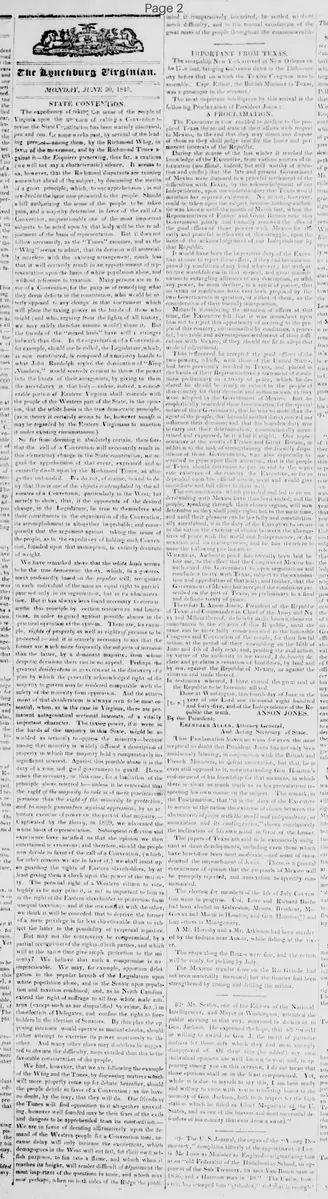
STATE CONVENTION.
The expediency of taking the sense of the people of Virginia upon the question of calling a Convention to revise the State Constitution has been warmly discussed, pro and con, for some weeks past, by several of the leading presses—among them, by the Richmond Whig, in favor of the movement, and by the Richmond Times against it—the Enquirer preserving, thus far, a cautious (we will not say a characteristic) silence. It seems to us, however, that the Richmond disputants are running somewhat ahead of the subject, by discussing the merits of a great principle, which, to our apprehension, is not involved in the issue now presented to the people. Should a bill authorizing the sense of the people to be taken pass, and a majority determine in favor of the call of a Convention, unquestionably one of the most important subjects to be acted upon by that body will be the readjustment of the basis of representation. But it does not follow necessarily, as the "Times" assumes, and as the "Whig" seems to admit, that its decision will materially interfere with the existing arrangement, much less that it will certainly result in an apportionment of representation upon the basis of white population alone, and without reference to taxation. Many persons are in favor of a Convention, for the purpose of remedying what they deem defects in the constitution, who would be utterly opposed to any change in that instrument which will place the taxing power in the hands of those who might (and who, arguing from the lights of all history, we may safely therefore assume would) abuse it. But the friends of the "mixed basis" have still a stronger bulwark than this. In the organization of a Convention for example, should one be called, the Legislature, which, as now constituted, is composed of a majority hostile to what John Randolph styled the domination of "King Numbers," would scarcely consent to throw the power into the hands of their antagonists, by giving to them the ascendancy in that body—unless, indeed, a considerable portion of Eastern Virginia shall coincide with the people of the Western part of the State, in the opinion, that the white basis is the true democratic principle, (as in theory it certainly seems to be, however unsafe it may be regarded by the Eastern Virginians to sanction it under existing circumstances.)
So far from deeming it absolutely certain, therefore, that the call of a Convention will necessarily result in this elementary change in the State constitution, we regard the apprehension of that event, expressed and so earnestly dwelt upon by the Richmond Times, as altogether unfounded. We do not, of course, intend to deny that this is one of the objects contemplated by the advocates of a Convention, particularly in the West; but merely to show, that, if the opponents of the desired change, in the Legislature, be true to themselves and their constituents in the organization of the Convention, its accomplishment is altogether improbable; and consequently that the argument against taking the sense of the people, as to the expediency of holding such Convention, founded upon that assumption, is entirely destitute of weight.
We have remarked above that the white basis seems to be the true democratic theory, which, in a government professedly based on the popular will, recognizes in each individual of the mass an equal right to participate not only in its organization, but in its administration. But it has always been found necessary to circumscribe this principle by certain restrictions and limitations, in order to guard against possible abuses in the practical operation of the system. There are, for example, rights of property as well as rights of persons to be protected; and it is scarcely necessary to say that the former are much more frequently the subjects of invasion than the latter, by a dominant majority, from whose despotic decisions there can be no appeal. Perhaps the greatest desideratum in government is the discovery of a plan by which the generally acknowledged right of the majority to govern may be rendered compatible with the safety of the minority from oppression. And the attainment of that desideratum is always seen to be most essential, when, as is the case in Virginia, there are permanent antagonistical sectional interests, of a vitally important character. The taxing power, if it were in the hands of the majority in this State, might be so wielded as seriously to oppress the minority—because among that minority is widely diffused a description of property in which the majority hold a comparatively insignificant interest. Against this possible abuse it is the duty of a wise and good government to guard. Hence arises the necessity, in this case, for a limitation of the principle above referred to—unless it be contended that the right of the majority to rule is of more practical importance than the right of the minority to protection, and to ample guarantees against oppression, by an arbitrary exercise of power on the part of that majority.—
Captivated by the theory, in 1829, we advocated the white basis of representation. Subsequent reflection and experience have satisfied us that the opinion we then entertained is erroneous; and therefore, should the people now decide in favor of the call of a Convention, (which, for other reasons we are in favor of,) we shall insist upon guarding the rights of Eastern slaveholders, by at least giving them a check upon the power of the majority. The personal right of a Western citizen to vote, highly as he may prize it, is not so important to him as is the right of the Eastern slaveholder to protection from unequal taxation;—and if the one conflict with the other, we think it will be conceded that to deprive the former of a mere privilege is far less objectionable than to subject the latter to the possibility of perpetual injustice.
But may not the controversy be compromised, by a partial recognition of the rights of both parties, and which will at the same time give ample protection to the minority? We believe that such a compromise is not impracticable. We may, for example, apportion delegation in the popular branch of the Legislature upon white population alone, and in the Senate upon population and taxation combined, and, as in North Carolina, extend the right of suffrage to all free white male citizens (except such as are disqualified by crime, &c.,) in the election of Delegates, and confine the right to freeholders in the election of Senators. By this plan the opposing interests would operate as mutual checks, should either attempt to exercise its power injuriously to the other. And many other plans may doubtless be suggested to obviate the difficulty, more entitled than this to the favorable consideration of the people.
We find, however, that we are following the example of the Whig and the Times, by discussing matters which will more properly come up for debate hereafter, should the people decide in favor of a Convention; as we have no doubt, by the way, that they will do. Our friends of the Times will find opposition to it altogether unavailing, however well founded may be their fears of the evils and dangers to be apprehended from its convocation.—
We are in favor of deciding affirmatively upon the demand of the Western people for a Convention now, because delay will only increase the excitement, which demagogues in the West will not fail, for their own selfish purposes, to fan into a flame, and which when it reaches its height, will render difficult of adjustment the most important of the questions in issue, and which may now perhaps, when on both sides of the Ridge the public mind is comparatively unexcited, be settled without much difficulty, and to the mutual satisfaction of the great mass of the people throughout the commonwealth.
The expediency of taking the sense of the people of Virginia upon the question of calling a Convention to revise the State Constitution has been warmly discussed, pro and con, for some weeks past, by several of the leading presses—among them, by the Richmond Whig, in favor of the movement, and by the Richmond Times against it—the Enquirer preserving, thus far, a cautious (we will not say a characteristic) silence. It seems to us, however, that the Richmond disputants are running somewhat ahead of the subject, by discussing the merits of a great principle, which, to our apprehension, is not involved in the issue now presented to the people. Should a bill authorizing the sense of the people to be taken pass, and a majority determine in favor of the call of a Convention, unquestionably one of the most important subjects to be acted upon by that body will be the readjustment of the basis of representation. But it does not follow necessarily, as the "Times" assumes, and as the "Whig" seems to admit, that its decision will materially interfere with the existing arrangement, much less that it will certainly result in an apportionment of representation upon the basis of white population alone, and without reference to taxation. Many persons are in favor of a Convention, for the purpose of remedying what they deem defects in the constitution, who would be utterly opposed to any change in that instrument which will place the taxing power in the hands of those who might (and who, arguing from the lights of all history, we may safely therefore assume would) abuse it. But the friends of the "mixed basis" have still a stronger bulwark than this. In the organization of a Convention for example, should one be called, the Legislature, which, as now constituted, is composed of a majority hostile to what John Randolph styled the domination of "King Numbers," would scarcely consent to throw the power into the hands of their antagonists, by giving to them the ascendancy in that body—unless, indeed, a considerable portion of Eastern Virginia shall coincide with the people of the Western part of the State, in the opinion, that the white basis is the true democratic principle, (as in theory it certainly seems to be, however unsafe it may be regarded by the Eastern Virginians to sanction it under existing circumstances.)
So far from deeming it absolutely certain, therefore, that the call of a Convention will necessarily result in this elementary change in the State constitution, we regard the apprehension of that event, expressed and so earnestly dwelt upon by the Richmond Times, as altogether unfounded. We do not, of course, intend to deny that this is one of the objects contemplated by the advocates of a Convention, particularly in the West; but merely to show, that, if the opponents of the desired change, in the Legislature, be true to themselves and their constituents in the organization of the Convention, its accomplishment is altogether improbable; and consequently that the argument against taking the sense of the people, as to the expediency of holding such Convention, founded upon that assumption, is entirely destitute of weight.
We have remarked above that the white basis seems to be the true democratic theory, which, in a government professedly based on the popular will, recognizes in each individual of the mass an equal right to participate not only in its organization, but in its administration. But it has always been found necessary to circumscribe this principle by certain restrictions and limitations, in order to guard against possible abuses in the practical operation of the system. There are, for example, rights of property as well as rights of persons to be protected; and it is scarcely necessary to say that the former are much more frequently the subjects of invasion than the latter, by a dominant majority, from whose despotic decisions there can be no appeal. Perhaps the greatest desideratum in government is the discovery of a plan by which the generally acknowledged right of the majority to govern may be rendered compatible with the safety of the minority from oppression. And the attainment of that desideratum is always seen to be most essential, when, as is the case in Virginia, there are permanent antagonistical sectional interests, of a vitally important character. The taxing power, if it were in the hands of the majority in this State, might be so wielded as seriously to oppress the minority—because among that minority is widely diffused a description of property in which the majority hold a comparatively insignificant interest. Against this possible abuse it is the duty of a wise and good government to guard. Hence arises the necessity, in this case, for a limitation of the principle above referred to—unless it be contended that the right of the majority to rule is of more practical importance than the right of the minority to protection, and to ample guarantees against oppression, by an arbitrary exercise of power on the part of that majority.—
Captivated by the theory, in 1829, we advocated the white basis of representation. Subsequent reflection and experience have satisfied us that the opinion we then entertained is erroneous; and therefore, should the people now decide in favor of the call of a Convention, (which, for other reasons we are in favor of,) we shall insist upon guarding the rights of Eastern slaveholders, by at least giving them a check upon the power of the majority. The personal right of a Western citizen to vote, highly as he may prize it, is not so important to him as is the right of the Eastern slaveholder to protection from unequal taxation;—and if the one conflict with the other, we think it will be conceded that to deprive the former of a mere privilege is far less objectionable than to subject the latter to the possibility of perpetual injustice.
But may not the controversy be compromised, by a partial recognition of the rights of both parties, and which will at the same time give ample protection to the minority? We believe that such a compromise is not impracticable. We may, for example, apportion delegation in the popular branch of the Legislature upon white population alone, and in the Senate upon population and taxation combined, and, as in North Carolina, extend the right of suffrage to all free white male citizens (except such as are disqualified by crime, &c.,) in the election of Delegates, and confine the right to freeholders in the election of Senators. By this plan the opposing interests would operate as mutual checks, should either attempt to exercise its power injuriously to the other. And many other plans may doubtless be suggested to obviate the difficulty, more entitled than this to the favorable consideration of the people.
We find, however, that we are following the example of the Whig and the Times, by discussing matters which will more properly come up for debate hereafter, should the people decide in favor of a Convention; as we have no doubt, by the way, that they will do. Our friends of the Times will find opposition to it altogether unavailing, however well founded may be their fears of the evils and dangers to be apprehended from its convocation.—
We are in favor of deciding affirmatively upon the demand of the Western people for a Convention now, because delay will only increase the excitement, which demagogues in the West will not fail, for their own selfish purposes, to fan into a flame, and which when it reaches its height, will render difficult of adjustment the most important of the questions in issue, and which may now perhaps, when on both sides of the Ridge the public mind is comparatively unexcited, be settled without much difficulty, and to the mutual satisfaction of the great mass of the people throughout the commonwealth.
What sub-type of article is it?
Constitutional
Taxation
What keywords are associated?
Virginia Convention
Basis Of Representation
White Basis
Mixed Basis
Slaveholders Protection
Taxation
Sectional Interests
What entities or persons were involved?
Richmond Whig
Richmond Times
Enquirer
John Randolph
Eastern Virginia
Western Virginia
Legislature
Editorial Details
Primary Topic
Virginia Convention To Revise State Constitution And Basis Of Representation
Stance / Tone
Supportive Of Convention With Safeguards For Minority Slaveholder Interests
Key Figures
Richmond Whig
Richmond Times
Enquirer
John Randolph
Eastern Virginia
Western Virginia
Legislature
Key Arguments
Debate On Calling Convention Is Ahead Of Taking People's Sense
Convention Unlikely To Change To White Basis If Opponents Organize It Properly
White Basis Is Democratic Theory But Needs Limits To Protect Property Rights
Majority Rule Must Balance With Minority Protection, Especially Slaveholders From Taxation Abuse
Advocate Compromise Like White Basis In House, Mixed In Senate
Support Convention Now To Prevent Escalation Of Sectional Excitement