Thank you for visiting SNEWPapers!
Sign up free
The National Intelligencer And Washington Advertiser
Washington, District Of Columbia
What is this article about?
A citizen of Georgetown opposes a proposed bridge over the Potomac River 4 miles below the upper city areas, arguing it would impede navigation, devalue property in Georgetown and upper Washington by 100%, benefit lower Washington and Alexandria, and harm western interior interests. Queries if Congress would approve such injustice, citing examples from other rivers without bridges below major ports.
Clipping
OCR Quality
Full Text
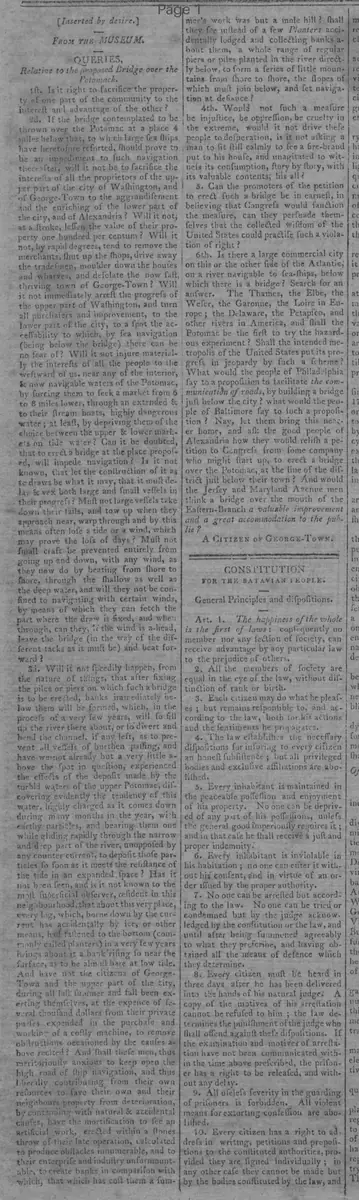
FROM THE MUSEUM.
QUERIES,
Relative to the proposed Bridge over the Potomack.
1st. Is it right to sacrifice the property of one part of the community to the interest and advantage of the other?
2d. If the bridge contemplated to be thrown over the Potomac at a place 4 miles below that, to which large sea ships have heretofore resorted, should prove to be an impediment to such navigation thereabout, will it not be to sacrifice the interests of all the proprietors of the upper part of the city of Washington, and of George-Town to the aggrandizement and the enriching of the lower part of the city, and of Alexandria? Will it not, at a stroke, lessen the value of their property one hundred per centum? Will it not, by rapid degrees, tend to remove the merchants, shut up the shops, drive away the tradesmen, moulder down the houses and wharves, and desolate the now fast thriving town of George-Town? Will it not immediately arrest the progress of the upper part of Washington, and turn all purchasers and improvement, to the lower part of the city, to a spot the accessibility to which, by sea navigation (being below the bridge) there can be no fear of? Will it most injure materially the interests of all the people to the westward of us, near any of the interior, who now navigable waters of the Potomac, by forcing them to seek a market from 6 to 8 miles lower, through an extended & to their team boats, highly dangerous water; at least, by depriving them of the choice between the upper & lower markets on tide water? Can it be doubted, that to erect a bridge at the place proposed, will impede navigation? Is it not known, that let the construction of it as to draws be what it may, that it must delay & vex both large and small vessels in their progress? Must not large vessels take down their sails, and tow up when they approach near, warp through and by this means often lose a tide or a wind, which may prove the loss of days? Must not small craft be prevented entirely from going up and down, with any wind, as they now do by beating from shore to shore, through the shallow as well as the deep water, and will they not be confined to navigating with certain winds by means of which they can fetch the part where the draw is fixed, and when through, can they, if the wind is a-head, leave the bridge (in the way of the different tacks as it must be) and beat forward?
3d. Will it not speedily happen, from the nature of things, that after fixing the piles or piers on which such a bridge is to be erected, banks immediately below them will be formed, which, in the process of a very few years, will so fill up the river thereabout, or so divert and hem in the channel, if any left, as to prevent all vessels of burthen passing, and have we not already but a very little above the spot in question, experienced the effects of the deposit made by the turbid waters of the upper Potomac, discovering evidently the tendency of this water, highly charged as it comes down during many months in the year, with earthly particles, and bearing them on while gliding rapidly through the narrow and deep part of the river, unopposed by any counter current, to deposit those particles so soon as it meets the resistance of the tide in an expanded space? Has it not been seen, and is it not known to the most superficial observer, resident in this neighbourhood, that about this very place, every log, which, borne down by the current has accidentally by ice, or other means, had fastened to the bottom (commonly called planters) in a very few years brings about it a bank rising so near the surface, as to be almost bare at low tide. And have not the citizens of George-Town and the upper part of the city, during all last summer and fall been exerting themselves, at the expense of several thousand dollars from their private purses expended in the purchase and working of a costly machine, to remove obstructions occasioned by the causes above recited? And shall these men, thus meritoriously anxious to keep open the high road of ship navigation, and thus liberally contributing from their own resources to save their own and their neighbours property from deterioration, by contending with natural & accidental causes, have the mortification to see an artificial work, erected within a stone's throw of their late operation, calculated to produce obstacles innumerable, and to their enterprise and industry unsurmountable, to create banks in comparison with which, that which has cost them a sum- mer's work was but a mole hill? shall they see instead of a few Planters accidentally lodged and collecting banks about them, a whole range of regular piers or piles planted in the river directly below, to form a series of little mountains from shore to shore, the slopes of which must join below, and set navigation at defiance?
4th. Would not such a measure be injustice, be oppression, be cruelty in the extreme, would it not drive these people to desperation, is it not asking a man to sit still calmly to see a fire-brand put to his house, and unagitated to witness its consumption, story by story, with its valuable contents; like all?
5. Can the promoters of the petition to erect such a bridge be in earnest, in believing that Congress would sanction the measure, can they persuade themselves that the collected wisdom of the United States could practice such a violation of right?
6th, Is there a large commercial city on this or the other side of the Atlantic; on a river navigable to sea-ships, below which there is a bridge? Search for an answer. The Thames, the Elbe, the Weser, the Garonne, the Loire in Europe; the Delaware, the Patapsco, and other rivers in America, and shall the Potomac be the first to try the hazardous experiment? Shall the intended metropolis of the United States put its progress in jeopardy by such a scheme?
What would the people of Philadelphia say to a proposition to facilitate the communication of roads, by building a bridge just below the city? what would the people of Baltimore say to such a proposition? Nay, let them bring this nearer home, and ask the good people of Alexandria how they would relish a petition to Congress from some company who might start up, to erect a bridge over the Potomac, at the line of the district just below their town? And would the Jersey and Maryland Avenue men think a bridge over the mouth of the Eastern-Branch a valuable improvement and a great accommodation to the public?
A CITIZEN OF GEORGE-TOWN.
What sub-type of article is it?
What themes does it cover?
What keywords are associated?
What entities or persons were involved?
Letter to Editor Details
Author
A Citizen Of George Town.
Main Argument
the proposed bridge over the potomac 4 miles below upper washington and georgetown would unjustly sacrifice the property and interests of the upper areas and interior regions to benefit lower washington and alexandria by impeding navigation, forming banks, and devaluing properties by 100%.
Notable Details