Thank you for visiting SNEWPapers!
Sign up free
Editorial
February 9, 1853
Washington Telegraph
Washington, Hempstead County, Arkansas
What is this article about?
The editorial extols the religious and societal importance of marriage, noting its historical ties to religion and vulnerability to disruptive philosophies. It references biblical views, Greek bridal torch ceremonies, and a quote from Medea lamenting unfulfilled maternal duties.
Clipping
OCR Quality
98%
Excellent
Full Text
Marriages.
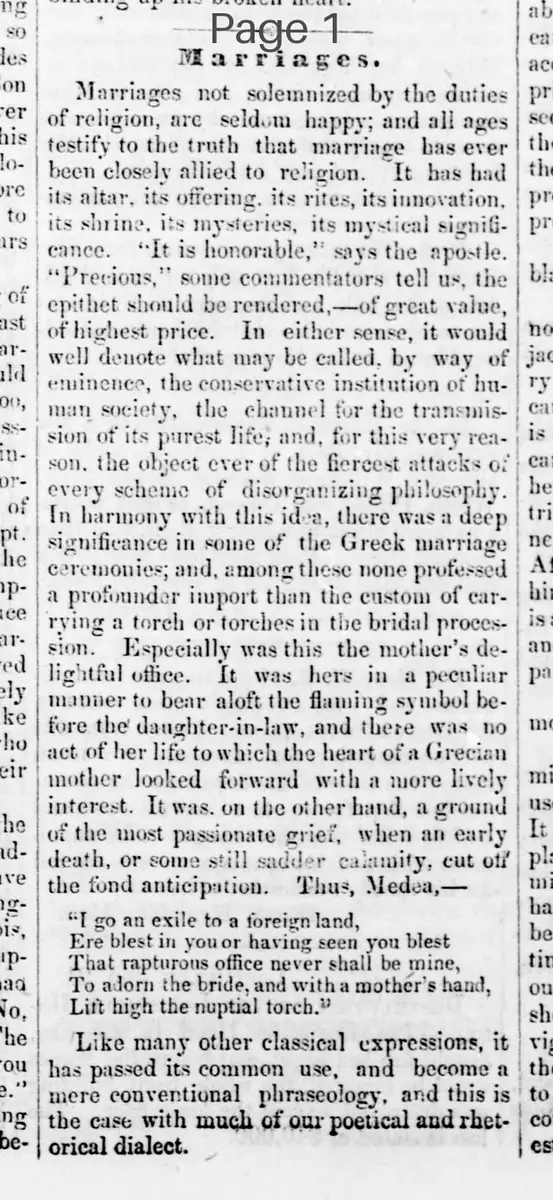
Marriages not solemnized by the duties of religion, are seldom happy; and all ages testify to the truth that marriage has ever been closely allied to religion. It has had its altar, its offering, its rites, its innovation, its shrine, its mysteries, its mystical significance. "It is honorable," says the apostle. "Precious," some commentators tell us, the epithet should be rendered,—of great value, of highest price. In either sense, it would well denote what may be called, by way of eminence, the conservative institution of human society, the channel for the transmission of its purest life; and, for this very reason, the object ever of the fiercest attacks of every scheme of disorganizing philosophy. In harmony with this idea, there was a deep significance in some of the Greek marriage ceremonies; and, among these none professed a profounder import than the custom of carrying a torch or torches in the bridal procession. Especially was this the mother's delightful office. It was hers in a peculiar manner to bear aloft the flaming symbol before the daughter-in-law, and there was no act of her life to which the heart of a Grecian mother looked forward with a more lively interest. It was, on the other hand, a ground of the most passionate grief, when an early death, or some still sadder calamity, cut off the fond anticipation. Thus, Medea,—
"I go an exile to a foreign land.
Ere blest in you or having seen you blest
That rapturous office never shall be mine
To adorn the bride, and with a mother's hand.
Lift high the nuptial torch."
Like many other classical expressions, it has passed into common use, and become a mere conventional phraseology, and this is the case with much of our poetical and rhetorical dialect.
Marriages not solemnized by the duties of religion, are seldom happy; and all ages testify to the truth that marriage has ever been closely allied to religion. It has had its altar, its offering, its rites, its innovation, its shrine, its mysteries, its mystical significance. "It is honorable," says the apostle. "Precious," some commentators tell us, the epithet should be rendered,—of great value, of highest price. In either sense, it would well denote what may be called, by way of eminence, the conservative institution of human society, the channel for the transmission of its purest life; and, for this very reason, the object ever of the fiercest attacks of every scheme of disorganizing philosophy. In harmony with this idea, there was a deep significance in some of the Greek marriage ceremonies; and, among these none professed a profounder import than the custom of carrying a torch or torches in the bridal procession. Especially was this the mother's delightful office. It was hers in a peculiar manner to bear aloft the flaming symbol before the daughter-in-law, and there was no act of her life to which the heart of a Grecian mother looked forward with a more lively interest. It was, on the other hand, a ground of the most passionate grief, when an early death, or some still sadder calamity, cut off the fond anticipation. Thus, Medea,—
"I go an exile to a foreign land.
Ere blest in you or having seen you blest
That rapturous office never shall be mine
To adorn the bride, and with a mother's hand.
Lift high the nuptial torch."
Like many other classical expressions, it has passed into common use, and become a mere conventional phraseology, and this is the case with much of our poetical and rhetorical dialect.
What sub-type of article is it?
Moral Or Religious
Social Reform
What keywords are associated?
Marriage
Religion
Greek Ceremonies
Moral Institution
Bridal Torch
Medea
What entities or persons were involved?
Apostle
Medea
Grecian Mother
Editorial Details
Primary Topic
Religious Significance Of Marriage
Stance / Tone
Affirmative And Reverent
Key Figures
Apostle
Medea
Grecian Mother
Key Arguments
Marriages Without Religion Are Seldom Happy
Marriage Allied To Religion Throughout History
Marriage As Conservative Institution Of Society
Targeted By Disorganizing Philosophies
Greek Torch Ceremony Symbolizes Maternal Joy In Marriage
Classical Expressions Become Conventional Phrases