Thank you for visiting SNEWPapers!
Sign up free
The New Hampshire Gazette And General Advertiser
Portsmouth, Exeter, Rockingham County, New Hampshire
What is this article about?
A New Hampshire citizen replies to 'A true Republican,' defending constitutional provisions including property qualifications clear of debt for officials, non-binding instructions to representatives, rotation in the governorship, and checks on the commander-in-chief, arguing against proposed amendments.
Merged-components note: This is a single letter to the editor continued across pages; the text flows directly from the end of the first component to the start of the second.
Clippings
1 of 2
OCR Quality
Full Text
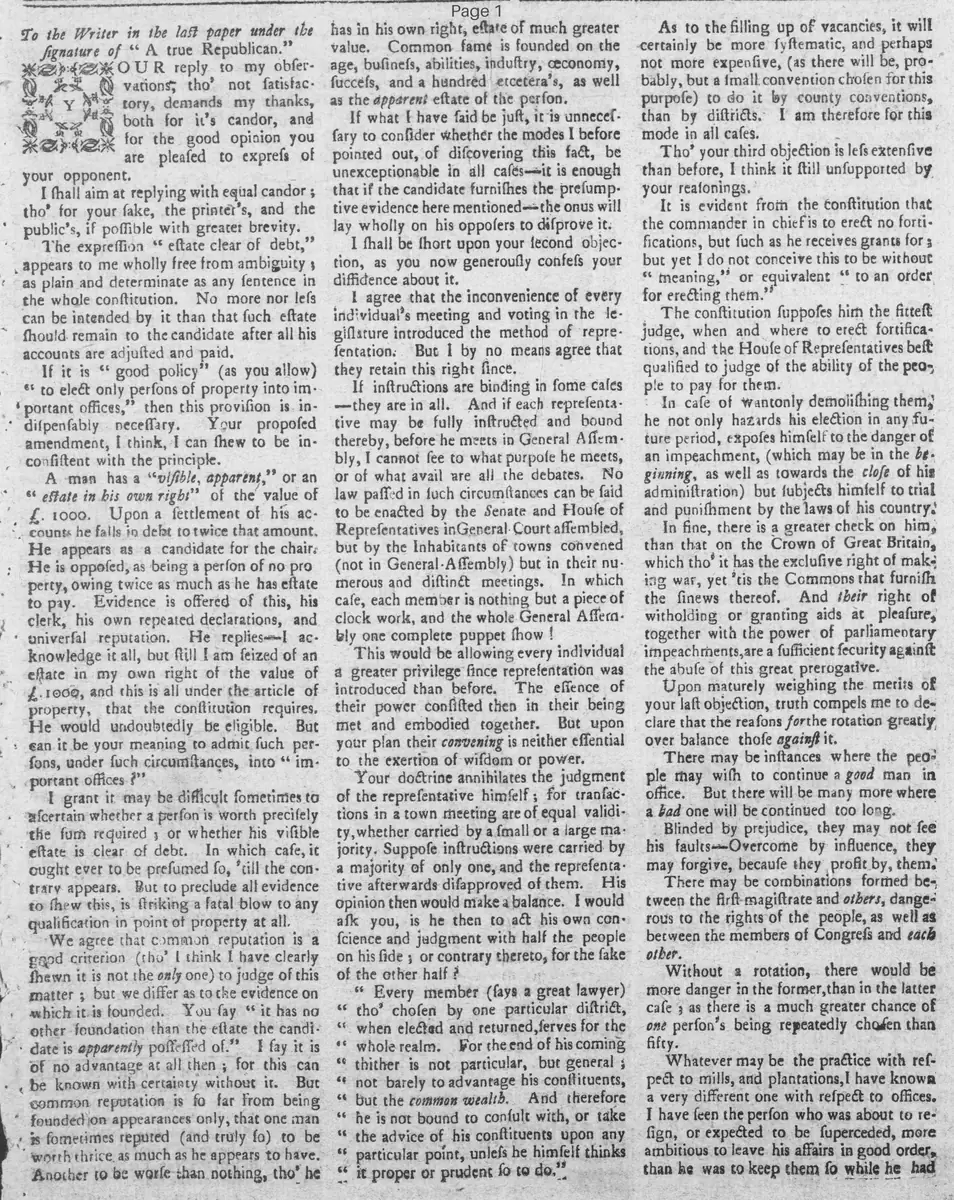
Our reply to my observations, tho not satisfactory, demands my thanks, both for it's candor, and for the good opinion you are pleased to express of your opponent.
I shall aim at replying with equal candor; tho' for your sake, the printer's, and the public's, if possible with greater brevity.
The expression "state clear of debt," appears to me wholly free from ambiguity; as plain and determinate as any sentence in the whole constitution. No more nor less can be intended by it than that such state should remain to the candidate after all his accounts are adjusted and paid.
If it is "good policy" (as you allow) to elect only persons of property into important offices, then this provision is indispensably necessary. Your proposed amendment, I think, I can shew to be inconsistent with the principle.
A man has a "visible, apparent," or an "estate in his own right" of the value of £1000. Upon a settlement of his accounts he falls in debt to twice that amount. He appears as a candidate for the chair. He is opposed, as being a person of no property, owing twice as much as he has estate to pay. Evidence is offered of this, his clerk, his own repeated declarations, and universal reputation. He replies-I acknowledge it all, but till I am seized of an estate in my own right of the value of £1000, and this is all under the article of property, that the constitution requires. He would undoubtedly be eligible. But can it be your meaning to admit such persons, under such circumstances, into "important offices"?
I grant it may be difficult sometimes to ascertain whether a person is worth precisely the sum required; or whether his visible estate is clear of debt. In which case, it ought ever to be presumed so. 'till the contrary appears. But to preclude all evidence to shew this, is striking a fatal blow to any qualification in point of property at all.
We agree that common reputation is a good criterion (tho' I think I have clearly shewn it is not the only one) to judge of this matter; but we differ as to the evidence on which it is founded. You say "it has no other foundation than the estate the candidate is apparently possessed of." I say it is of no advantage at all then: for this can be known with certainty without it. But common reputation is so far from being founded on appearances only, that one man is sometimes reputed (and truly so) to be worth thrice as much as he appears to have. Another to be worse than nothing, tho' he has in his own right, estate of much greater value. Common fame is founded on the age, business, abilities, industry, oeconomy, success, and a hundred etceteras, as well as the apparent estate of the person.
If what I have said be just. it is unnecessary to consider whether the modes I before pointed out, of discovering this fact, be unexceptionable in all cases-it is enough that if the candidate furnishes the presumptive evidence here mentioned the onus will lay wholly on his opposers to disprove it.
I shall be short upon your second objection, as you now generously confess your diffidence about it.
I agree that the inconvenience of every individual's meeting and voting in the legislature introduced the method of representation: But I by no means agree that they retain this right since. If instructions are binding in some cases --they are in all. And if each representative may be fully instructed and bound thereby, before he meets in General Assembly, I cannot see to what purpose he meets, or of what avail are all the debates. No law passed in such circumstances can be said to be enacted by the Senate and House of Representatives in General Court assembled. but by the Inhabitants of towns convened (not in General-Assembly) but in their numerous and distinct meetings. In which case, each member is nothing but a piece of clock work. and the whole General Assembly one complete puppet show!
This would be allowing every individual a greater privilege since representation was introduced than before. The essence of their power consisted then in their being met and embodied together. But upon your plan their convening is neither essential to the exertion of wisdom or power.
Your doctrine annihilates the judgment of the representative himself: for transactions in a town meeting are of equal validity, whether carried by a small or a large majority. Suppose instructions were carried by a majority of only one, and the representative afterwards disapproved of them. His opinion then would make a balance. I would ask you, is he then to act his own conscience and judgment with half the people on his side; or contrary thereto, for the sake of the other half?
Every member (says a great lawyer) "tho chosen by one particular district, when elected and returned, serves for the whole realm. For the end of his coming thither is not particular, but general "not barely to advantage his constituents, but the common wealth. And therefore he is not bound to consult with, or take the advice of his constituents upon any particular point, unless he himself thinks it proper or prudent so to do."
As to the filling up of vacancies, it will certainly be more systematic, and perhaps not more expensive, (as there will be, probably, but a small convention chosen for this purpose) to do it by county conventions, than by districts. I am therefore for this mode in all cases.
Tho' your third objection is less extensive than before, I think it still unsupported by your reasonings.
It is evident from the constitution that the commander in chief is to erect no fortifications, but such as he receives grants for; but yet I do not conceive this to be without "meaning," or equivalent "to an order for erecting them."
The constitution supposes him the fittest judge, when and where to erect fortifications, and the House of Representatives best qualified to judge of the ability of the people to pay for them.
In case of wantonly demolishing them. he not only hazards his election in any future period, exposes himself to the danger of an impeachment, (which may be in the beginning, as well as towards the close of his administration) but subjects himself to trial and punishment by the laws of his country.
In fine, there is a greater check on him. than that on the Crown of Great Britain. which tho' it has the exclusive right of making war, yet tis the Commons that furnish the sinews thereof. And their right of withholding or granting aids at pleasure, together with the power of parliamentary impeachments, are a sufficient security against the abuse of this great prerogative.
Upon maturely weighing the merits of your last objection, truth compels me to declare that the reasons for the rotation greatly over balance those against it.
There may be instances where the people may wish to continue a good man in office. But there will be many more where a bad one will be continued too long. Blinded by prejudice, they may not see his faults-Overcome by influence, they may forgive, because they profit by, them. There may be combinations formed between the first magistrate and others, dangerous to the rights of the people, as well as between the members of Congress and each other.
Without a rotation, there would be more danger in the former, than in the latter case; as there is a much greater chance of one person's being repeatedly chosen than fifty.
Whatever may be the practice with respect to mills, and plantations, I have known a very different one with respect to offices. I have seen the person who was about to resign, or expected to be superseded, more ambitious to leave his affairs in good order, than he was to keep them so while he had
a prospect of continuing in office. This must be the case with every man worthy to hold an office.
The rotation in the choice of a Treasurer, to which you do not object, is founded on a direct contrary principle to what you maintain.
Besides, in the case of a Governor, only four years intervene between his resignation and possible re-election.
Where the rotation is established, a Governor cannot take offence at being superseded after three years, which he would be extremely apt to do without it.
You do not appear to me to reason with your usual perspicuity, when you take notice of the instances I adduced to shew that a good general rule may sometimes operate unfavourably.
You ask, if there is any magic in the number thirty. I answer yes; mighty magic, if that number be fixed upon in the constitution. Whether it is the best number to be fixed on, is another question: Tho' you acknowledge it to be, by approving of every part to which you had not objected.
Tho' the numbers 17 and 21 have in them no magic implicitly considered; yet nor there is so much, that a person a moment short of the first, in years, is disqualified from being an executor; and another, a moment short of the last, from doing a thousand things which one a moment older might do without restraint.
Yet wisdom does not always dwell with years, nor is youth always void of understanding.
For your catalogue of worthies, I could give a much larger one of royal butchers and villains, equally celebrated, and in their day equally popular.
But even some of the characters you mention, I should deprecate to see at the head of this government.
What I said of Gen. Lee was prompted by justice and compassion. I felt the indignity of his being ranked with the most execrable of human beings!
I did not suppose him perfect, but yet in point of virtue, at least, on a footing with the rest of mankind.
The people's acquiescence in his sentence, is no proof that in general they are not the best judges. Perhaps it was right; yet whoever reads his trial with impartiality, will be ready to think there was as much policy at least, as justice, in the determination.
When I said "the people were the judges in every resort," I confess I ought to have qualified it with an almost. Where they are (tho' they may be liable to prejudices, to have their passions excited, as well as the people of Rome addressed from the rostrum)—I still exult in the reflection!
The PEOPLE were judges in, and of this revolution! The PEOPLE were judges of the necessity of resisting tyrannic power, and what they judged they afterwards acted and died! The high tribunal of JURIES (the most invaluable of all our privileges) is composed of the PEOPLE; and the PEOPLE are to be judges of this constitution!
A CITIZEN OF NEW-HAMPSHIRE.
What sub-type of article is it?
What themes does it cover?
What keywords are associated?
What entities or persons were involved?
Letter to Editor Details
Author
A Citizen Of New Hampshire
Recipient
A True Republican
Main Argument
defends the new hampshire constitution's provisions on property qualifications clear of debt for officeholders, non-binding nature of representative instructions, rotation in the governorship, and executive checks, refuting objections and proposed amendments by 'a true republican.'
Notable Details