Thank you for visiting SNEWPapers!
Sign up free
Literary
November 25, 1868
The Evansville Journal
Evansville, Vanderburgh County, Indiana
What is this article about?
In a family evening scene, the narrator (Effie) dreams of past and future while waiting for brother David. Siblings discuss a romantic story's ending. David arrives with news of Mr. St. George and Hope's early return from abroad, delivering a gift painting from Hope to Effie.
Clipping
OCR Quality
98%
Excellent
Full Text
A SISTER'S STORY.
I.
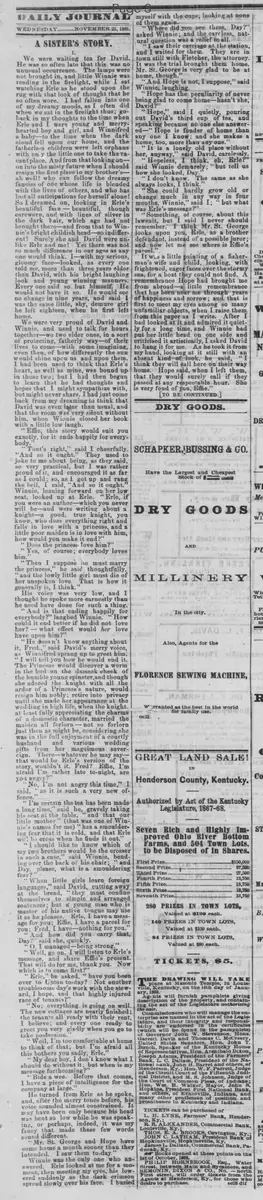
We were waiting tea for David. He was so often late that this was no unusual occurrence. The lamps were not brought in, and little Winnie was reading in the firelight, while I sat watching Erle as he stood upon the rug with that look of thought that he so often wore. I had fallen into one of my dreamy moods, as I often did when we sat in the firelight thus; going back in my thoughts to the time when Erle and I were young and merry-hearted boy and girl, and Winnifred a baby—to the time when the dark cloud fell upon our home, and the fatherless children were left orphans with only the little one to take the vacant place. And from that looking on—on into the misty future when I should resign the first place in my brother's—ah well! who can follow the dreamy fancies of one whose life is blended with the lives of others, and who has lost all anticipations for herself alone! So I dreamed on, looking in Erle's beautiful face—beautiful, though careworn, and with lines of silver in the dark hair, which age had not brought there—and from that to Winnie's bright childish head—so indifferent! Surely she and David were unlike Erle and me! Yet there was not so much difference in our ages as any one would think. I—with my serious, gloomy face—looked, as every one told me, more than three years older than David, with his bright laughing look and young winning manners. Every one said so but himself. He would not have it so. He would see no change in nine years, and said I was the same little, shy, demure girl he left eighteen, when he first left home.
We were very proud of David and Winnie, and used to talk for hours together—we two elder ones, in a sort of protecting, fatherly way—of their lives to come—with some imagining, even then, of how differently the sun would shine upon us and upon them. I had been used to think that Erle's heart, as well as mine, was bound up in those two; but I had then begun to learn that he had thoughts and hopes that I might sympathize with, but might never share. I had just come back from my dreaming to think that David was even later than usual, and that the room was very silent without him, when Winnie closed her book with a little low laugh.
"Effie, this story would suit you exactly, for it ends happily for everybody."
"That's right," said I cheerfully. "And so it ought." They used to joke to me about being, as they said, so very practical, but I was rather proud of it, and encouraged it as far as I could; so, as I got up and rang the bell, I said, "And so it ought."
Winnie, leaning forward on her low seat, looked up at Erle. "Erle, if you were an author—which you never will be—and were writing about a knight—a good, true knight, you know, who does everything right and falls in love with a princess, and a little poor maiden is in love with him, how would you make it end?"
"Does the princess love him?"
"Yes, of course; everybody loves him."
"Then I suppose he must marry the princess," he said thoughtfully, "and the lowly little girl must die of her unspoken love. That is how it generally is, I think."
His voice was very low, and I thought he spoke more earnestly than he need have done for such a thing.
"And is that ending happily for everybody?" laughed Winnie. "How could it end better if he did not love her?—what effect would her love have upon him?"
"He doesn't know anything about it, Fred," said David's merry voice, as Winnifred sprang up to greet him. "I will tell you how he would end it. The Princess would discover a worm in the bud on the damask cheek of the humble young spinster, and though she adored the knight with all the ardor of a Princess's nature, would resign him nobly; retire into privacy until she made her appearance at the wedding in high life, when the knight, at least fully appreciating the charms of a domestic character, married the maiden all forlorn—not so forlorn just then as might be, considering she was in the full enjoyment of a courtly husband and various wedding gifts from her magnanimous sovereign. There—whatever he may say—that would be Erle's version of the story, wouldn't it, Fred? Effie, I'm afraid I'm rather late to-night, are you angry?"
"No, I'm not angry this time," I said, as it is such a very new offence.
"I'm certain the tea has been made a long time," said he, gravely taking his seat at the table, "and that our little mother" (that was one of Winnie's names for me) "has a smouldering fear that it is cold, and that Erle will be cross when he finds it out."
"I should like to know which of my two brothers would be the crosser in such a case," said Winnie, bending over the back of his chair; "and Day, please, what is a smouldering fear?"
"… When little girls learn foreign languages," said David, cutting away at the bread, "they must confine themselves to simple and arranged sentences; but a young man who is master of his native tongue may use it as he pleases. Erle, I have a message for you; Effie, I have a parcel for you: Fred, I have—nothing for you."
"And how did you carry that, Day?" said she, quickly.
"O, I managed being strong."
"Well, go on. I will listen to Erle's message, and share Effie's present. That will do for me, thank you. Now which is to come first?"
"Erle," he asked, "have you been over to Upton to-day? Not another troublesome day's work with the steward, I hope, and that highly injured race of tenants?"
"No; everything is going on well. The new cottages are nearly finished: the tenants all ready with their rent, I believe; and every one ready to greet you very gladly when you go to take possession."
"Well, I'm too comfortable at home to think of that; but I'm afraid all this bothers you sadly, Erle."
"… My dear boy, I don't know what I should do without it; but when is my message forthcoming?"
"Bide a wee. Before that comes, I have a piece of intelligence for the company at large."
He turned from Erle as he spoke, and, after the merry tones before, his voice sounded almost constrained. It may have been only because his head was bent so low while he was speaking, or perhaps, indeed, it was my fancy that made these few words sound different.
"Mr. St. George and Hope have come home a month sooner than they intended. I saw them to-day."
Winnie was the only one who answered. Erle looked at me for a moment, then meeting my eyes, his lowered suddenly as the dark crimson spread slowly over his face. I busied myself with the cups, looking at none of them again.
"Where did you see them, Day?" asked Winnie; and the careless, natural question was a relief to all.
I saw their carriage at the station, and I waited for them. They are in town still with Fletcher, the attorney. It was the trial brought them home. Mr. St. George is very glad to be at home, though."
"And Hope is not, I suppose," said Winnie, laughing.
"Hope has the peculiarity of never being glad to come home—hasn't she, David?"
"Hope," said I quietly, pouring out David's third cup of tea, and speaking because no one else answered—"Hope is fonder of home than any one I know: and she makes a home, too, more than any one."
"It is a lonely old place without her, anyway," said David, carelessly.
"Hopeless, I think, eh, Erle?" said Winnie demurely; "but tell us how she looked, Day."
"I don't know. The same as she always looks, I think."
"She could hardly grow old or change much in any way in four months, Winnie," said I; "but what was Erle's message?"
"Something, of course, about this lawsuit, but I said I never should remember. I think Mr. St. George looks upon you, Erle, as a brother defendant, instead of a possible juror; and now let me see where is Effie's parcel."
It was a little painting of a fisherman's wife and child, looking, with frightened, eager faces over the stormy sea, for a boat they could not find. A remembrance Hope had brought me from abroad—a little remembrance that has been near me through years of happiness and sorrow; and that is first to meet my eyes among so many unfamiliar objects, when I raise them from this paper as I write. After I had looked at it and admired it quietly for a long time, and Winnie had put her little head on one side and criticised it artistically, I asked David to hang it for me. As he took it from my hand, looking at it still with an absent kind of look, he said, "I think they will call here on their way home. Hope said, when I left them, that they would surely call if they passed at any respectable hour. She is very fond of you, Effie."
TO BE CONTINUED.
I.
We were waiting tea for David. He was so often late that this was no unusual occurrence. The lamps were not brought in, and little Winnie was reading in the firelight, while I sat watching Erle as he stood upon the rug with that look of thought that he so often wore. I had fallen into one of my dreamy moods, as I often did when we sat in the firelight thus; going back in my thoughts to the time when Erle and I were young and merry-hearted boy and girl, and Winnifred a baby—to the time when the dark cloud fell upon our home, and the fatherless children were left orphans with only the little one to take the vacant place. And from that looking on—on into the misty future when I should resign the first place in my brother's—ah well! who can follow the dreamy fancies of one whose life is blended with the lives of others, and who has lost all anticipations for herself alone! So I dreamed on, looking in Erle's beautiful face—beautiful, though careworn, and with lines of silver in the dark hair, which age had not brought there—and from that to Winnie's bright childish head—so indifferent! Surely she and David were unlike Erle and me! Yet there was not so much difference in our ages as any one would think. I—with my serious, gloomy face—looked, as every one told me, more than three years older than David, with his bright laughing look and young winning manners. Every one said so but himself. He would not have it so. He would see no change in nine years, and said I was the same little, shy, demure girl he left eighteen, when he first left home.
We were very proud of David and Winnie, and used to talk for hours together—we two elder ones, in a sort of protecting, fatherly way—of their lives to come—with some imagining, even then, of how differently the sun would shine upon us and upon them. I had been used to think that Erle's heart, as well as mine, was bound up in those two; but I had then begun to learn that he had thoughts and hopes that I might sympathize with, but might never share. I had just come back from my dreaming to think that David was even later than usual, and that the room was very silent without him, when Winnie closed her book with a little low laugh.
"Effie, this story would suit you exactly, for it ends happily for everybody."
"That's right," said I cheerfully. "And so it ought." They used to joke to me about being, as they said, so very practical, but I was rather proud of it, and encouraged it as far as I could; so, as I got up and rang the bell, I said, "And so it ought."
Winnie, leaning forward on her low seat, looked up at Erle. "Erle, if you were an author—which you never will be—and were writing about a knight—a good, true knight, you know, who does everything right and falls in love with a princess, and a little poor maiden is in love with him, how would you make it end?"
"Does the princess love him?"
"Yes, of course; everybody loves him."
"Then I suppose he must marry the princess," he said thoughtfully, "and the lowly little girl must die of her unspoken love. That is how it generally is, I think."
His voice was very low, and I thought he spoke more earnestly than he need have done for such a thing.
"And is that ending happily for everybody?" laughed Winnie. "How could it end better if he did not love her?—what effect would her love have upon him?"
"He doesn't know anything about it, Fred," said David's merry voice, as Winnifred sprang up to greet him. "I will tell you how he would end it. The Princess would discover a worm in the bud on the damask cheek of the humble young spinster, and though she adored the knight with all the ardor of a Princess's nature, would resign him nobly; retire into privacy until she made her appearance at the wedding in high life, when the knight, at least fully appreciating the charms of a domestic character, married the maiden all forlorn—not so forlorn just then as might be, considering she was in the full enjoyment of a courtly husband and various wedding gifts from her magnanimous sovereign. There—whatever he may say—that would be Erle's version of the story, wouldn't it, Fred? Effie, I'm afraid I'm rather late to-night, are you angry?"
"No, I'm not angry this time," I said, as it is such a very new offence.
"I'm certain the tea has been made a long time," said he, gravely taking his seat at the table, "and that our little mother" (that was one of Winnie's names for me) "has a smouldering fear that it is cold, and that Erle will be cross when he finds it out."
"I should like to know which of my two brothers would be the crosser in such a case," said Winnie, bending over the back of his chair; "and Day, please, what is a smouldering fear?"
"… When little girls learn foreign languages," said David, cutting away at the bread, "they must confine themselves to simple and arranged sentences; but a young man who is master of his native tongue may use it as he pleases. Erle, I have a message for you; Effie, I have a parcel for you: Fred, I have—nothing for you."
"And how did you carry that, Day?" said she, quickly.
"O, I managed being strong."
"Well, go on. I will listen to Erle's message, and share Effie's present. That will do for me, thank you. Now which is to come first?"
"Erle," he asked, "have you been over to Upton to-day? Not another troublesome day's work with the steward, I hope, and that highly injured race of tenants?"
"No; everything is going on well. The new cottages are nearly finished: the tenants all ready with their rent, I believe; and every one ready to greet you very gladly when you go to take possession."
"Well, I'm too comfortable at home to think of that; but I'm afraid all this bothers you sadly, Erle."
"… My dear boy, I don't know what I should do without it; but when is my message forthcoming?"
"Bide a wee. Before that comes, I have a piece of intelligence for the company at large."
He turned from Erle as he spoke, and, after the merry tones before, his voice sounded almost constrained. It may have been only because his head was bent so low while he was speaking, or perhaps, indeed, it was my fancy that made these few words sound different.
"Mr. St. George and Hope have come home a month sooner than they intended. I saw them to-day."
Winnie was the only one who answered. Erle looked at me for a moment, then meeting my eyes, his lowered suddenly as the dark crimson spread slowly over his face. I busied myself with the cups, looking at none of them again.
"Where did you see them, Day?" asked Winnie; and the careless, natural question was a relief to all.
I saw their carriage at the station, and I waited for them. They are in town still with Fletcher, the attorney. It was the trial brought them home. Mr. St. George is very glad to be at home, though."
"And Hope is not, I suppose," said Winnie, laughing.
"Hope has the peculiarity of never being glad to come home—hasn't she, David?"
"Hope," said I quietly, pouring out David's third cup of tea, and speaking because no one else answered—"Hope is fonder of home than any one I know: and she makes a home, too, more than any one."
"It is a lonely old place without her, anyway," said David, carelessly.
"Hopeless, I think, eh, Erle?" said Winnie demurely; "but tell us how she looked, Day."
"I don't know. The same as she always looks, I think."
"She could hardly grow old or change much in any way in four months, Winnie," said I; "but what was Erle's message?"
"Something, of course, about this lawsuit, but I said I never should remember. I think Mr. St. George looks upon you, Erle, as a brother defendant, instead of a possible juror; and now let me see where is Effie's parcel."
It was a little painting of a fisherman's wife and child, looking, with frightened, eager faces over the stormy sea, for a boat they could not find. A remembrance Hope had brought me from abroad—a little remembrance that has been near me through years of happiness and sorrow; and that is first to meet my eyes among so many unfamiliar objects, when I raise them from this paper as I write. After I had looked at it and admired it quietly for a long time, and Winnie had put her little head on one side and criticised it artistically, I asked David to hang it for me. As he took it from my hand, looking at it still with an absent kind of look, he said, "I think they will call here on their way home. Hope said, when I left them, that they would surely call if they passed at any respectable hour. She is very fond of you, Effie."
TO BE CONTINUED.
What sub-type of article is it?
Prose Fiction
What themes does it cover?
Friendship
Love Romance
Social Manners
What keywords are associated?
Family Dynamics
Sibling Bonds
Unspoken Love
Homecoming
Domestic Scene
Romantic Fantasy
Literary Details
Title
A Sister's Story.
Key Lines
"Then I Suppose He Must Marry The Princess," He Said Thoughtfully, "And The Lowly Little Girl Must Die Of Her Unspoken Love. That Is How It Generally Is, I Think."
"Mr. St. George And Hope Have Come Home A Month Sooner Than They Intended. I Saw Them To Day."
It Was A Little Painting Of A Fisherman's Wife And Child, Looking, With Frightened, Eager Faces Over The Stormy Sea, For A Boat They Could Not Find.