Thank you for visiting SNEWPapers!
Sign up free
Editorial
January 16, 1772
The Massachusetts Spy
Boston, Suffolk County, Massachusetts
What is this article about?
The Whisperer editorial accuses British ministers of concealing a 1770 conspiracy by Jonathan Britain and Catholic associates to enlist soldiers for France and arson at Portsmouth Dock Yard, implicating Lords Mansfield, Bute, and foreign ambassadors in treason against the King.
Clipping
OCR Quality
88%
Good
Full Text
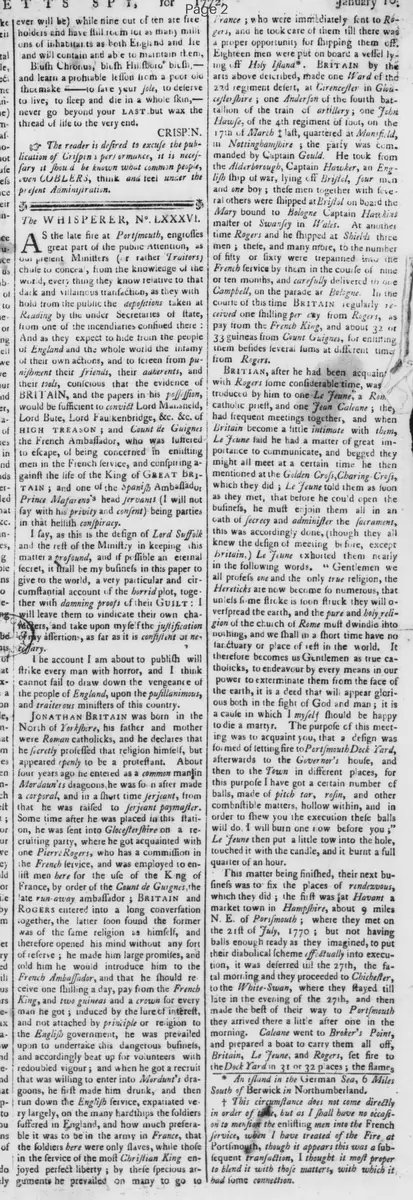
The WHISPERER. N. LXXXVI.
As the late fire at Portsmouth, engrosses
a great part of the public Attention, as
our present Ministers (or rather Traitors)
choose to conceal, from the knowledge of the
world, every thing they know relative to that
dark and villainous transaction, as they wish
with hold from the public the depositions taken at
Reading by the under Secretaries of state,
from one of the incendiaries confined there :
And as they expect to hide from the people
of England and the whole world the infamy
of their own actions, and to screen from pu-
nishment their friends, their adherents, and
their tools, conscious that the evidence of
BRITAIN, and the papers in his possession,
would be sufficient to convict Lord Mansfield,
Lord Bute, Lord Falkenbridge, &c. &c. of
HIGH TREASON ; and Count de Guignes
the French Ambassador, who was suffered
to escape, of being concerned in enlisting
men in the French service, and conspiring a-
gainst the life of the King of GREAT BRI-
TAIN; and one of the Spanish Ambassa-
dor Prince Masserano's head servants (I will not
say with his privity and consent) being parties
in that hellish conspiracy.
I say, as this is the design of Lord Suffolk
and the rest of the Ministry in keeping this
matter a profound, and if possible an eternal
secret, it shall be my business in this paper to
give to the world, a very particular and cir-
cumstantial account of the horrid plot, toge-
ther with damning proofs of their GUILT : I
will leave them to vindicate their own cha-
racters, and take upon myself the justification
of my assertions, as far as it is consistent or ne-
cessary.
The account I am about to publish will
strike every man with horror, and I think
cannot fail to draw down the vengeance of
the people of England, upon the pusillanimous,
and traitorous ministers of this country.
Jonathan Britain was born in the
North of Yorkshire, his father and mother
were Roman catholics, and he declares that
he secretly professed that religion himself, but
appeared openly to be a protestant. About
four years ago he entered as a common man in
Mordaunt's dragoons, he was on after made
a corporal, and in a short time serjeant, from
that he was raised to serjeant paymaster.
Some time after he was placed in this sta-
tion, he was sent into Gloucestershire on a re-
cruiting party, where he got acquainted with
one Pierre Rogers, who has a commission in
the French service, and was employed to en-
list men here for the use of the King of
France, by order of the Count de Guignes, the
late run-away ambassador ; BRITAIN and
Rogers entered into a long conversation
together, the latter soon found the former
was of the same religion as himself, and
therefore opened his mind without any sort
of reserve ; he made him large promises, and
told him he would introduce him to the
French Ambassador, and that he should re-
ceive one shilling a day, pay from the French
King, and two guineas and a crown for every
man he got ; induced by the lure of interest,
and not attached by principle or religion to
the English government, he was prevailed
upon to undertake this dangerous business,
and accordingly beat up for volunteers with
redoubled vigour; and when he got a recruit
that was willing to enter into Mordaunt's dra-
goons, he first made him drunk, and then
run down the English service, expatiated ve-
ry largely, on the many hardships the soldiers
suffered in England, and how much prefera-
ble it was to be in the army in France, that
the soldiers here were only slaves, while those
in the service of the most Christian King en-
joyed perfect liberty ; by these specious ar-
guments he prevailed on many to go to
France ; who were immediately sent to Ro-
gers, and he took care of them till there was
a proper opportunity for shipping them off.
Eighteen men were put on board a vessel ly-
ing off Holy Island*. Britain by the
arts above described, made one Ward of the
22d regiment desert, at Cirencester in Glou-
cestershire ; one Anderson of the fourth bat-
tallon of the train of artillery; one John
Hawke, of the 4th regiment of foot, on the
17th of March last, quartered at Mansfield,
in Nottinghamshire ; the party was Com-
manded by Captain Gould. He took from
the Alderborough, Captain Hawker, an Eng-
lish ship of war, lying off Bristol, four men
and one boy ; these men together with seve-
ral others were shipped at Bristol on board the
Mary bound to Boulogne Captain Hawkins
master of Swansea in Wales. At another
time Rogers and he shipped at Shields three
men; these, and many more, to the number
of fifty or sixty were trepanned into the
French service by them in the course of nine
or ten months, and carefully delivered to one
Campbell, on the parade at Boulogne. In the
course of this time BRITAIN regularly re-
ceived one shilling per day from Rogers, as
pay from the French King, and about 32 or
33 guineas from Count Guignes, for enlisting
them besides several sums at different times
from Rogers.
BRITAIN, after he had been ac-
quainted
with Rogers some considerable time, was
introduced by him to one Le Feune, a Ro-
man
catholic priest, and one Jean Caleane ; the
had frequent meetings together, and when
Britain become a little intimate with them,
Le Feune said he had a matter of great im-
portance to communicate, and begged they
might all meet at a certain time he then
mentioned at the Golden Cross, Charing-Cross,
which they did ; Le Feune told them as soon
as they met, that before he cou'd open the
business, he must enjoin them all in an
cath of secrecy and administer the sacrament,
this was accordingly done, (though they all
knew the design of meeting before, except
Britain,) Le Feune exhorted them nearly
in the following words. " Gentlemen we
all profess one and the only true religion, the
Hereticks are now become so numerous, that
unless some stroke is soon struck they will o-
ver spread the earth, and the pure and holy reli-
gion of the church of Rome must dwindle into
nothing, and we shall in a short time have no
sanctuary or place of refuge in the world. It
therefore becomes us Gentlemen as true ca-
tholics, to endeavour by every means in our
power to exterminate them from the face of
the earth, it is a deed that will appear glori-
ous both in the sight of God and man ; it is
a cause in which I myself should be happy
to die a martyr. The purpose of this meet-
ing was to acquaint you, that a design was
formed of setting fire to Portsmouth Dock Yard,
afterwards to the Governor's house, and
then to the Town in different places, for
this purpose I have got a certain number of
balls, made of pitch tar, rosin, and other
combnustible matters, hollow within, and in
order to shew you the execution these balls
will do, I will burn one now before you ;"
Le Feune then put a little tow into the hole,
touched it with the candle, and it burnt a full
quarter of an hour.
This matter being finished, their next bu-
siness was to fix the places of rendezvous,
which they did; the first was at Havant a
market town in Hampshire, about 9 miles
N. E. of Portsmouth; where they met on
the 21st of July, 1770; but not having
balls enough ready as they imagined, to put
their diabolical scheme effectually into execu-
tion, it was deferred till the 27th, the fa-
tal morning and they proceeded to Chichester,
to the White-Swan, where they stayed till
late in the evening of the 27th, and then
made the best of their way to Portsmouth
they arrived there a little after one in the
morning. Caleane went to Broker's Point,
and prepared a boat to carry them all off,
Britain, Le Feune, and Rogers, set fire to
the Dock Yard in 31 or 32 places; the flames
* An island in the German Sea, 6 Miles
South of Berwick in Northumberland.
+ This circumstance does not come directly
in order of time, but as I shall have no occa-
sion to mention the enlisting men into the French
service, when I have treated of the Fire at
Portsmouth, though it appears this was a sub-
sequent transaction, I thought it most proper
to blend it with those matters, with which it
had some connection.
As the late fire at Portsmouth, engrosses
a great part of the public Attention, as
our present Ministers (or rather Traitors)
choose to conceal, from the knowledge of the
world, every thing they know relative to that
dark and villainous transaction, as they wish
with hold from the public the depositions taken at
Reading by the under Secretaries of state,
from one of the incendiaries confined there :
And as they expect to hide from the people
of England and the whole world the infamy
of their own actions, and to screen from pu-
nishment their friends, their adherents, and
their tools, conscious that the evidence of
BRITAIN, and the papers in his possession,
would be sufficient to convict Lord Mansfield,
Lord Bute, Lord Falkenbridge, &c. &c. of
HIGH TREASON ; and Count de Guignes
the French Ambassador, who was suffered
to escape, of being concerned in enlisting
men in the French service, and conspiring a-
gainst the life of the King of GREAT BRI-
TAIN; and one of the Spanish Ambassa-
dor Prince Masserano's head servants (I will not
say with his privity and consent) being parties
in that hellish conspiracy.
I say, as this is the design of Lord Suffolk
and the rest of the Ministry in keeping this
matter a profound, and if possible an eternal
secret, it shall be my business in this paper to
give to the world, a very particular and cir-
cumstantial account of the horrid plot, toge-
ther with damning proofs of their GUILT : I
will leave them to vindicate their own cha-
racters, and take upon myself the justification
of my assertions, as far as it is consistent or ne-
cessary.
The account I am about to publish will
strike every man with horror, and I think
cannot fail to draw down the vengeance of
the people of England, upon the pusillanimous,
and traitorous ministers of this country.
Jonathan Britain was born in the
North of Yorkshire, his father and mother
were Roman catholics, and he declares that
he secretly professed that religion himself, but
appeared openly to be a protestant. About
four years ago he entered as a common man in
Mordaunt's dragoons, he was on after made
a corporal, and in a short time serjeant, from
that he was raised to serjeant paymaster.
Some time after he was placed in this sta-
tion, he was sent into Gloucestershire on a re-
cruiting party, where he got acquainted with
one Pierre Rogers, who has a commission in
the French service, and was employed to en-
list men here for the use of the King of
France, by order of the Count de Guignes, the
late run-away ambassador ; BRITAIN and
Rogers entered into a long conversation
together, the latter soon found the former
was of the same religion as himself, and
therefore opened his mind without any sort
of reserve ; he made him large promises, and
told him he would introduce him to the
French Ambassador, and that he should re-
ceive one shilling a day, pay from the French
King, and two guineas and a crown for every
man he got ; induced by the lure of interest,
and not attached by principle or religion to
the English government, he was prevailed
upon to undertake this dangerous business,
and accordingly beat up for volunteers with
redoubled vigour; and when he got a recruit
that was willing to enter into Mordaunt's dra-
goons, he first made him drunk, and then
run down the English service, expatiated ve-
ry largely, on the many hardships the soldiers
suffered in England, and how much prefera-
ble it was to be in the army in France, that
the soldiers here were only slaves, while those
in the service of the most Christian King en-
joyed perfect liberty ; by these specious ar-
guments he prevailed on many to go to
France ; who were immediately sent to Ro-
gers, and he took care of them till there was
a proper opportunity for shipping them off.
Eighteen men were put on board a vessel ly-
ing off Holy Island*. Britain by the
arts above described, made one Ward of the
22d regiment desert, at Cirencester in Glou-
cestershire ; one Anderson of the fourth bat-
tallon of the train of artillery; one John
Hawke, of the 4th regiment of foot, on the
17th of March last, quartered at Mansfield,
in Nottinghamshire ; the party was Com-
manded by Captain Gould. He took from
the Alderborough, Captain Hawker, an Eng-
lish ship of war, lying off Bristol, four men
and one boy ; these men together with seve-
ral others were shipped at Bristol on board the
Mary bound to Boulogne Captain Hawkins
master of Swansea in Wales. At another
time Rogers and he shipped at Shields three
men; these, and many more, to the number
of fifty or sixty were trepanned into the
French service by them in the course of nine
or ten months, and carefully delivered to one
Campbell, on the parade at Boulogne. In the
course of this time BRITAIN regularly re-
ceived one shilling per day from Rogers, as
pay from the French King, and about 32 or
33 guineas from Count Guignes, for enlisting
them besides several sums at different times
from Rogers.
BRITAIN, after he had been ac-
quainted
with Rogers some considerable time, was
introduced by him to one Le Feune, a Ro-
man
catholic priest, and one Jean Caleane ; the
had frequent meetings together, and when
Britain become a little intimate with them,
Le Feune said he had a matter of great im-
portance to communicate, and begged they
might all meet at a certain time he then
mentioned at the Golden Cross, Charing-Cross,
which they did ; Le Feune told them as soon
as they met, that before he cou'd open the
business, he must enjoin them all in an
cath of secrecy and administer the sacrament,
this was accordingly done, (though they all
knew the design of meeting before, except
Britain,) Le Feune exhorted them nearly
in the following words. " Gentlemen we
all profess one and the only true religion, the
Hereticks are now become so numerous, that
unless some stroke is soon struck they will o-
ver spread the earth, and the pure and holy reli-
gion of the church of Rome must dwindle into
nothing, and we shall in a short time have no
sanctuary or place of refuge in the world. It
therefore becomes us Gentlemen as true ca-
tholics, to endeavour by every means in our
power to exterminate them from the face of
the earth, it is a deed that will appear glori-
ous both in the sight of God and man ; it is
a cause in which I myself should be happy
to die a martyr. The purpose of this meet-
ing was to acquaint you, that a design was
formed of setting fire to Portsmouth Dock Yard,
afterwards to the Governor's house, and
then to the Town in different places, for
this purpose I have got a certain number of
balls, made of pitch tar, rosin, and other
combnustible matters, hollow within, and in
order to shew you the execution these balls
will do, I will burn one now before you ;"
Le Feune then put a little tow into the hole,
touched it with the candle, and it burnt a full
quarter of an hour.
This matter being finished, their next bu-
siness was to fix the places of rendezvous,
which they did; the first was at Havant a
market town in Hampshire, about 9 miles
N. E. of Portsmouth; where they met on
the 21st of July, 1770; but not having
balls enough ready as they imagined, to put
their diabolical scheme effectually into execu-
tion, it was deferred till the 27th, the fa-
tal morning and they proceeded to Chichester,
to the White-Swan, where they stayed till
late in the evening of the 27th, and then
made the best of their way to Portsmouth
they arrived there a little after one in the
morning. Caleane went to Broker's Point,
and prepared a boat to carry them all off,
Britain, Le Feune, and Rogers, set fire to
the Dock Yard in 31 or 32 places; the flames
* An island in the German Sea, 6 Miles
South of Berwick in Northumberland.
+ This circumstance does not come directly
in order of time, but as I shall have no occa-
sion to mention the enlisting men into the French
service, when I have treated of the Fire at
Portsmouth, though it appears this was a sub-
sequent transaction, I thought it most proper
to blend it with those matters, with which it
had some connection.
What sub-type of article is it?
Partisan Politics
Foreign Affairs
Crime Or Punishment
What keywords are associated?
Portsmouth Fire
French Enlistment
Catholic Conspiracy
British Ministers Treason
Jonathan Britain
Count De Guignes
What entities or persons were involved?
Lord Mansfield
Lord Bute
Lord Falkenbridge
Count De Guignes
Prince Masserano
Lord Suffolk
Jonathan Britain
Pierre Rogers
Le Feune
Jean Caleane
Editorial Details
Primary Topic
Exposure Of Portsmouth Fire Conspiracy And French Enlistment Plot
Stance / Tone
Strongly Accusatory Against Ministers And Catholic Conspirators
Key Figures
Lord Mansfield
Lord Bute
Lord Falkenbridge
Count De Guignes
Prince Masserano
Lord Suffolk
Jonathan Britain
Pierre Rogers
Le Feune
Jean Caleane
Key Arguments
Ministers Conceal Evidence Of Treason To Protect Themselves And Allies
Britain Enlisted 50 60 Men For French Service Under Guignes' Orders
Catholic Plot To Burn Portsmouth Dock Yard To Exterminate Heretics
Conspirators Used Incendiary Balls And Planned Escape By Boat
Britain's Testimony Implicates High Officials In High Treason And Regicide Plot