Thank you for visiting SNEWPapers!
Sign up free
Gazette Of The United States
New York, New York County, New York
What is this article about?
In the House of Commons on May 21, Mr. Whitbread moved for an address to the King regarding the magistrates' conduct during the July 1791 Birmingham riots against Dissenters, criticizing government handling. The motion was defeated 46-189.
Merged-components note: Continuation of the London House of Commons report on Birmingham riots across pages 1 and 2; sequential reading order indicates they belong together.
Clippings
1 of 2
OCR Quality
Full Text
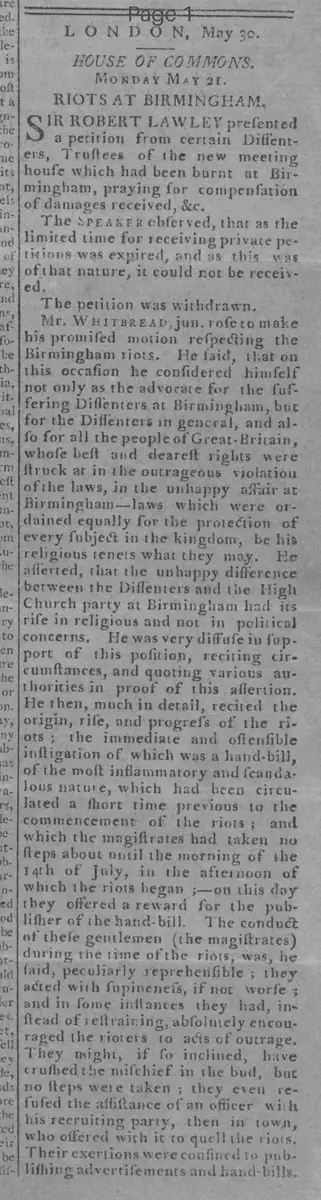
HOUSE OF COMMONS.
MONDAY, MAY 21.
RIOTS AT BIRMINGHAM.
Sir Robert Lawley presented a petition from certain Dissenters, Trustees of the new meeting house which had been burnt at Birmingham, praying for compensation of damages received, &c.
The Speaker observed, that as the limited time for receiving private petitions was expired, and as this was of that nature, it could not be received.
The petition was withdrawn.
Mr. Whitbread, jun. rose to make his promised motion respecting the Birmingham riots. He said, that on this occasion he considered himself not only as the advocate for the suffering Dissenters at Birmingham, but for the Dissenters in general, and also for all the people of Great-Britain, whose best and dearest rights were struck at in the outrageous violation of the laws, in the unhappy affair at Birmingham—laws which were ordained equally for the protection of every subject in the kingdom, be his religious tenets what they may. He asserted, that the unhappy difference between the Dissenters and the High Church party at Birmingham had its rise in religious and not in political concerns. He was very diffuse in support of this position, reciting circumstances, and quoting various authorities in proof of this assertion.
He then, much in detail, recited the origin, rise, and progress of the riots; the immediate and ostensible instigation of which was a hand-bill, of the most inflammatory and scandalous nature, which had been circulated a short time previous to the commencement of the riots; and which the magistrates had taken no steps about until the morning of the 14th of July, in the afternoon of which the riots began;—on this day they offered a reward for the publisher of the hand-bill. The conduct of these gentlemen (the magistrates) during the time of the riots, was, he said, peculiarly reprehensible; they acted with supineness, if not worse; and in some instances they had, instead of restraining, absolutely encouraged the rioters to acts of outrage. They might, if so inclined, have crushed the mischief in the bud, but no steps were taken; they even refused the assistance of an officer with his recruiting party, then in town, who offered with it to quell the rioters. Their exertions were confined to publishing advertisements and hand-bills,
With respect to the trials of the rioters, he disapproved of the conduct of government in them. The witnesses of the sufferers were permitted to be intimidated by the populace, and thereby prevented from giving proper evidence; some were acquitted, though guilty on the clearest evidence, and every partiality shown to the culprits. The pardon granted to the rioter Hands, he compared to that granted some years ago, for similar reasons, to the notorious Macquirk; and when justice was suffered to take its course, and verdicts found for the sufferers, the damages allowed were far from being sufficient. Viewing matters in this light, and which he hoped the house would see and feel with him, he found himself obliged, for the honor of the Church and State of England, to attempt to explore and redress those grievances; he therefore would move, "That an humble address be presented to his majesty, praying that he will order to be laid before the House, an account of the information received by his ministers concerning the conduct of the magistrates of Warwick and Worcestershire, relative to the riots in Birmingham in July 1791, and what had been the conduct of his majesty's ministers in consequence thereof, &c."
The motion was seconded by Mr. GREY.
Sir Robert Lawley said, that he had received a requisition, signed by many respectable persons among his constituents (of Warwickshire) that he should, if the characters of the Birmingham magistrates were attacked in the course of the debate expected this evening, take an opportunity of vindicating them, and to express their grateful sense of the proper conduct of those gentlemen on the occasion alluded to. His own opinion on the subject was, that the Hon. Gentleman was stirring up the embers of a dying flame.
Mr. Secretary Dundas said, that to the elaborate declamations of the Hon. Gentleman, and to his garbled statement of occurrences, he should oppose a plain narrative of facts; and the House, he doubted not, would come to a proper decision on the subject. Whatever might have been the remote causes of the animosities in question, he would not now consider the effects were visible; the operation of a mob he thought the worst political evil. The latter causes of dissention between the Dissenters and Church Party at Birmingham were, he said, more of a political than of a religious nature; these had been excited and favored by the perpetual circulation of inflammatory and seditious writings; these had prejudiced the minds of one party against the other; and the immediate causes of the flame breaking out, were, 1st, the notice of the intended celebration of the French Revolution; and, 2dly, the appearance of the scandalous and inflammatory hand-bill. He then detailed the steps taken by gentlemen in the business from the first account received, to the execution of the criminals. The first accounts received by government were on the Saturday morning following the commencement of the riots, and instantly orders were issued from the Secretary of State's and the War Office, for the nearest troops to Birmingham to march to that place. These were at Nottingham, and so expeditiously were the orders conveyed and executed, that the troops were in Birmingham on the evening of the same day of which the accounts were first received. Soon after their arrival the tumults were quelled. Respecting the legal part of the transactions, Mr. Chamberlayne, Solicitor of the Treasury, Mr. Justice Bond, and a Barrister to assist them, were immediately sent to make the necessary enquiries; the result of which was, that 13 persons appeared to them to deserve to be rigorously and capitally prosecuted, which they were; five of whom were sentenced to die, and of which number one was pardoned, on the most positive proofs of perfect innocence. He concluded by expressing his hostility to the motion.
Mr. WYNDHAM was of opinion, that notwithstanding what he had heard, there was something dark and mysterious in several parts of the business, which seemed to call for an earnest enquiry.
Mr. JENKINSON, in a short speech, defended the conduct of government in the entire transaction; he thought they had acted with integrity and vigor.
After some further conversation the question was put, and the House divided—Ayes 46—Noes 189.
Majority 143 against Mr. Whitbread's motion.
Adjourned.
What sub-type of article is it?
What keywords are associated?
What entities or persons were involved?
Where did it happen?
Foreign News Details
Primary Location
Birmingham
Event Date
Monday, May 21.
Key Persons
Outcome
motion defeated: ayes 46, noes 189, majority 143 against. riots quelled by troops; 13 prosecuted, 5 sentenced to die (1 pardoned); damages to sufferers insufficient.
Event Details
Debate in House of Commons on riots in Birmingham in July 1791, triggered by inflammatory hand-bill and celebration of French Revolution, targeting Dissenters. Mr. Whitbread criticized magistrates' supineness and government's handling of trials and pardons. Dundas defended government's prompt troop deployment and prosecutions. Motion for address to King on magistrates' conduct rejected.