Thank you for visiting SNEWPapers!
Sign up free
The Enquirer
Richmond, Henrico County, Virginia
What is this article about?
In May 1804, the French Tribunate resolves to proclaim Napoleon Bonaparte as Emperor of the French, making the title hereditary in his family. Preparations for his coronation in August at Aix-la-Chapelle are underway, amid European reactions and British naval vigilance.
Clipping
OCR Quality
Full Text
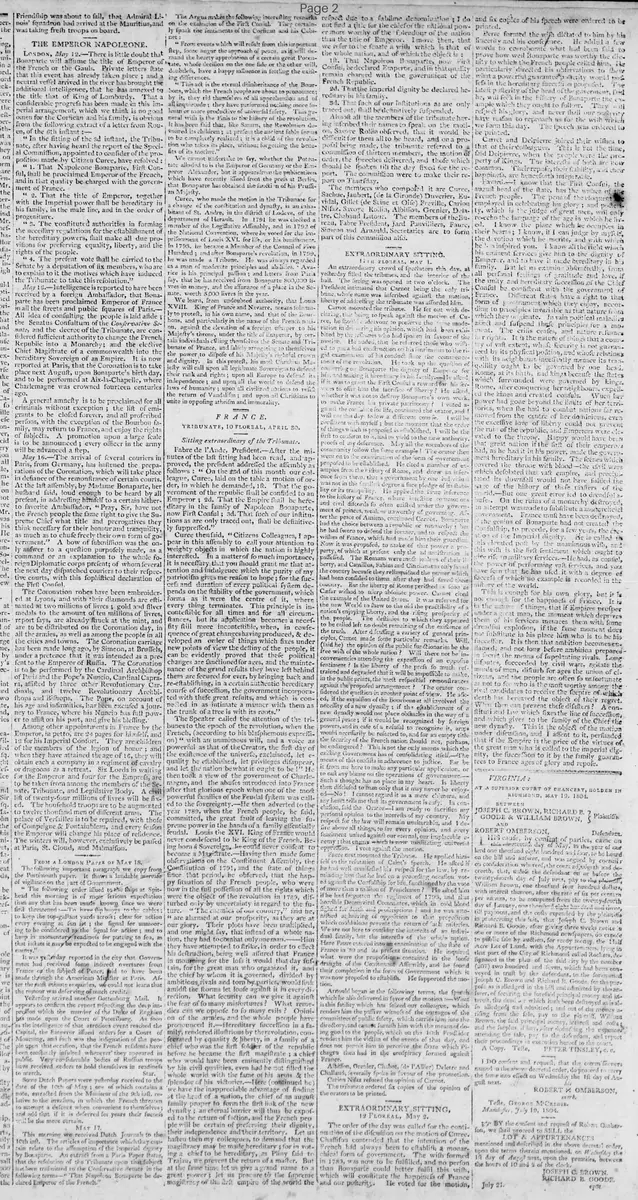
London, May 12.-There is little doubt that Bonaparte will assume the title of Emperor of the French or the Gauls. Private letters state that this event has already taken place: and a neutral vessel arrived in the river has brought the additional intelligence, that he has annexed to the title that of King of Lombardy. That a considerable progress has been made in this imperial arrangement, which we think is no good omen for the Corsican and his family, is obvious from the following extract of a letter from Rouen, of the 6th instant:--
"In the sitting of the 3d instant, the Tribunate, after having heard the report of the Special Commission, appointed to consider of the proposition made by Citizen Curee, have resolved:
"1. That Napoleone Bonaparte, First Consul, shall be proclaimed Emperor of the French, and in that quality be charged with the government of France.
"2. That the title of Emperor, together with the Imperial power shall be hereditary in his family, in the male line, and in the order of progeniture.
"3. The constituted authorities in forming the necessary regulations for the establishment of the hereditary powers, shall make all due provisions for preserving equality, liberty, and the rights of the people.
"4. The present vote shall be carried to the Senate by a deputation of six members, who are to explain to it the motives which have induced the Tribunate to take this resolution."
May 16.-Intelligence is reported to have been received by a foreign Ambassador, that Bonaparte has been proclaimed Emperor of France in all the streets and public squares of Paris. All idea of consulting the people is laid aside; the Senatus Consultum of the Conservative Senate, and the decree of the Tribunate, are considered sufficient authority to change the French Republic into a Monarchy: and the elective Chief Magistrate of a commonwealth into the hereditary Sovereign of an Empire. It is now reported at Paris, that the Coronation is to take place next August, upon Bonaparte's birth day, and to be performed at Aix-la-Chapelle, where Charlemagne was crowned fourteen centuries ago.
A general amnesty is to be proclaimed for all criminals without exception; the list of emigrants to be closed forever, and all proscribed persons, with the exception of the Bourbon family, may return to France, and enjoy the rights of subjects. A promotion upon a large scale is to be announced; every officer in the army will be advanced a step.
May 16. The arrival of several couriers in Paris, from Germany, has hastened the preparations of the Coronation, which will take place in defiance of the remonstrance of certain courts. At the last assembly, by Madame Bonaparte, her husband said, loud enough to be heard by all present, in addressing himself to a certain hither-to favorite Ambassador, "Pray, Sir, have not the French people the same right to give the Supreme Chief what title and prerogatives they think necessary for their honour and tranquility, as much as to choose freely their own form of government." A bow of submission was the only answer to a question purposely made, as a command or an explanation to the whole foreign Diplomatic corps present; of whom several the next day dispatched couriers to their respective courts, with this sophistical declaration of the First Consul.
The Coronation robes have been embroidered at Lyons, and with their diamonds are estimated at two millions of livres; gold and silver medals to the amount of ten millions of livres, report says, are already struck at the mint, and are to be distributed on the Coronation day, in all the armies, as well as among the people in all the cities and towns. The Coronation carriage has been made long ago, by Simeon, at Brussels, under a pretence that it was intended as a present to the Emperor of Russia. The Coronation is to be performed by the Cardinal Archbishop of Paris and the Pope's Nuncio, Cardinal Caprara, assisted by three other Revolutionary Cardinals, and twelve Revolutionary Archbishops and Bishops. The Pope, on account of his age and infirmities, has been excused a journey to France, where his Nuncio has full power to assist on his part, and give his blessing.
Among other appointments in France by the Emperor, in petto, are 24 pages for himself, and 12 for his Imperial Consort. They are children of the members of the legion of honor: and when they have attained the age of 16, they will obtain each a company in a regiment of cavalry or dragoons as a retreat. Six Lords in waiting for the Emperor and four for the Empress, are to be taken from among the members of the Senate, Tribunate, and Legislative Body. A civil list of twenty-four millions of livres will be fixed. The household troops are to be augmented to twelve thousand men of different arms. The palace of Versailles is to be repaired, with those of Compiegne & Fontainebleau, and every season the Emperor will change his place of residence. The winters will, however, exclusively be passed at Paris, St. Cloud, and Malmaison.
From a London Paper of May 18.
The following important paragraph we copy from the Portsmouth paper. It shows a laudable increase of vigilance on the part of Government.
"The following order issued to the Ships at Spithead this morning is of more serious expectation than any that has been made known since we were first threatened:-To have flanbuoys to the cables: to keep the top-gallant yards across; clear for action every evening at sun set; the signal for unmooring to be considered as the signal for action; and to keep in momentary readiness for putting to sea, as that instant it may be expected to be engaged with the enemy."
It was yesterday reported in the city that Government had received some indirect overtures from France on the subject of Peace, said to have been made through the American Minister at Paris. After the most minute enquiries, we could not learn that the rumour was deserving of much credit.
Yesterday arrived another Gottenburg Mail. It appears to confirm the report respecting the deep impression which the murder of the Duke of Enghien has made upon the Court of Petersburg. As soon as the intelligence of that atrocious event reached the Capital, the Emperor issued orders for a Court of Mourning, and such was the indignation of the people upon that occasion, that the French residents have been constantly insulted whenever they appeared in public. Very considerable bodies of Russian troops have received orders to hold themselves in readiness to march.
Star.
Some Dutch Papers were yesterday received to the date of the 10th of May: one of which contains a note, extracted from the Moniteur of the 9th inst. relative to the invasion, in which the French threaten to attempt a descent when convenient to themselves: and add that if it is deferred for years their success will be the more certain.
May 17.
This morning we received Dutch Tournaux to the 10th inst. The articles of importance which they contain relate to the assumption of the Imperial dignity by Bonaparte. An extract from a Paris Paper states, that the resolution of the Tribunate upon that subject has been transmitted to the Conservative Senate in the following terms-"That Napoleon Bonaparte be declared Emperor of the French."
The Avenus makes the following interesting remarks on the exaltation of the First Consul. They certainly speak the sentiments of the Corsican and his Cabinet:
"From events which will result from this important step, some augur the approach of peace, as it will demand the hearty approbation of a certain great Potentate, whose decision on the one side or the other will, doubtless, have a happy influence in settling the existing differences.
This act is the eternal disinheritance of the Bourbons, which the French people are about to pronounce; by it, they rid themselves of all apprehension and of all inquietude: they have performed nothing more solemn or more productive of universal safety. This general wish is the Finis to the history of the revolution. It has been said that, like Saturn, the Revolution devoured its children: at present the ancient fable seems to be completely realized: it is a child of the revolution who takes its place, without forgetting the benefits of its mother."
We cannot undertake to say, whether the Potentate alluded to is the Emperor of Germany or the Emperor Alexander, but it appears from the publications which have recently issued from the press at Berlin, that Bonaparte has obtained the sanction of his Prussian Majesty.
Curee, who made the motion in the Tribunate for a change of the constitution and dynasty, is an inhabitant of St. Andre, in the district of Lodeve, of the department of Herault. In 1791 he was elected a member of the Legislative Assembly, and in 1793 of the National Convention, where he voted for the imprisonment of Louis XVI. for life, or his banishment. In 1795, he became a Member of the Council of Five Hundred: and after Bonaparte's revolution, in 1799, he was made a Tribune." He was always regarded as a man of moderate principles and abilities. Avarice is his principal passion: and letters from Paris say, that he has received from Bonaparte 500,000 livres-in money, and the assurance of a place in the Senate, worth 50,000 livres in the year.
We learn, from undoubted authority, that Louis XVIII. King of France and Navarre, means solely to protest, in his own name, and that of the Bourbons, and particularly in the name of the French nation, against the elevation of a foreign usurper to his Majesty's throne, under the title of Emperor, by certain individuals calling themselves the Senate and Tribunate of France, and falsely arrogating to themselves the power to dispose of his Majesty's rightful crown and dignity. In this protest, his most Christian Majesty will call upon all legitimate Sovereigns to defend their rank and rights; upon all Europe to defend its independence: and upon all the world to defend the laws of humanity; upon all civilized nations to resist the return of Vandalism: and upon all Christians to unite in opposing atheism and immorality.
FRANCE.
TRIBUNATE, 10 FLOREAL, APRIL 30.
Sitting extraordinary of the Tribunate.
Fabre de l'Aude, President.--After the minutes of the last sitting had been read, and approved, the president addressed the assembly as follows: "On the 23d of this month our colleague, Curee, laid on the table a motion of order, in which he demanded, 1st. That the government of the republic shall be confided to an Emperor; 2d. That the Empire shall be hereditary in the family of Napoleon Bonaparte, now First Consul; 3d. That such of our institutions as are only traced out, shall be definitively suppressed."
Curee then said, "Citizens Colleagues, I appear in this assembly to call your attention to weighty objects in which the nation is highly interested. In a matter of so much importance, it is necessary that you should grant me that attention and indulgence which the purity of my patriotism gives me reason to hope; for the success and duration of every political system depends on the stability of the government, which forms as it were the centre of it, where every thing terminates. This principle is incontestable for all times and for all circumstances, but its application becomes a necessity still more incontestable, when, in consequence of great changes having produced, & developed an order of things which fixes under new points of view the destiny of the people, it can be evidently proved that these political changes are sanctioned for ages, and the maintenance of the grand results they have left behind them are secured for ever, by bringing back and re-establishing, in a certain authentic hereditary course of succession, the government incorporated with these great results, and which is connected in so intimate a manner with them as the trunk of a tree is with its roots.'"
The Speaker called the attention of the tribunes to the epoch of the revolution, when the French, (according to his blasphemous expression) "with an unanimous will, and a voice as powerful as that of the Creator, the first day of the existence of the universe, exclaimed, let equality be established, let privileges disappear, and let the nation be what it ought to be!" He then took a view of the government of Charlemagne, and the abuses introduced into France after that glorious epoch when one of the most powerful families of the Feudal system was called to the sovereignty.--He then adverted to the year 1789, when the French people, he said, committed, the great fault of leaving the supreme power in the hands of a family essentially feudal." Louis the XVI. King of France would never condescend to be King of the French. Being born a Sovereign, he could never consent to become a Magistrate.-Having then made some observations on the Constituent Assembly, the Constitution of 1791, and the state of things since that period, he observed, that the happy situation of the French people, who were now in the full possession of all the rights which were the object of the revolution in 1789, disturbed only by uncertainty in regard to the future.
"The enemies of our country," said he, "are alarmed at our prosperity, as they are at our glory. Their plots have been multiplied, and one might say, that instead of a whole nation, they had to combat only one man.--Him they have attempted to strike, in order to effect his destruction, being well assured that France in mourning for the loss it would that day sustain, for the great man who organized it, and the chief by whom it is governed, divided by ambitious rivals and torn by parties, would sink amidst the storms let loose against it in every direction. What security can we give it against the fear of so many misfortunes? What remedies can we oppose to so many evils? Opinion of the armies, and the whole people have pronounced it.-Hereditary succession in a family, rendered illustrious by the revolution, consecrated by equality & liberty, in a family of a chief who was the first soldier of the republic before he became the first magistrate; a chief who would have been eminently distinguished by his civil qualities, even had he not filled the whole world with the fame of his arms & the splendor of his victories.--Here (continued he) we have the inappreciable advantage of finding at the head of a nation, the chief of an august family proper to form the first link of the new dynasty; an eternal barrier will thus be exposed to the return of faction, and the French people will be certain of preserving their dignity, their independence and their territory. Let us hasten then my colleagues, to demand that the magistracy may be made hereditary; for in voting a chief to be hereditary, as Pliny said to Trajan, we prevent the return of a master. But at the same time let us give a grand name to a great power; let us procure to the supreme magistracy of the first empire of the world the repeal due to a sublime denomination; I do not find a title for the chief or the national power more worthy of the splendor of the nation than the title of Emperor. I move then, that we refer to the senate a wish which is that of the whole nation, and of which the object is:
1st. That Napoleon Bonaparte, now First Consul, be declared Emperor, and in that quality remain charged with the government of the French Republic.
2d. That the imperial dignity be declared hereditary in his family.
3d. That such of our institutions as are only traced out, shall be definitively suspended.
Almost all the members of the tribunate having inscribed their names to speak on the motion, Savoye Rollin observed, that it would be difficult for them all to be heard, and on a proposal being made, the tribunate referred to a commission of thirteen members, the function of order, the speeches delivered, and those which should be spoken till the day fixed for the report. 'The commission were to make their report on Thursday. The members who composed it are Curee, Sachu, Jaubert, (de la Gironde) Duverier, Euvidal, Gillet (de Somme et Oise) Freville, Carion Nantz, Savoye Rollin, Albitzon, Grenier, Delatre, Chabaud Latour. The members of the Bureau, Fabre President, Jard Panvilliers, Faure, Simeon and Arnauld, Secretaries are to form part of this commission also.
EXTRAORDINARY SITTING
11TH FLOREAL, MAY 1.
An extraordinary crowd of spectators this day, as yesterday filled the tribunes, and the interior of the hall. The sitting was opened at two o'clock. The President intimated that Carnot being the only tribune, whose name was inscribed against the motion, liberty of addressing the tribunate was afforded him.
Carnot mounted the tribune. He set out with declaring, that being to speak against the motion of Curee, he should endeavour to preserve the same moderation in delivering his opinion, which had been exhibited by the tribunes who had spoken in favour of the motion. He added, that he referred those who wished to put a bad construction on his sentiments to the rigid examination of his conduct since the commencement of the revolution. He took up the question of conferring on Bonaparte the dignity of Emperor for life, and making it hereditary in his family-He asked if it was to grant the First Consul a reward for his services to offer him the sacrifice of liberty? He asked, whether it was not to destroy Bonaparte's own work, to make France his private patrimony? I voted against the consulat for life, continued the orator, and I will not this day follow a different course. I will be consistent with myself: but the moment that the order of things which is proposed is established, I will be the first to conform to it, and to yield to the new authority. proofs of my deference. May all the members of the community follow the same example! The orator then went on to the examination of the form of government proposed to be established. He cited a number of examples from the history of Rome, and drew an inference from them, that a government by one individual was not in the smallest degree a sure pledge of its stability or its tranquility. He applied the same inference to the history of France. where intestine commotions and civil discords so often existed under the government of princes, weak or unworthy of governing. After the peace of Amiens, continued Carnot. Bonaparte had the choice between a republic or monarchy: but he had sworn to defend the former, and to respect the wishes of France, which had made him their guardian. Now it was proposed, to make of that power a property, of which at present only the administration is possessed. The Romans were most jealous of their liberty, and Camillus, Fabius and Cincinnatus only saved the country because they relinquished the power which had been confided to them after they had saved their country. But the liberty of Rome perished as soon as Caesar wished to usurp absolute power. Carnot cited the example of the United States." It was reserved for the new World to show to the old the practicability of a nation's enjoying liberty, and the rising prosperity of the people. The destinies to which they appeared to be called left no doubt remaining of the existence of the truth. After discussing a variety of general principles, Carnot made some particular remarks. Will. (said he) the opinion of the public functionaries be the free wish of the whole nation? Will there not be inconveniencies attending the expression of an opposite sentiment? Is the liberty of the press so much restrained and degraded that it will be impossible to make, in the public prints, the most respectful remonstrances against the proposed arrangement? The orator considered the question in another point of view. He asked, if the expulsion of the Bourbons at all involved the necessity of a new dynasty; if the establishment of a new dynasty would not place obstacles in the way of a general peace; if it would be recognized by foreign powers, and in case of a refusal to recognize it, arms would necessarily be resorted to, and for an empty title the security of the French nation should not, perhaps, be endangered? This is not the only means which the existing Government has of consolidating itself.-The means of this consists in adherence to justice. Far be it from me here to make any particular application, or to cast any blame on the operations of government.-- Such a thought has no place in my heart. Is liberty then disclosed to man only that it may never be enjoyed---No! I cannot regard it as a mere chimera, and my heart tells me that its government is easy. In conclusion, said the Orator--I am ready to sacrifice my personal opinion to the interests of my country. My respect for the law will remain unalterable, and I desire above all things, to see every opinion, and every sentiment united against our eternal, our implacable enemy; that enemy which is now meditating universal oppression. I vote against the motion.
Faure next mounted the Tribune. He applied himself to the refutation of Carnot's speech. He asked if he had well manifested his respect for the law, by reminding him that he had on a preceding occasion voted against the Consulship for life, sanctioned by the vote of more than a million of Frenchmen? He asked him if he had forgotten the reciment of 1793, and that horrible Decemviral Committee, which in cold blood sighed for death and proscriptions; and he was astonished at hearing of opposition to that proposition which could alone prevent the return of such miseries. We are not here to consider the interests of an individual family, but the interests of the whole nation. Here Faure entered into an examination of the state of France in 1789 and its present situation. He inquired what were the propositions contained in the loose draught of the Constituent Assembly, and he found their completion in the form of Government which it was now proposed to establish. He supported the motion.
Arnauld began in the following terms, the speech which he also delivered in favor of the motion: What is this fatuity which has seized our colleague, which renders him the passive witness of the outrages of the committees of public safety, which carries him into the directory, and canst furnish him with the means of doing good to the people, which on the 18th Fructidor renders him the victim of the events of that day, and does not permit him to perceive the share which Pichegru then had in the conspiracy formed against France.
Albitzon, Grenier, Chabot, (de l'Allier) Delatre and Chabaud, severally spoke in favour of the proposition. Carion Nantz refuted the opinion of Carnot. The tribunate ordered six copies of the opinion of the orators to be printed.
EXTRAORDINARY SITTING,
12 FLOREAL, May 2.
The order of the day was called for the continuation of the discussion on the motion of Curee.
Chaboud contended that the intention of the French had always been to establish a monarchical form of government. The wish formed in 1790, was now to be fulfilled, and no person than Bonaparte could better fulfil this wish, which will constitute the happiness of France and our posterity. He voted for the motion, and six copies of his speech were ordered to be printed.
Perce formed the wish dictated to him by his Sincerity and his conscience. He added a few words to corroborate what had been said to prove how well Bonaparte was worthy the dignity to which the French people called him. He particularly directed his observations to show what a powerful guarantee posterity would possess in the hereditary succession proposed. The Latest posterity of the head of the government, said he, will seek in the history of Bonaparte the example which they ought to follow.' They will respect his glory, and never shall our posterity have reason to reproach us for the wish which we form this day." The speech was ordered to be printed.
Carret and Delpierre joined their wishes to that of their colleagues. This is not the time, said Delpierre, when the people were the property of Kings. The interests of both are now common. Their repose, their stability, and their happiness, are henceforth inseparable.
Favard--I know that the First Consul, the august head of the state, has the wishes of the French people. The pens of the eloquent are employed in celebrating his glory; and posterity, which is the judge of great men, will only re-echo the language of the age in which he lived. I know the place which he occupies in their hearts: I know, if I can judge by my own, the devotion which he merits, and with which he has inspired you. I know all the right which his eminent services give him to the dignity of Emperor, and to have it made hereditary in his family. But let us examine abstractly, from all personal feelings of gratitude and love. if the unity and hereditary succession of the Chief Consul be consistent with the government of France. Different states have a right to that form of government which they enjoy, according to principles invariable as that nature from which they originate. In vain political maladies affect and suspend these principles for a moment. The crisis ceases, and nature resumes her rights. It is the nature of things that a country of vast extent, whose security is not guaranteed by its physical position, and whose relations with its neighbours incessantly menace its tranquility ought to be governed by one head. Rome, at its birth, had kings because the states which surrounded were governed by kings. Rome, after conquering her neighbours, expelled the kings and created consuls. When her power had gone beyond the limits of her territories, when she had to combat nations far removed from the centre of her dominions, even the excessive love of liberty could not prevent the ruin of the republic, and Emperors were elevated to the throne. Happy would have been that great nation if the first of their emperors had, as he had it in his power, made the government hereditary in his family. The scenes which covered the throne with blood -the civil wars which desolated that vast empire, and precipitated its downfall would not have sullied the page of the history of these masters of the world. But one great error led to dreadful abuse-. On the ruins of a monarchy destroyed. an attempt was made to substitute a monarchical government. France must have been destroyed. the genius of Bonaparte had not created the Consulship, to precede, for a few years, the creation of the Imperial dignity. He is called to his elevated post by the unanimous wish, and this wish is the first sentiment which ought to give rise to military services.-He had, as consul, the power of performing vast services, and you have seen that he has used it with a degree of success of which no example is recorded in the history of the world.
This is enough for his own glory, but it is not enough for the happiness of France. It is in the nature of things. that if Empires prosper under a great man, the moment which deprives them of his services menaces them with some dreadful explosion, if the same moment does not substitute in his place him who is to be his successor. It is then that ambition becomes en flamed, and not long before ambition prepares- in secret the means of supplanting rivals. Long disputes, succeeded by civil wars, agitates the minds of men, disturb for ages the union of citizens, and the people are often so unfortunate at not to see who is the most worthy among the rival candidates to receive the sceptre of which death has bereaved the object of their regret. What then can prevent these disasters? A constitutional law which fixes the line of succession, and which gives to the family of the Chief the new dynasty. This is the object of the motion under discussion, and I assent to it, persuaded that if the Empire is the price of the virtues of. the great man who is called to the imperial dignity, the succession to it by the family guarantees to France ages of glory and repose.
What sub-type of article is it?
What keywords are associated?
What entities or persons were involved?
Where did it happen?
Foreign News Details
Primary Location
Paris
Event Date
May 1804
Key Persons
Outcome
napoleon bonaparte proclaimed emperor of the french; title hereditary in his family; preparations for coronation in august; general amnesty proclaimed; military promotions; european courts react with mourning and readiness.
Event Details
The French Tribunate, on motion by Curee, resolves to proclaim Napoleon Bonaparte as Emperor and make the title hereditary. Debates include speeches by Curee supporting and Carnot opposing. Resolution sent to Senate. Public proclamation in Paris; coronation planned for August at Aix-la-Chapelle. Includes details on robes, medals, appointments, and international reactions including Russian mourning over Duke of Enghien and British naval preparations.