Thank you for visiting SNEWPapers!
Sign up free
Editorial
December 6, 1811
Norfolk Gazette And Publick Ledger
Norfolk, Virginia
What is this article about?
This editorial critiques the US government's compliance with France's continental system against Britain, arguing that French Berlin and Milan decrees were never revoked but suspended only in response to US concessions, using official documents and correspondence from diplomat Jonathan Russell to highlight French exploitation of American neutrality.
Clipping
OCR Quality
95%
Excellent
Full Text
From the United States' Gazette.
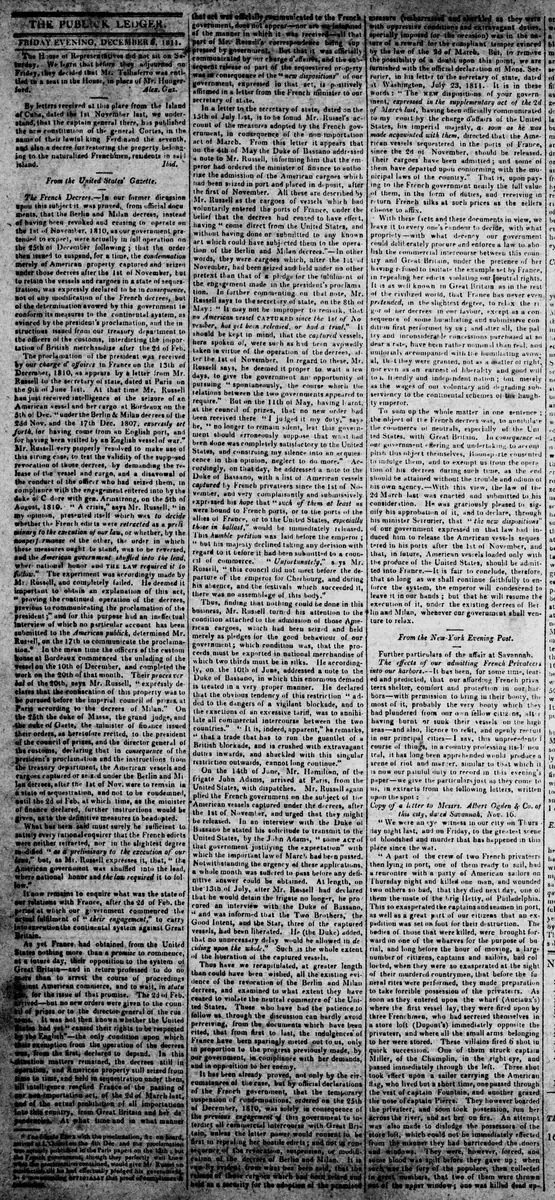
The French Decrees.—In our former discussion on this subject it was proved, from official documents, that the Berlin and Milan decrees, instead of having been revoked and ceasing to operate on the 1st of November, 1810, as our government pretended to expect, were actually in full operation on the 25th of December following; that the order then issued to suspend, for a time, the condemnation merely of American property captured and seized under those decrees after the 1st of November, but to retain the vessels and cargoes in a state of sequestration, was expressly declared to be in consequence, not of any modification of the French decrees, but of the determination avowed by this government to conform its measures to the continental system, as evinced by the president's proclamation, and the instructions issued from our treasury department to the officers of the customs, interdicting the importation of British merchandize after the 2d of Feb.
The proclamation of the president was received by our chargé d'affaires in France on the 13th of December, 1810, as appears by a letter from Mr. Russell to the secretary of state, dated at Paris on the 9th of June last. At that time Mr. Russell had just received intelligence of the seizure of an American vessel and her cargo at Bordeaux on the 5th of Dec. "under the Berlin & Milan decrees of the 23d Nov. and the 17th Dec. 1807, expressly set forth, for having come from an English port, and for having been visited by an English vessel of war."
Mr. Russell very properly resolved to make use of this strong case, to test the validity of the supposed revocation of those decrees, by demanding the release of the vessel and cargo, and a disavowal of the conduct of the officer who had seized them, in compliance with the engagement entered into by the duke of Cadore with gen. Armstrong, on the 5th of August, 1810. "A crisis," says Mr. Russell, "in my opinion, presented itself which was to decide whether the French edicts were retracted as a preliminary to the execution of our law, or whether, by the non-performance of the other, the order in which these measures ought to stand, was to be reversed, and the American government shuffled into the lead, where national honor and THE LAW required it to follow." The experiment was accordingly made by Mr. Russell, and completely failed. He deemed it important to obtain an explanation of this act, "proving the continued operation of the decrees, previous to communicating the proclamation of the president;" and for this purpose had an ineffectual interview of which no particular account has been submitted to the American publick, determined Mr. Russell, on the 17th to communicate the proclamation. In the mean time the officers of the custom house at Bordeaux commenced the unlading of the vessel on the 10th of December, and completed the work on the 20th of that month. Their proces verbal of the 20th, says Mr. Russell, "expressly declares that the confiscation of this property was to be pursued before the imperial council of prizes, at Paris according to the decrees of Milan." On the 25th the duke of Massa, the grand judge, and the duke of Gaete, the minister of finance issued their orders, as heretofore recited, to the president of the council of prizes, and the director general of the customs, declaring that in consequence of the president's proclamation and the instructions from the treasury department, the American vessels and cargoes captured or seized under the Berlin and Milan decrees, after the 1st of Nov. were to remain in a state of sequestration, and not to be condemned, until the 2d of Feb. at which time, as the minister of finance declared, further instructions would be given, and the definitive measures to be adopted.
What has been said must surely be sufficient to satisfy every rational enquirer that the French edicts were neither retracted, nor in the slightest degree modified "as a preliminary to the execution of our laws" but, as Mr. Russell expresses it, that, "the American government was shuffled into the lead, where national honor and the law required it to follow."
It now remains to enquire what was the state of our relations with France, after the 2d of Feb. the period at which our government commenced the actual fulfilment of "their engagement," to carry into execution the continental system against Great Britain.
As yet France, had obtained from the United States nothing more than a promise to commence, at a future day, their opposition to the system of Great Britain—and in return professed to do no more than to arrest the course of proceedings against American commerce, and to wait, in statu quo, for the issue of that promise. The 2d of Feb. arrived—but no new orders were given to the council of prizes or to the director general of the customs. It was not then known whether the United States had yet "caused their rights to be respected by the English" the only condition upon which their exemption from the operation of the decrees from the first, declared to depend. In this situation matters remained, the decrees still in operation, and American property still seized from time to time—and held in sequestration under them, until intelligence reached France of the passing of the non-importation act, of the 2d of March last and of the actual prohibition of all importations into this country, from Great Britain and her dependencies. At what time and in what manner this act arrived in France with the proclamation, &c. on board the John Adams, on the 4th Dec, and the proclamation published in the Paris papers on the 12th: but before it though they perfectly well knew its contents, would give Mr. Russell no occasion to complain that he had effectually pledged his government
(that act was officially communicated to the French government, does not appear nor are we in need of the manner in which it was received it that part of Mr Russell's correspondence being suppressed by government But that it was officially communicated by our charge d'affaires, and the subsequent release of part of the sequestered property was in consequence of the "new dispositions" of our government, expressed in that act, is positively affirmed in a letter from the French minister to our secretary of state.
In a letter to the secretary of state, dated on the 15th of July last, is to be found Mr. Russell's account of the measures adopted by the French government, in consequence of the non-importation act of March. From this letter it appears that on the 4th of May the Duke of Bassano addressed a note to Mr. Russell, informing him that the emperor had ordered the minister of finance to authorize the admission of the American cargoes which had been seized in port and placed in deposit, after the first of November. All these are described by Mr. Russell as the cargoes of vessels which had voluntarily entered the ports of France, under the belief that the decrees had ceased to have effect, having "come direct from the United States, and without having done or submitted to any known act which could have subjected them to the operation of the Berlin and Milan decrees."—In other words, they were cargoes which, after the 1st of November, had been seized and held under no other pretext than that of a pledge for the fulfilment of the engagement made in the president's proclamation. In further commenting on that note, Mr. Russell says to the secretary of state, on the 8th of May: "It may not be improper to remark, that no American vessel captured since the 1st of November, has yet been released, or had a trial." It should be kept in mind, that the captured vessels, here spoken of, were such as had been avowedly taken in virtue of the operation of the decrees, after the 1st of Novemner. In regard to these, Mr. Russell says, he deemed it proper to wait a few days, to give the government an opportunity of pursuing "spontaneously, the course which the relations between the two governments appeared to require." But on the 11th of May, having learnt, at the council of prizes, that no new order had been received there "I judged it my duty," says he, "no longer to remain silent, lest this government should erroneously suppose that what had been done was completely satisfactory to the United States, and construing my silence into an acquiescence in this opinion, neglect to do more." Accordingly, on that day, he addressed a note to the Duke of Bassano, with a list of American vessels captured by French privateers since the 1st of November, and very complaisantly and submissively expressed his hope that "such of them at least as were bound to French ports, or to the ports of the allies of France, or to the United States, especially those in ballast," would be immediately released.
This humble petition was laid before the emperor; "but his majesty declined taking any decision with regard to it before it had been submitted to a council of commerce." Unfortunately, says Mr. Russell, "this council did not meet before the departure of the emperor for Cherbourg, and during his absence, and the festivals which succeeded it, there was no assemblage of this body."
Thus, finding that nothing could be done in this business, Mr. Russell turned his attention to the condition attached to the admission of those American cargoes, which had been seized and held merely as pledges for the good behaviour of our government; which condition was, that the proceeds must be exported in national merchandize of which two thirds must be in silks. He accordingly, on the 10th of June, addressed a note to the Duke of Bassano, in which this enormous demand is treated in a very proper manner. He declared that the obvious tendency of this restriction "added to the dangers of a vigilant blockade, and to the exactions of an excessive tariff, was to annihilate all commercial intercourse between the two countries." "It is, indeed, apparent," he remarks, "that a trade that has to run the gauntlet of a British blockade, and is crushed with extravagant duties inwards, and shackled with this singular restriction outwards, cannot long continue."
On the 14th of June, Mr. Hamilton, of the frigate John Adams, arrived at Paris, from the United States, with dispatches. Mr. Russell again plied the French government on the subject of the American vessels captured under the decrees, after the 1st of November, and urged that they might be released. In an interview with the Duke of Bassano he stated his solicitude to transmit to the United States, by the John Adams, "some act of that government justifying the expectation" with which the important law of March had been passed.
Notwithstanding the urgency of these applications, a whole month was suffered to pass before any definitive answer could be obtained. At length, on the 13th of July, after Mr. Russell had declared that he would detain the frigate no longer, he procured an interview with the Duke of Bassano, "and was informed that the Two Brothers, the Good Intent, and the Star, three of the captured vessels, had been liberated. He (the Duke) added, that no unnecessary delay would be allowed in deciding upon the whole." Such is the whole extent of the liberation of the captured vessels.
Thus have we recapitulated, at greater length than could have been wished, all the existing evidence of the revocation of the Berlin and Milan decrees, and examined to what extent they have ceased to violate the neutral commerce of the United States. Those who have had the patience to follow us through the discussion can hardly avoid perceiving, from the documents which have been cited, that from first to last, the indulgences of France have been sparingly meted out to us, only in proportion to the progress previously made, by our government, in compliance with her demands, and in opposition to her enemy.
It has been already proved, not only by the circumstances of the case, but by official declarations of the French government, that the temporary suspension of condemnations, ordered on the 25th of December, 1810, was solely in consequence of the previous engagement by this government to interdict all commercial intercourse with Great Britain, unless the latter power would consent to be first in repealing her hostile edicts; and not in consequence of the revocation, suspension or modification of the decrees of Berlin and Milan. It is evident from what has been said, that the relief of those cargoes which had been seized in security for the
measure (embarrassed and shackled as they were with oppressive conditions and extravagant duties, specially imposed for the occasion) was in the nature of a reward for the compliant temper evinced by the law of the 2d of March. But, to remove the possibility of a doubt upon this point, we are furnished with the official declaration of Mr. Serrurier, in his letter to the secretary of state, dated at Washington, July 23, 1811. It is in these words: "The new dispositions of your government, expressed in the supplementary act of the 2d of March last, having been officially communicated to my court by the chargé d'affaires of the United States, his imperial majesty, as soon as he was made acquainted with them, directed that the American vessels sequestered in the ports of France, since the 2d of November, should be released. Their cargoes have been admitted; and some of them have departed upon conforming with the municipal laws of the country." That is, upon paying to the French government nearly the full value of them, in the form of duties, and receiving in return French silks at such prices as the sellers choose to affix.
With these facts and these documents in view, we leave it to every one's candour to decide, with what propriety—with what decency our government could deliberately procure and enforce a law to abolish the commercial intercourse between this country and Great Britain, under the pretence of her having refused to imitate the example set by France, in repealing her edicts violating our neutral rights.
It is as well known in Great Britain as in the rest of the civilized world, that France has never even pretended, in the slightest degree, to relax the rigour of her decrees in our favour, except as a consequence of some humiliating and submissive condition first performed by us; and after all, the paltry and inconsiderable concessions purchased at so dear a rate, have been rather nominal than real, and uniformly accompanied with the humiliating avowal, that they were granted, not as a matter of right, nor even as an earnest of liberality and good will to a friendly and independent nation; but merely as the wages of our voluntary and degrading subserviency to the continental schemes of the haughty emperor.
To sum up the whole matter in one sentence; the object of the French decrees was, to annihilate the commerce of neutrals, especially of the United States, with Great Britain. In consequence of our government offering and undertaking to accomplish this object themselves, Bonaparte consented to indulge them, and to exempt us from the operation of his decrees during such time, as the end should be attained without the trouble and odium of his own agency.—With this view, the law of the 2d March last was enacted and submitted to his consideration. He was graciously pleased to signify his approbation of it, and to declare, through his minister Serrurier, that "the new dispositions of our government expressed in that law had induced him to release the American vessels sequestered in his ports after the 1st of November, and that, in future, American vessels loaded only with the produce of the United States, should be admitted into France.—It is fair to conclude, therefore, that so long as we shall continue faithfully to enforce the system, the emperor will condescend to leave it in our hands; but that he will resume the execution of it, under the existing decrees of Berlin and Milan, whenever our government shall venture to relax.
The French Decrees.—In our former discussion on this subject it was proved, from official documents, that the Berlin and Milan decrees, instead of having been revoked and ceasing to operate on the 1st of November, 1810, as our government pretended to expect, were actually in full operation on the 25th of December following; that the order then issued to suspend, for a time, the condemnation merely of American property captured and seized under those decrees after the 1st of November, but to retain the vessels and cargoes in a state of sequestration, was expressly declared to be in consequence, not of any modification of the French decrees, but of the determination avowed by this government to conform its measures to the continental system, as evinced by the president's proclamation, and the instructions issued from our treasury department to the officers of the customs, interdicting the importation of British merchandize after the 2d of Feb.
The proclamation of the president was received by our chargé d'affaires in France on the 13th of December, 1810, as appears by a letter from Mr. Russell to the secretary of state, dated at Paris on the 9th of June last. At that time Mr. Russell had just received intelligence of the seizure of an American vessel and her cargo at Bordeaux on the 5th of Dec. "under the Berlin & Milan decrees of the 23d Nov. and the 17th Dec. 1807, expressly set forth, for having come from an English port, and for having been visited by an English vessel of war."
Mr. Russell very properly resolved to make use of this strong case, to test the validity of the supposed revocation of those decrees, by demanding the release of the vessel and cargo, and a disavowal of the conduct of the officer who had seized them, in compliance with the engagement entered into by the duke of Cadore with gen. Armstrong, on the 5th of August, 1810. "A crisis," says Mr. Russell, "in my opinion, presented itself which was to decide whether the French edicts were retracted as a preliminary to the execution of our law, or whether, by the non-performance of the other, the order in which these measures ought to stand, was to be reversed, and the American government shuffled into the lead, where national honor and THE LAW required it to follow." The experiment was accordingly made by Mr. Russell, and completely failed. He deemed it important to obtain an explanation of this act, "proving the continued operation of the decrees, previous to communicating the proclamation of the president;" and for this purpose had an ineffectual interview of which no particular account has been submitted to the American publick, determined Mr. Russell, on the 17th to communicate the proclamation. In the mean time the officers of the custom house at Bordeaux commenced the unlading of the vessel on the 10th of December, and completed the work on the 20th of that month. Their proces verbal of the 20th, says Mr. Russell, "expressly declares that the confiscation of this property was to be pursued before the imperial council of prizes, at Paris according to the decrees of Milan." On the 25th the duke of Massa, the grand judge, and the duke of Gaete, the minister of finance issued their orders, as heretofore recited, to the president of the council of prizes, and the director general of the customs, declaring that in consequence of the president's proclamation and the instructions from the treasury department, the American vessels and cargoes captured or seized under the Berlin and Milan decrees, after the 1st of Nov. were to remain in a state of sequestration, and not to be condemned, until the 2d of Feb. at which time, as the minister of finance declared, further instructions would be given, and the definitive measures to be adopted.
What has been said must surely be sufficient to satisfy every rational enquirer that the French edicts were neither retracted, nor in the slightest degree modified "as a preliminary to the execution of our laws" but, as Mr. Russell expresses it, that, "the American government was shuffled into the lead, where national honor and the law required it to follow."
It now remains to enquire what was the state of our relations with France, after the 2d of Feb. the period at which our government commenced the actual fulfilment of "their engagement," to carry into execution the continental system against Great Britain.
As yet France, had obtained from the United States nothing more than a promise to commence, at a future day, their opposition to the system of Great Britain—and in return professed to do no more than to arrest the course of proceedings against American commerce, and to wait, in statu quo, for the issue of that promise. The 2d of Feb. arrived—but no new orders were given to the council of prizes or to the director general of the customs. It was not then known whether the United States had yet "caused their rights to be respected by the English" the only condition upon which their exemption from the operation of the decrees from the first, declared to depend. In this situation matters remained, the decrees still in operation, and American property still seized from time to time—and held in sequestration under them, until intelligence reached France of the passing of the non-importation act, of the 2d of March last and of the actual prohibition of all importations into this country, from Great Britain and her dependencies. At what time and in what manner this act arrived in France with the proclamation, &c. on board the John Adams, on the 4th Dec, and the proclamation published in the Paris papers on the 12th: but before it though they perfectly well knew its contents, would give Mr. Russell no occasion to complain that he had effectually pledged his government
(that act was officially communicated to the French government, does not appear nor are we in need of the manner in which it was received it that part of Mr Russell's correspondence being suppressed by government But that it was officially communicated by our charge d'affaires, and the subsequent release of part of the sequestered property was in consequence of the "new dispositions" of our government, expressed in that act, is positively affirmed in a letter from the French minister to our secretary of state.
In a letter to the secretary of state, dated on the 15th of July last, is to be found Mr. Russell's account of the measures adopted by the French government, in consequence of the non-importation act of March. From this letter it appears that on the 4th of May the Duke of Bassano addressed a note to Mr. Russell, informing him that the emperor had ordered the minister of finance to authorize the admission of the American cargoes which had been seized in port and placed in deposit, after the first of November. All these are described by Mr. Russell as the cargoes of vessels which had voluntarily entered the ports of France, under the belief that the decrees had ceased to have effect, having "come direct from the United States, and without having done or submitted to any known act which could have subjected them to the operation of the Berlin and Milan decrees."—In other words, they were cargoes which, after the 1st of November, had been seized and held under no other pretext than that of a pledge for the fulfilment of the engagement made in the president's proclamation. In further commenting on that note, Mr. Russell says to the secretary of state, on the 8th of May: "It may not be improper to remark, that no American vessel captured since the 1st of November, has yet been released, or had a trial." It should be kept in mind, that the captured vessels, here spoken of, were such as had been avowedly taken in virtue of the operation of the decrees, after the 1st of Novemner. In regard to these, Mr. Russell says, he deemed it proper to wait a few days, to give the government an opportunity of pursuing "spontaneously, the course which the relations between the two governments appeared to require." But on the 11th of May, having learnt, at the council of prizes, that no new order had been received there "I judged it my duty," says he, "no longer to remain silent, lest this government should erroneously suppose that what had been done was completely satisfactory to the United States, and construing my silence into an acquiescence in this opinion, neglect to do more." Accordingly, on that day, he addressed a note to the Duke of Bassano, with a list of American vessels captured by French privateers since the 1st of November, and very complaisantly and submissively expressed his hope that "such of them at least as were bound to French ports, or to the ports of the allies of France, or to the United States, especially those in ballast," would be immediately released.
This humble petition was laid before the emperor; "but his majesty declined taking any decision with regard to it before it had been submitted to a council of commerce." Unfortunately, says Mr. Russell, "this council did not meet before the departure of the emperor for Cherbourg, and during his absence, and the festivals which succeeded it, there was no assemblage of this body."
Thus, finding that nothing could be done in this business, Mr. Russell turned his attention to the condition attached to the admission of those American cargoes, which had been seized and held merely as pledges for the good behaviour of our government; which condition was, that the proceeds must be exported in national merchandize of which two thirds must be in silks. He accordingly, on the 10th of June, addressed a note to the Duke of Bassano, in which this enormous demand is treated in a very proper manner. He declared that the obvious tendency of this restriction "added to the dangers of a vigilant blockade, and to the exactions of an excessive tariff, was to annihilate all commercial intercourse between the two countries." "It is, indeed, apparent," he remarks, "that a trade that has to run the gauntlet of a British blockade, and is crushed with extravagant duties inwards, and shackled with this singular restriction outwards, cannot long continue."
On the 14th of June, Mr. Hamilton, of the frigate John Adams, arrived at Paris, from the United States, with dispatches. Mr. Russell again plied the French government on the subject of the American vessels captured under the decrees, after the 1st of November, and urged that they might be released. In an interview with the Duke of Bassano he stated his solicitude to transmit to the United States, by the John Adams, "some act of that government justifying the expectation" with which the important law of March had been passed.
Notwithstanding the urgency of these applications, a whole month was suffered to pass before any definitive answer could be obtained. At length, on the 13th of July, after Mr. Russell had declared that he would detain the frigate no longer, he procured an interview with the Duke of Bassano, "and was informed that the Two Brothers, the Good Intent, and the Star, three of the captured vessels, had been liberated. He (the Duke) added, that no unnecessary delay would be allowed in deciding upon the whole." Such is the whole extent of the liberation of the captured vessels.
Thus have we recapitulated, at greater length than could have been wished, all the existing evidence of the revocation of the Berlin and Milan decrees, and examined to what extent they have ceased to violate the neutral commerce of the United States. Those who have had the patience to follow us through the discussion can hardly avoid perceiving, from the documents which have been cited, that from first to last, the indulgences of France have been sparingly meted out to us, only in proportion to the progress previously made, by our government, in compliance with her demands, and in opposition to her enemy.
It has been already proved, not only by the circumstances of the case, but by official declarations of the French government, that the temporary suspension of condemnations, ordered on the 25th of December, 1810, was solely in consequence of the previous engagement by this government to interdict all commercial intercourse with Great Britain, unless the latter power would consent to be first in repealing her hostile edicts; and not in consequence of the revocation, suspension or modification of the decrees of Berlin and Milan. It is evident from what has been said, that the relief of those cargoes which had been seized in security for the
measure (embarrassed and shackled as they were with oppressive conditions and extravagant duties, specially imposed for the occasion) was in the nature of a reward for the compliant temper evinced by the law of the 2d of March. But, to remove the possibility of a doubt upon this point, we are furnished with the official declaration of Mr. Serrurier, in his letter to the secretary of state, dated at Washington, July 23, 1811. It is in these words: "The new dispositions of your government, expressed in the supplementary act of the 2d of March last, having been officially communicated to my court by the chargé d'affaires of the United States, his imperial majesty, as soon as he was made acquainted with them, directed that the American vessels sequestered in the ports of France, since the 2d of November, should be released. Their cargoes have been admitted; and some of them have departed upon conforming with the municipal laws of the country." That is, upon paying to the French government nearly the full value of them, in the form of duties, and receiving in return French silks at such prices as the sellers choose to affix.
With these facts and these documents in view, we leave it to every one's candour to decide, with what propriety—with what decency our government could deliberately procure and enforce a law to abolish the commercial intercourse between this country and Great Britain, under the pretence of her having refused to imitate the example set by France, in repealing her edicts violating our neutral rights.
It is as well known in Great Britain as in the rest of the civilized world, that France has never even pretended, in the slightest degree, to relax the rigour of her decrees in our favour, except as a consequence of some humiliating and submissive condition first performed by us; and after all, the paltry and inconsiderable concessions purchased at so dear a rate, have been rather nominal than real, and uniformly accompanied with the humiliating avowal, that they were granted, not as a matter of right, nor even as an earnest of liberality and good will to a friendly and independent nation; but merely as the wages of our voluntary and degrading subserviency to the continental schemes of the haughty emperor.
To sum up the whole matter in one sentence; the object of the French decrees was, to annihilate the commerce of neutrals, especially of the United States, with Great Britain. In consequence of our government offering and undertaking to accomplish this object themselves, Bonaparte consented to indulge them, and to exempt us from the operation of his decrees during such time, as the end should be attained without the trouble and odium of his own agency.—With this view, the law of the 2d March last was enacted and submitted to his consideration. He was graciously pleased to signify his approbation of it, and to declare, through his minister Serrurier, that "the new dispositions of our government expressed in that law had induced him to release the American vessels sequestered in his ports after the 1st of November, and that, in future, American vessels loaded only with the produce of the United States, should be admitted into France.—It is fair to conclude, therefore, that so long as we shall continue faithfully to enforce the system, the emperor will condescend to leave it in our hands; but that he will resume the execution of it, under the existing decrees of Berlin and Milan, whenever our government shall venture to relax.
What sub-type of article is it?
Foreign Affairs
Trade Or Commerce
War Or Peace
What keywords are associated?
French Decrees
Berlin Milan
Continental System
Neutral Commerce
Us France Relations
Non Importation Act
American Vessels Seized
What entities or persons were involved?
Mr. Russell
Duke Of Cadore
Gen. Armstrong
Duke Of Massa
Duke Of Gaete
Duke Of Bassano
Mr. Serrurier
Napoleon Bonaparte
Us President
France
Great Britain
United States
Editorial Details
Primary Topic
Critique Of French Berlin And Milan Decrees And Us Subservience To Continental System
Stance / Tone
Strongly Critical Of Us Government's Compliance With France
Key Figures
Mr. Russell
Duke Of Cadore
Gen. Armstrong
Duke Of Massa
Duke Of Gaete
Duke Of Bassano
Mr. Serrurier
Napoleon Bonaparte
Us President
France
Great Britain
United States
Key Arguments
Berlin And Milan Decrees Remained In Operation After November 1810 Despite Us Expectations
French Suspension Of Condemnations Was Due To Us Commitment To Continental System, Not Decree Revocation
Us Non Importation Act Of March 1811 Prompted Limited French Releases Of Sequestered Property
French Concessions Were Conditional And Exploitative, Tied To Us Anti British Measures
Us Policy Humiliated National Honor By Prioritizing French Demands Over Neutral Rights
No Genuine Revocation Of Decrees; Only Temporary Indulgences For Us Compliance