Thank you for visiting SNEWPapers!
Sign up free
Berkeley And Jefferson Intelligencer
Martinsburg, Berkeley County, Virginia
What is this article about?
London reports from November 12 discuss ongoing British ministerial deliberations on revising the 12th article of the 1794 Jay Treaty with the US, concerning American trade restrictions to British West and East Indies. US demands unrestricted access, backed by threats, amid renewed Anglo-French hostilities. Negotiators include Monroe and upcoming Pinkney.
Merged-components note: The text content continues seamlessly across these two components, discussing the same topic of the British-American treaty and its articles, indicating they form a single logical article.
Clippings
1 of 2
OCR Quality
Full Text
The paper from which the above mentioned foreign news is taken says "A member of the legislature has received a letter from Col. Mercer, who accompanied Col. Monroe to Europe, stating that there was every prospect of an immediate peace between France and Great Britain; that there would be a change of ministry in England Sheridan and Fox coming in and that Buonaparte had determined to settle down the government of France upon true Republican principles."
[Fed. Gaz.]
PETERSBURG, January 13.
IMPORTANT.
To the Editors
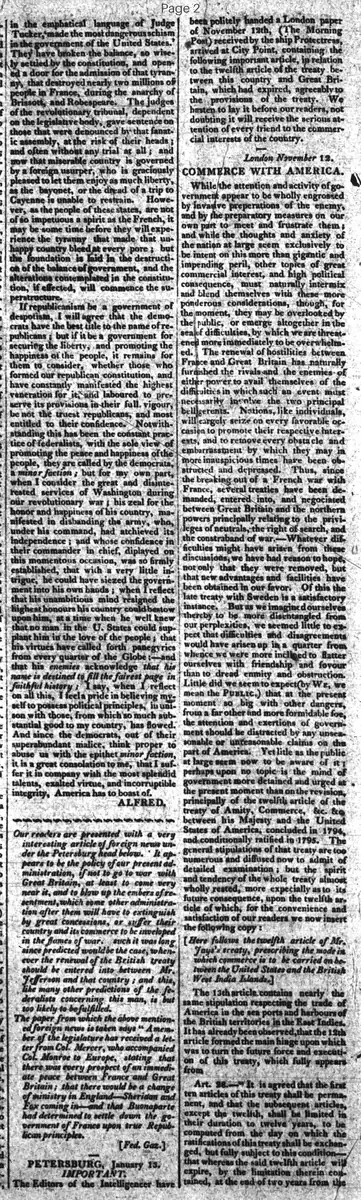
We have been politely handed a London paper of November 12th, The Morning Post, received by the ship Protectress arrived at City Point, containing the following important article, in relation to the twelfth article of the treaty between this country and Great Britain, which had expired, agreeably to the provisions of the treaty. We hasten to lay it before our readers, not doubting it will receive the serious attention of every friend to the commercial interests of the country.
London, November 12.
COMMERCE WITH AMERICA.
While the attention and activity of government appear to be wholly engrossed by invasive preparations of the enemy and by the preparatory measures on our own part to meet and frustrate them; and while the thoughts and anxiety of the nation at large seem exclusively to be intent on this more than gigantic and impending peril, other topics of great commercial interest, and high political consequence, must naturally intermix and blend themselves with these more ponderous considerations, though, for the moment, they may be overlooked by the public, or emerge altogether in the sea of difficulties, by which we are threatened more immediately to be overwhelmed.
The renewal of hostilities between France and Great Britain has naturally furnished the rivals and the enemies of either power to avail themselves of the difficulties in which such an event, must necessarily involve the two principal belligerents. Nations, like individuals, will eagerly seize on every favorable occasion to promote their respective interests, and to remove every obstacle and embarrassment by, which they may in more inauspicious times have been obstructed and depressed.
Thus, since the breaking out of a French war with France, several treaties have been demanded, entered into, and negotiated between Great Britain and the northern powers principally relating to the privileges of neutrals, the right of search, and the contraband of war.
Whatever difficulties might have arisen from these discussions, we have had reason to hope, not only that they were removed, but that new advantages and facilities have been obtained in our favor. Of this the late treaty with Sweden is a satisfactory instance. But as we imagined ourselves thereby to be more disentangled from our perplexities, we seemed little to expect that difficulties and disagreements would have arisen up in a quarter from whence we were more inclined to flatter ourselves with friendship and favor than to dread enmity and obstruction.
Little did we seem to expect (by we mean the Public,) that at the present moment so big with other dangers, from a far other and more formidable foe the attention and exertions of government should be distracted by any unreasonable or unreasonable claims on the part of America.
Yet little as the public at large seem now to be aware of it perhaps upon no topic is the mind of government more detained and urged at the present moment than on the revision, principally of the twelfth article of the treaty of Amity, Commerce, &c. &c. between his Majesty and the United States of America, concluded in 1794, and conditionally ratified in 1795.
The general stipulations of that treaty are too numerous and diffused now to admit of detailed examination; but the spirit and tendency of the whole treaty almost wholly rested more especially as to its future consequence, upon the twelfth article of which, for the convenience and satisfaction of our readers we now insert the following copy:
Here follows the twelfth article of Jay's treaty, prescribing the mode in which commerce is to be carried on between the United States and the British West-India Islands.
TK
The 13th article contains nearly the same stipulation respecting the trade of America in the sea ports and harbours of the British territories in the East Indies.
It has already been observed, that the 12th article formed the main hinge upon which was to turn the future force and execution of this treaty, which fully appears from
Art. 28. It is agreed that the first ten articles of this treaty shall be permanent, and that the subsequent articles, except the twelfth, shall be limited in their duration to twelve years, to be computed from the day on which the ratifications of this treaty shall be exchanged; but fully subject to this condition that whereas the said twelfth article will expire, by the limitation therein contained, at the end of two years from the
signing of the preliminary, or other article of peace which shall terminate the present war in which his majesty is engaged, it is agreed, that proper measures shall, by concert, be taken for bringing the subject of that article into amicable treaty and discussion, so early before the expiration of the said term, as that new arrangements on that head may at that time be perfected and ready to take place, but if it should unfortunately happen, that his majesty and the United States, should not be able to agree on such new arrangements, in that case, all the articles of this treaty, except the first ten, shall then cease and expire together."
This is the unfortunate issue which the above article seemed to have in perspective, and which constitutes the principal ground of the discussion in which we understand that ministers, are now deeply engaged. Under any other circumstances, the points in dispute might be easily adjusted; but when so many other more momentous concerns are at stake and when we know that the craft, malice, and intrigue of our great enemy will continually and anxiously blow their pestilential breath on every little sore that may break out in the body of any other state, till they fester and inflame it into acrimonious virulence, we may easily imagine how much they endeavor to irritate the temper of the United States of themselves, perhaps, too sanguinely disposed to deceive or extort advantages, from the present perplexities and perilous posture of British affairs. The renewal of this treaty we are credibly informed, has for some time back formed a principal object of the discussions of the consular cabinet, and is now under the serious consideration of the government of this country. The American government is said to hold the most lofty and menacing language respecting their just pretensions. They strongly remonstrate against any restriction or limitation whatever, either on their trade, or the amount of their tonnage; the arguments they urged to enforce compliance with their demands are backed by threats which we can never imagine they would seriously attempt to carry into effect. Indeed these threats are of a nature which prudence persuades us from detailing, but which would seem to aim a severe blow at the general commercial interests of this country, and which would prove fatal to the commercial existence of many respectable individuals. It is well known that the trade of America, in West India and East India articles, with the continent of Europe, most especially with France has of late considerably increased; and in proportion to its growing prosperity, will they naturally be anxious to enlarge it, or at least to preserve it undiminished and unrestrained. Such a disposition on their part, their obvious interests must prompt them to entertain; it is for us to examine how far it may be reconcilable with ours. Mr. Monroe is said to have received fresh instructions from his government to press this point with every possible urgency; nor are his exertions and discretion solely to be relied on; but another negotiator, we believe, a Mr. Pinkney is expected soon to arrive from America, in order to give additional force and activity to the pending negociation. Ministers will no doubt feel the importance of continuing to maintain a friendly understanding with the United States: but as their coolness and moderation will no doubt admonish them against any harsh or violent extremity, so also are we inclined to hope that their energy and firmness will preserve them from any unworthy condescension, or pusillanimous concession.
The following is copied from one of our latest London papers:
"A Cabinet was held on Friday and Saturday which sat for several hours each day. The subject of deliberation was supposed to be the discussions pending between this country and America, relative to the construction of the 12th Article of the treaty of Commerce concluded between his Majesty and the United States in 1794. By this article the Americans are restricted from trading to any of our ports or settlements in vessels above the burthen of 70 tons. They now strongly remonstrate against any restriction or limitation whatever, and it is said they hold very lofty language respecting their pretensions. This subject, we understand, occupies at present much of the attention and anxiety of Ministers. Upon a question of such delicacy and importance, we forbear at present to make any comment. It is one however which involves, not only the existence of many respectable individuals, but even the general commercial interests of this country."
The following is from the London Evening Post of the 12th November;
"Some difficulties of a commercial nature relative to the trade of the West India Islands are now under the consideration of Ministers—but we have little doubt that every thing will be easily adjusted to the satisfaction of both nations; we, however think that if America be very impertinent and urgent at the present, it is both indecorous and unfair, as a nation engaged in defending its existence, as we are, ought not to be pressed by a friendly power on any subject that is of a nature to admit of delay which must be the case with every commercial regulation."
What sub-type of article is it?
What keywords are associated?
What entities or persons were involved?
Where did it happen?
Foreign News Details
Primary Location
London
Event Date
November 12
Key Persons
Outcome
ongoing negotiations with us demands for unrestricted trade to british west and east indies; british ministers engaged in discussions amid threats from america; no final resolution reported.
Event Details
British newspapers report ministerial focus on revising the 12th article of the 1794 Jay Treaty, which restricts US vessels over 70 tons from trading with British West India Islands (and similar for East Indies in 13th article). The article expired, leading to disputes. US remonstrates against restrictions, using threats to demand full access. Monroe presses urgently; Pinkney expected to join. Context includes renewed Anglo-French war and neutral trade treaties.