Thank you for visiting SNEWPapers!
Sign up free
Watauga Democrat
Boone, Watauga County, North Carolina
What is this article about?
North Carolina imports 8 million bushels of wheat annually despite potential for profitable local production. Extension director Charles A. Sheffield notes increased interest in wheat planting this fall in counties like Cumberland, Caswell, and Durham, urging farmers to remedy the shortage through better rotation with legumes.
Clipping
OCR Quality
Full Text
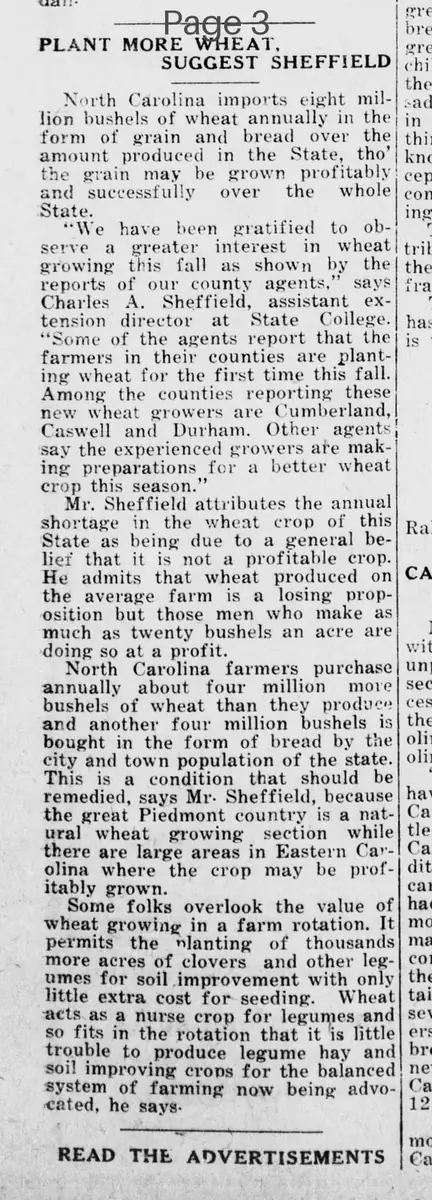
SUGGEST SHEFFIELD
North Carolina imports eight million bushels of wheat annually in the form of grain and bread over the amount produced in the State, tho the grain may be grown profitably and successfully over the whole State.
"We have been gratified to observe a greater interest in wheat growing this fall as shown by the reports of our county agents," says Charles A. Sheffield, assistant extension director at State College. "Some of the agents report that the farmers in their counties are planting wheat for the first time this fall. Among the counties reporting these new wheat growers are Cumberland, Caswell and Durham. Other agents say the experienced growers are making preparations for a better wheat crop this season."
Mr. Sheffield attributes the annual shortage in the wheat crop of this State as being due to a general belief that it is not a profitable crop. He admits that wheat produced on the average farm is a losing proposition but those men who make as much as twenty bushels an acre are doing so at a profit.
North Carolina farmers purchase annually about four million more bushels of wheat than they produce and another four million bushels is bought in the form of bread by the city and town population of the state. This is a condition that should be remedied, says Mr. Sheffield, because the great Piedmont country is a natural wheat growing section while there are large areas in Eastern Carolina where the crop may be profitably grown.
Some folks overlook the value of wheat growing in a farm rotation. It permits the planting of thousands more acres of clovers and other legumes for soil improvement with only little extra cost for seeding. Wheat acts as a nurse crop for legumes and so fits in the rotation that it is little trouble to produce legume hay and soil improving crops for the balanced system of farming now being advocated, he says.
READ THE ADVERTISEMENTS
What sub-type of article is it?
What themes does it cover?
What keywords are associated?
What entities or persons were involved?
Where did it happen?
Story Details
Key Persons
Location
North Carolina
Event Date
This Fall
Story Details
North Carolina faces an annual wheat shortage, importing 8 million bushels despite suitable growing conditions statewide. Charles A. Sheffield reports increased planting interest in counties like Cumberland, Caswell, and Durham, attributing the issue to misconceptions about profitability and advocating for wheat in farm rotations to improve soil with legumes.