Thank you for visiting SNEWPapers!
Sign up free
Foreign News
December 2, 1877
The Sun
New York, New York County, New York
What is this article about?
Commentary on the vitality of the Ottoman Empire amid ongoing conflict, praising Turkish soldiers' courage and the nation's progress, countering negative Western views with insights from Col. James Baker on life in Bulgaria and Roumelia.
Clipping
OCR Quality
85%
Good
Full Text
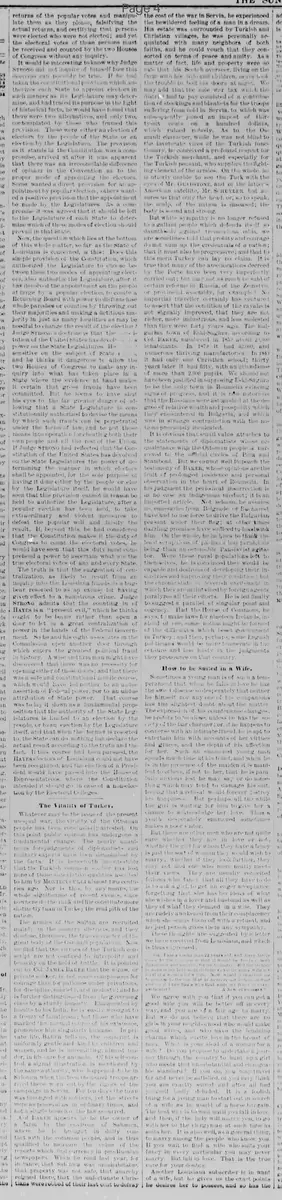
The Vitality of Turkey.
Whatever may be the issue of the present struggle, the spirit of the Ottoman people has been conclusively attested, and on this point public opinion has undergone a fundamental change. The early warnings of diplomatists and military experts have been corrected by the facts. It is no longer incredible that the Turk should count for as much as he has done in the past. None of those odious qualities ascribed to him by Montesquieu almost two centuries ago can be discovered in him now. Nor is this, by any means, the whole significance of recent events, since nowhere does the rank and file constitute more distinctly than in Turkey the real pith of the nation.
The armies of the Sultan are recruited mainly in the country districts, and they come, therefore, straight from the heart of the Ottoman population. Now we know that the feats of the Turkish soldier are not confined to rapidity and tenacity on the field of battle. It is pointed out by Col. James Baker that the nizam, or private soldier, is as much celebrated for courage as for patience under privations, sobriety, and modesty; and he is further distinguished from the governing class by a sturdy honesty. Exasperated by insults to his faith, he is easily wrought to a frenzy of fanaticism; but those who have marked his local career of industry pronounce him singularly humane. In private life, Baker tells us, the Moslem script is uniformly gentle and kind to children and women, and he is unerring almost to a degree in his care for animals of the lower creation. A signal illustration is mentioned by the same authority, who happened to be in Sophia when three thousand troops arrived there on their way out by the railroads of the campaign in Servia. For three days the town was thronged with soldiers, yet the streets were as peaceful as in ordinary times, and not a single humane law was violated.
Col. Baker, who is the owner of a farm in the environs of Sophia, where he is brought in daily contact with the common people, and is thus qualified to contradict the sins of the reports which disfigure our pro-Russian newspapers. When he read last year, for instance, that Sophia was uninhabitable, that property was not safe, that anarchy reigned there, that the unfortunate Christians were robbed of their last cent to defray the cost of the war in Servia, he experienced the bewildered feeling of a man in a dream. His estate was surrounded by Turkish and Christian villages, he was personally acquainted with many neighbors of both faiths, and he could vouch that they consorted on terms of peace and amity. As a matter of fact, life and property were so safe that his Scotch overseer, living on the farm with his wife and children, never took the trouble to bolt his doors at night. We may add that the sole war tax which the district had to pay consisted of a contribution of stockings and blankets for the troops suffering from cold in Servia, to which was subsequently joined an impost of thirty-six cents on a hundred dollars, which ruined nobody. As to the Ottoman character, while he was not blind to the inveterate vices of the Turkish functionary, he conceived a profound respect for the Turkish merchant, and especially for the Turkish peasant, who supplies the fighting element of the armies. On the whole, he is utterly unable to see the Turk with the eyes of Mr. Gladstone, and of the latter's American satellite, Mr. Schuyler, but assures us that only the head, or, so to speak, the seat, of the nation is diseased; the body is sound and strong.
But while sympathy is no longer refused to a gallant people which defends itself so dauntlessly against tremendous odds, we are sometimes taught that probity and courage do not sum up the credentials of a nation; that it must also be progressive; and that to this merit Turkey can lay no claim. It is true that many of the ameliorations decreed by the Porte have been very imperfectly carried out; but may not as much be said of certain reforms in Russia, of the Zemstvo, or provincial assembly, for example? No impartial traveller certainly has ventured to assert that the condition of the rayahs is not signally improved, that they are not richer, more industrious, and less molested than they were forty years ago. The Bulgarian town of Eski-Zaghra, according to Col. Baker, numbered in 1850 about 2,000 inhabitants. In 1870 it had 32,000, and numerous thriving manufactories. In 1854 it had only one Christian school; thirty years later it had forty, with an attendance of more than 2,000 pupils. We should not have been justified in supposing Eski-Zaghra to be the only town in Roumelia evincing signs of progress, and it is now notorious that the Russians were as much punished as the degree of relative wealth and prosperity which they encountered in Bulgaria, and which was in strange contradiction with the tales previously inculcated.
It is obvious that small value attaches to the statements of diplomatists whose acquaintance with the Ottoman people is narrowed to the official circles of Pera and Stamboul. But we cannot well impeach the testimony of Baker, whose opinions are the fruit of prolonged residence and personal observation in the heart of Roumelia. In his judgment the periodical insurrection is in no case an indigenous product; it is an imported article. Not seldom, he assures us, consulates from Belgrade or Bucharest have had to use force to drive the Bulgarian peasant under their flag; at other times dazzling promises have sufficed to hoodwink him. On the whole, he inclines to think the less scrupulous of Panslavs a less perilous foe than an ostensible Panslavist agitator. Were these rural populations left to themselves, he is convinced they would be capable and desirous of developing their industries and improving their condition; but such is not the state of reverish excitement in which they are maintained by foreign agents, which paralyzes all their efforts. He is led finally to suggest a parallel of singular point and cogency. Had the House of Commons, he says, to make laws for nineteen Irelands, instead of one, some notion might be formed of the difficulties which beset government in Turkey; and then, perhaps, some English politicians would be more temperate in their abuse and less hasty in the judgments they pronounce on that country.
Whatever may be the issue of the present struggle, the spirit of the Ottoman people has been conclusively attested, and on this point public opinion has undergone a fundamental change. The early warnings of diplomatists and military experts have been corrected by the facts. It is no longer incredible that the Turk should count for as much as he has done in the past. None of those odious qualities ascribed to him by Montesquieu almost two centuries ago can be discovered in him now. Nor is this, by any means, the whole significance of recent events, since nowhere does the rank and file constitute more distinctly than in Turkey the real pith of the nation.
The armies of the Sultan are recruited mainly in the country districts, and they come, therefore, straight from the heart of the Ottoman population. Now we know that the feats of the Turkish soldier are not confined to rapidity and tenacity on the field of battle. It is pointed out by Col. James Baker that the nizam, or private soldier, is as much celebrated for courage as for patience under privations, sobriety, and modesty; and he is further distinguished from the governing class by a sturdy honesty. Exasperated by insults to his faith, he is easily wrought to a frenzy of fanaticism; but those who have marked his local career of industry pronounce him singularly humane. In private life, Baker tells us, the Moslem script is uniformly gentle and kind to children and women, and he is unerring almost to a degree in his care for animals of the lower creation. A signal illustration is mentioned by the same authority, who happened to be in Sophia when three thousand troops arrived there on their way out by the railroads of the campaign in Servia. For three days the town was thronged with soldiers, yet the streets were as peaceful as in ordinary times, and not a single humane law was violated.
Col. Baker, who is the owner of a farm in the environs of Sophia, where he is brought in daily contact with the common people, and is thus qualified to contradict the sins of the reports which disfigure our pro-Russian newspapers. When he read last year, for instance, that Sophia was uninhabitable, that property was not safe, that anarchy reigned there, that the unfortunate Christians were robbed of their last cent to defray the cost of the war in Servia, he experienced the bewildered feeling of a man in a dream. His estate was surrounded by Turkish and Christian villages, he was personally acquainted with many neighbors of both faiths, and he could vouch that they consorted on terms of peace and amity. As a matter of fact, life and property were so safe that his Scotch overseer, living on the farm with his wife and children, never took the trouble to bolt his doors at night. We may add that the sole war tax which the district had to pay consisted of a contribution of stockings and blankets for the troops suffering from cold in Servia, to which was subsequently joined an impost of thirty-six cents on a hundred dollars, which ruined nobody. As to the Ottoman character, while he was not blind to the inveterate vices of the Turkish functionary, he conceived a profound respect for the Turkish merchant, and especially for the Turkish peasant, who supplies the fighting element of the armies. On the whole, he is utterly unable to see the Turk with the eyes of Mr. Gladstone, and of the latter's American satellite, Mr. Schuyler, but assures us that only the head, or, so to speak, the seat, of the nation is diseased; the body is sound and strong.
But while sympathy is no longer refused to a gallant people which defends itself so dauntlessly against tremendous odds, we are sometimes taught that probity and courage do not sum up the credentials of a nation; that it must also be progressive; and that to this merit Turkey can lay no claim. It is true that many of the ameliorations decreed by the Porte have been very imperfectly carried out; but may not as much be said of certain reforms in Russia, of the Zemstvo, or provincial assembly, for example? No impartial traveller certainly has ventured to assert that the condition of the rayahs is not signally improved, that they are not richer, more industrious, and less molested than they were forty years ago. The Bulgarian town of Eski-Zaghra, according to Col. Baker, numbered in 1850 about 2,000 inhabitants. In 1870 it had 32,000, and numerous thriving manufactories. In 1854 it had only one Christian school; thirty years later it had forty, with an attendance of more than 2,000 pupils. We should not have been justified in supposing Eski-Zaghra to be the only town in Roumelia evincing signs of progress, and it is now notorious that the Russians were as much punished as the degree of relative wealth and prosperity which they encountered in Bulgaria, and which was in strange contradiction with the tales previously inculcated.
It is obvious that small value attaches to the statements of diplomatists whose acquaintance with the Ottoman people is narrowed to the official circles of Pera and Stamboul. But we cannot well impeach the testimony of Baker, whose opinions are the fruit of prolonged residence and personal observation in the heart of Roumelia. In his judgment the periodical insurrection is in no case an indigenous product; it is an imported article. Not seldom, he assures us, consulates from Belgrade or Bucharest have had to use force to drive the Bulgarian peasant under their flag; at other times dazzling promises have sufficed to hoodwink him. On the whole, he inclines to think the less scrupulous of Panslavs a less perilous foe than an ostensible Panslavist agitator. Were these rural populations left to themselves, he is convinced they would be capable and desirous of developing their industries and improving their condition; but such is not the state of reverish excitement in which they are maintained by foreign agents, which paralyzes all their efforts. He is led finally to suggest a parallel of singular point and cogency. Had the House of Commons, he says, to make laws for nineteen Irelands, instead of one, some notion might be formed of the difficulties which beset government in Turkey; and then, perhaps, some English politicians would be more temperate in their abuse and less hasty in the judgments they pronounce on that country.
What sub-type of article is it?
War Report
Political
What keywords are associated?
Ottoman Empire
Turkish Soldiers
War Resilience
Bulgaria Progress
Col James Baker
What entities or persons were involved?
Col. James Baker
Montesquieu
Mr. Gladstone
Mr. Schuyler
Sultan
Where did it happen?
Turkey
Foreign News Details
Primary Location
Turkey
Key Persons
Col. James Baker
Montesquieu
Mr. Gladstone
Mr. Schuyler
Sultan
Event Details
The article discusses the resilience and positive qualities of the Ottoman people and Turkish soldiers during the present struggle, countering negative stereotypes and reports. It highlights their courage, honesty, and progress in regions like Bulgaria, based on observations by Col. James Baker, and critiques biased views from pro-Russian sources and figures like Gladstone.