Thank you for visiting SNEWPapers!
Sign up free
National Republican (Washington City
Washington, District Of Columbia
What is this article about?
An indignation meeting at Ford's Opera House in Washington, DC, organized by the Clan-Na-Gael association, protests the execution of American citizen Patrick O'Donnell by the British government. Speakers denounce England's brutality, criticize US Minister Lowell and the State Department for timidity, and call for stronger action against Irish oppression.
Clipping
OCR Quality
Full Text
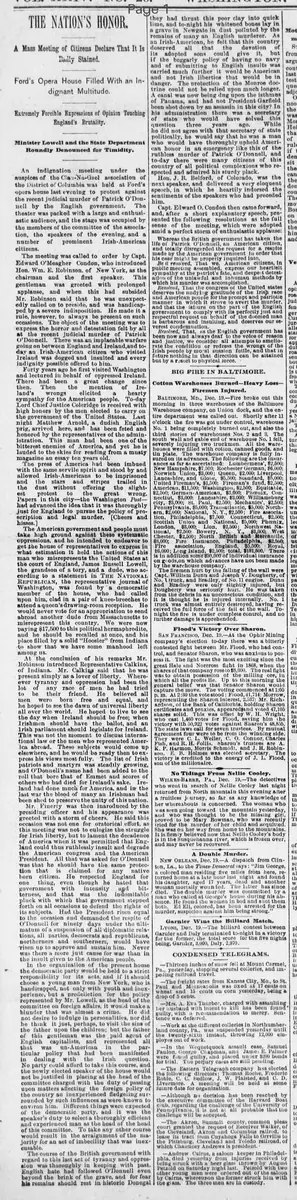
A Mass Meeting of Citizens Declare That It Is Badly Stained.
Ford's Opera House Filled With an Indignant Multitude.
Extremely Forcible Expressions of Opinion Touching England's Brutality.
Minister Lowell and the State Department Roundly Denounced for Timidity.
An indignation meeting under the auspices of the Clan-Na-Gael association of the District of Columbia was held at Ford's opera house last evening to protest against the recent judicial murder of Patrick O'Donnell by the English government. The theater was packed with a large and enthusiastic audience, and the stage was occupied by the members of the committee of the association, the speakers of the evening, and a number of prominent Irish-American citizens.
The meeting was called to order by Capt. Edward O'Meagher Condon, who introduced Hon. Wm. E. Robinson, of New York, as the chairman and the first speaker. This gentleman was greeted with prolonged applause, and when this had subsided Mr. Robinson said that he was unexpectedly called on to preside, and was handicapped by a severe indisposition. He made it a rule, however, to always be present on such occasions. The object of the meeting was to express the horror and detestation felt by all at the recent judicial murder of Patrick O'Donnell. There was an implacable warfare going on between England and Ireland, and to-day an Irish-American citizen who visited Ireland was dogged and insulted and every indignity possible offered to him.
Forty years ago he first visited Washington and lectured in behalf of oppressed Ireland. There had been a great change since then. Then the mention of Ireland's wrongs elicited a hearty sympathy for the American people. To-day Lord Chief Justice Coleridge is received with high honors by the men elected to carry on the government of the United States. Last night Matthew Arnold, a dudish English prig, arrived here, and has been feted and honored by the representatives of the administration. This man had been one of the bitterest enemies of America, and yet he is lauded to the skies for reading from a musty magazine an essay ten years old.
The press of America had been imbued with the same servile spirit and stood by and allowed Irish-Americans to be imprisoned and the stars and stripes trailed in the dust without offering the slightest protest to the great wrong. Papers in this city—the Washington Post—had advanced the idea that it was thoroughly just for England to pursue the policy of proscription and legal murder. [Cheers and hisses.]
The American government and people must take high ground against these systematic oppressions, and he intended to endeavor to get the house of representatives to express in what estimation it held the actions of this man who misrepresents the United States at the court of England, James Russell Lowell, the grandson of a tory, and a dude, who according to a statement in THE NATIONAL REPUBLICAN, the representative journal of Washington, was found by a democratic member of the house, who had called upon him, clad in a pair of knee-breeches to attend a queen's drawing-room reception. He would never vote for an appropriation to send abroad another dude from Massachusetts to misrepresent this country. We were now paying $17,500 to this political hermaphrodite, and he should be recalled at once, and his place filled by a solid "Hoosier" from Indiana to show that we have some manhood left among us.
At the conclusion of his remarks Mr. Robinson introduced Representative Calkins, of Indiana. Mr. Calkins said that he was present simply as a lover of liberty. Wherever tyranny and oppression had been the lot of any race of men he had tried to be their friend. He believed all men were born free and equal, and he hoped to see the dawn of universal liberty all over the world. He hoped to live to see the day when Ireland should be free; when Irishmen should have the ballot, and an Irish parliament should legislate for Ireland.
This was not the moment to discuss international law or the men who represent America abroad. These subjects would come up elsewhere, and he would be ready then to express his views most fully. The list of Irish patriots and martyrs was steadily growing, and O'Donnell's name had been added to the roll that bore that of Emmet and scores of others who had died for Ireland's sake. Ireland had done much for America, and in the last war the blood of many an Irishman had been shed to preserve the unity of this nation.
Mr. Finerty was then introduced by the presiding officer and his appearance was greeted with a storm of cheers. He said this occasion was not one for oratorical effort, as this meeting was not to eulogize the struggle for Irish liberty, but to lament the decadence of America when it was permitted that England could thus ruthlessly insult and degrade the American congress and the American President. All that was asked for O'Donnell was that he should have the same protection that is claimed for any native born citizen. He respected England for one thing, even though he hated that government with intensity and bitterness, and that was the indomitable pluck with which that government stepped forth on all occasions to defend the rights of its subjects. Had the President risen equal to the occasion and demanded the respite of O'Donnell for ninety days under the ultimatum of a suspension of all diplomatic relations, all parties, democrats and republicans, northerners and southerners, would have risen up to approve and sustain him. Never was there a more just cause for war than in the insult given to the American people.
In the organization of the present house the democratic party would be held to a strict responsibility for its acts, and if it should choose a young man from New York, who is handicapped, not only with youth and inexperience, but a predilection for the policy represented by Mr. Lowell, as the head of the committee on foreign affairs, it would make a blunder that was almost a crime. He did not desire to indulge in personalities, nor did he think it just, perhaps, to visit the sins of the father upon the children; but the father of this gentleman was the paid agent of English capitalists, and represented all that was un-American in the particular policy that had been manifested in dealing with the Irish question.
No party could afford to take this course, and the newly elected speaker of the house would not be justified in placing at the head of the committee charged with the duty of passing upon matters affecting the foreign policy of the country an inexperienced fledgeling surrounded by such influences as were known to environ him. Different things were expected of the democratic party, and it was the speaker's duty to select a thoroughly efficient and experienced man as the head of this committee. To take any other course would result in the arraignment of the majority for an act of imbecility that was inexcusable.
The course of the British government with regard to this last act of tyranny and oppression was thoroughly in keeping with past. English hate had followed O'Donnell even beyond the brink of the grave, and for fear his remains should rest in historic Donegal they had thrust this poor clay into quick lime, and to-night his whitened bones lay in a grave in Newgate in dust polluted by the remains of many an English murderer. As an Irish-American, he felt that this country deserved all that the devotion of its adopted sons could give it, but if the beggarly policy of having no navy and of submitting to English insults was carried much further it would be American and not Irish liberties that would be in danger. The protection of the Monroe doctrine could not be relied upon much longer.
A canal was now being dug upon the isthmus of Panama, and had not President Garfield been shot down by an assassin in this city? In his administration there was a secretary of state who would have solved this question three years ago. While he did not agree with that secretary of state politically, he would say that he was a man who would have thoroughly upheld American honor in an emergency like this of the ruthless murder of Patrick O'Donnell, and to-day there were many citizens of this country of all political complexions who respected and admired his sturdy pluck.
Hon. J. B. Belford, of Colorado, was the next speaker, and delivered a very eloquent speech, in which he heartily indorsed the sentiments of the speakers who had preceded him.
Capt. Edward O. Condon then came forward, and, after a short explanatory speech, presented the following resolutions as the full sense of the meeting, which were adopted amid a perfect storm of enthusiastic applause:
Whereas, the British government has taken the life of Patrick O'Donnell, an American citizen, and totally disregarded the request for a respite made by the American government in order that his case might be properly inquired into,
Be it resolved, That we, American citizens, in public meeting assembled, express our heartfelt sympathy at the patriot's fate, and deepest detestation of the unlawful and inhuman methods by which his murder was accomplished.
Resolved, That the congress of the United States deserves the undying gratitude of the Irish race and American people for the prompt and patriotic manner in which it strove to avert the murder, and that the failure on the part of the English government to comply with its perfectly just and respectful request on behalf of the doomed man is barbarous and insulting, and deserves our severest condemnation.
Resolved, That, as the English government has been now and always deaf to the voice of reason and justice, we consider all attempts to ameliorate the condition or redress the wrongs of the Irish people by moral suasion futile, and that in future nothing in that direction can be attained but by a resort to physical force.
What sub-type of article is it?
What themes does it cover?
What keywords are associated?
What entities or persons were involved?
Where did it happen?
Story Details
Key Persons
Location
Ford's Opera House, District Of Columbia
Event Date
Last Evening
Story Details
Indignation meeting protests the judicial murder of American citizen Patrick O'Donnell by England, denounces US officials for timidity, praises Congress's efforts, and resolves that only physical force can redress Irish wrongs.